![]()
1
Introduction
The City of Culture
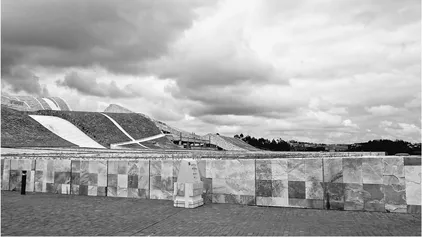
Overlooking Santiago de Compostela—the capital of Galicia, the autonomous region of northwestern Spain—atop Mount Gaiás sit the buildings of the Cidade da Cultura de Galicia (City of Culture of Galicia). Seen from the city, the complex appears to retreat into the mountain, away from the winding cobblestone streets of the old town. Undulating waves of stone and glass stand in contrast with the surrounding green fields, even as the curves of the structure mimic the rolling hills in the background. The compound is unapologetically modern yet built in the image of the medieval city below.
FIGURE 1.1 The Cidade da Cultura
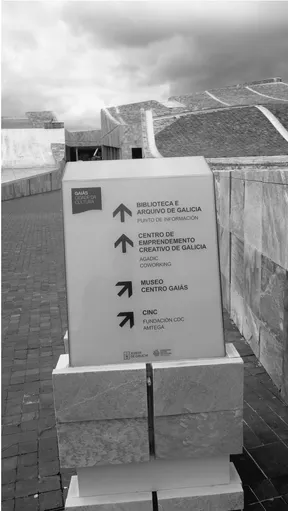
To get there, my husband and I ride a bus from the medieval city center, through the more modern neighborhoods, past the train station, the new athletic facilities and public pool. As the bus climbs uphill, the city recedes into the background. The vibrant greens of the countryside and bright orange rooftops of the buildings in Santiago are a stark contrast to the sleek monochromatic palate of the Cidade ahead. The bus pulls into the parking area, where a few cars are scattered in the larger lot. As I exit the bus, a sign provides a brief orientation with arrows pointing straight ahead for the Library and Archives of Galicia, to the right for the museum and Center for Cultural Innovation (CINC) (see Figure 1.2). We follow a stone-lined brick path into the Cidade. The stone from the walls matches that of the buildings—all the facades are covered in split quartzite, carved at specialized angles to create the curved walls that characterize the complex. The buildings are smooth, the stone and glass cold, but the curves inviting—the resulting composition guides the eye through the panorama of the mountaintop.
The Foundation for the City of Culture, established to oversee the completion of the project, describes the project as a “new ‘city’, inclusive and plural,” a space that will contribute to Galicia’s future and internationalization within the information and knowledge society (www.cidadedacultura.gal/en/info/city-culture-galicia). The project began in 1999, when the Xunta de Galicia, the autonomous government, passed the law for the Foundations of Interest for Galicia, focused on the creation and maintenance of a “multifunctional, multidisciplinary and all-encompassing space, contributing towards cultural interaction” (www.cidadedacultura.gal/en/info/foundation). Following the conventional wisdom of the time, the Xunta saw public investment in large-scale projects as a way of establishing Santiago de Compostela as a “global city,” in turn attracting private investment.
In the wake of the acclaim Bilbao’s Frank Gehry-designed Guggenheim museum received upon its 1997 opening, this iteration of neoliberalism had particular resonance—several Spanish cities sought to follow Bilbao’s example. According to architectural critic Llatzer Moix, municipalities were looking to “make cities better in cultural terms, but also economic terms” (Morris, 2012). As such, with the Foundations of Interest for Galicia legislation, the Xunta sought to achieve two goals—create a center for the local community and bring global attention and investment to Sanitago de Compostela and Galicia. The Cidade da Cultura is a product of the economic transformations of the last decades, representative of how neoliberalism has encouraged the public and cultural sectors to adapt to its ideological tenets of the market (Massey, 2007, p. 4). It also is a stark example of the impact of neoliberalism on our collective social fabric, particularly the contested nature of cultural space and practices.
An international roster of “star-chitects” submitted designs, including Daniel Libeskind (who had just completed the Jewish Museum in Berlin), César Portela (winner of the national architecture award from Spain in 1999 for his bus station in Córdoba), and Juan Navarro Baldewig (who built the Olympic Training Pavilion for the Barcelona Olympics). The jury selected a proposal by Peter Eisenman, a member of the New York Five, based on its uniqueness “both in concept and plasticity, and exceptionally in tune with the site’s location” and awarded him the project (www.cidadedacultura.gal/en/info/competition-ideas).
While the conventional wisdom of the late 1990s and early 2000s encouraged development at a grand scale, the 2008 financial crisis and the austerity measures that followed turned public opinion against such large-scale projects. By the time the Cidade da Cultura opened to the public in 2011, the Cidade had come to be viewed as a political vanity project. At four times over the proposed budget, the Xunta de Galicia halted construction in 2013, canceling the International Art and Music Center and the planned Science Arts Center. The final cost of the project was 475.9 million Euros—over five times the cost of the Bilbao Guggenheim (Jaque, 2014). In a 2015 column, Moix (2015) described the Cidade as “Fraga’s1 pharaonic project,” lamenting how much public money had been spent on it.
The Cidade da Cultura is emblematic of contemporary debates about the utility of public space and culture. Eisenman’s design embodies many of the con tradictory trends in contemporary neoliberalism—a commitment to the past as a means of investing in the future, looking to the local as a means of engaging the global, and the strategic use of culture as a means of attracting financial capital. The Foundation for the City of Culture of Galicia is quite explicit that this is its mission. As the website for the Cidade explains,
Inspired by Compostela’s old centre and the five medieval pilgrimage routes that lead to the cathedral, the architect transferred this grid to the mountain summit. Starting from this concept, the original project is formed by six buildings that are connected by streets and one central square inspired by the scallop, which is the symbol of the pilgrimage.
(www.cidadedacultura.gal/en/info/project)
Encouraging entrepreneurs to locate there, the website continues:
The unique buildings of the City of Culture, interconnected by streets and plazas, and equipped with state-of-the-art technology, make up a space of excellence for reflection, debate and actions orientated towards Galicia’s future and internationalization.
(www.cidadedacultura.gal/en/info/spaces-let)
The Cidade is also emblematic of the pitfalls of such strategies. Construction on the two buildings that were to be the cornerstones of the project was halted as austerity measures were imposed during la crisis, the aftermath of the 2008 financial crash. Even as the Cidade emphasizes Santiago de Compostela’s situatedness—the layout of the streets, the scallop shell that is the symbol of the city and the pilgrimage—the tile used on the buildings and walkways was split quartzite, imported from Brazil. The art museum was to house a collection focused on European and Latin American art, the architect a member of the New York Five. Thus, the project draws resources from the global, seeks to represent the local, and hopes to attract transnational corporate investment. Public funds are used to attract private funds; “culture” is operationalized towards the needs of the global finance industry. As the cultural geographer Doreen Massey (2015) observed, the response to the crisis has been to reduce public projects in continued service to “the market” (2015, p. xii).
Mobilizing Heritage
I begin with the story of the Cidade da Cultura because it resonates with the rest of this volume—embodying the contradictions of utilizing “heritage” in the service of “modernization,” contemporary emphasis on the local and authentic as a marketing strategy, and how the past is incorporated into the present. The Cidade expressly draws on these themes. Eisenman’s design explicitly references two of the most prominent signifiers of Galicia: the scallop shell (a symbol of the Camino de Santiago) and the medieval city surrounding the cathedral. Using computer-modeling software, Eisenman superimposed the ground plan of Santiago’s medieval city onto a topographic map of the hillside, followed by a Cartesian grid—merging the premodern with the postmodern. This, the architect describes, “repositions old and new in a simultaneous matrix never before seen” (ArchDaily, 2011). The striated texture of the scallop shell is incorporated into the facades of the buildings.
Approaching the Cidade as a text emphasizes culture as a palimpsest, where the new is written over the old, with the remainder of the old part of the new project. The Cidade’s exhibit on its construction resonates with Walter Benjamin’s observations on Paris. Benjamin (1999) noted that with “the Haussmannization of Paris, the phantasmagoria was rendered in stone. Though intended to endure in quasi-perpetuity, it also reveals its brittleness” (p. 24). Similar to the Parisian Arcades, the design and conceptualization of the Cidade emphasizes the use of technology in its construction—computer programming to ensure that the complex resembled the scallop shell that is the symbol of the Camino de Santiago and reflects the layout of the city center. The selection of what elements of the totality of Galician culture become “rendered in stone” speak to the values and priorities of the historical present. Examination of these elements reveals more about the present than it does about the past.
These tensions are not unique to Galicia, but they exemplify the ways in which many localities have sought to negotiate between a celebration of heritage and culture and the demands of the global neoliberal economy in the post-crash era. This book looks for spaces where we might resist the fossilization of culture in the service of neoliberal systems. I came to Galicia because of my own family history, locating myself within the circuits of Hispanidad, but became interested in how Galicia’s heritage was being mobilized as a means of economic develop ment. Nostalgia is a central theme that emerged, as Galicia became a site to untangle my own family’s diasporic relationship to Spain, while also attending to the dynamic relationship between the local and the global as the world dealt with the aftershocks of 2008.
Globalized Nostalgia
Through my narrative and experience in Galicia, I examine mechanics of producing and performing culture that are simultaneously local and transnational. I structure my performative analysis around an exploration of “globalized nostalgia.” I identify globalized nostalgia as, to borrow a term from Raymond Williams (1977), “a structure of feeling,” generated from the transnational circulation of socially constructed performances of essentialist, or primordial, identities (of products, locations, peoples) that rely on claims to an authentic past, one based on “heritage” for their consumptive value.
During my time in Galicia, the importance of “space” became evident as I approached the task of untangling representations of “place” (Tuan, 1977). The machinations of public policy, commodity culture and cultural performances were made clear through my participation in and observation of local festivals, foodways, and tourism initiatives. The significance of land and heritage to local communities as a means of gaining investment through marketing and modernization efforts exacerbates tensions between stasis and cultural fluidity.
In the wake of the 2008 financial crash, populism became commodifiable, as products and services were branded as “authentic,” “heritage,” and relying on “traditional labor.” This was joined by a political populism, as reactionary movements emerged in Europe and the United States. Since then, left-wing coalitions have developed, notably SYRIZA in Greece and Podemos in Spain, to challenge the European Union’s austerity measures, but have had mixed success. Meanwhile, the reactionary right has already altered the prevailing global order: in 2016 Britain voted to leave the European Union, and far-right parties throughout Europe gained seats in government. Riding a similar wave of xenophobia and populism-as-nationalism, Donald Trump became president of the United States, and pulled the U.S. out of the Paris Climate Agreement, UNESCO, and has already altered the Iran Nuclear Deal.
Heritage+Authenticity
Heritage and authenticity are pivotal concepts upon which contemporary politics and culture turn. As space is made valuable through a re-entrenchment of a primordial sense of belonging, belief in an “essence” of an area can quickly slide into chauvinism. The tensions between the increased mixing of peoples and cultures, the undeniable hybridity of contemporary life, and the commercial packaging and export of visions of an authentic, knowable “heritage” stand in stark tension with each other. This tension, between hybridity and authenticity, underscores much of the political volatility that we are experiencing.
The focus on heritage as linked to physical space is starkly contrasted by the quotidian experience of global simultaneity, whether digitally or through a trip to the grocery store (Wasabi! Plantains!) or shopping mall (H&M! Zara!). As Sarah Banet-Weiser (2012) observes, cultural meanings both organize economic exchange and are organized by economic exchange (p. 7). Technological and consumer experiences tend to relegate questions of authenticity to the commercial realm. When heritage is invoked it is as a branded exception to the otherwise homogenizing effects of late capitalism. Local culture is translated into the language of the global marketplace.
The use of heritage as a way to give place meaning creates a different set of relationships under contemporary neoliberalism. David Harvey (2008) argues that the growth of cities is a response to systemic crises in capitalism, which encourage investment in real estate. As cities grow, the rural is seen as a respite from the city (Ito, 2011), guardian of an authentic, idyllic past. Artisanal practices, local culture, and history are mobilized to signal difference, and therefore value. Government agencies and private investors, in turn, invest in artisanal products and practices to strengthen their position in the global market.
These developments emerge in the space between policies aimed at cultural protectionism and economies that rely on cultural exploitation. For example, the European Union’s appellation scheme consists of a tiered system of “quality guarantees” and branding for products of patrimonial value (Ceisel, 2013a). Adherence to patrimonial practices becomes a means to obtain funding—allowing for modernization of production with the aim of broader distribution and export. This process explicitly links narratives of primordial belonging and tradition to specialized marketplace protection and position.
Hybridity+Diaspora
Challenging discourses of authenticity, hybridity problematizes boundaries and encourages us to try to think past neat categories and definitions. It calls “heritage” into question, refuting the purity of the “authentic” as a possibility. Thinking through hybridity opens up intellectual space beyond neoliberalism’s “acritical celebrations of mixture.” As Angharad Valdivia (2005) notes, hybridity provides the conceptual scaffolding “to study the blending of cultures and bodies, juxtaposed against the carelessness of neoliberalism.” It is here that we find “spaces for intervention as well as possible displacements and erasures” (p. 308).
Hybridity is “a communicative practice constitutive of, and constituted by, sociopolitical and economic arrangements . . . a space where intercultural and international communication practices are continuously negotiated in interactions of differential power” (Kraidy, 2002, p. 317). Transnational cultural flows cannot be defined along strict lines of national influences, but rather, cultural developments occur through the exchange of various signifiers. These cultural circuits are visible through the phenomena of Latinidad and Hispanidad—the routes of cultural exchange and migration between the Americas and the Iber...