- 192 pages
- English
- ePUB (mobile friendly)
- Available on iOS & Android
eBook - ePub
About this book
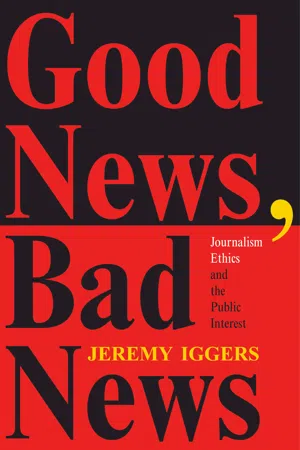
In Good News, Bad News , Jeremy Iggers argues that journalism's institutionalized conversation about ethics largely evades the most important issues regarding the public interest and the civic responsibilities of the press. Changes in the ownership and organization of the news media make these issues especially timely; although journalism's ethics rest on the idea of journalism as a profession, the rise of market-driven journalism has undermined journalists' professional status. Ultimately, argues Iggers, journalism is impossible without a public that cares about the common life. Written in an accessible style, Good News, Bad News is important reading for journalists, communication scholars, and students. }Public dissatisfaction with the news media frequently gives rise to calls for journalists to live up to the ethical standards of their profession. But what if the fault lies in part with the standards themselves?Jeremy Iggers argues that journalisms institutionalized conversation about ethics largely evades the most important issues regarding the public interest and the civic responsibilities of the press. Changes in the ownership and organization of the news media make these issues especially timely; although journalisms ethics rest on the idea of journalism as a profession, the rise of market-driven journalism has undermined journalists professional status.Ultimately, argues Iggers, journalism is impossible without a public that cares about the common life. A more meaningful approach to journalism ethics must begin with a consideration of the role of the news media in a democratic society and proceed to look for practical ways in which journalism can contribute to the vitality of public life.Written in an accessible style, Good News, Bad News is important reading for journalists, communication scholars, and students. }
Information
1
How Journalists Talk About Ethics
If there is a word for bad journalism in America, and you look it up in the encyclopedia, and there's Janet Cooke's picture.
—Ted Koppel, ABC Nightline, May 10,1996
Ted Koppel is surely right, but his remark raises an interesting question: With so many Great Moments in Bad Journalism to choose from (not to mention all of the Enduring Disgraces), ranging from the O. J. Simpson media circus to the perennial horse-race coverage of presidential elections and the virtual news blackout on such important (but dull) public issues as the 1996 Telecommunications Act, how did this young black woman manage to capture this distinction? Did she really earn it or could affirmative action be involved? Or might the notoriousness of the Cooke case be an example of what's wrong with the way journalists think about ethics?
The Case of Janet Cooke
In 1981, Janet Cooke, a reporter for the Washington Post, was awarded the Pulitzer Prize for a dramatic news story titled "Jimmy's World," purportedly the account of the life of an eight-year-old drug addict. Jimmy was later revealed to be a fictional composite character, the prize was withdrawn, and Cooke resigned in disgrace.
The Janet Cooke scandal has become, quite literally, the textbook example of journalistic misconduct. Virtually every book on media ethics pub lished since 1981 offers at least a passing reference to the case. The National News Council published a special report on the Cooke case,1 and the Poynter Institute for Media Studies held a symposium on its impact ten years after the incident. Media Watch, a conservative media newsletter, gives a monthly Janet Cooke Award "to distinguish the most outrageously distorted news story of the month."
The Mystery
How did the case of Janet Cooke achieve such notoriety? To answer that question, we need to explore both the history of American journalism and the way that journalism's internal conversation about ethics is conducted. Cooke's status embodies a judgment by American journalism, as an institution, about what is ethically important. Examining her case is a way of exploring how journalism reaches ethical judgments, but it may also offer insight into the factors that shape news judgment generally.
To understand the Cooke case, it is not enough to look at codes of ethics and ethics handbooks, since these documents do not always reflect actual practice. Nor does it suffice to look only at prevailing practices, because some of those practices are contested within the journalism community as unethical. If we turn to what journalists say about the rules that govern their practices, we find that many disagree about the rules and that many of the rules are unspoken.
Thus the ethics of journalism can only be fully explored through the discourse—or conversation—of many, sometimes discordant, voices in codes of ethics and in college textbooks, in editor's memoranda and "underground" newsletters, in ombudsmen's columns, in the minutes of news council meetings, and in reporters' split-second decisions, as well as in coffee-break conversations in newsrooms and in the "Darts and Laurels" column of the Columbia Journalism Review.
The Simple Answer
At the Poynter Institute conference, lay Black, chair of the ethics committee of the Society of Professional Journalists (SPJ) and Poynter-Jamison Chair in Media Ethics at the University of South Florida, offered the conventional explanation of the Cooke affair: "The short, simple answer is that Janet Cooke was a news reporter who did not tell the truth; in so doing, she violated one of the fundamental tenets of journalism."2
This interpretation is reflected in the overwhelming majority of writings about the Janet Cooke affair. Stephen Klaidman and Tom Beauchamp, authors of The Virtuous Journalist,3 choose the Cooke case to illustrate their arguments about the importance of trust between reporters and editors. Even though the publication of "Jimmy's World" was the collective responsibility of Cooke and an entire chain of command, the moral significance of the case is interpreted by Klaidman and Beauchamp entirely in terms of Cooke's wrongdoing. "Perhaps it is unfair to The Washington Post to recount again Cooke's fictitious reports"4 they begin, and they go on to analyze the case as an instance of misplaced trust.
Interpretations of the episode vary. In his textbook, Committed Journalism, Edmund Lambeth of the University of Missouri uses the Cooke case to discuss the ethics of truth-telling. Cooke's "tragic professional death" comes from her absence of learning, "both cognitive and ethical," of the habit of accuracy. "Deliberate falsification ... is the most egregious breach of the ethic of truth-telling."5
Implicit in the standard explanation is the suggestion that the ostracism of Janet Cooke and the notoriety of her case stem from a straightforward application of well-established rules to a particularly egregious case of misconduct.
Why This Case?
The conventional explanation leaves many important questions unanswered: What is the conception of truth intended in Lambeth's "ethic of truth-telling"? How is this rule applied to particular cases? The conventional explanation, as it stands, cannot adequately account for the singular notoriety of the Cooke case. Does Cooke's behavior really deserve to be counted as the most infamous crime in the history of journalism?
One explanation sometimes offered is that the deception involved the most prestigious prize in American journalism. But this explanation is problematic, given that the fame and importance of the Pulitzer Prize is something that journalism itself has manufactured. Does the status of the Cooke case truly reflect an impartial judgment of its significance or is the indignation greater because journalism's own ox was gored?
Compare the case of Janet Cooke with that of Kurt Lohbeck, a former stringer in Afghanistan for CBS News. In a carefully documented report in the Columbia Journalism Review (January/February 1990), reporter Mary Ellen Walsh offers evidence that Lohbeck had falsified reports, staged battie scenes, and worked as a publicist for the mujahideen. Lohbeck's fictions continued over a much more extended period than Cooke's, were disseminated to a far larger audience, and were much more substantially false. The basic reality portrayed by Cooke in "Jimmy's World" is true—there are many child victims of the drug epidemic who are in important respects not unlike Cooke's fictional Jimmy. In the case of the Afghan coverage, the coverage was not merely false, it distorted the larger picture, representing the mujahideen as stronger and more unified than they actually were.
In theory, the Lohbeck case ought to rank among the great journalistic scandals of our time. But ultimately, Cooke's case received vastly more media attention. Even within the journalism community the Lohbeck case remains little-known.
One of the few dissenting voices at the Poynter Institute conference on the Cooke affair was Jonathan Kwitny, a former Wall Street Journal reporter and host of a public television news program. "The Cooke episode raised no question worth debating, save maybe the values of checking the pedigree of new hires a bit more carefully," argued Kwitny in a speech titled "The Ethics of Ownership." "In the most fundamentally ethical society we could create, every now and again some human misfit would still rob a bank, murder a spouse, or even, yes, lie to a newspaper."6
Kwitny argues that there are cases that present much more serious violations of the public's right to know and of the news media's duty to inform the public. "Why did the biggest stories in recent years—the Iran Contra scandal, Gorbachev's moves to end the Cold War, the savings-and-loan catastrophe and the collapse of communism in Eastern Europe . . . come as total shocks to the public, even though evidence of all of these events had long been developing?"7
The result of this failure to report, argues Kwitny, "was that American interests may have been damaged for years by the continuation of outmoded policies." These are, Kwitny suggests, more significant consequences than any that may have resulted from Janet Cooke's story. By failing to adequately inform the American public about these events, the news media deprived the public of its right to play its proper role in self-governance.
Kwitny's explanation for these failures of journalistic responsibility have to do with who owns the media and the subservience of journalism to economic interests. And that raises a different set of issues that he believes should be put on the ethical agenda for journalists: the social responsibilities of news media owners.
But the fact remains that the Cooke case has achieved legendary status, while the Lohbeck case and the cases Kwitny cites are either ignored or regarded as ethically insignificant. Why is it that fictional reporting is considered a violation of the "ethic of truth-telling," but the failure to investigate the truthfulness of one's sources is not? Why are the economic prerogatives of owners generally excluded from the institutionalized discourse of journalism ethics? In order to explain, we need to look at the kinds of cases that journalists do talk about and to explore how the more abstract foundational principles of professional ethics are translated into procedural rules. It is important to have not only an understanding of how the formal rules are interpreted, but also an understanding of power relationships in journalism and the historical context in which the concepts and forces shaping the institutionalized ethical discourse developed.
What emerges from such inquiry is a picture of journalism ethics, like perhaps all professional ethics, as a self-interested discourse, motivated by the institutional priorities of the participants and subject to conflicts, in-coherencies, and silences at junctures where those interests conflict. This is a very different sort of discourse than the disinterested inquiry into the nature of the good that is held to be an ideal of ethical reasoning. (We may set aside the question of whether that ideal is ever realized in practice.)
To put it in other terms, since all discourse is in some sense interested, that is, motivated by human interests, this is not a discourse motivated by a quest to seek the common interest, but rather one that uses the vocabulary of moral discourse to advance particular interests. The ethics of journalism are not very different than the ethics of law or medicine in this regard, but journalism is unique in its capacity to shape public values and to mold public opinion about the standards to which it should be held.
Ethics in Theory and Practice
The kind of ethical discourse or conversation that takes place on a daily basis among working journalists is different from the more abstract and theoretical discourse that can be found in codes of ethics, in papers given at professional conferences, and in other official venues. Although we can refer to this distinction in terms of the practical and the theoretical, the practical discourse is not simply an elaboration of the principles expressed in the codes of ethics, nor are the codes and similar statements merely attempts to capture in theoretical terms a set of values widely held by practitioners.
The ways journalists report and edit are shaped by the relations of power and by the institutional priorities within the organizations that employ them. These relations and priorities are not in equilibrium, but exist in an ongoing state of conflict. Thus, the institutional values of journalism are not grounded in a static set of rules but rather emerge from an evolving set of practices. These values are transmitted by individual working journalists whose actions are constrained and defined by the dynamics of concrete real-life situations. In so far as ethical rules can be identified, they must be understood as emerging from these practices and contexts, subject to interpretation in concrete situations.
An action or practice becomes an ethical issue when it is made problematic in an ethical discourse. Such a discourse is structured—there are rules about what may be said and who is privileged to speak. Only the executive editor is privileged to speak in an editor's memorandum, and what he or she may say is constrained by the relationships that exist between publisher, editor, newsroom staff, and the public. In order for an issue to achieve the status of being ethically problematic, there must exist an appropriate forum for the generation of such a discussion.
The SPJ Code of Ethics is produced by the ethics committee of the organization, whose primary mission is to promote recognition of journalism as a profession. This mission is reflected in the selection of issues that it chooses to acknowledge as ethical and the issues that it does not address.
The ethical criticisms expressed in "The Downward Spiral," published sporadically by a small group of disaffected employees of the Detroit Free Press in the mid-80s, reflected a somewhat different set of priorities—a defense of traditional "hard news" values against a marketing-oriented corporate ownership. Nearly all of the articles that appeared in "The Downward Spiral" were unsigned; the need for anonymity imposed a complex set of restrictions on what might be said and limited participation to those journalists willing to accept the attendant risks.
Theory As It Relates to Practice
It is not enough to describe the various things that journalists say in different contexts of institutional power about professional ethics. We also need to develop a theory of how these utterances are related and interpreted. If we speak of this larger discourse as an apparatus, our task is to understand how the apparatus works. Some components may prove to be more important than others, and some things that journalists say about ethics may prove to be purely ceremonial or even insincere.
Thus, a useful treatment of the ethics of journalism must encompass all of its components, including the contexts from which those ethics emerge. Within the more theoretical component of prescriptive principles and rules, there are several levels of abstraction or generality—a theory of the social responsibility of the media, a stratum of principles, and a set of procedural rules that operationalize those principles. Two key issues are the relationship between theory and practice and the relationships between the theoretical propositions at various levels, for example, how a principle of fairness comes to be equated with rules of procedure a, b, and c, and not rules d, e, and f. Ultimately, all the components must be drawn together to create an overall picture of the origins and workings of journalism ethics.
Practice: The Ethical Discourse
When journalists talk about ethics, they mostly talk about cases—either cases of misconduct or cases that represent a conflict between two competing journalistic rules or values. Like everybody else, they tend to talk about the cases that are in the news—media coverage of the private lives of politicians, whether reporters should have the right to make promises of confidentiality, or whether the page-one photograph of the grieving family ...
Table of contents
- Cover
- Half Title
- Title
- Copyright
- Dedication
- Contents
- Acknowledgments
- Introduction
- 1 How Journalists Talk About Ethics
- 2 Talking in Code(s): The Foundations of Journalism Ethics
- 3 Contemporary Ethical Concepts in Historical Context
- 4 Journalism Since Cooke: The Corporate Cultural Revolution
- 5 Objectivity's Legacy
- 6 The Myth of Neutrality and the Ideology of Information
- 7 Toward a Pragmatist Ethical Theory for Journalism
- 8 Toward a Public Journalism
- Notes
- Bibliography
- Index
Trusted by 375,005 students
Access to over 1.5 million titles for a fair monthly price.
Study more efficiently using our study tools.
Frequently asked questions
Yes, you can cancel anytime from the Subscription tab in your account settings on the Perlego website. Your subscription will stay active until the end of your current billing period. Learn how to cancel your subscription
No, books cannot be downloaded as external files, such as PDFs, for use outside of Perlego. However, you can download books within the Perlego app for offline reading on mobile or tablet. Learn how to download books offline
Perlego offers two plans: Essential and Complete
- Essential is ideal for learners and professionals who enjoy exploring a wide range of subjects. Access the Essential Library with 800,000+ trusted titles and best-sellers across business, personal growth, and the humanities. Includes unlimited reading time and Standard Read Aloud voice.
- Complete: Perfect for advanced learners and researchers needing full, unrestricted access. Unlock 1.5M+ books across hundreds of subjects, including academic and specialized titles. The Complete Plan also includes advanced features like Premium Read Aloud and Research Assistant.
We are an online textbook subscription service, where you can get access to an entire online library for less than the price of a single book per month. With over 1.5 million books across 990+ topics, we’ve got you covered! Learn about our mission
Look out for the read-aloud symbol on your next book to see if you can listen to it. The read-aloud tool reads text aloud for you, highlighting the text as it is being read. You can pause it, speed it up and slow it down. Learn more about Read Aloud
Yes! You can use the Perlego app on both iOS and Android devices to read anytime, anywhere — even offline. Perfect for commutes or when you’re on the go.
Please note we cannot support devices running on iOS 13 and Android 7 or earlier. Learn more about using the app
Please note we cannot support devices running on iOS 13 and Android 7 or earlier. Learn more about using the app
Yes, you can access Good News, Bad News by Jeremy Iggers in PDF and/or ePUB format, as well as other popular books in Languages & Linguistics & Journalism. We have over 1.5 million books available in our catalogue for you to explore.