- 304 pages
- English
- ePUB (mobile friendly)
- Available on iOS & Android
eBook - ePub
About this book
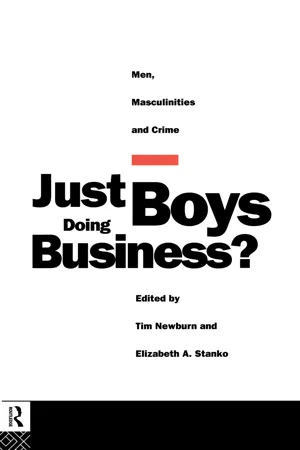
What is it about crime that makes it `men's work'? Can we imagine masculinity without crime? This is the first book of its kind to bring contributors from three continents together to examine the relationship between masculinity and crime. Covering such areas as policing, prisons, violence against women, homicide, white-collar crime, and male victimisation, this book will force us to rethink many aspects of masculinity and crime.
Information
Chapter 1
Theorising masculine subjectivity
Tony Jefferson
INTRODUCTION: EXEMPLIFYING THE PROBLEM
LOOKING BACK ON IT (AGAIN)
AT NINETEEN I was a brave old hunchback,
Climbing to tremendous heights,
Preparing to swing down on my golden rope
And rescue Accused Innocence.
Climbing to tremendous heights,
Preparing to swing down on my golden rope
And rescue Accused Innocence.
But on my swooping, downward path one day
Innocence ducked,
And I amazed at such an act
Crashed into a wall she had been building.
Innocence ducked,
And I amazed at such an act
Crashed into a wall she had been building.
Twenty-one years later,
Sitting stunned beside that same brick wall
I see others climbing their golden ropes
And hear innocence sniggering.
Sitting stunned beside that same brick wall
I see others climbing their golden ropes
And hear innocence sniggering.
I say nothing much,
But sit with bandages and the hope
That maybe after all
Some sweet fool might in time
Swing right through that wall.
But sit with bandages and the hope
That maybe after all
Some sweet fool might in time
Swing right through that wall.
(Patten 1988: 62)
Like all poems, Patten’s poem has many meanings. But one I take from it concerns the chastening effect of experience on the unrealistic desire to live up to the ambitious ideals (‘tremendous heights’) of masculinity. Yet, despite the inevitable failure, the hope lives on that ‘some sweet fool’ might one day achieve the unachievable and ‘swing right through that wall’. Its surreal humour, self-deprecating honesty, and wry optimism make it a lovely poem; but what makes it special for me is its ability to connect concretely with my own experience. My aim in what follows is to trace a critical path through ‘theorising masculine sujectivity’ that remains similarly connected to the level of experience, albeit in a rather less immediately recognisable way. Without this, I fear, critiques of masculinity, however well-intended, will fall on deaf ears.
The poem’s notion of ‘climbing to tremendous heights’ is not dissimilar to the quest for ‘transcendence’ – the desire to achieve immortality through some extraordinary act (‘rescue Accused Innocence’) – that has been identified as masculinity’s ultimate value. Robin Morgan (1989), for example, identifies it as central to the heroic ‘death or glory’ appeal of terrorism to young men; while Cameron and Frazer (1987) cite transcendence as the ‘common denominator’ for understanding why sexual murderers are overwhelmingly men, and the sadism behind their ‘lust to kill’. Important though these accounts are, the truth is that most men’s transcendent strivings get thwarted en route as the poem graphically recounts (‘crashed into a wall’), or, thankfully, find less obviously harmful outlets than either terrorism or sexual murder. Put another way, the gap between the ideal of transcendence (‘preparing to swing down on my golden rope’) and mundane reality (‘sitting stunned . . . with bandages’) may be too great to bridge, or, perhaps consequently, undesirable even to attempt.
Bell hooks’ moving account of the difference between her strict, fearsome, provider-father and her ‘easygoing . . . affectionate, full of good humor, loving . . . brother’ would find echoes in many families, as would her brother’s lack of interest ‘in becoming a patriarchal boy’ (1992: 87). She also remembers being ‘fascinated and charmed’ by a whole gallery of other black men ‘who were not obsessed with being patriarchs: by Felix, a hobo who jumped trains [and] never worked a regular job; by Kid, who lived out in the country and hunted . . . rabbits and coons . . . by Daddy Gus, who spoke in hushed tones’ (ibid.: 88), and by countless others. Like her brother, these men were clearly dancing to a very different tune than that of the ‘patriarchal masculine ideal’ (ibid.) which inspired her father. It is not clear whether this is because they felt they did not match up to the ideal, did not desire it, or were resisting it; but it certainly suggests that the notion of a single masculinity that all men aspire to must be given up. Rather, we need to be thinking about a range of masculinities, though undoubtedly some, like the patriarchal ideal embodied by bell hooks’ father, are more dominant than others. Connell’s notion of a ‘“hegemonic masculinity” [which] is always constructed in relation to various subordinated masculinities as well as in relation to women’ (1987: 183) best captures both notions: the variety of masculinities and their hierarchical ordering.2
It is this hierarchical ordering, of course, that largely accounts for the pressure exerted by the ‘ideal’. As bell hooks sadly relates, her brother eventually succumbed, in early adult life, to the pressure ‘to become a man’s man – phallocentric, patriarchal and masculine’ (1987: 87). Moreover, once the ‘pressure’ has become internalised, a part of one’s sense of self, then failure to live up to the ideal can have painful, even catastrophic, consequences. Bell hooks’ brother was ‘forever haunted by the idea of patriarchal masculinity’ (bell hooks 1992: 87). So too was Peter Sutcliffe, as Joan Smith (1989) convincingly argues; yet he never felt it achievable because of his strong identification with his beloved, oppressed mother. This internal conflict in Sutcliffe, between an unachievable ideal of masculinity embodied in his bullying father, and an all too real identification with a femininity embodied in his weak, downtrodden mother, eventually manifested itself as an obsessional search for a way to eradicate ‘this weakness within himself. And he found it only when he began ripping, stabbing, mutilating and destroying women’s bodies’ (Smith 1989: 148).
This sense of insecurity or fear of failure usually takes more benign, though still damaging, forms; the feeling of vulnerability precipitated for men on entering an emotionally significant relationship, for example. Here the need for and dependence on another is posed most starkly, in direct contradiction to the notions of self-sufficiency and independence central to hegemonic masculinity. It is almost as if to succeed in love one has to fail as a man. This is so even for (especially for?) men who are considered socially powerful. Martin was one such; but it was a power secured at some psychic cost, as the following quotation reveals:
just by showing that you’re soft on somebody . . . you put yourself in an incredibly insecure state . . . as soon as you’ve shown that there is this terrible hole in you – that you want somebody else – then you’re in an absolute state of insecurity.
(Hollway 1983: 127; emphasis in original)
This widespread feeling of insecurity amongst men problematises those accounts of masculinity that see only its highly visible social power and miss its often hidden connection with psychic vulnerability. It also renders untenable the still dominant explanation of how notions of masculinity are internalised, namely, through constant exposure to the masculine sex-role model in the home, the school, the media, etc.(cf. Staples 1989: 75).3 Such an explanation removes any notion of the difficulties actual men experience in relating to these ‘models’, and any sense of the variety of models on offer. Moreover, its overdeterministic, overly sociological thrust renders the notion of change impossible to conceptualise; how, for example, are we to understand the emergence of new masculinities – critical gay culture or the ‘cool pose’ of some young black men (Majors 1989: 84–5) – if not as in some ways a response, or resistance, to existing masculinities, rather than their simple reproduction?4
Let me summarise. So far, I have argued that the idea of masculinity as an ideal that all men aspire to and which is unproblematically internalised by successive generations of male children being exposed to a range of socialising agencies is simply contradicted too often at the level of experience to take us very far. It ignores the obvious difficulties that boys and men often have in either accepting or achieving the ideal, or both. This all but universal experience of failure can lead to an active rejection of the ideal on offer and a positive identification with an alternative, albeit subordinate, masculinity; painful, sometimes frenzied, attempts to drag an unwilling psyche into line with the unwanted social expectations; living a life of quiet desperation; or, perhaps most commonly, a lot of faking it. All this means we are going to have to think about masculine subjectivity in a way which does proper justice to the complexities of both the external and the internal world (the task of the sections 2 and 3) and then to the very difficult question of the relation between them (the task of section 4). As we shall see, this involves approaching the specific question of masculine subjectivity through the more general literature on subjectivity.
2 A MULTIPLY DIVIDED SOCIETY
Phil Cohen’s use of the phrase ‘multiply divided subjects in a multiply divided society’ (Cohen 1986: 52) neatly sums up the complexity of both the internal and external world on which the last section ended. But how can we ‘think’ this complexity? Let’s start with a multiply divided society. The primary question is: do we live in a world that is structured according to some set of principles, or are we ‘post-structure’?
Connell, practice, and a multiply structured gender order
Connell (1987) is the most sophisticated theorist of masculinity who operates with the notion of a structured world. ‘Social structure’ for him refers to ‘the constraints that lie in a given form of social organisation’ (1987: 92). However, to avoid the familiar problems with structuralism and thereby offer ‘an opening towards history’ (1987: 95), he needs to produce a notion of practice which is primary (yet structured). This he does in the following way:
Practice is the transformation of . . . [a] situation in a particular direction. To describe structure is to specify what it is in the situation that constrains the play of practice. Since the consequence of practice is a transformed situation which is the object of new practice, ‘structure’ specifies the way practice (over time) constrains practice.
(Connell 1987: 95)
Connell’s object of enquiry is the field of gender relations, which for him consists of three structures, namely, labour, power and cathexis, though this is neither a necessary, nor, necesssarily, an exhaustive list (ibid.: 96). These are interrelated, but there is no ‘ultimate determinant’ (ibid.: 116). There is, however, ‘an orderliness, which needs to be understood’ (ibid.), but this is not ‘the unity of a system. . . . It is a unity – always imperfect and under construction – of historical composition . . . the real historical process of interaction and group formation’ (ibid.). The product of this process at any given moment is the ‘gender order’, a term Connell borrows from Jill Matthews, which he defines as ‘a historically constructed pattern of power relations between men and women and definitions of femininity and masculinity’ (Connell, 1987: 98–9).
All this is impressive: the notion of structure enables the obvious hierarchical ordering of the field of gender relations to be addressed, whilst the notion of multiple, interacting but irreducible, structures allows for considerable complexity; and placing constrained practice in command ensures a central place to questions of history and change. But questions still remain. How, for example, are we to conceptualise relations among men, especially when class and ethnic and generational relations are included? Is the relationship between hegemonic and the various subordinated masculinities structured? If so, how many structures are needed to think this series of relationships? Finally, if structure is simply the outcome of prior practice, albeit constrained practice, how does practice produce, and continually reproduce, something as systematic as the gender order? It is the difficulties posed by some of these questions which have led many to abandon the notion that explanations are usefully to be sought in underlying structures in favour of one of the many variants of poststructuralism. Of these, the Foucauldian version with its focus on ‘historically specific discursive relations and social practices’ (Weedon 1987: 22) is undoubtedly the most important for us.
Poststructuralism, Foucault and discourse
Essentially, Foucault argues that meaning is not to be sought, pace structuralism, in underlying structures, nor in the intentions of speaking subjects. Rather, we must turn to the historically specific discursive relations within which particular practices (social and institutional) with their specific modalities of power and accompanying knowledges are necessarily located, and particular subjectivities constructed.
Giving primacy to discourse has created many confusions. These hinge on the precise meaning of discourse – is it confined to words and texts or can it include non-linguistic phenomena? – and on its relationship to objects and events outside discourse – is there a non-discursive realm, a world beyond discourse, or is everything discourse? I think the confusion disappears once the centrality of meaning is understood. Although the importance of language to meaning-production necessarily makes linguistic phenomena central to the notion of discourse, it is also the case that social meanings are carried by non-verbal phenomena as well. Thus there seems to me no difficulty in accepting Macdonell’s paraphrasing of Laclau that ‘any institutional practice and any technique “in and through which social production of meaning takes place” [Laclau 1980: 87] may be considered part of discourse’ (1986: 4)’. The focus on meaning also eliminates problems of the relationship between the discursive and the extra-discursive. Michele Barrett summarises her understanding of Foucault’s The Archaeology of Knowledge (1990) on this point in a wonderfully brief phrase, namely, ‘the production of “things” by “words”’ (1991: 130). In other words, though ‘things’ have a pre-discursive existence, they only lose their object status and thereby acquire a social and historical meaning, in discourses (‘words’). More simply still: the world cannot be ‘thought’ other than in discursive categories.5 Discourses are set off from each other by the ‘regularities’ discoverable in what would appear to be a heterogeneity of statements (‘dispersions of statements’); though the results of Foucault’s brilliant historical researches into various ‘dispersions of statements’ – of madness, punishment, sexuality and so on – are more illuminating than the method advocated for discovering their discursive regularities (cf. Barrett 1991: 126–9). This certainly poses problems for those attempting to identify particular discourses. However, I think that within this approach, Connell’s hegemonic and subordinate masculinities become so many competing discourses.
If everything that produces social meaning is part of discourse, and the world cannot be thought except through discourses, then discourses become ubiquitous. This, of course, dissolves the problem of ‘how many structures’ which besets structural approaches; but in the process, it also makes a systematic understanding of the social whole all but impossible. Given this, it is somewhat ironic that, as Dews points out, the effect of this plethora of discourses and practices has been fairly singular, in practice: ‘Power in modern societies is portrayed as essentially oriented towards the production of regimented, isolated and self-policing subjects’ (1984: 77).
If the notion of discourse threatens to undermine the notion of a gender order, it also, as with poststructuralism generally, obliterates the subject. By reducing subjects to the effects of discourses, either to a sum of discursive positionings or to a product of the interplay of discourses, it effectively erases them; in so doing, poststructuralism echoes structuralism’s corresponding reduction of subjects to the effects of structures. As Dews neatly puts it, Foucault’s ‘peremptory equation of subjectification and subjection erases the distinction between the enforcement of compliance with a determinate system of norms, and the formation of a reflexive consciousness which may subsequently be directed against the existing system of norms’ (Dews 1984: 95).6
At this point it is time to consider the question of the subject more directly.
3 MULTIPLY DIVIDED SUBJECTS
Freud, the unconscious and repression
Traditional Freudianism exhibits many problems. Perhaps most often cited are: the universality, and hence incipient ahistoricism of the psycho-sexual order (the Oedipal complex), that ...
Table of contents
- Cover
- Title page
- Copyright page
- Contents
- List of figures
- List of contributors
- Introduction: men, masculinities and crime
- 1 Theorising masculine subjectivity
- 2 Challenging the problem of men’s individual violence
- 3 Cop canteen culture
- 4 Young black males: marginality, masculinity and criminality
- 5 Schooling, masculinities and youth crime by white boys
- 6 Tougher than the rest? Men in prison
- 7 Mannish boys: Danny, Chris, crime, masculinity and business
- 8 What’s the big deal? We are men and they are women
- 9 When men are victims: the failure of victimology
- 10 Masculinity, honour and confrontational homicide
- 11 Masculinities, violence and communitarian control
- 12 Boys keep swinging: masculinity and football culture in England
- 13 Masculinities and white-collar crime
- References
- Index
Trusted by 375,005 students
Access to over 1.5 million titles for a fair monthly price.
Study more efficiently using our study tools.
Frequently asked questions
Yes, you can cancel anytime from the Subscription tab in your account settings on the Perlego website. Your subscription will stay active until the end of your current billing period. Learn how to cancel your subscription
No, books cannot be downloaded as external files, such as PDFs, for use outside of Perlego. However, you can download books within the Perlego app for offline reading on mobile or tablet. Learn how to download books offline
Perlego offers two plans: Essential and Complete
- Essential is ideal for learners and professionals who enjoy exploring a wide range of subjects. Access the Essential Library with 800,000+ trusted titles and best-sellers across business, personal growth, and the humanities. Includes unlimited reading time and Standard Read Aloud voice.
- Complete: Perfect for advanced learners and researchers needing full, unrestricted access. Unlock 1.5M+ books across hundreds of subjects, including academic and specialized titles. The Complete Plan also includes advanced features like Premium Read Aloud and Research Assistant.
We are an online textbook subscription service, where you can get access to an entire online library for less than the price of a single book per month. With over 1.5 million books across 990+ topics, we’ve got you covered! Learn about our mission
Look out for the read-aloud symbol on your next book to see if you can listen to it. The read-aloud tool reads text aloud for you, highlighting the text as it is being read. You can pause it, speed it up and slow it down. Learn more about Read Aloud
Yes! You can use the Perlego app on both iOS and Android devices to read anytime, anywhere — even offline. Perfect for commutes or when you’re on the go.
Please note we cannot support devices running on iOS 13 and Android 7 or earlier. Learn more about using the app
Please note we cannot support devices running on iOS 13 and Android 7 or earlier. Learn more about using the app
Yes, you can access Just Boys Doing Business? by Tim Newburn,Elizabeth A Stanko in PDF and/or ePUB format, as well as other popular books in Social Sciences & Criminology. We have over 1.5 million books available in our catalogue for you to explore.