eBook - ePub
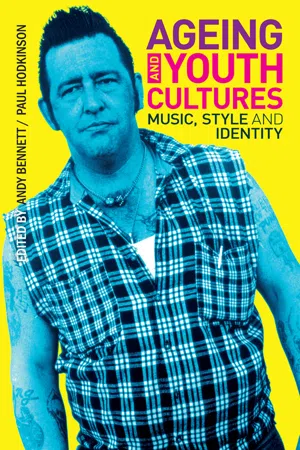
Ageing and Youth Cultures
Music, Style and Identity
- 208 pages
- English
- ePUB (mobile friendly)
- Available on iOS & Android
eBook - ePub
Ageing and Youth Cultures
Music, Style and Identity
About this book
What happens to punks, clubbers, goths, riot grrls, soulies, break-dancers and queer scene participants as they become older? For decades, research on spectacular 'youth cultures' has understood such groups as adolescent phenomena and assumed that involvement ceases with the onset of adulthood. In an age of increasingly complex life trajectories, Ageing and Youth Cultures is the first anthology to challenge such thinking by examining the lives of those who continue to participate into adulthood and middle-age. Showcasing a range of original research case studies from across the globe, the chapters explore how participants reconcile their continuing involvement with ageing bodies, older identities and adult responsibilities. Breaking new ground and establishing a new field of study, the book will be essential reading for students and scholars researching or studying questions of youth, fashion, popular music and identity across a wide range of disciplines.
Information
Part I
Ageing, Image and Identity
–1–
‘More than the Xs on My Hands’: Older Straight Edgers and the Meaning of Style
Introduction
Many scholars have noted the ‘spectacular’ element of subcultural styles—goths’ sinister, macabre fashions (Hodkinson 2002); punks’ sculpted hair and garish makeup (Henry 1989); skinheads’ boots, braces and shaved heads (Hebdige 1979). For scholars in the Birmingham School tradition, style was an element of semiotic warfare, a symbolic act of resistance among working-class youth to both inequality and ‘mainstream’ society. Youth associated with music scenes use subcultural styles to help foster a collective identity, to establish authenticity and to set themselves apart from other youth scenes. Less commonly explored questions relate to what happens when spectacular styles meet the demands of adulthood. If articulating an embodied style as a visible, symbolic rejection of dominant social norms and values is at the heart of participation in many music scenes, how do scenesters’ music identities and styles change as they age and spectacular fashions become undesirable or inconvenient? If many young people use style to set themselves apart from their peers and ‘adult’ society, how do the meanings of style change as they become adults?
This chapter explores how older adherents of straight edge (sXe)—a clean-living youth scene associated with hardcore punk music—interpret and display their straight-edge affiliation as they age. Straight edgers make a lifetime commitment to abstain from alcohol, tobacco, illegal drugs and often ‘casual’ sex, communicating their commitment via tattoos and clothing marked with the straight edge symbol, an ‘X’ (Haenfler 2006; Wood 2006). I draw upon eight years of ethnographic field research and thirty-seven interviews conducted between 1996 and 2004 in Denver, Colorado, and ten follow-up interviews with straight edgers aged over 30 undertaken in 2010. During my fieldwork, I attended over a hundred hardcore shows and socialized with straight-edge kids in a variety of settings. Most of my participants were aged between 17 and 25 (though I also interviewed several 30-somethings). For this current project, I conducted interviews with one woman and nine men, now all over 30 and still straight edge. Nine had earned a university degree (three held postgraduate degrees) and all were employed full time. Their careers included geographer, biologist, community planner, librarian and military officer. Three were married, two were engaged, one had a child and the rest were in committed relationships. I analyzed the interviews in order to search for emergent themes, and compared participants’ responses with their transcripts and behaviours from the past.
This chapter shows that for most older participants, straight edge becomes less of an embodied stylistic display and more of a personal philosophy or expression of lifestyle politics. Yet periodic and strategic displays of straight-edge affiliation are still meaningful, communicating longevity in the scene, setting an example for younger adherents or signifying continued resistance to conventional norms. The chapter concludes with a discussion of how adherents of many ‘youth’ scenes transform the meaning of style as they age, modifying and reframing the visible symbols of youth.
Straight Edge Origins and Styles
Straight edge emerged as an offshoot of the US punk scene, specifically from Washington, DC, hardcore band Minor Threat, whose 1981 song ‘Straight Edge’ provided the movement with its name. Adherents appreciated the ‘question everything’ and DIY ethos of punk, but abhorred what they viewed as the scene’s self-destructive, nihilist drug and alcohol abuse. Scrawling black Xs on their hands (Xing up)—appropriated from club owners who marked underage kids’ hands—straight edgers made it cool not to drink. By the mid-1980s, straight-edge scenes had emerged across the United States, and a variety of hardcore bands identified themselves specifically as ‘straight-edge bands’. Straight edge came to mean a lifetime commitment to abstinence, with bands often using their lyrics to promote the advantages of ‘clean living’. Beyond the basic tenets of drug-free living, many in the movement embraced vegetarianism, environmentalism, antisexism and antiracism, and other political causes. While still primarily an underground scene, straight edge has spread throughout the world, with vibrant communities from Canada to Argentina, Scandinavia to South Africa and Japan to New Zealand. While many straight edgers eventually ‘sell out’ and begin drinking, a substantial number maintain a drug-free lifestyle into their thirties and forties.
Like most youth scenes, straight-edge style is not singular or uniform, reflecting the post-subculture theory assertion that ‘the relationship between style, musical taste and identity has become progressively weaker and articulated more fluidly’ (Bennett and Kahn-Harris 2004: 11). Rather, straight edgers display a wide variety of styles, ranging from the unassuming, preppie emo fashion to the unkempt, bearded, patch-covered style favoured by many crust and gutter punks. The ‘youth crew’ era of straight edge (1986–91) and its revival (1997–2006) featured an athletic look, including cargo shorts, close-cropped hair, band shirts and hooded sweatshirts—a style that many edge kids over 30 maintain today. The mid-1990s saw the emergence of sports team jerseys, camouflage pants and military caps, while the 2000s brought indie rock-inspired tight pants, bandanas, longer, styled and/or dyed-black hair and black clothes, making some straight edgers distinguishable from their emo/goth/punk peers only by their Xs. Women often wear fitted or sleeveless versions of the same shirts, typically avoiding clothing they see as ‘too girly’ while still adopting some feminine styles. In the past, straight edgers as a group could have been described as somewhat more clean-cut than their punk peers, and even in 2010 most avoided the more ostentatious markers of punk. However, straight edgers increasingly have followed the ongoing trend of body modification present in music (and other) scenes more generally, displaying multiple tattoos, piercings and stretched ears. Through every era of straight edge and each iteration of its style, the X has remained the movement’s most consistent, visible symbol—worn on band shirts, drawn on hands with a marker, stickered on cars, sewn on book bags and tattooed on bodies.
The Strategies of Style
As noted in the Introduction to this book, there is a popular assumption that subculturists grow up and out of their respective scenes, that youthful music communities are a meaningful but relatively inconsequential ‘phase’ on the path to the more serious endeavours of adulthood. While overstated, such beliefs are not entirely unfounded and might be even more applicable to straight edge, given its strict all-or-nothing ideology: one sip of alcohol forfeits any claim on the identity, and relatively few straight-edge kids remain abstinent past the age of 25. Nevertheless, older straight edgers remain, though they are often less visible than their younger counterparts.
Older straight edgers employ a variety of stylistic strategies, at various times ‘covering’ or reflexively deploying their edge identity. Some avoid embodying any stylistic references to straight edge despite still claiming the identity, while others proudly sport Xs into their late thirties and beyond, intentionally displaying their edge. Even more straight edgers fall between these extremes, selectively using style in various ways. Bennett (2006: 222–3) notes that ‘many of the features attributed by subcultural theorists to young music fans—notably visual style, frequent face-to-face contact, and a publicly articulated collective identity—are not necessarily regarded with the same importance by older followers of rock, punk, and other post-1950s popular music genres.’ Individuals are ‘reflexive in their appropriation and use of particular musical and stylistic resources’ (2006: 223). Not only are the meanings of style more complex than previously theorized, they are contextual and often change over the course of one’s subcultural ‘career’. The following sections reveal the meanings older straight edgers attribute to their range of stylistic expression, focusing on what they perceive as the limits of style and then on style’s potential uses.
The Limits of Style
Nothing to Prove: Straight Edge Gets Personal
In the course of my fieldwork, I observed a trend repeated in a variety of music scenes: younger kids new to straight edge and hardcore spent the most time, effort and resources fashioning a straight-edge style, ‘looking the part’ of a straight-edge kid. Straight edge was a central identity in their conception of self, an identity prominently displayed on an almost daily basis. In fact, style is part of a scene’s initial appeal, as Luke,1 a 36-year-old tattoo artist, explained:
At first it was kind of like an image thing. It looks cool. It’s against everything that high school is about. I got into it that way. Obviously later on I found out that it was more of a positive lifestyle.
Ken, now 34, still straight edge and still singing in a hardcore band, voiced similar sentiments:
Those are the kids that wear straight-edge shirts to every single show and X up at every single show and give other people shit about what they do. That’s just like the same thing as skinheads. A fresh-cut skinhead wears his boots and braces and freshly shaven head every single day. Every single day, without fail. It’s the same thing. You get into it and you’re all gung-ho about it … Then after a while it just becomes part of you. In straight edge it becomes less about being the poster boy for straight edge and more about doing it for you.
Most who maintained a straight-edge identity into adulthood shed some aspects of the hardcore ‘look’, displaying Xs less (if at all) and adopting somewhat more conventional styles even as they continued to adhere to unconventional values. Straight edge became more a personal philosophy than a collective identity or marker of scene status. These older straight edgers identified with the straight-edge subculture—that is, a ‘cultural phenomenon that refers to sets of shared values and beliefs, practices, and material objects’—without necessarily participating in the scene, the social spaces (whether local, translocal or virtual) and relationships related to the production and consumption of (for example) music (Williams 2011: 50). They persisted in their abstinence from drugs and alcohol (and even in some cases enjoyment of the style and music) but often had infrequent contact with straight edgers in social settings such as shows.
Like the punks in Bennett’s (2006) and Andes’s (1998) studies, older straight edgers claimed to have ‘internalized’ straight-edge values to such a degree that outward manifestations of their affiliation became unnecessary. Derek, a 37-year-old social worker, claimed: ‘I would sometimes X up even if I wasn’t going to a show.’ However, as he aged, straight edge became more an internalized code and less a style:
Today [straight edge] is pretty much how I live my life. It is almost like second nature. Whereas before it was something I was very conscious about, I needed to tell everyone I met about it, and let them know about it, I will say in the past sixteen or so years I have mellowed out a lot. It is much more personal to me now.
As a youth, Derek emulated members of straight-edge bands, adopting the styles and Xs featured prominently in band photos on record sleeves. While he continued occasionally to wear hardcore band shirts, and remained very proud of his straight-edge identity, his focus shifted to the meanings he associated with straight-edge and hardcore values—creating a personally fulfilling, ‘positive’, drug-free life in defiance of homogenized mainstream values.
Wearing Xs and Xing up was central to establishing connections and community, but became less necessary (and less possible) as straight edgers aged. Bruce, a 32-year-old geographer, illustrated this shift:
So, ‘back in the day’ the community aspect was huge. A lot of that had to do with the collegiate atmosphere I am sure, feeling different from the norm. Now though, I mean even though I still have straight-edge friends near and far, it is much more of a personal thing. Like, when I was younger the team was a huge part. And now I think the personal, internal side is a much bigger piece like, almost to the point where straight edge was something I did, but now it is something I am.
Perhaps because of the rigid behaviour strictures, relatively few straight edgers persist into their thirties, diminishing the opportunity to connect with other similarly aged straight edgers. While all of my participants still had significant relationships with other (older) straight edgers, their scene networks largely had evaporated. If they were to persist, straight edge had to become more personal.
Other straight edgers reported that displaying Xs was part of ‘proving’ authenticity in their youth. As they aged, they saw efforts towards proving their edge affiliation as inauthentic; wearing Xs for others’ consumption, to gain others’ esteem, went against their claim that straight edge was ‘personal’. Asked whether he Xed up when he was younger, Tony, a 36-year-old entrepreneur, explained: ‘I did in the late ’80s, but then I just found that to be a little dumb. I felt the kids that needed to do that need to prove something to themselves, like they needed to talk themselves into straight edge … Straight edge was for myself.’ Sam, a 32-year-old army staff officer, said: ‘I feel that I am old enough and secure enough in life [that] I don’t have to impress anyone.’
Kyle, a 32-year-old city planner and Peace Corps veteran, explained why he no longer Xed up his hands, believing his actions better represented his commitment than a subcultural symbol:
I show [my commitment to straight edge] in my actions. I live my life and all around me know how I live and what I stand for. I have no need or desire to draw on my hands. I loved the power it gave me back in the day, or at least I thought it did. It looked tough and I wanted people to know what I believed in. I didn’t have the confidence at that time to just live and show people … It isn’t really the meaning that changed, it was the need to showcase what I believed in.
Initially, style is central to embodying straight-edge authenticity. As adherents’ connection to a scene fades, style is replaced by a more personalized, customized commitment to straight-edge ideology.
Acting their Age: Xs are Impractical
A variety of participants in my original study had altered their appearance for practical—often work-related—reasons. Several working in professional office settings had removed body jewellery and let piercings close over. Even those who still strongly identified with straight edge found the style occasionally inconvenient. For John, a 33-year-old father who still played in a hardcore band, his work context made Xing up at shows difficult, even if he might want to do it:
I work in a professional environment where walking around with Xs half faded on my hands looks a little weird. That’s mainly it. I have a Sharpie2 in my guitar case, and one in my car, but most of the time, it comes down to ‘I have an 8.00 a.m. meeting tomorrow with someone, and I don’t want my hands to look like I went to some bar the night before.’
Maggie, a 31-year-old public librarian, agreed. ...
Table of contents
- Cover
- Half Title
- Title Page
- Copyright Page
- Contents
- About the Authors
- Introduction
- PART I: AGEING, IMAGE AND IDENTITY
- PART II: CONSTRAINTS OF THE AGEING BODY
- PART III: RESOURCES AND RESPONSIBILITIES
- PART IV: AGEING COMMUNITIES
- Notes
- References
- Index
Trusted by 375,005 students
Access to over 1.5 million titles for a fair monthly price.
Study more efficiently using our study tools.
Frequently asked questions
Yes, you can cancel anytime from the Subscription tab in your account settings on the Perlego website. Your subscription will stay active until the end of your current billing period. Learn how to cancel your subscription
No, books cannot be downloaded as external files, such as PDFs, for use outside of Perlego. However, you can download books within the Perlego app for offline reading on mobile or tablet. Learn how to download books offline
Perlego offers two plans: Essential and Complete
- Essential is ideal for learners and professionals who enjoy exploring a wide range of subjects. Access the Essential Library with 800,000+ trusted titles and best-sellers across business, personal growth, and the humanities. Includes unlimited reading time and Standard Read Aloud voice.
- Complete: Perfect for advanced learners and researchers needing full, unrestricted access. Unlock 1.5M+ books across hundreds of subjects, including academic and specialized titles. The Complete Plan also includes advanced features like Premium Read Aloud and Research Assistant.
We are an online textbook subscription service, where you can get access to an entire online library for less than the price of a single book per month. With over 1.5 million books across 990+ topics, we’ve got you covered! Learn about our mission
Look out for the read-aloud symbol on your next book to see if you can listen to it. The read-aloud tool reads text aloud for you, highlighting the text as it is being read. You can pause it, speed it up and slow it down. Learn more about Read Aloud
Yes! You can use the Perlego app on both iOS and Android devices to read anytime, anywhere — even offline. Perfect for commutes or when you’re on the go.
Please note we cannot support devices running on iOS 13 and Android 7 or earlier. Learn more about using the app
Please note we cannot support devices running on iOS 13 and Android 7 or earlier. Learn more about using the app
Yes, you can access Ageing and Youth Cultures by Andy Bennett, Paul Hodkinson, Andy Bennett,Paul Hodkinson in PDF and/or ePUB format, as well as other popular books in Social Sciences & Fashion Design. We have over 1.5 million books available in our catalogue for you to explore.