- 320 pages
- English
- ePUB (mobile friendly)
- Available on iOS & Android
eBook - ePub
About this book
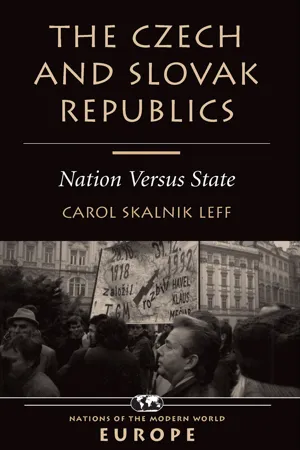
This clear, objective introduction to the politics of Czechoslovakia and the successor Czech and Slovak Republics provides a comprehensive analysis of Czechoslovakia in the postcommunist period. Carol Leff builds a framework for understanding the dynamics of the "triple transition": democratization, marketization, and a national transformation that has reconfigured the dynamic between state and nation. She shows how the interaction of these three transformational agendas has shaped Czechoslovakia's development, ultimately culminating in the paradoxical disintegration of a state that most of its citizens wished to preserve. The book offers a valuable case study of a country coming back to Europe, but it also provides an opportunity for analyzing the influence of communism on what had been a significant interwar European state. The book's strong comparative element will make it invaluable as well for those seeking to understand contemporary Central and Eastern Europe.
Information
Introduction to a Small Country at the Crossroads of Europe
The collapse of European communism has not only created a new post-cold war global order; it has also created a new Europe in which the cold war divisions are eroding under the impact of a series of modest but persistent experiments in democratization and marketization in the east. It is no longer possible to study Western Europe without paying serious attention to the transformations under way in Eastern Europe. This is true for several reasons, the most dramatic of which occupy the headlines in the form of violent regional instability in the former Yugoslavia and the former Soviet Union. Before 1989, Western Europe was insulated from such upheavals and their spillover effects by Soviet dominance in the region. The collapse of communism meant the end of this insulation—and the need to respond to conflicts with which existing institutions like NATO were not designed to deal. However, an equally important reason to pay attention to the east is the sustained effort of Central European countries to "return to Europe" by pursuing the unprecedented goal of converting communist economies into capitalist economies and redesigning moribund political institutions into functioning democratic mechanisms. In sometimes overly optimistic anticipation of success, these formerly communist countries are already lined up outside the doors of the North Atlantic Treaty Organization (NATO) and the European Union (EU), hoping for admission into a community of prosperity and security that none of these small and vulnerable countries can achieve alone.
Individually, none of these countries will have the international significance of a China or Russia. But their collective destinies will shape the future contours of European power as a whole, either adding to its political and economic weight or subtracting from it by deflecting attention and resources to regional conflict management. Czechoslovakia is not typical of all its postcommunist neighbors. There is no "typical" East European country, but if there were, Czechoslovakia would resent the label, since the Czechs in particular consider themselves simply "European," without geographical adjectives.1 However, Czechoslovakia's trek toward Europe bears the marks of the communist experience that the entire region shared, and its transformation effort is an excellent case study in the problems of major regime change on a shoestring budget. It is a case study of significant successes and spectacular failures, not the least of which was the dissolution of one of the region's more economically advanced, educated, and stable countries into two pieces in 1992.
On the eve of World War II, when the European great powers were about to carve up Czechoslovakia at Munich, the British prime minister, Neville Chamberlain, professed not to know exactly where it was and why it mattered; Czechoslovakia's plight, he said, was "a quarrel in a far-away country among people of whom we know nothing."2 This chapter and the following one comprise an attempt to help to avoid Chamberlain's mistake. In these two companion chapters I will analyze the evolution of the Czechoslovak state from its inception in 1918 until the time of its break with communist rule in 1989. In subsequent chapters I will dissect the current transition period. In these introductory chapters, the emphasis will be on the legacies of the earlier experiences of political and social transformation and their relevance to the present.
The international media and the East European publics alike were euphoric at the sudden collapse of communism in 1989 and the promise of free elections soon to come. At that moment, the end of the old regime seemed tantamount to the arrival of democracy. As everyone has learned since then, a noncommunist government is not necessarily a democratic one. In the following discussion, I will frequently use the adjective "postcommunist" to describe the political and economic institutions in place throughout the region in the early 1990s. This is partly a simple description of fact; what we see is what exists after the collapse of the classic version of the communist system, with its dominant single party, administered economy, and lack of legitimate opposition.
The use of the term postcommunist is also, however, a reminder that what we see is not necessarily describable as democracy or capitalism simply because it is no longer communist. We know what these regimes are in transition from—from authoritarian communist regimes. We do not know what they are in transition to, and it is too soon to be sure that any or all of the efforts under way will turn out to culminate in economic and political regimes that resemble the ones we call capitalist and democratic elsewhere.3 Some may succeed in replicating the Western European models sufficiently well to join the European Union and other Western institutions and to be studied comparatively as variants of European politics. Others may revert to authoritarian rule, but it will still be a postcommunist authoritarian rule, like that of Slobodan Milošević in Serbia, that builds on nationalism more than on socialism, and includes some features of competitive politics (an opposition press, for example, or electoral competition). Still others may find themselves suspended in limbo between the former authoritarian politics and the achievement of a stable, legitimate democracy. Scholars of democratization talk about "unconsolidated" democracies that lurch from free election to free election without ever achieving governments that can govern well or gain popular acceptance and legitimacy.4 Many of the trappings of democracy are there, but the system does not work, and it stumbles from crisis to crisis, often reliant on emergency executive power instead of bargaining and compromise. Russia might turn out to be such a case. Or there are cases where the system achieves relative stability but is not fully democratized because certain political forces are barred from achieving any real power in the system, and others (the military or former communists, for example) exercise democratically unaccountable power behind the scenes. Romania or some of the states of the former Soviet Union might fall into this category.
"Postcommunist" may be the most responsible term to label all of these embryonic systems, acknowledging their possibilities without prejudging the eventual outcome. It also seems valid to refer to them as "transitional" regimes, as long as it is not implied that the transition will automatically end in successful democratization. However, the label "postcommunist" has an additional usefulness. Scholars are still debating whether these cases can be incorporated into the larger universe of cases of attempted democratization that have appeared globally since the 1970s, amounting to what Samuel Huntington has called a "third wave" of global democratization.5 The doubters are those who see the postcommunist regime changes as especially complex; Latin American and most South European countries that have undergone recent democratizing transitions, they argue, only need to concentrate on one kind of transformation—a political one to resurrect or create democratic institutions. They already have capitalist economies and are, with the exception of Spain, culturally and ethnically homogeneous enough to avoid the pain of simultaneous negotiations to resolve long-standing nationalist tensions.
This is not so in the postcommunist countries. Because of their socialist economic system and their multinational complexity, they must undergo what Claus Offe calls a "triple transition" if they are to reconstruct the old order: the political transition common to the other cases, plus an economic transition to establish markets and private enterprise, plus an identity-security transition to negotiate internal differences among national groupings and determine the state's territorial boundaries.6 As we will see, these simultaneous transitions interact with one another, often in ways that delay and complicate the individual tasks. Offe himself poses several variants of this "dilemma of simultaneity," raising the question of whether it is really possible to graft a democratic political system onto a communist society before the economic transition has produced a new class structure with a stake in the new political system. And yet, how to pursue an often painful economic transition without democracy to give legitimacy to the effort? Labeling Czechoslovakia and the other current regimes of the former Soviet bloc "postcommunist," therefore, is a reminder of the special problems that these countries face. The framework of a postcommunist triple transition effort is a useful one for thinking about the tasks the Czech and Slovak governments have faced since 1989 and the way in which their approaches have differed from each other's and from those of other states in the region.
At the same time, the special problems of rebuilding after communism do not make these states completely incomparable to other transitional regimes in other times and places. In fact, in reviewing the antecedents of the current period of transformation, it is clear that Czechoslovakia's earlier history contains several periods of multiple transformation, all of which have shaped the chances for a successful consolidation of a prosperous, stable regime in the present.
At the time of its demise in 1992, Czechoslovakia was still a rather young European state, emerging from the drawing boards of the Versailles Peace Conference after World War I as part of a larger experiment in replacing the collapsed empires of East Central Europe with smaller successor states that might stabilize the region and facilitate workable parliamentary democracy on the basis of national self-determination. The experiment involved the attempt to make a rough fit between state boundaries and national groupings, in order to avert the repetition of the kind of internal ethnonational conflict that had afflicted the former empires and plunged Europe into war in 1914. The effort was hardly an unqualified success, not least because it was nearly an impossible task to divide the complex and intermixed national groupings of the region along neatly demarcated territorial lines; the interwar states in East Central Europe remained multinational and further inflamed matters in most cases by behaving as if they were not. This was the first attempted transition to democracy in modern Eastern Europe, and it ended in failure both domestically and internationally. The author of one textbook on East European politics entitled his chapter on this period "Flunking Democracy."7 The democratic features of these states broke down under the pressures of governance, internal divisions, and external threats; by 1938, Czechoslovakia was the only functioning parliamentary democracy in the region. Internationally, the region remained a zone of instability and conflicting great power interests; it ultimately fell to Hitler in his quest to construct a thousand-year Third Reich.
East Central Europe's second chance at democratic transition was briefer still. The reconstruction of the regimes following the Allied victory over Nazi Germany soon succumbed to the authoritarian model imposed on the region by Stalin and his "liberating" Red Army. The regional democratization experiments that followed the collapse of communism in 1989, therefore, are the third set of such efforts since the reorganization of the European state system in 1918, and the legacies of the previous regimes are highly relevant to the chances for successful transformation in the present.
Czechoslovakia's experience of political and economic change in this twentieth-century period shares many commonalities with its eastern neighbors that make it a valuable case study in the general patterns of postcommunist regime transformation. Like its neighbors, it was constructed on the ruins of one of the four imperial powers that had governed the region before the twentieth century, all of which failed to survive World War I in their previous form. Czechoslovakia was formed from adjoining territories of the Austro-Hungarian empire: the Czech lands of Bohemia and Moravia, administered from the imperial capital of Vienna by the Austrian half of the dual monarchy; parts of Austrian Silesia; and Slovakia, an integral part of the Hungarian half of the dual monarchy. Like its neighbors, the newly constructed state would lose its sovereignty to Hitler in World War II. The Nazi pattern of dominance varied from state to state. In the case of Czechoslovakia, the Czech lands were directly ruled by Berlin as a protectorate, and Slovakia was permitted nominal independence under the umbrella of German foreign policy goals. After the war, Czechoslovakia also met the regional fate of subordination to Soviet hegemony; following the events of 1948, variously described as a communist coup or the "Glorious February Revolution," depending on the viewer's ideological standpoint, Czechoslovakia became the last of the East Central European states to fall under Soviet domination and to undergo political and economic communization. And finally, Czechoslovakia broke with the Soviet model in 1989 as the bloc as a whole disintegrated. Like the rest of the region, then, Czechoslovakia had been an often unwilling experimental laboratory for all the major Western political experiments of the twentieth century—democracy, communism, and fascism.
These general parallels do not mean that Czechoslovakia's experience was "typical" in every important respect. All of the region's states were in some sense multinational, but each configuration was different and changed differentially over time. Levels of economic development varied considerably from north to south in Eastern Europe; Czechoslovakia inherited one of the more favorable economic bases. All the countries had to cope with the reality of being wedged between two large and potentially threatening neighbors, Germany and the Soviet Union; in fact, they were created in order to provide a buffer zone, or, perhaps more appropriately, a shatter zone, between east and west. But the mix of threat and hostility from these larger powers varied from country to country. In Czechoslovakia before 1945, the overwhelming concern was with Germany, whereas Poland, having been both invaded and territorially partitioned by both big powers in its modern experience, was hard pressed to decide which of its large neighbors was the more dangerous. In the following chapters, these and other distinctions will be part of the larger picture of common experience that places into perspective the individual Czechoslovak transition and the uniquely peaceful disintegration of the state.
In the present chapter, however, the main purpose is to introduce students in North American universities to the citizens of the Czech and Slovak states—citizens who shared a joint state between 1918 and 1939, and again between 1945 and 1993. Joint statehood was in part an experiment in coping with the problem, already very obvious, of being a small state in Central Europe, since the conjoining of two smaller nations into a somewhat larger one was an exercise in selfdefense against predatory neighbors. This certainly was not a sufficient deterrent to Nazi or Soviet expansion. Ultimately, Czechs and Slovaks would seek their security in a broader European framework after the collapse of the communist regime in the peaceful "Velvet Revolution" of 1989. But by that time, the original rationale for a common state had eroded so badly that two new Czech and Slovak Republics sought their security separately after the final decision to divide the state in 1992. This oddly peaceful disintegration of a functioning country has been tagged the "Velvet Divorce" by those who want to contrast it with the more violent and tragic events in Yugoslavia.
The Constituent Nations of Czechoslovakia
The failed political marriage of Czechs and Slovaks makes it especially important to define who they are. What commonalities caused them to consider a common state...
Table of contents
- Cover
- Half Title
- Title
- Copyright
- Dedication
- Contents
- List of Tables and Maps
- Acknowledgments
- Chronology
- Introduction to a Small Country at the Crossroads of Europe
- Selected Bibliography
- About the Book and Author
- Index
Trusted by 375,005 students
Access to over 1.5 million titles for a fair monthly price.
Study more efficiently using our study tools.
Frequently asked questions
Yes, you can cancel anytime from the Subscription tab in your account settings on the Perlego website. Your subscription will stay active until the end of your current billing period. Learn how to cancel your subscription
No, books cannot be downloaded as external files, such as PDFs, for use outside of Perlego. However, you can download books within the Perlego app for offline reading on mobile or tablet. Learn how to download books offline
Perlego offers two plans: Essential and Complete
- Essential is ideal for learners and professionals who enjoy exploring a wide range of subjects. Access the Essential Library with 800,000+ trusted titles and best-sellers across business, personal growth, and the humanities. Includes unlimited reading time and Standard Read Aloud voice.
- Complete: Perfect for advanced learners and researchers needing full, unrestricted access. Unlock 1.5M+ books across hundreds of subjects, including academic and specialized titles. The Complete Plan also includes advanced features like Premium Read Aloud and Research Assistant.
We are an online textbook subscription service, where you can get access to an entire online library for less than the price of a single book per month. With over 1.5 million books across 990+ topics, we’ve got you covered! Learn about our mission
Look out for the read-aloud symbol on your next book to see if you can listen to it. The read-aloud tool reads text aloud for you, highlighting the text as it is being read. You can pause it, speed it up and slow it down. Learn more about Read Aloud
Yes! You can use the Perlego app on both iOS and Android devices to read anytime, anywhere — even offline. Perfect for commutes or when you’re on the go.
Please note we cannot support devices running on iOS 13 and Android 7 or earlier. Learn more about using the app
Please note we cannot support devices running on iOS 13 and Android 7 or earlier. Learn more about using the app
Yes, you can access The Czech And Slovak Republics by Carol Leff in PDF and/or ePUB format, as well as other popular books in Politics & International Relations & Comparative Politics. We have over 1.5 million books available in our catalogue for you to explore.