- 212 pages
- English
- ePUB (mobile friendly)
- Available on iOS & Android
eBook - ePub
About this book
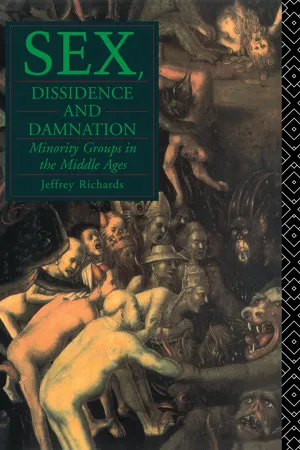
For the authorities in medieval Europe, dissent struck at the roots of an ordered, settled world. It was to be crushed - initially by reason and argument, eventually by torture. Jeffrey Richards examines the wretched lives of heretics, witches, Jews, lepers and homosexuals and uncovers a common motive for their persecution: sexual aberrance.
1
The Medieval Context
There have been throughout history recurrent periods of seismic change when the accepted norms and values of society have been decisively challenged and an explosion of new ideas and forms, beliefs and behaviour patterns has been touched off. The sixteenth century with its Renaissance and its Reformation; the era of Romanticism and revolution in the late eighteenth and early nineteenth centuries; and the 1960s with the rise of the counter-culture are examples. In each period, there has been a background of rising economic prosperity, growing materialism and increased leisure allowing the luxury of thought and experimentation. All have involved the idea of rebellion and rejection of the dominant ideology and all have been followed by periods of repression and retrenchment: Renaissance and Reformation were followed by absolutism and Counter-Reformation; revolution and Romanticism by, in England, the rise of evangelicalism and parliamentary democracy; and the counter-culture by the advent of Thatcherism and Reaganism. Each of these eras has centred on a rediscovery of the self and of selfhood, individuality, self-awareness and self-fulfilment. Each has seen the simultaneous assertion of asceticism and libertinism as a means of self-expression.
The twelfth century was another such period. The century saw a rising curve of self-expression in religion and sexuality with men and women explicitly or implicitly seeking greater access to God and greater control of their own bodies. The reaction to this by the authorities was the demand for conformity, religious and sexual. The text was the familiar cry of the totalitarian down the ages – ‘Is he one of us?’ In the thirteenth century the Church, the municipalities and the emerging national monarchies moved in to curb the freedom that had prevailed in the twelfth. The Church concerned itself particularly with the regulation of sexuality (the campaign against homosexuals, the segregation of prostitutes, the sacralization of marriage) and the regulation of spirituality (the reassertion of the clerical monopoly of access to God).
There are continuing and shaping themes in the Middle Ages: the tension between authority and dissent, between communality and individualism, between materialism and spirituality, between eroticism and asceticism: conflict between these opposing forces ebbs and flows, waxes and wanes, sharing that perpetual oscillation between extremes that Johan Huizinga saw as a prime characteristic of medieval life. It was a society capable of sudden and violent outbursts of hysteria and paranoia, violence and enthusiasm, often against a background of demographic crisis or social dislocation, associated frequently with outbreaks of famine and disease.
But above all two psychological cruces dominate the contours of the period: the passing of the millennium and the coming of the Black Death. It was expected that the world would come to an end a thousand years after Christ. Some imagined it would be in 1000, a thousand years after His birth; yet more expected it in 1033, a thousand years after His death. The monkish chronicler Raoul Claber captured in his chronicle the rising tide of excitement and apprehension. There were violent storms and serious food shortages in 1033; there were signs and portents in the heavens. ‘People’, he wrote, ‘believed that the ordinary pattern of the seasons and the elements which had reigned since the beginning of time had reverted to chaos once and for all and that the end of mankind had come.’ There was a mass movement of. pilgrims towards Jerusalem, as people wished to be in the holiest of earthly cities when Christ’s second coming would signal the last judgement of all human souls. ‘An immense throng began to converge from every corner of the world on the sepulchre of Jesus in Jerusalem.’
But the world did not come to an end. Mankind could breathe again. No one could now be quite certain when the end would come. The official line of the Church had always been that it was not given to mankind to know. But there was no shortage of prophets willing to make predictions. The most influential was Abbot Joachim of Fiore, who divided the history of the world into three ages, the second of which he saw ending amidst violent upheavals in 1260. But there were others who variously predicted the end of the world for 1186, 1229, 1290, 1300, 1310, 1325, 1335, 1346, 1347, 1348, 1360, 1365, 1375, 1387, 1395, 1396, 1400, 1417, 1429 and 1492–4. Even if people did not agree about the date, everyone knew how to recognize its imminence, for Christ himself had told his disciples what the signs would be, according to St Matthew (24 vv. 7–8): ‘Nation shall rise against nation; kingdom against kingdom; and there shall be famines and pestilences and earthquakes in divers places. And these are the beginning of sorrow.’ Such conditions were not uncommon in the Middle Ages.
At the centre of the medieval apocalyptic world-view was the rise of the concept of Anti-Christ, who from the tenth century onwards became alike a regular theme of theologians and a staple of popular culture, featuring in sermons, poems, histories and plays. Anti-Christ, whose life was a parody of Christ’s (born a Jew, Anti-Christ enters Jerusalem, gathers disciples, performs miracles), was an agent of the Devil, who, it was believed, would mislead Christians, persecute the faithful and rule as a tyrant until Christ himself came to rescue mankind in time for the last judgement. The concept appealed to the essentially dualistic nature of medieval popular belief, which saw and understood the idea of life as a permanent battlefield between Good and Evil, God and the Devil, Christ and Anti-Christ, angels and demons. Various figures at various times would be identified with Anti-Christ, not least among them Popes Boniface VIII and John XXII.
The prospect of the millennium which might occur at any time gave rise to two strains of thought. On the one hand there was that radical millenarianism which Norman Cohn has so brilliantly analysed in The Pursuit of the Millennium: a belief, often to be found in the lower depths of society, in the arrival of a Golden Age on earth, which would precede the end of the world. Establishments and authorities would be overthrown and an era of equality, purity and plenty would be ushered in. The dream produced a succession of violent outbursts throughout the Middle Ages and it frequently provided inspiration for the militant wing of heretical movements, notably the Hussites. There was a frantic and deluded optimism sustaining those who often had nothing else to look forward to apart from lifelong misery and an early death.
But there was a more generalized apocalypticism. Encouraged by the wandering charismatic preachers who were such a feature of the Middle Ages, people were pessimistic about the future of mankind in general but willing to take thought for their own souls. If the end of the world could happen at any time, it was vital to be prepared for meeting your Maker; hence the impulse towards penance, pilgrimage and in particular personal asceticism. This expectancy generated an atmosphere of puritanism and evangelicalism, conditioning people’s reactions to particular circumstances. It concentrated attention on the conquest of sin and on the first principles of the faith, on personal purity and on a rejection of the things of the world. Although the population did not continue in a permanent state of semi-mystical enthusiasm, that mindset remained and it frequently came to the fore at times of crisis.
Despite the permanent presence of the idea of apocalypse in the mentalité of the age, after 1033, when it was no longer securely ascertainable, there are abundant signs that Europe shook off its defensive Dark Age mentality and entered upon a period of revival, expansion, and creativity. Darkness was to be dispelled by Light, epitomized by the design, lavout and construction of the Gothic cathedrals which arose all over France, symbolizing the spiritual aspirations and sense of liberation of the age and embodying the principle that ‘God is Light’. It was of course a combination of social, economic and political forces that achieved the revival but it flowered and flourished in the two centuries following the millennium.
For the first time for centuries, there was peace. The threat from the Arabs, the Vikings and the Magyars which had put the very survival of Christendom at risk had receded. In the wake of peace came demographic growth, agricultural expansion and urban revival. The towns, eclipsed since the heyday of the Roman Empire, destroyed or reduced by the invaders, abandoned by their populations, flared and fizzed into life; none more so than those in northern Italy and the Low Countries, enriched and invigorated by swelling trade and burgeoning industry. A new literate and articulate class, the bourgeoisie, came into being, forming a middle band between the aristocracy and the peasants. The money economy came increasingly to supersede the old barter system. The need for numeracy and literacy, the intellectual stimulus of travel and the interchange of ideas provided a boost to education. The rise of the towns was one of the most influential features of the central Middle Ages.
The consequences of the urban revival were enormous, ramified, and far-reaching. As islands of freedom in a feudal world, the towns stimulated the development of representative assemblies and promoted the idea of self-government. They saw the emergence of a new form of law – commercial law – and more significantly promoted the idea of recourse to the courts instead of to violence and vendetta to settle disputes. They stimulated art, architecture and education. They were fertile sources of new ideas on religion, morality and belief as well as economics. They were potent vehicles for social mobility and opportunity.
The emergence of the national monarchies was the other great feature of the age. In theory, Christian society was unitary and universal, ruled in a harmonious partnership by the Holy Roman Emperor and the Pope. But a succession of violent clashes between Papacy and Empire beginning with the Investiture Contest, a bitter dispute about the appointment of clerics in the eleventh century, made nonsense of that, and the emergence of the new national monarchies with distinctive identities (notably France and England) fractured the theory with tumultuous reality. The Holy Roman Emperor was effectively reduced to being king of Germany and northern Italy. By the eleventh century the ingredients necessary for the emergence of nation-states were present: the stabilization of Europe and the creation of more defined boundaries and borders, the introduction of permanent political institutions particularly to handle finance and justice; and perhaps most important the beginning of a shift of loyalty from the local communities and religious organizations to the monarchy as the symbol of the nation. In France, a definite sense of national identity was engendered, sharpened by war with England, by conflict with the Papacy and by the promotion of Paris as the national capital, centre of learning, justice and administration. Something of the process was undergone by the Papacy, which without relinquishing its claims to supra-national authority, developed in the fourteenth and fifteenth centuries into a bureaucratic and legalistic monarchical power, acquiring a territorial state in central Italy and military and political alliances to implement its foreign policy. All of these embryonic states benefited from the rising population and from increasing wealth, which led to extra revenues flowing into their coffers.
But along with the great economic revival went a spiritual and intellectual revival. The Papacy in the tenth century had been morally bankrupt, the throne of St Peter, the play-thing of rival noble factions who elevated to occupy it a succession of scandalous charlatans. By 1045 there were three rival claimants. The Emperor Henry III stepped in to depose all three. Eventually he appointed his cousin as Pope Leo IX, the first of a succession of able and dedicated pontiffs who set out to reform both the Papacy and the priesthood and to put Rome at the head of the spiritual revival that was stirring. The restoration of the moral and spiritual independence and authority of the Papacy was only one facet of an explosion of religious feeling that took many and varied forms. Existing communities were reformed and reinvigorated, new monastic orders and houses were founded; there was a proliferation of holy hermits and the development of new forms of religious life (canons, friars); there was an upsurge in pilgrimages. The proclamation amidst scenes of wild enthusiasm of the First Crusade, the first of a series which spanned the remainder of the Middle Ages, harnessing the warrior knights of western Europe to the sacred cause of freeing the Holy Land, helped promote a concept of Christian knighthood, with new semimonastic chivalric orders, sword-blessings, the cult of warrior saints, the sacralization of the process of conferring knighthood and the preaching of ‘holy war’. In Spain the Christian kingdoms of the north began the drive to subdue the Moslem states in the centre and south of the country. In eastern Europe, religious missions, followed in due course by military expeditions, sought to convert the heathen Slavs. So farreaching and deep-rooted was this mood of reform and revival that the historian Brenda Bolton has justly dubbed it ‘The Medieval Reformation’.
This ‘reformation’ was matched by a ‘renaissance’ which was to open up the mind of man and send it off into all kinds of new and exciting directions. The ‘renaissance’ was the product of an educational revolution, as numerous urban schools arose to challenge the supremacy of the old monastic schools. From the new schools in the century emerged the universities, where philosophical, theological and intellectual speculation and debate found a permanent home. The ‘renaissance’ bred a new kind of scholar, dedicated to argument and logic, which found a leading place in the intellectual process for the first time since the fall of the Roman Empire.
Monumental intellectual undertakings were begun, including that of gathering, organizing and harmonizing the legacy of the Christian Roman past in scripture, theology and jurisprudence. Of particular significance, not just for the individual but for political, economic and social life, was the great revival in legal studies. The revival, stimulated by the rediscovery of the law codes of the Roman Emperor Justinian, produced a new breed of professionals – lawyers. They moved out of the universities and into the bureaucracies of the emerging national monarchies and of the Papacy. Around 1140, the canon lawyer Gratian completed his Decretum, a systematic code of Church law which was to remain authoritative throughout the Middle Ages.
But as Colin Morris has so persuasively argued, one of the most profound developments of the twelfth-century Renaissance was ‘the discovery of the individual’. The early Middle Ages had afforded little scope for individualism. Its essential characteristic was communality, understandable in an age whose primary motivation was defence and resistance to attack from all sides. Organizationally it was a time of the emergence of feudal ties, creating links that bound men together in the interests of mutual defence. It was a time of close-knit monastic communities, banded together to preserve the faith and civilized values against the onslaught of the barbarians. It was a time in which Christianity was pre-eminently interpreted as the community of the faithful, a single unified body within which the individual submerged his distinctiveness to become an obedient identikit servant of God. The dominant literary form of the age was the epic poem, which stressed the need for the loyalty of the individual to larger units; the lord, friends, the family. Thus the keynote of the Dark Ages was obedience and unquestioning faith in authority. But the new emphasis on argument, on reason, and on logic inevitably led to a widespread questioning of established views and this meant a new openness and a new intellectual adventurousness.
One of the central themes of medieval thought now became a search for self and individual fulfilment. ‘Know yourself, the alternative title of Peter Abelard’s Ethics, became the motto of the age. The desire for self-knowledge lay behind the rise of autobiography, a literary form almost unknown in the Ancient World, in the concentration in sermons and treatises on the way in which the individual could relate to God and in the great growth of love literature. The element common to them all is the concern with self-analysis, the discussion of feelings, the experience of emotional and spiritual fulfilment rather than physical and sexual satisfaction.
This search for self-knowledge powerfully reinforced the promotion of penitential confession as a significant feature of religious life. In the early Church, penance for sins required public confession and exclusion from the community until after the penance and formal readmission. The formal, public, and essentially forensic penance took place at one of the great Lenten festivals of the Church. But during the Dark Ages things began to change. Private confession increasingly took over and penance was negotiated with the priest and performed in private. By the twelfth century it had become accepted that outward and formal satisfaction was no substitute for inner repentance. This received additional emphasis from the ruling of the 1215 Lateran Council that annual confession was a minimum requirement for all members of the Church. It was an attempt at one level to introduce the idea of self-examination throughout society. This concern with inner attitudes is illustrated by a new stress on intention in the assessment of conduct. The early penitentials and penal codes of the medieval west prescribed punishment for the action rather than the intention behind it. But during the twelfth century intention became a major consideration in theology and philosophy.
Few aspects of the faith remained immune from the process of individualization. Whereas for the first thousand years of Christianity Christ on the cross had been depicted as triumphant and radiant, redeeming the whole of mankind; from 1050 to 1200 the emphasis in pictures and carvings was on Christ’s physical and emotional suffering and his individual love of mankind. At the same time a new position for prayer was adopted – kneeling with the hands together, the position in which the feudal vassal did his individual homage to his lord. This emphasized the individual’s quest for salvation and for a private and personal relationship with God. The Church also promoted the concept of individual consent in marriage, a novel idea in an age where marriage was universally arranged by families.
Individualism is the defining characteristic of the key artistic form of the central Middle Ages – the romance, which superseded the epic. The chivalric romance involved the hero in a quest for his real identity and his personal destiny, for self-knowledge and self-fulfilment, based on love rather than the achievement of a family, tribal or national goal like the epic hero.
The political theory of the early Middle Ages was conformist. It had to be to survive. The dominant view was theocracy, with power flowing down from God through his chosen rulers to the people who obey those set in authority over them. But the opening up of society led to the questioning of established order and authority. One form was satire and the twelfth century was the golden age of medieval satire, attacking corruption and abuses. Another was the development of the concept of the citizen, an individual with rights and duties as opposed to the subject, who had no rights and must obey even an unjust superior. This concept evolved following the rediscovery of Aristotle’s thought with its emphasis on individual rights and from the implications of the feudal system with its contractual arrangements between lord and vassal. St Thomas Aquinas (c. 1225–74) successfully harmonized the new individualism with traditional Christian teachings by emphasising the role of individual conscience.
This newly prominent individualism fuelled the two dominant characteristics which Alexander Murray regards as defining the twelfth and thirteenth centuries: avarice, the habit of desiring more and more money, and ambition, the habit of desiring more and more power. Avarice, the by-product of the return to a money economy, was manifested in the great increase in robbery and simony, mounting hostility to the Jews, and the preoccupation of preachers and satirists alike with the excessive love of money. Ambition was stimulated by the increasing social mobility, most notably in the rise of the literate and numerate professionals (lawyers, administrators, career clerics). It became a theme of sermons from preachers for the first time in the twelfth century.
All this is not to argue that there was a state of rampant and unrestrained individualism. Medieval society continued to be strongly marked by communality – the monastic community, the village community, the parish, confraternities and guilds, knightly orders, urban communes – but most of these organizations were entered into by the free choice of the individual and for the first time there was a wide variety of alternatives to choose from.
For the Church...
Table of contents
- Cover
- Half Title
- Title Page
- Copyright page
- Dedication
- Table of Contents
- List of illustrations
- Preface
- 1. The Medieval Context
- 2. Sex in the Middle Ages
- 3. Heretics
- 4. Witches
- 5. Jews
- 6. Prostitutes
- 7. Homosexuals
- 8. Lepers
- Further reading
- Index
Trusted by 375,005 students
Access to over 1.5 million titles for a fair monthly price.
Study more efficiently using our study tools.
Frequently asked questions
Yes, you can cancel anytime from the Subscription tab in your account settings on the Perlego website. Your subscription will stay active until the end of your current billing period. Learn how to cancel your subscription
No, books cannot be downloaded as external files, such as PDFs, for use outside of Perlego. However, you can download books within the Perlego app for offline reading on mobile or tablet. Learn how to download books offline
Perlego offers two plans: Essential and Complete
- Essential is ideal for learners and professionals who enjoy exploring a wide range of subjects. Access the Essential Library with 800,000+ trusted titles and best-sellers across business, personal growth, and the humanities. Includes unlimited reading time and Standard Read Aloud voice.
- Complete: Perfect for advanced learners and researchers needing full, unrestricted access. Unlock 1.5M+ books across hundreds of subjects, including academic and specialized titles. The Complete Plan also includes advanced features like Premium Read Aloud and Research Assistant.
We are an online textbook subscription service, where you can get access to an entire online library for less than the price of a single book per month. With over 1.5 million books across 990+ topics, we’ve got you covered! Learn about our mission
Look out for the read-aloud symbol on your next book to see if you can listen to it. The read-aloud tool reads text aloud for you, highlighting the text as it is being read. You can pause it, speed it up and slow it down. Learn more about Read Aloud
Yes! You can use the Perlego app on both iOS and Android devices to read anytime, anywhere — even offline. Perfect for commutes or when you’re on the go.
Please note we cannot support devices running on iOS 13 and Android 7 or earlier. Learn more about using the app
Please note we cannot support devices running on iOS 13 and Android 7 or earlier. Learn more about using the app
Yes, you can access Sex, Dissidence and Damnation by Jeffrey Richards in PDF and/or ePUB format, as well as other popular books in History & European Medieval History. We have over 1.5 million books available in our catalogue for you to explore.