- 304 pages
- English
- ePUB (mobile friendly)
- Available on iOS & Android
eBook - ePub
About this book
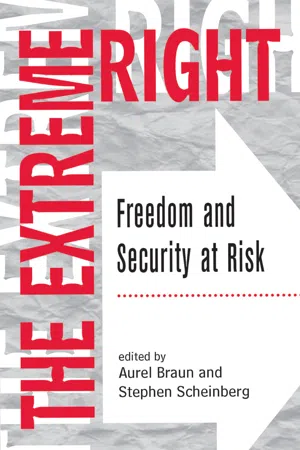
This book, offering a historical-sociological account of right-wing extremist movements in American history, seeks to identify threats to freedom and security, assess the responses to such threats, and suggest some means of dealing with the potential dangers.
Information
1
Introduction
During a visit to Moscow in May 1994 I asked an old academic acquaintance about his perceptions of the political conditions in Russia. He lamented the disarray among the democrats and was perturbed by the economic hardships and the all too visible poverty. But overall he remained optimistic. The transition was painful, but he assured me, “We are perfecting democracy.” In a society that had spent more than seven decades “perfecting communism,” this Russian democrat, a proponent of fundamental transformation, was employing, almost amusingly, Marxist language to describe the process of democratization in Russia. There was a kind of pride in his remarks that somehow Russia was catching up to the West. “We are joining,” he added, “what President Boris Yeltsin has called the ranks of the civilized nations.” His remarks, though, raised two issues: one about the understanding of the core characteristics of democracy and the other about the state of democracy in Western nations.
It is reassuring to see the tremendous interest in democratic theory in Russia. Many Russian intellectuals, for instance, have been reading the Federalist Papers. Yet it is surprising how many misconceptions about the nature of democracy remain. First, the belief that a political system can be perfected is deeply rooted in some ideologies but not in democracy. Democracy, as Thomas Jefferson and others have contended, is a continuing struggle. It is a system that involves checks and balances to compensate for human frailty and ambition. Unlike totalitarian ideologies, it does not represent a “once and for all solution.” It requires patience, commitment, and participation. It relies not only on institutions and processes but also on a vigilant and vibrant civil society. Therefore, an assumption that democracy can be perfected endangers the continuing commitment to the struggle to keep democracy viable and diminishes the will to deal with those who would undermine it.
Second, the notion that democracy somehow has been perfected in Western states is a misunderstanding of the character of political systems in pluralistic democracies. In the established democracies, institutions and processes have continued to evolve in order to ensure the protection of basic human rights and have indeed involved a continuing struggle against forces that in a variety of ways have challenged democratic ideals or have sought to diminish human dignity. The horrific carnage caused by right-wing extremists when they exploded a bomb in Oklahoma City in the United States in 1995 or the spectacle of millions of French citizens giving the right-wing demagogue Jean-Marie Le Pen, the leader of the Front National, a record 15 percent of the vote in April 1995 are but two of the manifestations of the continuing dangers of extremism in long-established democracies. In both emerging and established democracies, then, there is the need to deal with threats to freedom and security.
There is a need for balance and prudence, though, in analyzing such threats and risks. It is not the contention of this book that democracies are in mortal danger. Also, the authors are not involved in an attempt to measure the performance of governments either in emerging or established democracies on the basis of some strictly construed version of political correctness. Rather, they seek to identify threats to freedom and security, assess the responses to such threats, and suggest some means of dealing with the potential dangers.
Traditionally, the gravest threats to democracy from the right emanated from fascism. In most democracies, there are at least small groups that reject democratic institutions and idealize the old fascist regimes. But among the larger radical right groups, the resemblance to fascism is superficial. This applies to Jörg Haider’s Freedom Party in Austria and Gianfranco Fini’s National Alliance in Italy, which are more radical rightist parties than fascist ones. Fascist ideology was based on an integrated set of concepts that combined antiliberalism and xenophobic forms of nationalism and echoed the intellectual ferment in Europe in the post–World War I era. Scholars such as Stanley G. Payne have argued persuasively that the Western world has been inoculated against that kind of fascism.1 That classical fascism is not a probable threat in established democracies and probably not even in emerging ones, however, is not sufficiently comforting. There are numerous other threats.
As Oxford’s philosopher John Gray has written, in the liberal democracies the principal danger has come from the revival of the radical right.2 There are, of course, threats from violent skinheads and small neo-Nazi organizations, but it is the radical rightist parties whose members are populists and doctrinaires of the antigovernment right—who, as John Gray has argued, combine economic Darwinism with a deeply reactionary view of family life—that pose the greatest danger by widening social divisions, deepening political alienation, and fostering cultural warfare.3
Still, the existence of these parties is not a cause for panic. None of these radical right parties or individuals propagating these views have a good chance of gaining power in the established democracies. Jean-Marie Le Pen has virtually no chance even of sharing power nationally. In the Austrian elections in December 1995, Haider’s party failed to make gains for the first time in a decade.4 The issue, then, is not one of imminent danger but rather of the need for awareness of the potential for danger. Democracies should deal early with threats to freedom and security across the entire political spectrum, whether these emanate from skinheads, neo-Nazi groupings, or an antidemocratic radical right.
In the emerging democracies, though, the danger is graver. The absence of a deeply rooted legal system that can offer citizens protection, the fragile emerging democratic institutions, and the uncertain political processes all create an environment where opportunities for extremism exist. Further-more, in the postcommunist states, the lines between extreme left and right become blurred as prevailing political extremism combines features of both. The slower the transition in these postcommunist states, the more strength the antidemocratic seem to enjoy. But even in the more difficult situations, democratic forces can and should fight those of extremism. It would be most unfortunate if in any of these states, including Russia, the democratic forces were to become paralyzed with fear and abandon the fight. But to counter extremism effectively in the established and the emerging democracies, we must understand the nature of the threat clearly. This book is first, therefore, an effort to provide some conceptual clarification of the problem.
Conceptual clarification is essential to the process of finding a balanced approach to countering extremism. There is a problem in defining right-wing extremism, in part because much of the salient analysis has come not just from the left but from that part of the left that believed threats to freedom and security emanated exclusively from the political right. In established democracies this blinkered view of threats should not pose an insurmountable problem because with the collapse of communism in the former Soviet Union and East-Central Europe not only the external threat but also the internal possibilities for the extreme left have diminished or disappeared entirely. However, in assessing the threat to freedom and security in the postcommunist states, we must remember that not only is the division between right-wing and left-wing extremism difficult to define but an analytic separation may be misleading and counterproductive.
From the beginning of the imposition of communist regimes in Eastern Europe, there was a blurring of lines. In the German Democratic Republic (GDR) it was not uncommon for loyal members of the Nazi Party to “convert,” becoming equally loyal members of the Communist Party or even working for the dreaded GDR secret service. During communist rule, in certain cases such as Romania under Nicolae Ceau§escu, ultranationalism was used as a legitimating factor, thereby giving rise to a virulent type of national communism that in its xenophobia incorporated elements of both the extreme left and right. In the wake of the collapse of the Soviet Union one could also witness the blending of the extreme left and right in the reestablished Communist Party. The threat to Russian democracy comes from a “red-brown” combination of ultranationalism and the desire for central control. Often these tendencies are manifested in the same individual. This may indeed explain the facility with which some of these extremists can move from the Communist Party to an ultranationalist one and back.
In the postcommunist states the differences in attitudes and the rate of success in transition also points to another problem. In the Eastern and Central European states communism has been largely discredited. Surveys of attitudes show that the vast majority of individuals do not want the communist economic and political systems back. The highest number of those who did was recorded in Bulgaria at 29 percent and the lowest number in Poland at 8 percent.5 These low numbers are quite remarkable given the enormous amount of stress that the transition engendered. This transition, as one of the keenest analysts of change in Eastern Europe, Laszlo Csaba, noted, involved not merely some improvement of a prevailing system but rather implied the destruction of the traditional economic and political order under socialism and its replacement with multiparty democracy as well as a new set of coordination mechanisms and openness to economic, technological, and cultural exchange with the outside world.6 Thus in much of Eastern and Central Europe, democracy is taking root.
In Russia, however, the reaction to the attempts at fundamental political and economic transformation has been considerably less encouraging. Surveys show that a majority consistently gives a positive rating to the regime in power before the start of perestroika.7 Russia, therefore, does not appear to have reached the takeoff point for democratization that most of the East European states have.8 Russia has not reached the same measure of transformation. Therefore, the possibilities for extremism are enhanced. This is not to suggest that there is a danger of a return to the old hard-line communist regime. Rather, there are possibilities of various combinations of “red” and “brown” forces coalescing to push for an authoritarian agenda. Thus the concept of extremism as applied to the emerging democracies needs to take into account the dangers posed by the inability to reach a takeoff point for democratization (as in Russia) and the possible loss of transformation momentum in all postcommunist societies.
A second goal of this work is to examine the actual manifestations of extremism. The authors do not restrict their analyses to blatant acts of hatred and antidemocratic activity but also look at the subtle challenges to democracy that may in fact pose the most insidious long-range threats. Moreover, since the book is predicated on the notion of democracy as a continuing struggle, it is assumed that there is a perpetual danger in both emerging and established democracies that needs to be addressed calmly but decisively. Within this context the book touches in its various chapters on the issues of political will, that is, the willingness of both governments and populations to be vigilant and recognize the early warning signs of extremist threats to democracy and, further, to engage in a sustained effort to counter such threats. The authors also examine the mechanisms for dealing with extremism. Their examinations involve an assessment of tendencies, institutions, legislation, and attitudes. These analyses highlight what is common in the threats to freedom and security and the differences not only between the established and emerging democracies but also among the states in each category.
For this single-volume work, the selection of states for close examination was both a difficult and an important task. The overall coverage is from Vancouver to Vladivostock because this not only allows the contributors to examine most influential established democracies but also presents them with an opportunity to analyze the democratic process and the dangers posed to it by extremism during a historically remarkable period of transition in what had been the communist world. For a single-volume work the selection of states had to be prioritized and parsimonious. The rise of the right in Austria and Italy at first made these states tempting subjects. But in Austria, Jörg Haider’s Freedom Party, despite its clever anti-immigrant and nationalist oratory, has reached a plateau in its support. In Italy, Gianfranco Fini’s National Alliance is unlikely to access power even as a junior partner in a coalition. More significant, however, is the fact that in comparing the importance and influence of these states with the others selected, the contributors found them to be less urgent choices.
The United States, as a superpower and a long established democracy that has sought to build a multiethnic society, was an obvious choice. Right-wing extremism, moreover, has a long history in America. But concern here was not only with the most blatant manifestations of extremism (whether it came from skinheads or the Ku Klux Klan or even the lunatic fringe that was responsible for the Oklahoma City bombing). It was also essential to examine threats from the radical right. This radical right differs from the conservatism of Ronald Reagan or Margaret Thatcher because it rejects important elements of the democratic consensus in the United States. The candidacy of individuals such as David Duke and also of the much cleverer and more credible radical rightist Pat Buchanan raises issues about ultimate threats to freedom and security.
Canada, a country that Stephen Scheinberg calls the “peaceable kingdom” in Chapter 3, at first seems to be a state characterized by harmonious pluralism and multiculturalism. Yet here too there are right-wing extremists who wish to undermine democracy. Neo-Nazis have engaged in violence, and some have become involved in a large-scale propaganda effort that seeks to deny the Holocaust through an efficient distribution network that spews hate literature beyond Canada’s boundaries. In this “peaceable kingdom,” a separatist movement nearly succeeded in wrenching the country apart on the basis of ethnic dissatisfaction. When the proponents of separatism in Quebec lost the 1995 referendum the (separatist) provincial leader bitterly blamed it on the ethnic minorities and a business conspiracy.
Britain and France were also logical choices. Both headed huge empires, and they still wield considerable influence in the Commonwealth and in “La Francophone,” respectively. They are members of the United Nations Security Council and are nuclear powers. Long-established democracies but with somewhat different legal systems, they also have large minorities, many of which came from the former empires. Both states need to acknowledge multiethnicity, emphasize the notions of citizenship, and yet deal with the problems of seemingly intractable unemployment and social dislocation that so easily play into the hands of the extreme right.
Germany is not only the economic engine of Europe and the largest and wealthiest state in the European Union but is also a state recently reunified. It must integrate 16 million people who lived in nondemocratic political cultures under the Nazis and the communists. It is also a country that has taken in huge numbers of foreigners, first as guest workers, second as immigrants from former communist states beyond the Elbe, and third as asylum seekers. Germany, therefore, can teach and at the same time needs to learn many lessons in reinforcing democracy and in achieving a successful political and economic transition in what was East Germany. Last, what happens in Germany has a significant effect on the Eastern and Central European states because here Germany has the greatest economic impact and it is in the process of reestablishing, at least to a considerable degree, its former cultural influence.
Among the postcommunist states, Russia was the first and natural choice. It not only occupies an enormous area, stretching over eleven time zones, and has a population twice that of Germany but it retains thousands of potent nuclear weapons. It is also a multiethnic federation struggling to achieve democracy. There are over 25 million non-Russians living in the Russian Federation and there are a similar number of Russians living beyond the borders of the federation in what has been called the “near abroad.” Moreover, what happens in Russia has a profound effect on the states in the near abroad and potentially also on those in Eastern Europe.
After more than seven decades of communism, with a devastatingly mismanaged economy and with enormous unresolved ethnic issues, Russia seemed ill equipped to embark on the road to democracy. But even though monumental obstacles remain, remarkable progress has been made. This is why Russia is a kind of “land in between.” Given Russia’s importance, the way in which the government and the people of Russia deal with the problems of extremism—which, as noted, tends to be a vile cocktail of right-wing and left-wing demago...
Table of contents
- Cover
- Half Title
- Title Page
- Copyright Page
- Dedication
- Table of Contents
- Acknowledgments
- 1 Introduction
- 2 Right-Wing Extremism: In Search of a Definition
- 3 Canada: Right-Wing Extremism in the Peaceable Kingdom
- 4 Right-Wing Extremism in the United States
- 5 The Extreme Right in the United Kingdom and France
- 6 Contemporary Right-Wing Extremism in Germany
- 7 The Incomplete Revolutions: The Rise of Extremism in East-Central Europe and the Former Soviet Union
- 8 Russia: The Land Inbetween
- 9 Poland: The Vanguard of Change
- 10 Hungary: From “Goulash Communism” to Pluralistic Democracy
- 11 The Internationalization of the Extreme Right
- 12 Conclusions
- Appendix—List of Research Interviews
- Selected Bibliography
- About the Book and Editors
- About the Contributors
- Index
Trusted by 375,005 students
Access to over 1.5 million titles for a fair monthly price.
Study more efficiently using our study tools.
Frequently asked questions
Yes, you can cancel anytime from the Subscription tab in your account settings on the Perlego website. Your subscription will stay active until the end of your current billing period. Learn how to cancel your subscription
No, books cannot be downloaded as external files, such as PDFs, for use outside of Perlego. However, you can download books within the Perlego app for offline reading on mobile or tablet. Learn how to download books offline
Perlego offers two plans: Essential and Complete
- Essential is ideal for learners and professionals who enjoy exploring a wide range of subjects. Access the Essential Library with 800,000+ trusted titles and best-sellers across business, personal growth, and the humanities. Includes unlimited reading time and Standard Read Aloud voice.
- Complete: Perfect for advanced learners and researchers needing full, unrestricted access. Unlock 1.5M+ books across hundreds of subjects, including academic and specialized titles. The Complete Plan also includes advanced features like Premium Read Aloud and Research Assistant.
We are an online textbook subscription service, where you can get access to an entire online library for less than the price of a single book per month. With over 1.5 million books across 990+ topics, we’ve got you covered! Learn about our mission
Look out for the read-aloud symbol on your next book to see if you can listen to it. The read-aloud tool reads text aloud for you, highlighting the text as it is being read. You can pause it, speed it up and slow it down. Learn more about Read Aloud
Yes! You can use the Perlego app on both iOS and Android devices to read anytime, anywhere — even offline. Perfect for commutes or when you’re on the go.
Please note we cannot support devices running on iOS 13 and Android 7 or earlier. Learn more about using the app
Please note we cannot support devices running on iOS 13 and Android 7 or earlier. Learn more about using the app
Yes, you can access The Extreme Right by Aurel Braun,Stephen Scheinberg in PDF and/or ePUB format, as well as other popular books in Politica e relazioni internazionali & Politica comparata. We have over 1.5 million books available in our catalogue for you to explore.