- 318 pages
- English
- ePUB (mobile friendly)
- Available on iOS & Android
eBook - ePub
About this book
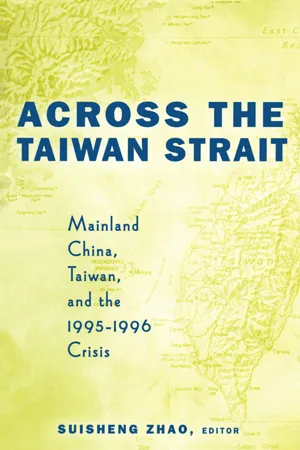
The 1995-1996 Taiwan Strait Crisis caused the largest naval movement by the United States in the Asia-Pacific since the Vietnam War. Using this crisis as a starting point, Across the Taiwan Strait takes an in-depth look at the relationship between mainland China and Taiwan. The contributors examine the causes of conflict and explore ways to prevent future tension from deteriorating into war. The political economy of Taiwan's mainland policy, the politics of mainland China's Taiwan policy, and the implications for U.S. security policy are also explored.
Information
MAKING SENSE OF BEIJING’S TAIWAN POLICY
SUCCESSION POLITICS AND NATIONAL REUNIFICATION
3
CHANGING LEADERSHIP CONSENSUS
THE DOMESTIC CONTEXT OF WAR GAMES
For two weeks in March 1996 the Taiwan Strait became the hottest spot in Asia: the loudspeakers in Taipei streets were accompanied by China’s live-fire exercises nearby; the United States assembled the largest naval presence close to the strait since the Vietnam War; the world talked uneasily about the possibility of a confrontation between China and the United States with Taiwan sandwiched in between. In the end nothing really happened, but each side claimed victory. Now people ask, “Taiwan Strait crisis, what crisis?”1 Looking back, the whole event seems to have been unwanted in the first place. But why the war games? This chapter is an attempt to analyze the domestic factors that propelled China to put on such a dramatic show.
Shifting Focus in China’s Leadership Consensus
Many Western journalists and China specialists believe China’s hard line on Lee Teng-hui had a lot to do with its domestic politics. They argue that members in the Politburo Standing Committee (PSC) were competing with each other to appear hawkish toward Taiwan at the final stage of power transfer from Deng Xiaoping. Jiang Zemin was criticized by his colleagues for his softness, which reportedly encouraged Lee to embark on a dangerous path.2 While there is some truth in this claim, it exaggerates the divisiveness of the Taiwan issue in Chinese elite politics. On the contrary, Taiwan in strife for independence was a factor helping the top Chinese civilian and military leaders to agree to a common response, rather than dividing them.
China’s post-Mao Taiwan policy was set by Deng in 1979 and has been quite consistent ever since. It is one policy of reunification built upon two opposing foundations: peaceful method and military means. Deng’s policy differed from the previous one in the Mao era in that Deng gave a prominent place to peaceful solutions. Instead of Liberating Taiwan, a popular slogan under Mao, he proposed the formula of “one country, two systems” as the way to resolve the Taiwan problem.3 In the next decade, a policy of peaceful overtures was the basis of leadership consensus guiding China’s efforts to get closer to Taiwan. This culminated in Jiang’s eight-point principle promulgated in February 1995. However, one cannot overlook the other key component of this guiding principle set by Deng and Jiang: military pressure must be employed if Taiwan refuses unification. The basic understanding is that without a level of coercion, the olive-branch option cannot produce the desired results. Indeed, even when the tune of peace was being played at high volume, the PLA never dropped hawkish vocabulary against Taiwan. This has been the job assigned to it under a general consensus. In the reunification game, some people play “white face,” while others play “black face.”4 In a way this transmits conflicting signals to outsiders. Yet it is simplistic to think that some leaders really prefer soft policies and others the opposite. Personal propensity does influence one’s stance. Some leaders may indeed have appeared more worldly than others. However, moderate approaches are conditioned on a belief that the Taiwan leadership is committed to one-China principle. At issue is the question of national sovereignty, which leaves little room for vacillation.
The missile test in July 1995 marked a turning point, because the PRC leadership shifted its reunification policy from peace inducement to threats of force. Although it has not given up the goal of eventual reunification through negotiations, emphasis on military deterrence thus seems to have gained more currency. Whether or not this shift is a temporary, calculated overreaction or long-term remains unclear. Given the rising influence of pro-independence forces across the strait, China’s hard-line reaction will probably hold central stage in its Taiwan policy for some time, although the message of peace will continue to be sent as well. Indeed, how to prevent something dramatic from happening is currently the single most important goal of the Chinese leadership.
There exists a broad consensus among Chinese leaders concerning how to achieve reunification, peaceful if possible, by force if necessary. They share a similar stance toward the trend to independence in Taiwan. Their rhetoric may shift from conciliatory to hard-line, depending more on the evolution of situations across the strait than on the domestic leadership lineup. There is no doubt that through talking tough, individual leaders may obtain support from key political allies, namely, the PLA. However, their hard-line attitudes toward Taiwan are meant not as much to jockey for a better position in the post-Deng power struggle as to maintain a leadership consensus that has always been in place. After all, most third-generation Chinese leaders are fundamentally nationalist. Some of them maybe even more so than their predecessors who at least had personal contact with KMT elders. For instance, Li Ruihuan is widely regarded as a reform-minded liberal. Yet he is the person who often voices the most hawkish comments on Hong Kong and Taiwan. In order to understand this consensus shift more clearly, it is useful to review the evolution in which this change took place.
Deng’s peace offensive toward Taiwan was meant to help China shift from politics in command to economics in command at home. Fast economic development was premised on a stable international environment. Reducing tension across the strait was part of the post-Mao leadership’s endeavor to construct such an environment. In other words, peaceful overtures toward Taipei were consistent with Deng’s foreign-policy guideline, which emphasized a nonconfrontational approach toward the West and good relations with China’s neighbors.5 A smooth relationship with the United States, for example, was assisted by China’s preference for peaceful resolution of the Taiwan issue, as seen in the Sino-U.S. Communiqué of August 17, 1982. Although erratic actions were taken from time to time, they were most often responses to what China perceived as serious violations of its national sovereignty and interest. On the whole China adopted a low-profile foreign-policy posture in order to buy time for China’s economic takeoff and military upgrading. This was vividly reflected by Deng’s twenty-eight-character foreign policy guidelines.6
As far as Taiwan was concerned, Deng’s peaceful inducement was a sophisticated policy based on a realization that hard-line policy only further alienated the Taiwanese. Certainly a hard-line would only reinforce Taipei’s no-contact policy and allow the two sides to drift further apart. The mainland-born KMT elders would soon have to pass political power onto younger leaders whose commitment to reunification was dubious at best. A matter of now or never, Deng ordered the PLA to cease artillery barrages at Jingmen and Mazu, two Taiwan-held islands off China’s coast; he welcomed Taiwan investment in the mainland by offering more preferential conditions to Taiwanese investors than to invest from other foreign countries; and he pressed for direct communications across the strait in the form of santong (postal service, transportation, and trade). With his “one country, two systems” formula, Deng promised to let Taiwan maintain its government and armed forces. He even went as far as calling for reunification, but not under the flag of the People’s Republic of China.7
China’s younger leaders had continued Deng’s “carrot” policy. In April 1993 two senior officials from both sides held the first high-level meeting in a third country (Singapore). A logical development from this seemed to be a cross-strait summit. The trend of mutual economic penetration gathered momentum. Increased contacts at the people-to-people level ameliorated historical animosity. It became an internationally acknowledged fact that tensions across the strait visibly eased. These developments led up to Jiang’s eight-point proposal in his first major Taiwan speech on January 30, 1995. The timing of the speech—during Spring Festival—was indicative of a desire for national reunification, as this traditional national holiday is devoted to family reunion. In this speech Jiang visualized what Deng had failed to specify in his often too-broad comments. For instance, Jiang assured protection of Taiwan investment, sanctioned Taiwan’s economic and cultural interaction with the world, and for the first time called for an equal bilateral consultation, including a summit dialogue. By using the word equal, Jiang avoided the sensitive issue of central/provincial government, which was China’s longtime emphasis. Prominent was the point: Chinese will not fight Chinese. Its underlying meaning corresponded to the relationship between peaceful and military solutions. China acquiesced in the status quo based on the one-China principle: if Taiwan did not declare independence, then there would be no war. This was one step further in the fulfillment of China’s pledge not to use military force as long as Lee Teng-hui continued to proclaim that independence was not his goal.
Jiang’s peace initiative may have demonstrated a higher level of sophistication and flexibility toward Taiwan. He was advised that there had been subtle changes in the mind-set of the majority of the Taiwan people, who now saw the status quo as in their best interest. Under the status quo they pursued more international recognition while stopping short of supporting de jure independence for fear of China’s military attack and lost business opportunities. For China this meant that overtly isolating Taiwan internationally only bred pro-independence sentiment among the people who still entertained feelings of attachment to the mainland. China’s interest would be best served if they did not move away from this status quo mentality, the precondition for combating independence. To this end, China believed that it had to allow a carefully measured latitude for Taiwan to engage in international affairs.8 In order to allow the “carrot” approach to work, it was necessary to deemphasize the policy of “stick” to some extent, as excessive military threat could only cause a backlash. Here China had to keep a delicate balance to ensure that the level of pressure was appropriate; to renounce the use of force required a high level of confidence.
The sources of Jiang’s confidence originated in the leadership’s calculation that China’s huge market and profound cultural influence would exert enough magnetic attraction to draw many Taiwanese toward the mainland. Over time, deepened economic interaction, cultural exchanges, and people-to-people contacts would sway the status quo in favor of China. This option was not available before Taiwan’s democratization, which made it impossible for the government to close the island to the mainland but could produce a better payoff than military threats.9 China’s huge market promises giant profits to Taiwan businessmen who have poured billions of dollars across the strait. Hence a new interest structure has emerged in Taiwan, acting to prohibit the slide toward independence.10 Indeed without the Chinese market, which has absorbed a large share of Taiwan’s labor-intensive industries, Taiwan’s industrial restructuring would have encountered more difficulties. Moreover, without $20 billion trade surplus with China each year, Taiwan would have registered negative trade growth.11 As the second-largest export market for Taiwan, China’s economic value has tremendous political implications. China has so far tolerated this large sum of trade deficits with Taiwan largely for reunification purposes, a strategy that has worked well.12 Those who have to decide on independence have to consider how the business sector responds, given that sector’s investment of more than $25 billion in China. According to a recent survey of Taiwan’s capitalists conducted by Taiwan Industrial Association, 70.8 percent of the respondents expressed worries about the worsening relations with the mainland.13 Pressure from them may have contributed to Lee Teng-hui’s conciliatory remarks to China immediately after the election.14
All this had been well planned and was progressing until Lee consolidated his power and vigorously pushed his Taiwanization policy at home and his pragmatic policy abroad. With his U.S. visit came the turning point, when Beijing shifted its foundation of consensus from inducement to pressure. The Taiwan authorities had been fully aware of the danger of increased unofficial contact across the strait. Taiwan’s economy began to show a measure of dependence on China. At the same time China’s fast-growing economic power eroded the economic foundation of Lee’s flexible diplomacy.15 His countermeasures were to strive to widen Taiwan’s living space in the world and raise its international profile. Both resonated the wishes of the Taiwan people. However, Lee’s policy directly clashed with China’s efforts to limit Taiwan’s global presence. It was logical for China to believe that there was an intimate connection between Taiwan’s greater weight in world affairs and its movement toward independence. Yet Beijing had not anticipated major breakthroughs in Taiwan’s money diplomacy whose gains in this regard were moderate. After all it was hard to equate a holiday visit to a state visit. Frustration of the Taiwanese began to show over the slow progress in Taiwan’s outward stretches. As pointed out by Ralph Clough, public attention tended to be focused, not on these small successes over China but on those cases in which the ROC achieved a breakthrough by establishing diplomatic relations with a major country or becoming a member of an international organization.16 That breakthrough finally arrived when Lee was allowed to make a speech at Cornell University in June 1995.
In fact China’s search for a new Taiwan policy had been conducted for some time, since Lee’s emotional burst out after the Thousand Islands Lake incident in May 1993 and his interview with Ryotaro Shiba, a Japanese writer, in 1994. Lee’s U.S. visit finally convinced Beijing that Deng’s soft-soft approach was no longer enough for the goal of reunification in the face of Lee’s covert but determined agenda. Immediately after Lee’s U.S. visit the Chinese leadership made a U-turn in its Taiwan policy. While efforts to attract Taiwan money were continued at the business level, conciliatory overtures were replaced for some time by name-calling attacks at the political level. Military preparation was readjusted for a possible confrontation across the strait.17 Beijing’s frustrations over fifteen years of wasted hardwork were expressed in a most telling way.
Why was Lee’s U.S. visit treated so seriously? According to a senior cadre in the Research Institute of Taiwan Affairs, Chinese Academy of Social Sciences, his visit was seen as proof of a qualitative change in his Taidu (independence) efforts. Before the visit he may have been drawing some blueprint for independence. Now he was doing the real thing. Upon arriving in North America, he genuinely embarked on the road of independence.18 As a result, the mainland had to battle both the KMT, with which it once hoped to cooperate in the joint cause of reunification, and the DDP, which was calling for immediate independence.
China was furious at the United States because it reasoned that without U.S. help, it was impossible for Taiwan to achieve any real ga...
Table of contents
- Cover
- Title Page
- Copyright Page
- Dedication
- CONTENTS
- NOTE ON ROMANIZATION
- FOREWORD
- LIST OF ABBREVIATIONS
- INTRODUCTION
- Overview
- Making Sense of Beijing’s Taiwan Policy
- Making Sense of Taipei’s Mainland Policy
- Lessons from the Crisis
- ABOUT THE EDITOR AND CONTRIBUTORS
- INDEX
Trusted by 375,005 students
Access to over 1.5 million titles for a fair monthly price.
Study more efficiently using our study tools.
Frequently asked questions
Yes, you can cancel anytime from the Subscription tab in your account settings on the Perlego website. Your subscription will stay active until the end of your current billing period. Learn how to cancel your subscription
No, books cannot be downloaded as external files, such as PDFs, for use outside of Perlego. However, you can download books within the Perlego app for offline reading on mobile or tablet. Learn how to download books offline
Perlego offers two plans: Essential and Complete
- Essential is ideal for learners and professionals who enjoy exploring a wide range of subjects. Access the Essential Library with 800,000+ trusted titles and best-sellers across business, personal growth, and the humanities. Includes unlimited reading time and Standard Read Aloud voice.
- Complete: Perfect for advanced learners and researchers needing full, unrestricted access. Unlock 1.5M+ books across hundreds of subjects, including academic and specialized titles. The Complete Plan also includes advanced features like Premium Read Aloud and Research Assistant.
We are an online textbook subscription service, where you can get access to an entire online library for less than the price of a single book per month. With over 1.5 million books across 990+ topics, we’ve got you covered! Learn about our mission
Look out for the read-aloud symbol on your next book to see if you can listen to it. The read-aloud tool reads text aloud for you, highlighting the text as it is being read. You can pause it, speed it up and slow it down. Learn more about Read Aloud
Yes! You can use the Perlego app on both iOS and Android devices to read anytime, anywhere — even offline. Perfect for commutes or when you’re on the go.
Please note we cannot support devices running on iOS 13 and Android 7 or earlier. Learn more about using the app
Please note we cannot support devices running on iOS 13 and Android 7 or earlier. Learn more about using the app
Yes, you can access Across the Taiwan Strait by Suisheng Zhao in PDF and/or ePUB format, as well as other popular books in Politics & International Relations & Political Economy. We have over 1.5 million books available in our catalogue for you to explore.