- 496 pages
- English
- ePUB (mobile friendly)
- Available on iOS & Android
eBook - ePub
About this book
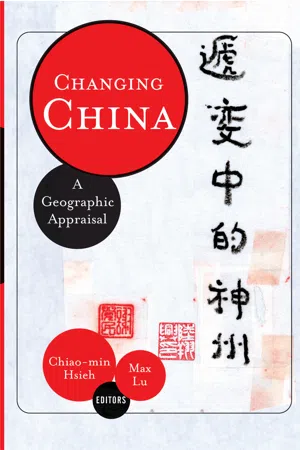
"This textbook will be welcomed by professors and students who have been long looking for an appropriate textbook for teaching and studying the changing geography of post-reform China." —Hongmian Gong, Hunter College, CUNY "A wonderful collection of current source data. The range of bibliographic material in these pages is great." —Kit Salter, University of Missouri, Columbia Changing China: A Geographic Appraisal provides an up-to-date and detailed account of the giant country that is undergoing an unparalleled and historic transition from a centralized command economy to a market-based economy, and from a rural, agricultural society to an urban, industrial power. Contributions from a distinguished team of geographers both inside and outside of China are divided into three parts that assess, respectively, economic changes since the reform of 1978, recent social transformations, and changes along China's peripheries including Hong Kong, Taiwan, Xinjiang, and inner Mongolia. An introductory chapter provides an overview of major themes. Includes a chronology of major events in Chinese history and a glossary of Chinese terms.
Information
1
Introduction: The Changing Geographies of China
Max Lu
In 1978, the Chinese government launched its ambitious economic reform and opened the country to the outside world after nearly thirty years of rigid, Soviet-style development. The reform started in the countryside as a way of tackling the chronic low productivity and incentive problems that plagued Chinese agriculture. Following a remarkable vsuccess in rural reforms, the government began to introduce market principles into the industrial sector. It encouraged the growth of private enterprises and established special economic zones (SEZs) and open cities along the coast, in which tax and other incentives are provided to attract foreign investment and technological know-how. Although punctuated by such political events as the military crackdown of the 1989 pro-democracy movement, the economic reform and open-door policy have been a great success.
A quarter century has passed since the reform started. China has undergone a profound metamorphosis that is unmatched in its long history. Its sustained fast economic growth, burgeoning market economy, expanding private sector, rural industrialization, unprecedented interregional migration, and increasing links between the Chinese economy and the world economy are all reshaping the landscape of this fascinating and complex giant. For the first time in the People's Republic, the private sector has become the most vital part of the economy, producing a significant portion of the country's GDP and creating new jobs. The sizable middle class that emerged after the reform is growing. The vast majority of the Chinese are getting a chance to savor freedom in their lives and work. With their newly found wealth, many are purchasing color televisions, washers, computers, cellular phones, even cars and homes—things they would not have even dreamed of not long ago. Millions of Chinese are also surfing on the Internet. The open-door policy has brought the Chinese people closer to the world. They pack the McDonalds, the Pizza Huts, the Ikea warehouse stores, the Putt Putt miniature golf courses, and Western-style nightclubs. They wear stylish clothes just as people in Paris or New York do. The glitzy shopping centers in many cities sell everything from the latest Celine Dion albums to expensive designer clothes and other luxuries. For better or worse, the youth of China are as familiar with Janet Jackson, Mariah Carey, Eminem, and Britney Spears as their counterparts in the West. New skylines have, emerged in many Chinese cities as old, crumbling buildings give way to skyscrapers. Even as Japan sinks further into recession and Southeast Asian countries continue to struggle following the July 1997 currency crisis in Thailand, China remains an oasis of prosperity, with an annual growth rate of around 8 percent. As the twenty-first century unfolds, China's emergence as an economic superpower has implications not only for the Asia-Pacific realm but also for the world.
The reform and the open-door policy have also significantly altered the spatial pattern of China's economy. The coastal area has enjoyed a disproportionate share of domestic and foreign investment and rapid economic growth; the special economic zones and other types of open areas located mainly along the coast have become new centers of growth and trade. Coastal cities like Shenzhen, Shanghai, and Guangdong set the pace for the rest of the country. With the pre-reform balanced development strategy giving way to one that emphasizes efficiency, the coastal area of the country has benefited from the reform far more than the interior has. The regional disparity between the coast and the inland has widened substantially.
China has changed, and continues to change, rapidly. Understanding the changes that are occurring in China is important not only because of the sheer size of the country but also because of the expand ing role China plays in various world affairs. This book documents, examines, and explains the changes that have taken place in China since the reform from a geographic perspective. As a science of space and place, geography provides a unique perspective for unraveling the forces behind the changes. Such knowledge helps to shed light on the future course China may take. The book focuses particularly on the themes and issues that have exerted and will likely continue to exert a significant impact on Chinas economy and society. The topics include, for example, land-use patterns and land-use change, agricultural growth and food security, rural surplus labor transfer, foreign investment distribution, industrialization, changing regional development patterns, migration, village transformation, large city expansion, ethnic diversity, and the future of Hong Kong, Taiwan, and China's minority areas. Although there are many other books on China's reform, economy, and politics, this book represents the first attempt to discuss the wide range of issues concerning contemporary China in a single volume.
In addition to this introductory chapter and an epilogue, the main body of the book consists of twenty-four chapters, which are organized into three sections. The first section, with ten chapters, focuses on various aspects of economic changes. The second section contains eight chapters about social changes. Six chapters form the third and final section, which discusses changes along China's periphery. The rest of this introduction provides an overview of the chapters in this volume. The overview is organized around the section themes.
Economic Changes
Part I addresses a number of very important economic issues in post-reform China. The first four chapters complement each other very well because they deal with different aspects of agricultural and rural development. Liping Di (Chapter 2) focuses his study on the types, determinants, patterns, and implications of land-use change in China. He states that although Chinas land-use patterns are the result of long-term actions of both natural and human forces on the land surface, human forces dominate current land-use change in China. He discusses the major types of land-use change since the reform, such as the conversion of farmland to urban and industrial use, the shift from growing grain to growing cash crops, farmland abandonment due to both the high opportunity cost of farming and industrialization, land reclamation, deforestation and reforestation, and desertification. The conversion of farmland to nonfarm uses is a key land-use change. The loss of prime farmland is particularly substantial in Chinas coastal provinces. Di also discusses the implications of farmland depletion and other land-use changes for China's food production and environment.
Clifton Pannell and Runsheng Yin (Chapter 3) address more specifically the problem of diminishing cropland. They argue that rapid farmland conversion to urban and industrial uses is putting a strain on China's grain production capability. The problem is particularly serious in densely populated coastal areas. However, the losses there are somewhat offset by gains in interior provinces, where limited economic opportunities offer more incentives for farming. Location and environmental characteristics, such as erosion and water Supply, are significant determinants of cropland loss. Pannell and Yin point out that while conflicting data and unreliable statistics make an accurate assessment of farmland supply difficult, the situation may not be as serious as previously claimed, since recent studies indicate Chinas overall stock of cultivated land is greater than officially reported.
Although Di, Pannell, and Yin are all concerned with China's agricultural growth and food production in their studies, Jianfa Shen (Chapter 4) tackles the issue headon. The debate over whether China will be able to feed itself unfolded soon after the publication of Lester Brown's 1995 book Who Will Feed China? Shen contributes to this ongoing debate by assessing China's future food security and the need for grain imports based on a demand and supply framework. He analyzes changes in national and regional grain production during 1990—1995 by examining four production factors: changes in the supply of arable land, the cropping index, the proportion of cropland for grain production, and grain yield per hectare. His analysis shows that major gains in grain output have come from increases in grain yield per capita and that major losses have resulted from the conversion of cropland to nongrain crops rather than from a decline in the amount of arable land. Changes in grain production differ among regions. Grain production dropped in eleven provinces between 1990 and 1995 because of diminished arable land, smaller proportion of cropland devoted to grain production, or decline in grain yield. Shen's simulations indicate that estimates of the amount of grain China will need to import from the world market in the future are very much dependent upon what assumptions one uses about per-capita grain consumption, yield, and proportion of cropland used for grain production. However, further boosts in yield are considered essential to securing sufficient grain supply for China's ever expanding population.
Sun Sheng Han (Chapter 5) deals with another very important issue in China: agricultural surplus labor transfer. Although rural labor surplus has always existed, economic reform brought the issue to the fore. By some estimates, the surplus amounts to about 250 million people. Han examines the concepts, characteristics, and impacts of agricultural surplus labor. He argues that the surplus labor has generated an active force toward the formation of innovative development policies. Whereas previous policy attempted to prevent the exodus of rural surplus labor, farmers are now allowed to settle in small towns and cities. Innovative policies have been devised to turn the surplus labor into a positive force that promotes rural industrialization and regional economic growth. The skills and remittances that rural migrants bring back to their hometowns are giving many poor areas a leg up in their attempt to spur economic development. Han also examines the problems related to rural labor transfer, such as the increased crime rates in cities, the feminization of the agricultural labor force due to the gender selectivity of rural out-migration, and the widespread environmental pollution caused by geographically dispersed rural industries. Appropriate government policies are therefore critically important in mitigating the negative effects while maximizing the benefits of rural surplus labor transfer.
The next two chapters deal with the changes in Chinas space economy since the initiation of economic reform. In Chapter 6, Dadao Lu documents the changes both in Chinas industrial development policies and in spatial patterns of development since the founding of the Peoples Republic in 1949. His discussion is organized around Chinas Five-Year Plans (FYPs) and based on a framework that includes three major points. First, industrial development was inward-looking and domestic resource-based in the pre-reform years but has moved toward globalization since the early 1980s. Second, the emphasis in industrial development has shifted from heavy industry to production of consumer goods and, more recently, to high-tech industry. Third, the planned economy has been gradually replaced by a market-oriented system. After the reform, industrial structure and spatial patterns have been shaped mainly by market forces. The regional disparity of industrial development, though mitigated to some extent in the three decades prior to the reform, remains substantial.
Max Lu (Chapter 7) further examines the recent changes in China's regional development patterns. He posits that two opposing forces are shaping the changes. One is the search for faster economic growth by local governments through developing industries with comparative advantages, which leads to regional specialization. The other is the regional imitation behavior prevalent in local governments' decision-making, which breeds homogenization of regional industrial structures. Empirical analysis of the employment data based on dissimilarity measures indicates that although the economic structure of most provinces is still very similar to that of the rest of the country, specialization has grown during the post-reform period. The author also argues that Chinas space economy may be experiencing an axial shift. The dominant role of the Yangtze River Delta as a traditional hinge region of China has been eroded to some extent by fast-growing South China, particularly Guangdong province. With the rise of South China, the return of Hong Kong to Chinese rule in July 1997, and the completion of the Beijing-Kowloon Railway, a north-south axis is emerging as the dominant economic flow, surpassing the traditional east-west one led by Shanghai. Nonetheless, the area surrounding Shanghai and the Yangtze River Delta, is likely to remain an important economic region of China.
The future role of the Yangtze River Delta area in China's space economy is explored by Mei-e Ren (Chapter 8). Ren argues that to achieve sustainable development in the region, four important issues must be addressed. They include the establishment of the Shanghai International Shipping Center, the readjustment of agriculture in response to increasing population and diminishing farmland, industrial restructuring, and environmental problems. He discusses the challenges facing the region's future.
Establishing various kinds of special zones seems to have become the method by which China furthers its reforms. Following the establishment of the special economic zones (SEZs) shortly after the inception of the reform, numerous economic and technological development zones have sprouted up all over China. These zones have already generated and will continue to generate profound impacts on China's regional economic development. In Chapter 9, Shuguang Wang examines the Chinese experience with the relatively recent incarnation of the SEZs—the New and High Technology Industrial Development Zones (NHTIDZs). These zones are designed to promote development of new products and industries supported by China's own scientific and high-tech capabilities and are modeled after technology parks or science cities in various Western countries such as the United States, Britain, and Japan. The influence of Northern California's Silicon Valley and Boston's Route 128 in the United States and the M4 Corridor in Britain has been especially significant. The NHTIDZs were designed to serve as new growth poles, spurring regional economic growth. Wang's analysis shows that remarkable achievements have indeed been made in those zones.
One objective of China's new development strategy is to attract foreign investment (including capital from Hong Kong and Taiwan) and technological know how to support its modernization drive. To that end, China set up special economic zones and devised many preferential policies. This strategy has been vastly successful. China has become the world's second largest recipient country of foreign direct investments just after the United States, In 2002, China received $50 billion in foreign investment, more than any other country. Chi Kin Leung (Chapter 10) examines the factors that determine the locational choices of foreign investors and how the foreign capital inflow has affected regional economic development. Using North China's coastal region as a case study, Leung has analyzed both the provincial investment data and the information collected from 2,417 foreign ventures in the region. He first details the locational and sectoral composition of the foreign direct investment (FDI) with respect to three types of regions: city proper and inner suburb, outer suburb, and county-level units. He then discusses the factors underlying the spatial and sectoral patterns of FDI and its local economic impact.
China's economic reform and open-door policy have not only attracted an enormous amount of foreign (including Hong Kong and Taiwan) investment but also significantly increased China's foreign trade. China is now the world's tenth largest exporter, with its exports in 2002 reaching $294 billion. Trade has transformed China from a virtually closed economy to a major participant in the international market. China's emergence as a major trading nation will have a tremendous impact on the rest of the world. In Chapter 11, Gang Xu discusses the characteristics of China's foreign trade and exchange regimes and the changevS in trade balance and commodity composition since the reform, with special attention to China's trade links with countries in the Pacific Rim region. He argues that China's rapid rise to the ranks of the world's major trading powers is attributed to its export-oriented coastal development strategy. Xu analyzes the circumstances under which China launched the new development strategy and its success in drawing foreign direct investment to spur industrialization. The rapid economic growth in the coastal area strengthened China's trade links with Hong Kong and Taiwan, so much so that Xu believes a new Chinese Economic Zone is emerging.
By 1997, China had enjoyed two decades of almost uninterrupted double-digit economic growth. This remarkable economic performance alone made China the envy of the world. However, the lingering Asian financial crisis in the late 1990s was the true test of Chinese economy's capability to absorb external shocks and move ahead. The challenge to China's economy has been complicated by Japan's major economic slump in the 1990s, its first since World War II. Up until the end of 2002, China seemed immune to the severe "Asian financial flu." Its economy appeared to be growing at a healthy annual rate of 7-8 percent. Xu attributes China's resilience in the midst of the widespread Asian financial crisis to its persistent trade surpluses in recent years, substantial growth in FDI inflows, huge buildup of its foreign exchange reserve, which, at the end of 2002 had grown to $286 billion, or the second largest in the world, and last but not the least, the small proportion of foreign capital inflows devoted to portfolio investment in China. Portfolio investment, whose investors tend to take flight at the first sign of economic trouble, is widely believed to be the major cause of the recent Asian crisis.
Social Changes
The various social changes taking place in China are the focus of Part II of this book. The topics explored include population growth and characteristics, ethnic diversity, migration, gender, growth and management of large cities, suburbanization, and village transformation. In Chapter 12, Chiao-min Hsieh examines the shifts in China's population and composition over the past fifty years based on data from the five Chinese censuses conducted in 1953, 1964, 1982, 1990, and 2000. After comparing the five censuses and investigating patterns of population density and redistribution revealed in the 1990 census, he discusses China's population problem and population policies, which have changed from advocating large families to encouraging family planning. After 1979, the government began to enforce a policy of one child families, a practice that has caused several social problems such as aging. Hsieh maintains that population control will be difficult, but China has no choice but to attempt to curb its rapid population growth.
Also using the Chinese census data, David Wong and Kevin Matthews (Chapter 13) examine the spatial dimensions of minority groups in China between 1980 and 1990. Several segregation and diversity measures are used to study the changing geographical dimensions of ethnic mixes at the national and provincial levels. Their study confirms earlier evidence of a massive reclassification of ethnic identity among minority populations. Although reclassification created dramatic increases in population size of some minority groups, they are still very small compared to the Han majority. The rising growth rates among minority groups have tended to alter the regional ethnic mixes, but the degree of change is dependent upon the scale of analysis. The population increases registered by many minorities have only slightly changed the national levels of segregation and diversity due to the relatively small size of most minority groups, but moderate changes were detected at the local level. In provinces such as Inner Mongolia (Neimenggu), Liaoning, and Sichuan, where the control over the growth of minority population had previously been rather tight, the minority's share in the total population has been rising.
The rapid structural changes in the Chinese economy, particularly its transition to a market economy, have resulted in a dramatic rise in population mobility. Chinas State Statistics Bureau estimated the number of internal migrants in 2002 at more than 120 million. With 73 percent of the migrants originating in rural areas, there is no doubt that China is experiencing a mass rural population exodus, much like ma...
Table of contents
- Cover
- Half Title
- Title
- Copyright
- Contents
- Editors and Contributors
- Preface
- Acknowledgments
- Administrative Map of China
- 1 Introduction: The Changing Geographies of China
- Part One Economic Changes
- Part Two Social Changes
- Part Three Changes Along China's Periphery
- Chronology of Events
- Glossary
- Index
Trusted by 375,005 students
Access to over 1.5 million titles for a fair monthly price.
Study more efficiently using our study tools.
Frequently asked questions
Yes, you can cancel anytime from the Subscription tab in your account settings on the Perlego website. Your subscription will stay active until the end of your current billing period. Learn how to cancel your subscription
No, books cannot be downloaded as external files, such as PDFs, for use outside of Perlego. However, you can download books within the Perlego app for offline reading on mobile or tablet. Learn how to download books offline
Perlego offers two plans: Essential and Complete
- Essential is ideal for learners and professionals who enjoy exploring a wide range of subjects. Access the Essential Library with 800,000+ trusted titles and best-sellers across business, personal growth, and the humanities. Includes unlimited reading time and Standard Read Aloud voice.
- Complete: Perfect for advanced learners and researchers needing full, unrestricted access. Unlock 1.5M+ books across hundreds of subjects, including academic and specialized titles. The Complete Plan also includes advanced features like Premium Read Aloud and Research Assistant.
We are an online textbook subscription service, where you can get access to an entire online library for less than the price of a single book per month. With over 1.5 million books across 990+ topics, we’ve got you covered! Learn about our mission
Look out for the read-aloud symbol on your next book to see if you can listen to it. The read-aloud tool reads text aloud for you, highlighting the text as it is being read. You can pause it, speed it up and slow it down. Learn more about Read Aloud
Yes! You can use the Perlego app on both iOS and Android devices to read anytime, anywhere — even offline. Perfect for commutes or when you’re on the go.
Please note we cannot support devices running on iOS 13 and Android 7 or earlier. Learn more about using the app
Please note we cannot support devices running on iOS 13 and Android 7 or earlier. Learn more about using the app
Yes, you can access Changing China by Chiao-min "Jimmy" Hsieh,Max Lu in PDF and/or ePUB format, as well as other popular books in Social Sciences & Asian Politics. We have over 1.5 million books available in our catalogue for you to explore.