eBook - ePub
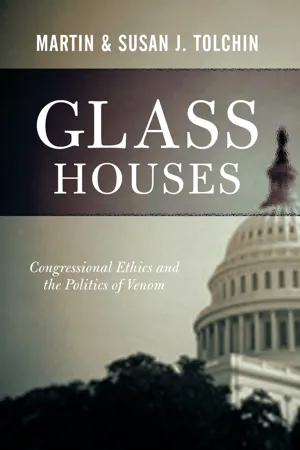
Glass Houses
Congressional Ethics And The Politics Of Venom
- 216 pages
- English
- ePUB (mobile friendly)
- Available on iOS & Android
eBook - ePub
Glass Houses
Congressional Ethics And The Politics Of Venom
About this book
The Congressional ethics process has been transformed into a lethal, partisan political tool, feared by lawmakers from both sides of the aisle. . Newt Gingrich, the Ghengis Khan of recent American politics, wrenched the humdrum Congressional ethics process out of its lethargy and turned it into an offensive tool for partisan gain. Now, instead of yawning, lawmakers quake at the thought of an ethics inquiry that can easily, often unfairly, tip elections and ruin careers. While members of the House and Senate confront the public's changing attitudes toward money, sex, and power, they are also forced to raise ever-escalating sums to finance their campaigns. Practices tolerated a decade ago now may cost lawmakers their seats or land them in jail. Lawmakers often don't know if they live in Salem or Gomorrah. Using new information culled from dozens of Capitol Hill interviews, Sue and Marty Tolchin show how ethics in Washington have changed over two centuries while offering new interpretations of past ethics cases. The first book to analyse the politicization of the ethics process, Glass Houses reveals in wicked and telling detail the forces that drive the modern lawmaker into a maelstrom of fierce corruption battles.
Information
1
The Ethics Wars
"The system was always political.
It was always a political weapon."
It was always a political weapon."
—Stan Brand, former counsel to the chief clerk of the House of Representatives
The Gingrich Era
He was an unlikely revolutionary, a former history professor, often unkempt, with an unruly shock of white hair across his forehead. A dedicated conservative, intense and articulate, he sought the limelight by hurling charges at his foes. In a losing campaign for Congress in 1974, he stood outside a Georgia prison and, borrowing from Mark Twain, characterized members of Congress as a bunch of "criminals."1
Elected to Congress on his third try in 1978, Newt Gingrich brought his own special spirit of combativeness to Washington. He used all available means, especially the ethics process, to lead what would become known as the Republican Revolution of 1994. But Gingrich's ethics crusade involved more than just personalities or ambition; it included a policy thrust as well. His vision was key to his scorched earth strategy that wrested control of the chamber from the Democrats and installed a conservative agenda, known as the "Contract with America," which made Congress subject to the same laws it enacted for the rest of the country. Gingrich climbed to the pinnacle of power as the first Republican Speaker in forty years. In the course of his ascent, Gingrich unleashed forces that toppled a Democratic Speaker, destroyed several careers, and ultimately claimed him as a victim.
"Ethics was not political until Gingrich," reflected Rep. Barney Frank, a brilliant, cantankerous ultraliberal Massachusetts Democrat who was himself a victim of Gingrich's vendettas. "He invented the politics of venom. Newt saw that Republicans could only take power by demonizing Democrats.... The Democrats responded in kind. Gingrich told Republicans to treat Democrats as'corrupt.'"
In fact, the ethics process always had political overtones, but Gingrich took it to new heights. The ensuing frenzy of charges and countercharges helped explain why the public's opinion of Congress plummeted at the turn of the new century. It was Congress itself that repeatedly diverted attention from substantive issues to focus on the foibles and follies of its own members, sometimes exacting draconian penalties that seemed far in excess of what they deserved. On the other hand, few would disagree that members of Congress should be held to the highest ethical standards, lest their lapses corrupt the legislative process and the very fabric of our democracy.
0To Gingrich, the ethics process was a long-neglected political weapon, as well as a legitimate one. Gingrich was appalled by the extent to which collegiality led lawmakers to ignore flagrantly unethical conduct. "It always fascinated me that when I got there, the basic attitude was, 'Unless it was a public relations nightmare, you didn't deal with it,"' Gingrich recalled in a recent interview. Although Congress has the sole authority to discipline its own members, that power had been used so sparingly that some critics, including Gingrich, felt that there were virtually no limits on a lawmakers behavior.
What bothered Gingrich initially was the long-time practice of allowing convicted felons to enjoy the full privileges of the House while their cases were on appeal. Gingrich immediately targeted Rep. Charles Diggs (D-Mich.), a dour Detroit undertaker who was convicted in 1978 on twenty-nine felony counts involving the diversion of congressional employees' salaries to his personal use. "I said if he voted," recalled Gingrich, "I would move to expel him. Now, members can't vote after their convictions while their appeals are pending."
Despite Gingrich's efforts, which included leading a Republican motion to expel Diggs, House members dropped their investigation following Diggs's admission of guilt and applied the lesser sanction of censure. Even a censure vote would never have occurred without Gingrich's initiative because Democrats as well as Republicans typically preferred to cover up their colleagues' problems until forced to act. Diggs was the first representative censured since 1921.
Several years later, in 1982, Congress and Gingrich confronted a massive scandal involving congressional pages that finally became impossible to ignore. Two lawmakers—Rep. Dan Crane, a flamboyant Illinois Republican, and Rep. Gerry E. Studds, a studious Massachusetts Democrat—were accused of having sexual relations with teenaged pages. Crane was charged with having an affair with a young woman and Studds with a young man. Democrats said that Gingrich attacked Crane as well as Studds in an effort to appear evenhanded. Crane was defeated for reelection, while Studds was reelected seven times from his district in eastern Massachusetts until he voluntarily retired in 1996. "Ethics problems hurt Republicans at the ballot box far more than they hurt Democrats," Gingrich reflected. "Republicans are perceived as having higher moral standards, as being more upright. With Democrats, voters don't care as long as they [their representatives] are effective."
Gingrich accelerated his campaign to invigorate the congressional ethics process. After Diggs, he attacked Rep. Fernand St Germain, a high-living Rhode Island Democrat and chairman of the House Banking Committee. St Germain was found to have repeatedly violated disclosure provisions of both the House Code and the Ethics in Government Act. But the Ethics Committee concluded that the "identified improprieties do not rise to a level warranting further action by this committee," Gingrich was appalled but not surprised that St Germain received only a mild slap on the wrist from the Democratic-controlled House in 1987.
In his boldest move, Gingrich leveled charges in 1987 against the Speaker of the House, Jim Wright, a Texas Democrat, The tall, red-headed Wright, a decorated combat pilot in World War II, began his career in politics as an unabashed liberal. As mayor of Weatherford, Texas, he had hired Craig Raupe, who lost his teaching job at the University of Texas because he had run afoul of a Red-hunting committee of the state legislature. Wright installed Raupe as director of recreational programs, and Raupe promptly desegregated the town's swimming pools. Elected to the state legislature, Wright was considered that body's most liberal member. When he came to Congress in 1955, Wright maintained his liberal credentials and installed Raupe as his chief of staff. At the same time, however, Wright also wooed the conservative oil, gas, and banking interests that were so powerful in his state.
Wright needed money and devised a scheme that caught Gingrich's attention. In strong headline-grabbing language, Gingrich attacked Wright for privately publishing a book of speeches and memoirs, Reflections of a Public Man, that was purchased in bulk by several of Wright's supporters.2 Since the book's sales netted Wright a sum of approximately $71,000, Wright was charged with using the book to circumvent House restrictions on outside income.
A master of vitriolic rhetoric, Gingrich called Wright a "crook" and the "worst Speaker of the twentieth century." Gingrich went on to accuse Wright of sixty-nine ethics violations, including improperly taking gifts from a real estate developer.3 Gingrich also charged that Wright had lobbied U.S. and Egyptian officials on behalf of the Neptune Oil Company shortly after the company had given Wright the chance to invest in a lucrative gas well. Wright countered that he was merely lobbying on behalf of a constituent, an argument that has been used in many other ethics cases, Wright was also accused of using the book as a campaign fund-raising tool, as well as a vehicle for funneling corporate money into his own pocket.
As the furor mounted, embarrassed Democratic elders finally persuaded Wright to resign. In a long and emotional speech before Congress, Wright predicted that Gingrich would eventually be consumed by his own "mindless cannibalism." In 1998, Gingrich unintentionally closed the loop when he notified Republican leaders of his own resignation: he declared he was not willing to "preside over people who were mindless cannibals."
Gingrich asserted that "Wright had clearly worked explicitly to violate the rules," said he pressed charges against Speaker Wright because "no Democrat was likely to bring those charges." In retrospect, Gingrich admitted Wrights punishment may have been excessive, but he noted that, "Members of his [Wright's] own caucus told him he had to leave. He had caved on a pay raise, and his members were really angry at him."
Wrights resignation emboldened his partisan attackers. "I retired in the mistaken belief that by resigning, I would so shock and shame everybody they would abandon the politics of disparagement," Wright recalled. "I was wrong."
"The poisoning of the well of civil discourse lingers on," he continued. "There's arsenic in the water, even today."
Wright said it cost him $500,000 in legal fees to defend himself against Gingrich's charges. "That nearly busted me," he said, noting that "people not wealthy can't afford a defense."
Ethics occupied a critical role in Gingrich's ambitious plans for himself and for his fellow Republicans. He used the ethics process frequently—some would say relentlessly—to transform it from a sleepy humdrum set of procedures into a real force de frappe feared by lawmakers in both the House and the Senate. The pursuit of ethics also speeded Gingrich's rise from an obscure backbencher to Speaker, helped the Republicans seize Congress from the Democrats for the first time in forty years, and made the new Speaker a national hero and an object of constant media attention. At the time of his stunning victory in 1994, he became one of the most renowned stars of national politics, accompanied everywhere by batteries of cameras and crowds of admirers. His face beamed out from the cover of Time magazine, and even the most trivial of his activities received extensive news coverage.
But the fabled Gingrich was not immune from the forces that he had unleashed. He reinvigorated the ethics process only to find it used against him. As he knew all too well, the ascension to power did not immunize him against partisan attack; on the contrary, it made him more vulnerable. Swollen by his new power, his insensitivity made him an easy target.
The first charges against Gingrich involved a book advance of $4.5 million that he had accepted from a publishing house owned by Rupert Murdoch immediately after becoming Speaker. The ethical problem was obvious to everyone but Gingrich. An international media mogul who owned a chain of newspapers and television stations, Murdoch stood to gain substantially from his relationship with the Speaker. Only after confronting a torrent of negative publicity did Gingrich give up the advance and agree to accept earned royalties instead. In fact, the book proved to be a bestseller although it earned far less than $4.5 million in royalties.
Gingrich contends that the two cases are not comparable even though Wright's $71,000 earnings paled in comparison to Gingrich's $4.5 million advance. Unlike Wright, Gingrich argued, "My books always had regular publishers and were sold in regular bookstores " Gingrich, now a private citizen, compared the furor that greeted his $4.5 million advance with what he regarded as "the silence with which lawmakers and the media have accepted Hillary Clinton's $8 million book advance," negotiated on the eve of her being sworn in as the junior senator from New York in January 2001. "No honest person thinks it is not a double standard," Gingrich declared. In retrospect, Gingrich's accusation against the media's treatment of Senator Clinton did not ring quite true: Persistent criticism of her book advance appeared for at least a month after it was made public; she also withstood—some say ignored—attacks from enemies and supporters alike for the "gift registry" that brought her thousands of dollars worth of china and silverware before January 3, 2001, when Senate ethics rules would take effect.
As payback for his attacks on Wright and other Democrats, Democratic leaders launched a fusillade of charges against Speaker Gingrich. In April 1989, Rep. Bill Alexander of Arkansas, the deputy Democratic whip, filed a 490-count complaint against the Speaker. "The only thing they found I did that was wrong was failure to disclose that I co-signed a loan for my daughter," Gingrich claimed. "My attorney had written a letter that was not technically correct, and I overlooked the mistakes."
More devastating were the more than five hundred charges involving GOPAC, a political action committee run by Gingrich to raise money for Republican candidates. Gingrich was accused of diverting funds from GOPAC to finance a course he taught at two small Georgia colleges, Kennesaw State College and Reinhardt College, on the subject of "Renewing American Civilization." The course was primarily financed by GOPAC via the tax-exempt Progress and Freedom Foundation. Democrats called it a tax-scam. The charges were leveled for the most part by House Democratic Whip David Bonior of Michigan. Other charges were also brought by Democrats: Rep. John Lewis, from Georgia, accused Gingrich of engaging in a "massive tax-fraud scheme"; George Miller, of California, said Gingrich's actions were designed to "defraud the tax laws of the country"; and Colorado Rep. Pat Schroeder said, "We might as well rip up all the laws, rip up all the rule books, if the guy at the head can thumb his nose at them."4 GOPAC had served Gingrich well: as his personal political action committee; as a fund-raising vehicle; and as a wellspring for the body of ideas that became the "Contract with America." But Gingrich was not protected from the newly invigorated ethics process. Even his fellow Republicans, unable to protect him from charges of ethics violations, voted decisively against him. After a bruising, partisan battle on January 21, 1997, the House of Representatives voted 395–28 to reprimand Speaker Gingrich.
The Speaker pleaded guilty, acknowledged that he had failed to seek detailed advice from a tax lawyer before proceeding with the course, and also admitted that he had provided "inaccurate, incomplete, and unreliable" information to Ethics Committee investigators. In return, the House not only reprimanded Gingrich, in January 1997, it levied an unprecedented and humiliating $300,000 fine against him that was agreed upon by leaders of both parties. "I had filed information that was wrong," Gingrich recalled, "but it was not intentional." He dismissed the charges against him as "99 percent partisan "
Gingrich saw nothing wrong with borrowing some of the money to pay the penalty from former presidential candidate and Senate Majority Leader Bob Dole, who had just left the Senate in 1996 to become a lawyer-lobbyist with Verner Liipfert Bernhard McPherson and Hand, a Washington, D.C., law firm.
Gingrich may have touched a public chord with his revival of ethics as a viable, politically potent issue. But at the same time, he was out of sync with public opinion when it came to his own activities. Roper polls recorded that 48 to 51 percent of the public considered his loan from Dole "inappropriate."5 But Gingrich's reluctance to pay the fine also indicated that he must have regarded the penalty as inappropriate. Nevertheless, he submitted his final payment a year later.
The congressional charges touched off a three-year Internal Revenue Service investigation that concluded that Gingrich had acted within the law. There was no tax fraud, said the IRS. James Cole, the Ethics Committee's outside: counsel, reached the same conclusion. But he warned the committee not to be fooled by the content of the classes, which included lectures on the uniqueness and diversity of the United States and praised leaders including Franklin Roosevelt, Harry Truman, and Ronald Reagan. "There was an effort to have the material appear to be nonpartisan on its face," Cole told the committee, "yet serve as a partisan political message for the purpose of building the Republican party." The course was basically a way to have Gingrich spread his political views, Cole said. "The idea to develop the message and disseminate it for partisan political use came first," Cole said. "The use of the 501C(3) [the Progress and Freedom Foundation]) came second as a source of fundings."6
The IRS found that people affiliated with GOPAC "were involved in the development of the course content, fund-raising, and other logistics." But the agency noted that Gingrich took care to keep GOPAC separate from the course by "the prompt establishment of the Progress and Freedom Foundation as a broadly funded, fully separate entity from GOPAC."
In view of his vindication by the IRS, the question is why Gingrich pleaded guilty and agreed to pay the $300,000 fine. "To grasp the answer, one has only to remember the white-hot environment of the months following the Republican takeover of Congress," wrote Byron York, describing the public furor surrounding questions of ethics in public life.7
Tony Blankley, Gingrich's press secretary and key adviser, recalled that, "I was struck by the ability of an allegation that was untrue and venomous to stick. Why do some things connect, and others don't? Who are the: judges who determine whether behavior is scandalous?"
In a curious twist of fate, GOPAC became the Speaker's undoing as quickly as it had become his benefactor. By the mid–1990s, political action committees (PACs) were a well-established institution on the national landscape, used and exploited by ambitious politicians from both parties, Gingrich joined the bandwagon and argued he was only doing what every other politician did to achieve political success: taking advantage of new interpretations of election laws that allowed for the development of PACs. But the issue soon arose, as it did with every other ethics case before and after the Gingrich era—such as Packwood, Keating, and Abscam—as to what constituted legitimate political activity and what raised questions of ethical misconduct. No answers were readily forthcoming, to the consternation of politicians caught in the middle. "Traditionally," wrote John Rohr, one of the nation's m...
Table of contents
- Cover
- Half Title
- Title
- Copyright
- Dedication
- Contents
- Preface and Acknowledgments
- Acronyms
- 1 The Ethics Wars
- 2 The Apple and Other Temptations
- 3 Joe McCarthy and the Ethics Process
- 4 Abscam and the "Keating Five"
- 5 The New Rules of the Ethics Wars
- 6 Sex—The Sin of Hypocrisy
- 7 Torricelli, the CIA, and the Intelligence Committee
- 8 Forgery—The Case of the Purloined Stationery
- 9 The Noble Lie—Modern Ethical Dilemmas
- 10 The Politics of Venom
- Appendix A, Summary of U.S. Senate Sanctions
- Appendix B, Summary of Expulsion, Censure, Reprimand, and Ethics Procedures in the House of Representatives, 1798—1999
- Notes
- References
- Index
- About the Authors
Trusted by 375,005 students
Access to over 1.5 million titles for a fair monthly price.
Study more efficiently using our study tools.
Frequently asked questions
Yes, you can cancel anytime from the Subscription tab in your account settings on the Perlego website. Your subscription will stay active until the end of your current billing period. Learn how to cancel your subscription
No, books cannot be downloaded as external files, such as PDFs, for use outside of Perlego. However, you can download books within the Perlego app for offline reading on mobile or tablet. Learn how to download books offline
Perlego offers two plans: Essential and Complete
- Essential is ideal for learners and professionals who enjoy exploring a wide range of subjects. Access the Essential Library with 800,000+ trusted titles and best-sellers across business, personal growth, and the humanities. Includes unlimited reading time and Standard Read Aloud voice.
- Complete: Perfect for advanced learners and researchers needing full, unrestricted access. Unlock 1.5M+ books across hundreds of subjects, including academic and specialized titles. The Complete Plan also includes advanced features like Premium Read Aloud and Research Assistant.
We are an online textbook subscription service, where you can get access to an entire online library for less than the price of a single book per month. With over 1.5 million books across 990+ topics, we’ve got you covered! Learn about our mission
Look out for the read-aloud symbol on your next book to see if you can listen to it. The read-aloud tool reads text aloud for you, highlighting the text as it is being read. You can pause it, speed it up and slow it down. Learn more about Read Aloud
Yes! You can use the Perlego app on both iOS and Android devices to read anytime, anywhere — even offline. Perfect for commutes or when you’re on the go.
Please note we cannot support devices running on iOS 13 and Android 7 or earlier. Learn more about using the app
Please note we cannot support devices running on iOS 13 and Android 7 or earlier. Learn more about using the app
Yes, you can access Glass Houses by Marty Tolchin,Mary Tolchin,Martin Tolchin in PDF and/or ePUB format, as well as other popular books in Politics & International Relations & American Government. We have over 1.5 million books available in our catalogue for you to explore.