Nature in Mind explores a kind of madness at the core of the developed world that has separated the growth of human cultural systems from the destruction of the environment on which these systems depend. It is now becoming increasingly clear that the contemporary Western lifestyle not only has a negative impact on the ecosystems of the earth but also has a detrimental effect on human health and psychological wellbeing. The book compares the work of Gregory Bateson and Henry Corbin and shows how an understanding of the "imaginal world" within the practice of systemic psychotherapy and ecopsychology could provide a language shared by both nature and mind. This book argues the case for bringing nature-based work into mainstream education and therapy practice. It is an invitation to radically reimagine the relationship between humans and nature and provides a practical and epistemological guide to reconnecting human thinking with the ecosystems of the earth.
eBook - ePub
Nature in Mind
Systemic Thinking and Imagination in Ecopsychology and Mental Health
- 126 pages
- English
- ePUB (mobile friendly)
- Available on iOS & Android
eBook - ePub
About this book
Information
Chapter 1
Our indigenous heritage
An awakening
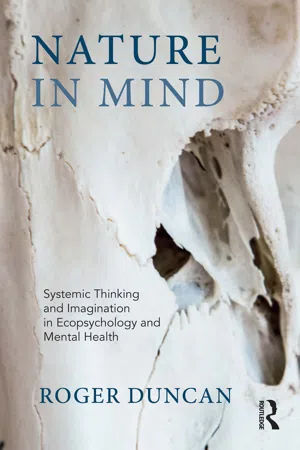
One of my earliest and most vivid memories was an experience I had at the age of about seven years old, when I was exploring an old chicken run in my parents’ garden that had been abandoned for many years and become overgrown with stinging nettles. Amongst the moss and the nettle stalks I found a small, clean, white, skull of a mouse. I picked up the tiny skull in my hand and turned it over to reveal underneath two smooth and shiny domes of bone, like tiny bone balloons that form part of the structure of the inner ear, and are known as the tympanic bulla. I was transfixed by what I saw, not only by the beauty and smoothness of the bone, but because I experienced this beauty as an intense feeling of wellbeing inside myself. I had the experience that the border between nature and my psyche had, surprisingly and spontaneously, melted away. I had become one with this delicate mouse skull and it was an experience that began a lifelong interest in bones and a search to rediscover this deep experience of connection with nature again.
This childhood experience led me to the study of biology, and later systemic psychotherapy, in search of a place where mind and nature connect and to rediscover a feeling of deep intersubjectivity with nature.
New brain, old planet: The neocortex and nature
The collective language of modern Western culture is, according to Carl Jung and James Hillman, based almost wholly on directed thinking (Cheetham, 2015). This is the type of thinking that we use to find direction and gain control of our environment when things become unpredictable. Hillman and Jung believed that the current alienation of modern humans from the rest of nature has a chronic locus in the use of conceptual language as the only way of making sense of the world (Cheetham, 2015).
Yet, the more unconscious parts of our thinking do not use conceptual language, but communicate in forms, images, and stories that signal to us about patterns and relationships that are often too complex to be captured in concepts. The rest of nature – ecosystems, plants, and animals – use this same type of communication, without concepts, which is transmitted in patterns and narratives that carry information about relationships between things (Bateson, 1979; Hoffmeyer, 2009). In this way nature is very similar to the unconscious parts of the brain, or more radically, nature could be seen as the oldest and subtlest but extended part of the human mind. For over 99.97 per cent of our time on earth modern humans have lived in close contact and communication with this subtle mind that we share with the earth. Currently, the part of the brain involved in conceptual thinking, the neocortex, has lost emotional contact with nature and the more instinctual patterns in our own minds because of its dependence on conceptual language. As a result of this separation the directed thinking mind now struggles to control the world; it sees the world only on its own terms. This book is, therefore, about the relationships between the human cerebral neocortex and the rest of the planet.
Gregory Bateson's unfinished business
It has been more than thirty years since Gregory Bateson’s call to understand patterns that connect mind and nature (Bateson, 1979). Yet, the search for a logical and linguistic solution to this problem remains elusive. As Bateson himself famously said, “The major problems in the world are the result of the difference between how nature works and the way people think” (Bateson, 2010).
From Rachel Carson’s Silent Spring in the 1960s, the threat of global overpopulation in the 1970s, nuclear mutually assured destruction (MAD) in the 1980s, to climate change and fracking in the 2000s, it seems clear that something humans are doing is fundamentally out of step with the rest of nature. We have the capacity to construct increasingly complex human artefacts, but the systemic intelligence that maintains the ecosystems of the earth still seems beyond many people’s understanding. Despite an endless treadmill of technological fixes and complex explanatory narratives, we are travelling ever deeper into an unfolding ecological disaster. We have fallen out of the dance with nature.
Gregory Bateson (1979) believed that in the development of the biological sciences and Darwinian theories of evolution that have shaped our contemporary view of nature, something important has been left out. Our sense of unity between mind and nature and the sense of being part of a larger whole has been broken, we have lost a more ancient belief in the wholeness or “parallelism” between nature and the human world that can be found in cultures that are more integrated with their environment. Bateson believed that,
We have lost Shiva, the dancer of Hinduism whose dance at the trivial level is both creation and destruction but in the whole beauty. We have lost Abraxas, the terrible and beautiful god of day and night in Gnosticism.
(Bateson, 1979, p. 18)
This loss, according to Bateson, is the result of a systemic epistemological error, an error in how we think about things that has led to alienating humans from the earth.
In his study of anthropological writing, professor of human ecology, Paul Shephard identified some fundamental differences between the modern and indigenous relationship with nature. The indigenous relationship was shaped by continual exposure to nature, both as hunters and the hunted, and was characterized by an embodied participation, through hunting, running, walking, and the creation of tools and imitation of patterns of behaviour in the animal and plant world. Indigenous mental processes have been recognized by anthropologists as having a sophistication rarely seen in Western thinking, where the environment was perceived in a non-linear and relational way, with less dependence than modern cultures on objects and a perceived objective reality. Nature was an environment encountered subjectively, where a hunter moved as a participant within it, oriented by action, and where animals and plants were seen as elements of a message requiring symbolic interpretation (Shepard, 1998).
These skills seemed to equip our ancestors really well when dealing with the discontinuity and complexity of the natural world and enabled them to maintain fluid and yet stable cultures that remained resilient through cycles of climatic and other ecological change; they were able to maintain a dynamic relationship between the emergent ecological and psychological narratives within nature and culture. This is in stark contrast with the fragility of modern culture where our current accumulated knowledge of psychological processes and our descriptions of the science of ecology and biology have remained closed from each other within separate academic silos.
As I walked out: A journey through time
As many young people have done before me, I set off travelling in my early twenties in search of adventure and, perhaps more importantly, in search of a sense of belonging to the wider world. I was curious about what other cultures did with their time and how they found a meaningful context for their lives. Growing up in Britain the culture around me seemed a little too rigid and removed from some deeper connection that I had fleetingly experienced in my encounter with the mouse skull. In my youth I had spent years searching for this connection in the fields and woods where I lived. Beyond the new housing estates and supermarket car parks, I found fragments of a lost natural history in the hedgerows and woodlands. Remnants of past farming practice, derelict farm buildings and implements, neglected old woodlands and paths, once part of a way of life now abandoned that had silently slipped away in one generation.
The Dead Sea Bedouin
My travels took me out of Europe to the Middle East in the early 1980s. At first I was just passing through unknown towns on buses and lorries looking out of the window on a changing landscape, but as I slowed down to a walking pace this changed. One night in Syria, in early March, I camped at some hot springs where sulfurous water, the temperature of a hot bath, ran in small rivulets and mixed with the cold water streams that also ran through the dry and rocky wadis. I spent the evening bathing in the hot water. Close by, Syrian workers were beginning the construction of a luxury spa; even here the land was under threat of change. The next afternoon I hitchhiked along a hot mountain road heading south. To my left in the east the landscape was sparse and arid, a land of mountains and huge dry canyons. To my right the land dropped quickly away to the Dead Sea far below, shrouded in heat haze. Beyond that, was the desert of the rift valley, Israel and the West Bank. My reverie was interrupted by a white Toyota pickup that stopped in front of me. I began climbing into the back for a lift but the driver called me round to the front. The driver and his companion were both dressed in smart traditional Bedouin attire, with white dishdashas down to their ankles and red and white scarves around their faces. The driver told me that he worked in the local bank in town and was going home for the day and asked if I would like to stay the night with his family. I agreed and we drove on for a few more minutes and then he drove off the road and parked the truck on the edge of the ravine overlooking the Dead Sea. He pointed down into the valley where there were a few Bedouin tents far below. “That’s my home,” he said, pointing to one of the tents and then to a small moving dot next to a camel, and said, “and that is my father”.
I followed him and his companion, sure footed in their sandals, down a rough goat track into the valley, arriving at the Bedouin tent to be greeted by his father. He invited us into the tent where he seated himself cross-legged by the smouldering, dusty fire pit. In the ashes was an ancient brass coffee pot with a long spout and he stoked up the fire with a few aromatic twigs to heat up the coffee, he chain-smoked and chatted to his son in Arabic as he did so. Coffee was then served in a single tiny cup that we all shared; he drank first as was the tradition when entertaining guests to show that the coffee was not poisoned. The Bedouin women lived in the same tent, but were screened behind a wall of woven goats’ hair, and as the sun went down they came out to receive and tether the goats, which the boys and men had brought in from the surrounding hills. She goats with kids were tethered by one foot to loops in a long hairy rope pegged at both ends and the girls milked them into an old and well-used five-litre Castrol GTX oil tin. The camp became busy for the evening as jobs were completed before the fading of the light. After a supper of goat’s meat and milk we strolled in the warm air and looked out across the valley to the rings of lights that marked the security fences of kibbutzim in Israel.
This event was embedded in a both ancient and current narrative of that land. Apart from the Toyota Land Cruiser, their belongings, tasks, and rituals of that day were unchanged for hundreds and possibly thousands of years. Abraham would have had no problem fitting into this evening and would have felt at home. Life for these Bedouin was modern and yet strongly referenced to timeless coordinates: land, family, and the daily rhythms and seasonality of animals’ lives. These Bedouin were connected with at least two thousand years of incommensurable and yet fundamentally unchanged history. The goats and Bedouin have been involved in this ritual for thousands of years, but every day was subtly different. Having been raised in suburban British culture and despite a good education and a University degree, I realized I was less prepared for this world of Abraham and his ancestors than the small boys who tended the goats. Here something of the indigenous remained intact in a way that was not romanticized, forced, or fabricated.
Loosening the ties
A few days later I had a meeting with a Syrian policeman who confiscated my passport. After a few hours of maintaining the pose of his professional position, he gave my passport back and invited me to his house for supper and we ate together on the floor with his children. He also served coffee in tiny cups that we shared, but this time it was from a thermos flask with a press down dispenser and not a brass coffee pot. Instead of watching the goats return from the hills we watched an episode of CHiPs on the television, a series about the Californian Highway patrol motorcycle police. I am not sure Abraham would have followed the show if he had turned up. The rituals of the policeman’s family had shifted from the Bedouin context and the goats were replaced by a TV series from another culture, a powerful new story with only a short window of relevant context. The episode of CHiPS, although probably running somewhere in the world, is now a dated 1970s TV show destined to become obsolete after a few short decades.
In a subtle way the lives of the policeman’s family had been altered by becoming uncoupled from the emergent, creative, and destructive matrix of nature; Bateson’s “terrible and beautiful god of day and night” that must have been experienced by the ancient lineage of Bedouin shepherds. The policeman and his family were now linked instead to stories and contexts generated out of the minds of TV producers. The beginning of an intangible and almost invisible disconnect between nature and everyday human life had begun.
The Sudan
Having travelled through Egypt and the Sudan by train and bus, I once again slowed down to walking pace and journeyed on foot, walking out of town into the rural villages of the Sudan. I walked through the spiny Sudanese savannah from village to village, following directions drawn for me on a scrap of paper by a local man. Beyond the reach of metalled roads, where people lived on less than a dollar a day, the culture was rich with a natural and open hospitality that I had never experienced before.
The villages were spaced approximately every ten miles and joined by human footpaths and the only indication that a village was close by, were groups of women returning from the bush with bundles of brushwood kindling balanced on their heads.
The Nuba tribes’ people, with whom I stayed, were generally very tall and well built and prided themselves on their strength and fighting skills. The men usually moved about naked, unless they saw a truck when they quickly pulled on their shorts as the government had declared nakedness illegal. I spent a few days staying with a Nuba family and their three small boys. The husband was a large muscular man and I helped him collect wood and weed his maize patch a short walk out of the village. One night before supper the husband and wife, equally large and quite strong, fell into a domestic dispute and after a short argument the fight quickly became a physical wrestling match. Husband and wife slammed into each other wordlessly wrestling, and were quite equally matched. The fight continued and I sat with the boys who waited patiently until it was finished, the only sound being the slap of contact of their parents sweating bodies. After a while they stopped the fight with a short verbal signal, both parents sweating and breathing heavily. I was struck by the non-verbal nature of their fight, few words were ever spoken but their wrestling had enabled them to clear the air and re-engage with the evening tasks.
Wealth in these villages was measured in cattle and almost everything I encountered had a natural and handmade origin. Houses made of earth with thatched roofs, knives and axes forged from lorry springs. The local blacksmith worked under a huge tree in a forge pumped by a small boy using goatskin bellows. Other than some metal tools and the ubiquitous twenty-five-litre plastic water containers, the type of tools and possessions they used appeared to have remained unchanged for many generations.
The staple diet in all the villages was maize. This meant that it was eaten at every meal, either as roasted cobs or milled and cooked into dough. Children supplemented this diet with grasshoppers that they caught and roasted. On special occasions such as funerals, one of which I attended, a goat or cow was killed and the meat was shared out. Death and the killing of animals was a part of life, animals were killed by the cutting of the throat and was usually accompanied in Arabic-speaking villages by a short blessing of “Bissmillah” (in the name of God). All life in these villages was intensely physical and body based, children would run outside to dance and sing in the rain during thunderstorms and adults would swim quickly in swollen rivers that had the power to wash away the unwary.
After one long day walking alone through the bush I arrived at a new village and entered a clearing where a gigantic baobab tree was lit up by the golden African afternoon sun. My arrival startled a group of children, dressed only in a thick covering of orange ochre clay, and they ran as silently and graceful as antelope from the first white person they had ever seen. I couldn’t help feeling I was seeing human beings in a way I had never seen before: vibrant, wild, and living in a culture where natural and social ecosystems were intimately connected.
Indigenous origins: San Bushman rock paintings
In southern Africa, I remember climbing amongst huge boulders under a hot sun, the surface was granular and reddish in colour and had been flaking off under the intense heat and cold of winter nights for many millennia. These bare granite outcrops known as “Kopjes”, are dotted about on the southern African landscape and provide undisturbed shelter for small colourful birds, like paradise flycatchers, as well as shelter for nervous green lizards. These are also a good hiding place for snakes such as the legendary and deadly black mambas and this brings a wariness to every movement on the rocks. When I climbed up to the top, the landscape opened out in front and behind me; as far as I could see this fertile and cultivated flat land was scattered with small villages and cattle kraals made of acacia thorns, and dotted with groups of wandering cattle and goats tended by small boys, and the sound of human voices carried clearly in the warm air.
I reached a flat rock outcrop facing the east and found what I was looking for, ancient rock paintings created by the San people or Bushmen, who once lived there. They were the first indigenous African hunter-gatherers forced off the land, first by Bantu tribes and later by European settlers. But their rock paintings where still there on the rock: antelope, elephants and people, hunters and dancers, lively and agile in red ochre pigment. Although the paintings were thousands of years old and the Bushman long gone, their presence lingers with the paintings, they could have been gone for only a few moments. I stayed a while and looked out over the plains the San Bushman once occupied.
All humans share an indigenous heritage and we vary only by the number of generations that we are now removed from the remembrance, acknowledgement, and context of these roots. For all of us, independent of religion, nationality, culture, or race, our great-great-grandfathers and -grandmothers lived their lives in continual contact and interaction with nature as hunter-gatherers.
At that time, I made sense of my experiences rationally...
Table of contents
- Cover
- Half Title
- Title
- Copyright
- Dedication
- Contents
- Acknowledgements
- About the author
- Introduction
- 1 Our indigenous heritage
- 2 Wilderness experience
- 3 Mind and nature revisited
- 4 Into the woods
- 5 Maps and territories
- 6 Soul encounter beyond the borders of language
- 7 Patterns of systemic relationships in nature
- 8 Reimagining human development
- Epilogue
- References
- Index
Trusted by 375,005 students
Access to over 1.5 million titles for a fair monthly price.
Study more efficiently using our study tools.
Frequently asked questions
Yes, you can cancel anytime from the Subscription tab in your account settings on the Perlego website. Your subscription will stay active until the end of your current billing period. Learn how to cancel your subscription
No, books cannot be downloaded as external files, such as PDFs, for use outside of Perlego. However, you can download books within the Perlego app for offline reading on mobile or tablet. Learn how to download books offline
Perlego offers two plans: Essential and Complete
- Essential is ideal for learners and professionals who enjoy exploring a wide range of subjects. Access the Essential Library with 800,000+ trusted titles and best-sellers across business, personal growth, and the humanities. Includes unlimited reading time and Standard Read Aloud voice.
- Complete: Perfect for advanced learners and researchers needing full, unrestricted access. Unlock 1.5M+ books across hundreds of subjects, including academic and specialized titles. The Complete Plan also includes advanced features like Premium Read Aloud and Research Assistant.
We are an online textbook subscription service, where you can get access to an entire online library for less than the price of a single book per month. With over 1.5 million books across 990+ topics, we’ve got you covered! Learn about our mission
Look out for the read-aloud symbol on your next book to see if you can listen to it. The read-aloud tool reads text aloud for you, highlighting the text as it is being read. You can pause it, speed it up and slow it down. Learn more about Read Aloud
Yes! You can use the Perlego app on both iOS and Android devices to read anytime, anywhere — even offline. Perfect for commutes or when you’re on the go.
Please note we cannot support devices running on iOS 13 and Android 7 or earlier. Learn more about using the app
Please note we cannot support devices running on iOS 13 and Android 7 or earlier. Learn more about using the app
Yes, you can access Nature in Mind by Roger Duncan in PDF and/or ePUB format, as well as other popular books in Psychology & History & Theory in Psychology. We have over 1.5 million books available in our catalogue for you to explore.