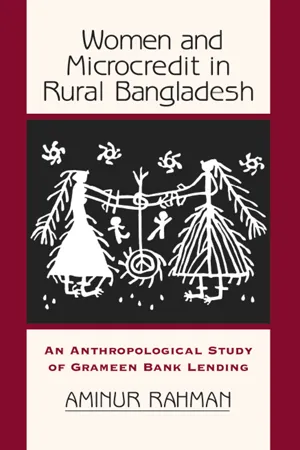
eBook - ePub
Women And Microcredit In Rural Bangladesh
An Anthropological Study Of Grameen Bank Lending
- 202 pages
- English
- ePUB (mobile friendly)
- Available on iOS & Android
eBook - ePub
Women And Microcredit In Rural Bangladesh
An Anthropological Study Of Grameen Bank Lending
About this book
The Grameen Bank of Bangladesh has been extending small loans to poor borrowers (primarily women) to promote self-employment and income generation since 1976. The apparent success of the Grameen Bank (that is, recruitment of clients, investment of loans, recovery rates on invested loans and profit margins) has made microcredit a new model for poverty alleviation and sustainable development. Anthropological research results on Grameen Bank lending to women presented in this book, however, illuminates the link between the success of the bank and debt-cycling of borrowers. The priority of earning profits to insure institutional economic viability caused Bank employees at the grassroots level to emphasize increasing the number of loans disbursed and loan recovery. By using the joint liability model of lending, the Bank workers and borrowing peers impose intense pressure on clients for timely repayment. Many borrowers maintain their regular payment schedules, but do so through a process of loan recycling (that is, pay off previous loans with new ones) that considerably increases borrower debt liability. The debt burdens on individual households in turn increase tension and anxiety among household members and produce unintended consequences for many clients.This book examines women borrowers' involvement with the microcredit program of the Grameen Bank, and the grassroots lending structure of the bank; it illustrates the implications of Grameen lending for the borrowers, their household members and bank workers. The focus of the study is on the processes of village-level microcredit operation; it addresses the realities of the day-to-day lives of women borrowers and bank workers and explains informant strategies for involving themselves in this microcredit scheme. The study is on the power dynamics of everyday lives of informants as they affect women borrowers' relationships within the household and the loan centers, and bank worker relationships within the loan center and the bank.
Information
1
Introduction
Microcredit—the extension of small amounts of collateral-free institutional loans to jointly liable poor group members for their self-employment and income generation—is a Grameen Bank innovation. Since 1976, the Grameen Bank has pioneered a credit delivery system in rural Bangladesh, bringing banking to poor villagers with a focus primarily on women. This bank is now the largest microlending institution in Bangladesh. It operates in fifty-six of the sixty-four districts in Bangladesh, with 1,100 rural branches covering 37,678 villages, more than half of all the villages in the country (see Figure 1.1). The cumulative investment of the Grameen Bank in rural Bangladesh is more than one billion U.S. dollars, disbursed among 2.3 million members, 95 percent of whom are women (Grameen Bank 1998).
In the 1980s the programmatic success1 of the microcredit scheme of Grameen Bank among poor women in rural Bangladesh became a demonstration of a successful equitable (with women as equal partners) and sustainable (in regard to financial viability for service-providing institutions) development initiative. The programmatic success and the endorsement of this success by a large number of impact and academic studies (R. I. Rahman 1986; Hossain 1988; Shehabuddin 1992; Fuglesang and Chandler 1993; Mizan 1994) have contributed to spreading the microcredit concept worldwide. In recent years the Grameen Bank’s approach of lending to poor women has attracted international interest, making microcredit “a new paradigm for thinking about economic development” (Morduch 1997:1). Now there is almost a global consensus that microlending to the poor is the key element for the twenty-first century’s economic and social development (Microcredit Summit 1998a). Currently, most bilateral and multilateral development agencies incorporate microcredit in their development projects and are keen to push other multisectoral social development-oriented nongovernmental organizations (NGOs) and private voluntary organizations (PVOs) into the function of credit delivery (Wood and Sharif 1997).

FIGURE 1.1 Grameen Bank Districts in 1995
Statement of the Problem
In this work, I examine the Grameen Bank lending structure of small loans among poor women in a rural community in Bangladesh and illustrate the implications of this lending for women borrowers, bank workers, and societal members. The study is a processual analysis of the credit program that enables a qualitative understanding of the impact of microcredit on poor people, with special attention to the involvement of rural women in the process. The main questions of this study are why are only women now recruited for the program? What are the social and economic impacts of such recruitment? How does the lending structure of the bank maintain the high investment and recovery rates in the study village, and what are the consequences of the investment and loan recovery on borrowers of the program and societal members in the village? The primary focus of the study is on women borrowers of the Grameen Bank, their interaction with peer group members and bank workers at the loan center and with the members of their household, the use of loans in the household economy, and the specific role of bank workers.
Despite the success of the Grameen Bank in delivering loans to poor women and bringing socioeconomic changes to many of these women’s households, my findings suggest that there are still many borrowers who become vulnerable and trapped by the system; they are unable to succeed. At the level of grassroots credit operation, bank workers encounter institutional pressure to increase loan investment and maintain high recovery rates on their invested loans. The bank workers and peer group borrowers inflict an intense pressure on borrowers for timely repayment, rather than working to raise collective responsibility and borrower empowerment as originally envisaged by the bank (Yunus 1994a:18). Many borrowers maintain their regular repayment schedules through a process of loan recycling (paying off previous loans by acquiring new ones) that considerably increases the borrowers’ debt liability. The burden of debt on individual households in turn increases anxiety and tension among household members and produces new forms of social and institutional dominance over many women clients in the program. The entrapment of the borrowers in debts and the long working hours for bank workers to keep up with their installment collection in loan centers and paperwork in the bank lead informants in this study to question the vision of the lending institution. Consequently, the informants (borrowers and bank workers) generate their own critical assessment—treated as a “hidden transcript” (Scott 1990) in the analysis—about the impact of the project. The incorporation of the hidden transcripts of informants in the analysis is central to this study.
The Grameen Bank
The word grameen in Bengali literally means “rural” or “village.” The Grameen Bank is a bank established with the objective of extending credit to poor people in rural Bangladesh who have no physical collateral. The story of the Grameen Bank is almost a legend. The founder, Muhammad Yunus, is a former economics professor who returned from the United States to Bangladesh in 1972 with his doctorate from Vanderbilt University. He joined Chittagong University, which is located in a rural area among many villages. During his tenure at the university, Yunus was confronted by the poverty that overwhelms many poor people in rural Bangladesh, who live in a world of debt alongside the rich people; the poor are kept in an omnipresent poverty circle (Yunus 1997). Through his direct encounter with rural people, Yunus was inspired to consider microcredit as a means of alleviating rural poverty.
Before institutional credit for poor people was introduced, there were primarily two credit sources available in rural Bangladesh—commercial banks and moneylenders. The commercial banks do not give loans to the poor because the poor are unable to provide collateral, whereas moneylenders will lend money but with very high interest rates.2 Both of these arrangements are incompatible with the return in small business. Yunus realized the implications of microcredit for the first time in 1976 through his interaction with a poor woman in the village of Jobra who made bamboo stools for a living. The woman could not afford to buy bamboo herself and borrowed money from a trader on the condition that she must sell her product to the trader at a price he decided. Because the woman could not sell her finished product to anybody else, the trader took advantage of the situation and paid a price that barely covered the cost of the raw material. The socioeconomic circumstances of this woman led Yunus to think that if the woman had a small amount of working capital then she could work for herself, retaining the surplus now appropriated by others. All she needed was the “small credit” necessary for working capital.
In 1976, Yunus first experimented with the microcredit concept in the form of an action research project—Grameen Bank Project (GBP)—in the village of Jobra (Counts 1990).3 This project was financially supported by a national commercial bank and supervised by students of the Economics Department of Chittagong University (Yunus was then department head). From 1976 to 1978, in collaboration with various commercial banks in the country, the microcredit action project was introduced in different villages in the same region. The experiment helped Yunus develop the appropriate supervisory and timely recovery measures of his microlending project. In 1979, with the financial assistance of the Bangladesh Central Bank, the project was introduced to the Tangail district (where I conducted my fieldwork). During 1979 to 1982, with financial support from the International Fund for Agricultural Development (IFAD), the Grameen project was further extended to three more regions of Bangladesh and became a national project. On October 2, 1983, a government ordinance transformed the Grameen project into the Grameen Bank, a specialized credit institution with the mandate of providing credit services to poor people in rural Bangladesh.
The Lending Structure of the Grameen Bank
The Grameen Bank lends to groups of borrowers, rather than to individuals, through a hierarchical structure. In this lending structure, more than 90 percent of Grameen Bank field staff—bank workers, managers, program officers, and area managers—are men, but 95 percent of borrowers are women. The borrowers in the project must address men bank workers as “sir”; the real power of bank workers (men) over borrowers (women) may therefore be reinforced by cultural norms of male status (Montgomery 1995:10). Figure 1.2 reflects the bank worker and borrower hierarchy.
At the bottom of the lending structure are individual borrowers and the peer loan groups. The bank workers organize interested persons in groups of five borrowers of the same sex and with similar socioeconomic background. The explicit criterion for borrowers to be included in Grameen loan groups is “landlessness,” which is also considered the main cause of rural poverty in Bangladesh (Siddiqui 1982; Jansen 1987; North-South Institute 1990; Rahman and Hossain 1996). The borrowers are supposed to be from households “owning less than 0.5 acre of cultivable land” or from households in which “total assets do not exceed the value of one acre of medium quality, single-cropped land in that area” (Bidhimala [Grameen Bank Constitution], 3.1; see Appendix C; Bernasek 1992:11). Formation of loan groups is followed by the selection or election of a group chair to be responsible for maintaining group discipline in the weekly meetings, conducting weekly transactions with the bank worker in the loan center, and proposing loans for other group members.

FIGURE 1.2 The Hierarchical Structure of Grassroots Grameen Bank Microlending
The loan center is the second-lowest position in the hierarchy of the grassroots loan operation. Six to eight loan groups in a village are federated into a loan center; they find a space or build a center hut in their vicinity for the weekly meetings and select or elect a center chief. The center chief is responsible for maintaining the overall discipline of the center, conducting center meetings, ensuring borrower attendance and installment payments, supervising individual borrower loan use, and reporting to the bank worker. At the center level, the center chief also holds the final authority to approve or disapprove the loan proposals of individual borrowers, which are initiated by the group chair.
The third level in the hierarchy is the local branch. Its workers are directly involved in executing the loan operation in the loan center. Bank workers form loan groups in the village, provide group members with adequate information on the Grameen Bank’s operation, and work with borrowers to establish their conformity to the discipline of the Grameen Bank.
After forming a loan group and teaching the borrowers the rules and regulations of the bank, the bank workers refer the group to the local branch manager for his or her consideration. From the local branch the proposal for group recognition goes to the fourth level, the area office. The area office is where the group gets final recognition as a Grameen group and borrowers become eligible for initiation of the lending process. In addition to these four grassroots strata, the lending operation is also influenced by the superior officers of the zone and head office.
In 1994 and 1995 the Grameen Bank offered four main types of loans: (1) general loans for year-round income generation, (2) seasonal loans for investment in agriculture activities and seasonal business, (3) house loans for building a tin-roof house, and (4) group fund loans based on the 5 percent deducted as the group tax by the bank on every loan approved to an individual borrower and deposited to a group fund account (GFA).The borrowers pay this deducted amount along with their capital. Until 1996, borrowers had no personal claim or right to their deposited amount in the GFA; they were allowed to borrow from the GFA only with the consent of the other members of the group (see Bidhimala, Section 4.6, Appendix C).
The borrowers reported that during its operation in the village the bank also has experimented with a few other types of loans, such as collective, family, tube well, and capital recovery loans. The bank introduced these different loans for its borrowers but gradually eliminated them because of the failure of their rates of recovery. In May 1997, at the time of my follow-up research, I found that the bank had introduced two more types of loans—animal sharecropping and leasing loans (macroloans of 100,000 to 200,000 taka)—for its borrowers to offset the declining investment trend in the study area.
The microlending of the Grameen Bank operates in a fifty-two week cycle. The weekly installment is 2 percent of the principal amount. Borrowers must repay the entire principal amount in fifty equal installments. In 1994–1995 the annual rate of interest for microloans was 20 percent and the emergency fund was 25 percent of the calculated interest on a particular loan. The interest and emergency fund payments add up to 12.5 percent more than regular weekly installments; borrowers must pay them in the remaining two weeks of the year to become eligible for their next new loan.4
Each loan proposal from individual borrowers in a center receives three successive and separate formal reviews before it can be finally approved by the area manager. The loan amount requested by an individual borrower needs to be agreed on by all members of the group. The group chairperson then approaches the center chief with the proposed loan. The center chief initiates the formal loan proposal, signs it, and gives it to a bank worker. The bank worker approves it and gives it to the branch manager. The branch manager approves the loan proposal and sends it to the area office. In the area office it is first approved by the responsible program officer and then finally countersigned by the area manager.
Once a group is recognized and approved by the Grameen Bank, loans to individual group borrowers are granted sequentially—by establishing a time cycle—rather than simultaneously. Two borrowers in a group receive their loans in the initial allocation and their loan repayment behavior is observed for a month or two. Their successful repayment entitles the next two borrowers in the group to apply for loans. The satisfactory repayment of four borrowers in two different time cycles entitles the last member of the group to a loan. By establishing such sequences in loan disbursement, the Grameen Bank creates peer pressure whereby each group member becomes responsible for other borrowers’ loans. In this microlending program the group is to function as an institution to ensure mutual accountability. The individual in the system is kept in line by a considerable amount of pressure from other borrowers of the group. The pressure of the group acts as the collateral for the bank.
Loans are approved for individual borrowers for specific projects for immediate investment in a cash income venture. According to explicit bank guidelines, the group chairperson and the center chief are obliged to supervise loan utilization immediately after the loan is disbursed. Upon their satisfactory investigation, they both are to report to the bank worker in a written form. The bank worker is obliged to verify the claim of the group chairperson and center chief and prepare a written description of the investment. Additionally, the investment of the borrower is supposed to be further supervised by the responsible branch manager and the program officer from the area office.
The objective of the organization of borrowers in groups and centers for the lending operation is not only to provide them economic opportunities but also to create an environment in which borrowers are able to exchange socially needed information, encouragement, and motivation for confidence building. The stated goal is to build unity, solidarity, and leadership among borrowers and ultimately to improve their social development and empowerment. The bank workers, policymakers, and even academics in Bangladesh usually generalize about Grameen microlending through quantitative representation. Representatives of public institutions appear to have played a commanding role in sustaining the international prominence of the bank and the pride of the country as an innovator of the microcredit concept.
Studies of the Grameen Bank
A substantial number of studies have been conducted, primarily by economists, on the microcredit program of the Grameen Bank since its beginning in 1983. Most of these studies are evaluative in nature,5 with the researchers examining the kind of impact the Grameen Bank microcredit programs have had on its borrowers (Ghai 1984; Ahmed 1985; R. I. Rahman 1986; Atiur Rahman 1986a and 1986b; Hossain 1988). These studies provide both quantitative and descriptive information on gradual changes in the number of Grameen Bank memberships, the amount of loans taken out by borrowers, income earned from loan money, household income, areas of investment, and social development indicators such as the practice of the “Sixteen Decisions” by borrowers (see Appendix B). A few other studies have been conducted on the Grameen Bank program in the 1990s that try to investigate the impact of loans on the empowerment of women borrowers (Hashemi and Schuler 1993 and 1996; Wahid 1993; Schuler and Hashemi 1994 and 1995; Goetz an...
Table of contents
- Cover
- Half Title
- Title Page
- Copyright Page
- Table of Contents
- List of Figures
- Preface
- Acknowledgments
- 1 Introduction
- 2 Field Research Methodology
- 3 Theoretical Framework
- 4 The Study Village and Its Socioeconomic Organization
- 5 Microlending and Equitable Development
- 6 Disbursement and Recovery of Loans: Bases for Escalation of Violence?
- 7 Microlending and Sustainable Development
- 8 Conclusion
- Appendix A: Glossary of Non-English Words
- Appendix B: The Sixteen Decisions
- Appendix C: Grameen Bank Bidhimala (Bye-laws/Constitution)
- References
- Index
Trusted by 375,005 students
Access to over 1.5 million titles for a fair monthly price.
Study more efficiently using our study tools.
Frequently asked questions
Yes, you can cancel anytime from the Subscription tab in your account settings on the Perlego website. Your subscription will stay active until the end of your current billing period. Learn how to cancel your subscription
No, books cannot be downloaded as external files, such as PDFs, for use outside of Perlego. However, you can download books within the Perlego app for offline reading on mobile or tablet. Learn how to download books offline
Perlego offers two plans: Essential and Complete
- Essential is ideal for learners and professionals who enjoy exploring a wide range of subjects. Access the Essential Library with 800,000+ trusted titles and best-sellers across business, personal growth, and the humanities. Includes unlimited reading time and Standard Read Aloud voice.
- Complete: Perfect for advanced learners and researchers needing full, unrestricted access. Unlock 1.5M+ books across hundreds of subjects, including academic and specialized titles. The Complete Plan also includes advanced features like Premium Read Aloud and Research Assistant.
We are an online textbook subscription service, where you can get access to an entire online library for less than the price of a single book per month. With over 1.5 million books across 990+ topics, we’ve got you covered! Learn about our mission
Look out for the read-aloud symbol on your next book to see if you can listen to it. The read-aloud tool reads text aloud for you, highlighting the text as it is being read. You can pause it, speed it up and slow it down. Learn more about Read Aloud
Yes! You can use the Perlego app on both iOS and Android devices to read anytime, anywhere — even offline. Perfect for commutes or when you’re on the go.
Please note we cannot support devices running on iOS 13 and Android 7 or earlier. Learn more about using the app
Please note we cannot support devices running on iOS 13 and Android 7 or earlier. Learn more about using the app
Yes, you can access Women And Microcredit In Rural Bangladesh by Aminur Rahman in PDF and/or ePUB format, as well as other popular books in Social Sciences & Development Economics. We have over 1.5 million books available in our catalogue for you to explore.