eBook - ePub
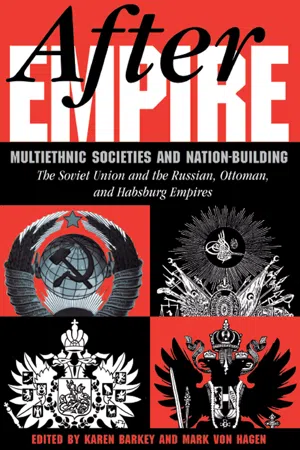
After Empire
Multiethnic Societies And Nation-building: The Soviet Union And The Russian, Ottoman, And Habsburg Empires
- 212 pages
- English
- ePUB (mobile friendly)
- Available on iOS & Android
eBook - ePub
After Empire
Multiethnic Societies And Nation-building: The Soviet Union And The Russian, Ottoman, And Habsburg Empires
About this book
This volume brings together a group of some of the most outstanding scholars in political science, history, and historical sociology to examine the causes of imperial decline and collapse of the Russian, Ottoman, and Habsburg empires.
Information
1
HOW EMPIRES END
From Herodotus to Montesquieu and beyond, poets, historians, and philosophers have recurrently produced one of our culture’s standard literary forms: the dirge for a fallen empire. Reflection on imperial decline has world-historical resonance because it records for all to see the fallibility of seemingly unshakable human enterprises. Contrast between sometime grandeur and startling ruin has often provided the text of moral reflections on imperial decline, orations in the ruins, either by new conquerors who boast their own superiority over the defeated or by philosophers who want to warn against the excesses of hubris. (We who now pronounce on the Soviet empire’s collapse should consider into which category we fall.) Among the philosophers’ laments, remember Lewis Mumford’s classic lines on Rome:
From the standpoint of both politics and urbanism, Rome remains a significant lesson of what to avoid: its history presents a series of classic danger signals to warn one when life is moving in the wrong direction. Wherever crowds gather in suffocating numbers, wherever rents rise steeply and housing conditions deteriorate, wherever a one-sided exploitation of distant territories removes the pressure to achieve balance and harmony nearer at hand, there the precedents of Roman building almost automatically revive, as they have come back today: the arena, the tall tenement, the mass contests and exhibitions, the football matches, the international beauty contests, the strip-tease made ubiquitous by advertisement, the constant titillation of the senses by sex, liquor, and violence—all in true Roman style. So, too, the multiplication of bathrooms and the over-expenditure on broadly paved motor roads, and above all, the massive collective concentration on glib ephemeralities of all kinds, performed with supreme technical audacity. These are symptoms of the end: magnifications of demoralized power, minifications of life. When these signs multiply, Necropolis is near, though not a stone has yet crumbled. For the barbarian has already captured the city from within. Come, hangman! Come, vulture!1
Thus Mumford applies his theory that beyond a modest limit the growth of political power and technical virtuosity dehumanize life, bringing on their own annihilation. Less orotund, but in the same vein, Alex Motyl declares that “absolutism engenders pathologies that lead to its own degeneration, a fact that, in territorially contiguous empires, necessarily leads to the decay of the center’s control of the periphery.”2
Before performing learned autopsies, however, we should just be sure the body was sick, and has actually died. Over the time that the world has known substantial states, after all, empires have been the dominant and largest state form, carnivorous dinosaurs that nothing but a terrestrial disaster, it seems, could eradicate. Only now, during the twentieth century, do we seem to be leaving the age of massive Eurasian empires that began in earnest across a band from the Mediterranean to East Asia almost four thousand years ago. To the extent that we regard such international compacts as the European Union, GATT, and NAFTA as embodying imperial designs, furthermore, even today’s requiem may prove premature.
If empires are indeed disappearing, their demise raises questions just as knotty as the dinosaurs’ sudden disappearance. At the end of the world’s bloodiest and most military century, does imperial disintegration mean that interstate military conquest will also decline, perhaps in favor of civil war and genocide? Does the dispersal of previous empires, including the massive decolonization that began in the 1960s, suggest what will happen to the debris of the most recent breakdowns? How generally, when, and where, does the end of empires generate new forms of conflict, internal and external? Do bursts of nationalism on behalf of former imperial fragments generally accompany the dissolution of central control? Under what conditions does—or, for that matter, could—successor states to empires form stable democratic regimes? Whether or not we have reached the end of imperial history, previous cycles of decline present us with pressing questions and ample bases for comparison.
As we undertake such comparisons, we should avoid the smug assumption that empires fail simply because they generally adopt unviable forms of rule. Historically, empires have been hardy beasts. Variants of the Chinese empire endured two millennia or more, the Byzantine empire continued for more than a millennium, the Roman empire lasted for about six centuries, the Ottoman empire survived about half a millennium, various Mongol empires occupied the widest contiguous territorial range of any political organization ever to exist for some five hundred years, while the ends of briefer but still momentous British, French, German, Italian, Spanish, Portuguese, Belgian, Dutch, American, Russian, Soviet, and Austro-Hungarian empires lie within the memories of living people.
Between the Roman and British juggernauts, Europe itself saw great Norman, Lithuanian-Polish, Swedish, Burgundian, and many other empires before consolidated states came to dominate the continent. Around the Mediterranean, larger Muslim states organized chiefly as empires. Meanwhile, more empires arose and fell in South America, Africa, and Southeast Asia. Given the recency of imperial presence in our world, we who speak generally and definitively of empire’s end run the risk of a characteristic Chinese error, mistaking the decline of a particular regime for the definitive end of a once-dominant political form. Just as we should hesitate to crow loudly about the irreversible “democratization” of a world where guerrilla, genocide, and politicide have become increasingly common practice,3 we should hold back before declaring that empires have departed forever to live with their ancestors.
Over the roughly ten millennia during which we have some evidence for the existence of states, most states have taken one of three forms. They have appeared as city-states, agrarian military domains, empires, or various combinations of the three, as in Venice’s attachment of a scattered maritime empire to a city-state or the Dutch Republic’s uneasy federation among city-states. Only during the last two centuries have consolidated states—coercion-wielding organizations governing directly and rather uniformly in a series of heterogeneous and clearly bounded territories—become the dominant state form, first in the European world, and then, by conquest and emulation, in the world as a whole.
Nor should we imagine consolidated states to have such great advantages over all other political organizations that they have rendered the others obsolete; after a mere two hundred years of hegemony, Western consolidated states are already showing signs of incapacity to provide either order or public goods in the face of challenges from networks of capital, labor, drugs, arms, and terror that cross their painfully erected borders with ease.4 A century from now, analysts may well treat consolidated states as ephemera, and empires as the historically dominant forms of political organization beyond a regional scale.
An empire is a large composite polity linked to a central power by indirect rule. The central power exercises some military and fiscal control in each major segment of its imperial domain, but tolerates the two major elements of indirect rule: (1) retention or establishment of particular, distinct compacts for the government of each segment; and (2) exercise of power through intermediaries who enjoy considerable autonomy within their own domains in return for the delivery of compliance, tribute, and military collaboration with the center.
As students of Switzerland, the United States, the German Federal Republic, Brazil, or South Africa will hurry to announce, these criteria are matters of degree rather than absolute distinctions; within their zones of competence, nevertheless, today’s federal governments rule much more uniformly and directly than did the Ottoman or Mongol states. Empires rule indirectly through variable compacts because they grow chiefly through military conquest of existing polities, aided by the collaboration (however coerced) of local power-holders who retain substantial discretion within their own jurisdictions. By the same logic, they ordinarily disintegrate in some combination of external conquest and peripheral resistance, either and both often executed by former agents of the center.
Empire has proved to be a recurrent, flexible form of large-scale rule for two closely related reasons: because it holds together disparate smaller-scale units without requiring much centrally-controlled internal transformation, and because it pumps resources to rulers without costly monitoring and repression. Regional rulers use existing practices, understandings, and relationships to extract the requisite minimum of tribute, military support, and loyalty for the center’s benefit. They can settle for extracting as much payment and service as the regions will bear without attempting to estimate the actual capacity of regions, localities, or individuals to pay. Just so long as regional rulers deploy some force of their own and have ready call on imperial force in emergencies, the imperial center need not build a dense system of regional policing, much less the monitoring and boundary-controlling mechanisms entailed by income taxes, property taxes, or even fine-grained excise taxes.5 Imperial extraction of resources normally operates, to be sure, at the cost of enormous slippage, evasion, personal influence, and inequality—one reason why an emperor’s sudden demand for increases in yield (or, conversely, his visible loss of coercive power) frequently generates rebellion by previously compliant subjects. But an imperial system’s crude simplicity makes it adaptable to many social terrains.
In contrast to the slow accretion of power in a city-state, an agrarian domain, or a consolidated state, imperial expansion therefore sometimes occurs with startling rapidity because it combines military conquest with political co-optation, absorbing existing systems of rule into webs of tribute and military alliance. Hence the quick looming of predatory Persian, Mongol, and Ottoman empires—all of them relying initially on armed horsemen—at the horizons of their agrarian neighbors. By the same token, however, empires can collapse spectacularly. Ruin sometimes rushes in because: (1) the empire’s dominated polities remain detachable by virtue of weak integration into any administrative web; (2) their viceroys enjoy autonomous power, including the power to defect; (3) subjugated populations retain distinct identities, memories, and grievances; and (4) information indicating that the center has become vulnerable spreads fast among dominated units and external enemies. The Chinese empire proved more durable than others largely because it countered all four of these threatening conditions. By extending a relatively uniform administrative structure down to the county level, by integrating county-level gentry into a system of competition for imperial favor, by rotating imperial bureaucrats frequently and refusing to station them in their provinces of origin, by stimulating internal mobility and reducing public recognition of ethnic distinctness, and by making effective shows of central force through much of its vast territory, the imperial state maintained most of its dynasties for centuries between collapses and conquests.6
In this light, we should remain skeptical about accounts of communism’s collapse that focus on a single fatal flaw in its imperial structure, whether Alex Motyl’s “absolutism” or something else. Motyl’s explanation takes a common form, internalist and universal. It is internalist because it locates the origins of collapse within the system. It is universal because it claims that all such systems collapse, sooner or later, for the same reason. Similarly, Joseph Tainter bases his internal and universalist analysis of “collapse” mainly on diminishing marginal returns to central control.7
Many other explanations, in contrast, insist on the uniqueness of their case(s) and/or the externality of essential causes, while the most common explanations combine unique and general causes of a given decline with a balance of internal and external factors.8 For the class of territorially contiguous empires, Motyl’s internalist-universalist account posits a recurrent process by which an allegedly necessary feature of such organizations—absolutism—undermines the conditions for its own survival. Let us set aside Motyl’s dubious use of “absolutism” to describe the actual operation of any state, as opposed to the ruler’s claims for heaven-blessed priority over regional magnates.9 Let us also pass by his unfortunate application of “prefect,” that quintessential term of deliberately constructed direct rule, to the empowered, semiautonomous intermediaries who serve imperial regimes.10
Motyl’s essential idea echoes Shmuel Eisenstadt’s classic characterization avant la lettre of the principal-agent problem in empires.11 Every empire does, indeed, face the problem of maintaining compliance and reliable information-gathering among regional agents who easily acquire ties, interests, and capacities that lead them to subvert the imperial enterprise, to ally with its enemies, or even to rebel on their own accounts. To suppose, however, that every empire succumbs to that dilemma one has to disregard the enormous variability in imperial durability and demise, and to forget the recurrent importance of external conquest.
To ask how empires end is like asking how rivers change their courses, how coral reefs go dead, how human lineages disappear. In vitro we might imagine a single course for empires, lineages, rivers, or reefs. Yet, verified in vivo, it does not occur. If empires have over four millennia been so prevalent and yet so various, we are unlikely to derive from their histories any constants less trivial than those I have already named: that some combination of external conquest and internal defection usually brings them down. Contemplating the Soviet Union, we might stretch such generalizations to stress the Afghan war’s depletion of Soviet military strength and credibility, the importance of Gorbachev’s declaration of non-intervention for the politics of Warsaw Pact states, or the attractions of capitalist connections to the Baltic states. But none of these will take us very far toward a systematic integration of the Soviet Union’s experience with that of other empires. I don’t want to spoil the game of comparing Soviet collapse with the Habsburg empire’s dissolution, but I do want to warn that the search for point-by-point correspondence should in principle have very little utility. We will make more progress if we place empires and their ends in a meaningful field of variation.
Alex Motyl has actually started the essential process of differentiation by offering the distinction between territorially contiguous and scattered empires. Still, that distinction does not obviously solve our problems; given the superiority of travel by water until the last century or so, for example, it is not evident that the scattered sea-linked Venetian empire was less well-connected than the contiguous but largely land-linked Russian empire, or that Venice’s suffocation through Ottoman expansion differed fundamentally from the Byzantine débâcle which Venetian-Ottoman collaboration had earlier hasten...
Table of contents
- Cover
- Half Title
- Title Page
- Copyright Page
- Dedication
- Table of Contents
- Acknowledgments
- 1 How Empires End
- 2 The End of Empires
- Part One Collapse of Empires: Causes
- Part Two Collapse of Empires: Consequences
- About the Book and Editors
- About the Contributors
- Index
Trusted by 375,005 students
Access to over 1.5 million titles for a fair monthly price.
Study more efficiently using our study tools.
Frequently asked questions
Yes, you can cancel anytime from the Subscription tab in your account settings on the Perlego website. Your subscription will stay active until the end of your current billing period. Learn how to cancel your subscription
No, books cannot be downloaded as external files, such as PDFs, for use outside of Perlego. However, you can download books within the Perlego app for offline reading on mobile or tablet. Learn how to download books offline
Perlego offers two plans: Essential and Complete
- Essential is ideal for learners and professionals who enjoy exploring a wide range of subjects. Access the Essential Library with 800,000+ trusted titles and best-sellers across business, personal growth, and the humanities. Includes unlimited reading time and Standard Read Aloud voice.
- Complete: Perfect for advanced learners and researchers needing full, unrestricted access. Unlock 1.5M+ books across hundreds of subjects, including academic and specialized titles. The Complete Plan also includes advanced features like Premium Read Aloud and Research Assistant.
We are an online textbook subscription service, where you can get access to an entire online library for less than the price of a single book per month. With over 1.5 million books across 990+ topics, we’ve got you covered! Learn about our mission
Look out for the read-aloud symbol on your next book to see if you can listen to it. The read-aloud tool reads text aloud for you, highlighting the text as it is being read. You can pause it, speed it up and slow it down. Learn more about Read Aloud
Yes! You can use the Perlego app on both iOS and Android devices to read anytime, anywhere — even offline. Perfect for commutes or when you’re on the go.
Please note we cannot support devices running on iOS 13 and Android 7 or earlier. Learn more about using the app
Please note we cannot support devices running on iOS 13 and Android 7 or earlier. Learn more about using the app
Yes, you can access After Empire by Karen Barkey,Mark Von Hagen in PDF and/or ePUB format, as well as other popular books in Politics & International Relations & 20th Century History. We have over 1.5 million books available in our catalogue for you to explore.