- 523 pages
- English
- ePUB (mobile friendly)
- Available on iOS & Android
eBook - ePub
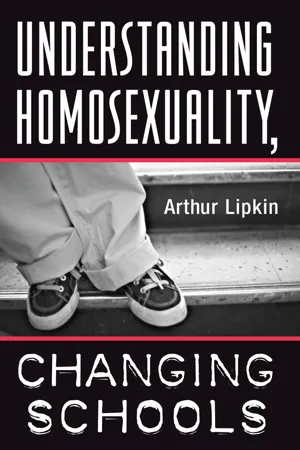
Understanding Homosexuality, Changing Schools
About this book
BRINGING TOGETHER thirteen topics related to homosexuality and education, Understanding Homosexuality, Changing Schools provides a foundation in gay/lesbian studies and offers models for equity, inclusion, and school reform. It is designed to help educators, policymakers, and the public understand the significance of gay and lesbian issues in education; aid communication between gay/lesbian students and their families and schools; facilitate the integration of gay and lesbian families into the school community; and promote the inclusion of gay and lesbian curricula in a range of disciplines. It also seeks to promote the healthy development of all students through reducing bigotry, self-hatred, and violence. This volume makes the gay, lesbian, bisexual, and transgender experience part of a democratic multicultural vision.
Information
1
Overview of the Problem
Diversity in Our Culture
There is a facile consensus in educational circles today as well as in government and media, that diversity is a good thing. Although our commitment to immigration, affirmative action, affordable housing, representative curricula, and the like may not be deep, sociologist Nathan Glazer observes, “We are all multiculturalists now.”1 At the very least, xenophobia and racial supremacy are not to be directly expressed in polite discourse.
Ironically, the original metaphor for American heterogeneity was a melting pot. Newcomers were once expected to divest themselves of cultural differences except perhaps for colorful and harmless folkways. The American educational dream was that good public schooling would help an upwardly mobile second generation leave urban ghettos for suburban blending.
Sectarian and ethnic Americans still find comfort among their own and occasionally clash with others, but the old suspicions and rivalries, as between urban Irish and Italians for example, have greatly diminished. Prejudice has been countered with the blandishment, “We are all Judeo-Christian Americans, sharing the values of piety, work, and family—our differences are minor.”
There are, of course, exceptions. Racism is abiding and pernicious. Although the question of whether one’s forebears came on the Mayflower or in steerage has become increasingly the grist of good humor, the intractable legacy of the slave ships is not easily mitigated.2 People of color who aspire to the middle class are not allowed to blend in to the degree that white ethnics have done.
Black people’s liberation from illusory assimilation has helped transform the melting pot to a patchwork quilt, emblematic of the beauty and strength of our differences. The case for respecting diversity, however, still rests on the congruence of Americans’ religious, moral, and economic tenets—subsumed in the code words “family values.” They are united in God, marriage, children, the comforts of home, and a disposable income. Thus, Bill Cosby’s Huxtables became the most popular black family in American history.
Stitching homosexuals into the patchwork is still a great challenge. In 1996 alone, 228 instances of institutional antigay discrimination were documented.3 (This pattern is consistent with abuses of homosexual human rights around the world.4) Even gays and lesbians with deep religious beliefs, conservative comportment, and manicured lawns face obstacles. Whatever else might qualify them for acceptance, homosexuals who merely live openly and without shame are seen by many as warring against God and the family. Those aspiring to marriage have been savaged.
The rhetoric of the homophobic opposition has a familiar ring: Some demagogues who have discovered the political utility of “the homosexual menace” in the ‘80s and ‘90s were likewise stridently racist in earlier decades.5
The denunciations regularly and unabashedly aimed at gays and lesbians prove the normativity of heterosexism in our culture. Although institutional racism and violent attacks on people of color have hardly disappeared, open expression of racial bigotry is tolerated far less than homophobic invective. So unfashionable is racism today that pollsters find white interview data unreliable for elections with African American candidates.6 Most children are admonished not to use racial epithets; a similar standard does not apply to words like “fag.”
Like white racists nostalgic for the Sambo days, some homophobes complain, “We always knew there were queers and bulldaggers around, but as long as they didn’t flaunt it, nobody bothered them. Now they want rights and they’re bringing trouble on themselves. They should just keep their sex lives private.” The nostalgic bigot would have us believe that the two spinsters sharing an apartment or the artistic bachelor uncle had only intemperate gossip to fear. Left out of their recollection are the beatings, police entrapment, lost jobs and families, and suffocated souls.
In short, homosexuals are permitted to exist so long as they acquiesce to invisibility and inferiority. Even liberal editorial arguments, such as those favoring domestic partnership over gay marriage, betray an underlying injunction to second-class status. It is no wonder that many, if not most, gays and lesbians choose the closet.
Attitudes Toward Homosexuality
The percentage of Americans who disapprove of homosexuality has ranged from 50–57 percent since 1982.7 (Disapproval of homosexual relationships, 75 percent in 1987, stood at 56 percent in 1996.8) In American courts, gays and lesbians “are at least three times as likely to face a biased jury as a person who is white, African American, Hispanic, or Asian.”9 Among teenagers in one recent poll, 58 percent of boys and 47 percent of girls said homosexuality is always “wrong.”10 Oddly, 58 percent of teens in another poll felt that gays in this country get too little respect.11
One Nation, After All, an end-of-the-century study, concluded that middle-class Americans are morally pragmatic and tolerant of racial, gender, and religious differences.12 The one exception to the nonjudgmental views of the “moderate majority” regards sexual orientation. “That is the one area where people use words like ‘sinful, hateful, wrong, immoral’—the kind of words they never used on any other subject.”13 Still, although they rejected homosexuality, nearly three-quarters of the respondents said gays should be left alone in their personal lives.
That attitude does not prevent closely fought ballot initiatives to classify homosexuality as “abnormal, wrong, unnatural, and perverse.”14 Antigay referenda were proposed in 10 states in 1994, although they went to voters in only two and both were defeated.15 In 1995, 39 antigay measures moved forward in 30 state legislatures.16 In just the first three months of 1996, 72 antigay bills were introduced.17 By 1998 only 10 states, 157 municipalities and counties, and the District of Columbia offered legal protections to gays and lesbians.18
At its root, homophobia is ignorance, yet the vast majority of schools are unwilling or unprepared to do anything about it. Other harmful prejudices are regularly challenged, in the interest at least of practical harmony if not of true multiculturalism. Yet a stubborn double standard prevails. It is easy to find schools, even some that are otherwise progressive, where “kids notice that when a racial slur is written on a wall, there is a fuss, but ‘fag’ on a locker remains for days, unremarked.”19 The consequences for students of the failure to address such issues are serious: a distorted view of human nature, bigotry, self-hatred, and violence.
Teaching about gays and lesbians and the diversity of their community would help reduce these problems. Yet school-based tolerance programs are almost always restricted to religious, racial, and ethnic understanding.20 Although teachers might draw attention to the links among other prejudices, they often see homophobia as separate, unrelated, and beyond the scope of the K-12 syllabus.
Few school leaders recognize how homophobia is related to student promiscuity, substance abuse, academic problems, and suicide. Nor do they acknowledge its connection to violence among heterosexual youth: that is, boys often beat other boys and batter girls to distance themselves from gayness. The vast majority of juveniles arrested for violent crime are male.21 They take foolish personal risks and shun academic success to prove they are not faggots.
Homophobic Violence
When young men seek a violent outlet for their internal conflicts, disappointments, and rage, they commonly direct their attacks at the dehumanized, if not demonized, “other.” They “displace their aggression more often onto a target whom they had earlier been led to dislike than onto a neutral target.”22 Not surprisingly, highly prejudiced people are likely to take out their anger on the targets of their prejudice.23 Thus “social norms often dictate which group is to be the scapegoat”:24 “The most frequent victims of hate violence today are blacks, Hispanics, Southeast Asians, Jews, and gays and lesbians. Homosexuals are probably the most frequent victims.”25
The incidence of hate crimes directed at those perceived to be gay or lesbian has been documented to some degree:
- In 1994 the overall number of bias-related crimes rose 25 percent nationwide, with gay and lesbian victims in 25 percent of assaults and nearly 66 percent of murders.26
- In 1995, the total number of hate crimes against gays and lesbians in 11 major cities had decreased by 8 percent, but the violence of the attacks escalated.27
- 2,399 incidents of antigay hate crimes were reported in just 14 locations across the country in 1996. These included 27 murders and 1,128 physical assaults.28
- 2,655 antigay hate crimes in 1997 (14 murders, 53 hospitalizations) were reported in 16 localities.29
- 2,552 antigay hate crimes were reported in 16 localities in 1998 (33 murders, 110 hospitalizations). There were stark increases in some weapon categories (guns, blunt objects, knives/sharp objects, and vehicles) and in verbal and physical abuse by police.30
- In New York City alone antigay bias crimes reported from January to October jumped from 46 in 1997 to 82 in 1998.31
- Antigay murders are often characterized by extreme viciousness.32 Nearly 60 percent of 151 antigay slayings reported in 29 states from 1992 to 1994 involved “extraordinary and horrific violence,” involving fewer guns than other killings, 26 percent versus 68 percent, and more knives, bats, clubs, and hammers.33
These statistics may reflect increased reporting, but many such hate crimes are in fact not reported because of victims’ concerns about being revealed as homosexual or fear of hostile or indifferent police response.34 Most jurisdictions lack discrete and sensitive community-based reporting mechanisms.35
The majority of hate crimes are committed for a thrill by white teenage males, sometimes substituting one minority person for another when a first target is unavailable.36 In a nationwide 1994 study of lesbian and gay homicides, 98 percent of the killers were male.37 As a rule, the victimizers are school-age.38 Their crime, usually executed by more than one attacker and boasted of to others, is a ritual assertion of group membership and shared values.39
In a 1996 incident, eight 16 and 17-year-olds cruised the gay neighborhood of West Hollywood, California, where after taunting and beating a gay man, they loudly rejoiced.40 In another case, a television news-magazine reporter interviewed a like-minded group driving around a gay bar. One teen laughingly confessed they were looking for a “faggot” to beat up. Challenged by the reporter, the boy said he felt no compunction because faggots really were not human—the prank was like “smashing pumpkins on Halloween.”
The ghastly 1998 murder of Wyoming college student Matthew Shepard could be the most notorious gay-bashing of the century.41 The near crucifixion of the diminutive Shepard by two high school dropouts appalled the country, yet his fate was ...
Table of contents
- Cover
- Half Title
- Title
- Copyright
- Dedication
- Contents
- Acknowledgments
- Introduction
- 1 Overview of the Problem
- 2 The Theories of Homosexuality
- 3 Etiology
- 4 Homophobia and Heterosexism
- 5 American History
- 6 Identity Formation
- 7 Multiple Identities
- 8 Counseling Issues
- 9 Gay and Lesbian Teachers
- 10 Gay and Lesbian Families
- 11 School Change
- 12 The Massachusetts Model
- 13 Reform and Opposition
- 14 Curriculum
- Notes
- Index
Trusted by 375,005 students
Access to over 1.5 million titles for a fair monthly price.
Study more efficiently using our study tools.
Frequently asked questions
Yes, you can cancel anytime from the Subscription tab in your account settings on the Perlego website. Your subscription will stay active until the end of your current billing period. Learn how to cancel your subscription
No, books cannot be downloaded as external files, such as PDFs, for use outside of Perlego. However, you can download books within the Perlego app for offline reading on mobile or tablet. Learn how to download books offline
We are an online textbook subscription service, where you can get access to an entire online library for less than the price of a single book per month. With over 1.5 million books across 990+ topics, we’ve got you covered! Learn about our mission
Look out for the read-aloud symbol on your next book to see if you can listen to it. The read-aloud tool reads text aloud for you, highlighting the text as it is being read. You can pause it, speed it up and slow it down. Learn more about Read Aloud
Yes! You can use the Perlego app on both iOS and Android devices to read anytime, anywhere — even offline. Perfect for commutes or when you’re on the go.
Please note we cannot support devices running on iOS 13 and Android 7 or earlier. Learn more about using the app
Please note we cannot support devices running on iOS 13 and Android 7 or earlier. Learn more about using the app
Yes, you can access Understanding Homosexuality, Changing Schools by Arthur Lipkin in PDF and/or ePUB format, as well as other popular books in Education & Education Curricula. We have over 1.5 million books available in our catalogue for you to explore.