- 192 pages
- English
- ePUB (mobile friendly)
- Available on iOS & Android
eBook - ePub
About this book
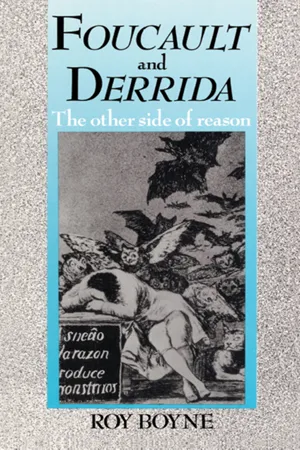
The writings of Michel Foucault and Jacques Derrida pose a serious challenge to the old established, but now seriously compromised forms of thought. In this compelling book, Roy Boyne explains the very significant advances for which they have been responsible, their general importance for the human sciences, and the forms of hope that they offer for an age often characterized by scepticism, cynicism and reaction. The focus of the book is the dispute between Foucault and Derrida on the nature of reason, madness and 'otherness'. The range of issues covered includes the birth of the prison, problems of textual interpretation, the nature of the self and contemporary movements such as socialism, feminism and anti-racialism. Roy Boyne argues that whilst the two thinkers chose very different paths, they were in fact rather surprisingly to converge upon the common ground of power and ethics. Despite the evident honesty, importance and adventurousness of the work of Foucault and Derrida, many also find it difficult and opaque. Roy Boyne has performed a major service for students of their writings in this compelling and accessible book.
Information
1 Foucault on Madness
Three major narratives intertwine within Foucault’s text, Madness and Civilisation.1 They concern the political economy of madness,2 the representation of madness in art and literature, and the relation between madness and science. As we will see in the course of the following expositions, questions can be raised regarding the accuracy of the historical research that lies behind them, and concerning the cogency of both the lines of argumentation and the schemas of interpretation. The important point to grasp, however, is that while specific criticisms may be sustained with respect to some of Foucault’s particular statements, what cannot be disputed is the force of his demonstration that the contemporary understanding of mental illness has been shaped by a complex cultural, political, economic and epistemological history. It is a demonstration that completely transcends the geographical restrictions of the research, limited as it is almost entirely to the history of France. As even his fiercest critics will admit, Foucault’s book on madness has provided one of the main inspirations for the rethinking, over the last three decades or so, of the nature of insanity.
Foucault’s voice is one of the most powerful in that chorus that tells us that to understand the present we must look to the past. We must recognize, however, that access to the past is policed. The normal methods of historical inquiry, and the widespread versions of historical truth, may both function to legitimate the practices of the present. The iconoclastic historian plays a political role.
The Political Economy of Madness
Leprosy was widespread throughout medieval Europe. Foucault’s research revealed that 220 lazar houses existed in twelfth-century England and Scotland alone. Throughout Europe at this time there were many thousands of lepers, and extensive provision was made for their exclusion from ordinary society. Attitudes to leprosy were compounded of fear, revulsion and disapprobation, but lepers were nevertheless often well cared for (Midelfort, 1980, p. 253). We have, then, a peculiar phenomenon: lepers were reviled, and excluded from ordinary society; but the places of exile to which the lepers were confined were sufficiently well endowed to provide a regime of care for the victims of the disease. The ‘immense fortune represented by the endowments of the lazar houses’ (MC, p. 4) testifies to the cultural significance of the leper within the medieval worldview. For Foucault, the leper was the Other of the medieval world, a prime source of contamination which was to be treated with respectful fear.
For reasons that are to some extent still obscure, leprosy was much less common by the time of the Renaissance. The practice of social exclusion appears to have had its effect, even if, in contrast with measures taken to control the plague some centuries later,3 eradication had not been its prime intent. Two questions arise in respect of this reduction in the incidence of leprosy. The first relates to the symbolic function of the leper: what figure is to become the new Other of European society? The second relates to the changes which were bound to take place in what we might call the economy of exclusion. Foucault will show that these two questions are tightly woven together.
The subsisting economic structure, exemplified by the wealth of the lazar houses, was not simply dismantled, with administrative self-congratulation as to a job well done. There was, argues Foucault, a period of disorganized transition extending over some two centuries or more. In part, sufferers from venereal disease inherited both the economic and social legacy of the leper. As Foucault puts it, speaking of the developments in the sixteenth century, ‘a new leper is born, who takes the place of the first’ (HF, p. 17). But this was neither a smooth nor total transition. While some establishments began to treat syphilitics, in what we might see as the second wave of medicine’s institutionally located confrontations with madness,4 others remained empty for decades. From the middle of the sixteenth century, beginning with the census which François I had undertaken in 1543, the aim of which was to ‘remedy the great disorder that exists at present in the lazar houses’ (MC, p. 4), a European reorganization and reorientation of the financial infrastructure of exclusion took place. The new isolates were to be the pariahs of non-productivity: the poor, the criminal, the homeless and the mad. How is this new focus to be accounted for?
It is important to set the context. The fifteenth century had been largely a period of economic expansion, and this extended well into the 1600s. But by 1640 this period of expansion was over, and, in France particularly, recession had set in. Among the factors contributing to the complex economic crisis which affected the whole of seventeenth-century Europe, Foucault mentions ‘reduction of wages, unemployment, scarcity of coin’ (MC, p. 49). To this can be added the cost of such military conflicts as the Thirty Years War, regular famine and plague which affected the state’s ability to sustain unprecedentedly high levels of taxation, and demographic contraction which contrasted with the population increases which had at least partly underpinned the previous period of expansion. Against this economic backdrop, the French political system was in a condition of upheaval as the monarchy, in alliance with the rising bourgeoisie, made inroads into the power of the feudal nobility, and built up a pervasive bureaucracy.5 As Foucault writes, ‘This structure proper to the monarchical and bourgeois order of France, contemporary with its organization in absolutist forms, soon extended its network over the whole of France’ (MC, p. 41).
Alongside these changes in social structure, the general attitudes and values of European culture were also changing. While it may have been the case, as Weber (1930, p. 177) suggests, that there was a certain celebration of poverty in the medieval mendicant orders, by the beginning of the seventeenth century the position was very different. During the sixteenth and early seventeenth centuries, beggary was anathematized. The poor and homeless were sometimes used as slave labour, in the sewers of Paris, for example, or in the galleys of Spain.6 At other times, they were expelled from the cities, whether informally or by official decree. The armies of beggars and vagabonds created by the desperate social conditions of Reformation Europe came to be seen as both a political problem, a ‘police’ matter as Foucault might say, and an affront to the newly developing ethic of work.
As the absolutist states of Europe extended their administrative reach, the Church was effecting both ideological and practical withdrawal from that part of its role which had formerly been concerned with succouring the poor. The teachings of Luther and Calvin, whether received favourably or not, found an echo throughout Europe, as poverty came to be seen as a secular matter. As Foucault explains:
Poverty is no longer held within a dialectic of humiliation and glory, but in a certain relation between disorder and order which surrounds it with guilt. Already, since Luther and Calvin, bearing the marks of eternal punishment, it will become in the world of state-controlled charity complacency in itself and an offence against the good workings of the state.7 (HF, p. 70)
Economic depression, changed attitudes to poverty, the de facto withdrawal of the Church, the emergence of a new work ethic, the administrative expansion of the state, all these factors combine to usher in what Foucault calls ‘the age of confinement’. It is, as he notes, ‘a phenomenon of European dimensions’. These factors help to explain the workhouse movement in England and the houses of correction – the Zuchthausern – in Germany. But Foucault’s main focus is on France, and here he identifies a specific moment: the decree of 1656 which founds the General Hospital in Paris.
On the surface, the foundation of the General Hospital appears to be just an administrative regrouping of several pre-existing establishments. Under the king’s edict, a variety of establishments were assigned to the poor of Paris. Article eleven of the edict specified that this applied to the destitute ‘of both sexes, of all ages and from all localities, of whatever breeding and birth, in whatever state they may be, able-bodied or invalid, sick or convalescent, curable or incurable’ (MC, p. 40). On Monday 14 May, 1657, following a second edict which made all forms of begging illegal, the militia began to round up the beggars, thence distributing them around the various buildings of the General Hospital. According to Foucault, this absolutist trawl through the murky waters of destitution netted up to 6,000 people in Paris alone: mad people, libertines, criminals, deviants of all kinds. Poverty, the moral disease of the idle and unproductive, was the necessary and sufficient condition for admission to the hospital. By the time of the Revolution, there were thirty-two such hospitals throughout France.
The constitution of these places makes them truly symbolic, for they were constituted as an entirely autonomous juridical estate. The edict of 1656 speaks of ‘stakes, irons, prisons and dungeons’ and sets down that no appeal will be allowed with respect to whatever regulations the directors of the General Hospital deem necessary. Thus the inmates of these institutions were both physically and administratively excluded from civil and political society. The insane would find their home in these places apart, not because they were ill, but because they were unproductive.
There is some dispute as to the nature of the hospital regime. Foucault asserts, not incorrectly it would seem, that attempts were made to put the inmates of these institutions to work. It is on this basis, as well as paying due regard to the poor as a potentially politically destabilizing social group, that he can say that confinement was not simply a response to a concatenation of crisis conditions in seventeenth-century Europe. He writes:
Outside of the periods of crisis, confinement acquired another meaning. Its repressive function was combined with a new use. It was no longer merely a question of confining those out of work, but of giving work to those who had been confined and thus making them contribute to the prosperity of all. The alternation is clear: cheap manpower in the periods of full employment and high salaries; and in periods of unemployment, reabsorption of the idle and social protection against agitation and uprisings. (MC, p. 51)
The symbolic import of the General Hospital rests on the radical exclusion of its inmates. Foucault’s history of madness is based on the idea that one can try to document the history of the various forms taken by the social Other, that one can show, by analysing the economic, political and cultural context, how particular groups came to occupy, at various times, the position of the Other. Yet the symbolic equivalence of poverty and leprosy as, in their different epochs, the social Other, was not so firmly fixed. Even if they were often unsuccessful, attempts were made to put the hospital inmates to work. Such attempts hardly attest to the ritual exclusion of the poor from society. It must also be added that this exclusion of the lumpenproletariat from society was nothing like totally effective: poverty was still much in evidence on the streets of Paris, and the politically subversive role of the underclass in eighteenth-century France is well documented (Marx, 1973). The otherness of non-productivity is, then, only partial. Indeed, the General Hospital came to be seen as a place of ‘privileged idleness’. In this history of otherness, we are at a transitional stage. But the ethic of work and of contribution to social well-being was crucial. Not only did this somewhat inefficient internment of the unproductive affirm the continuing relevance of the process of exclusion, it was also out of this heterogeneous process of incarceration that the mad were gradually crystallized, from the seventeenth century onwards, as the definitive social Other of the modern period. It was the inability of the insane to make any ordered contribution to the economic functioning of the hospitals that helped prepare the way for the closing of the symbolic transference.8
What were these places of confinement really like? Drawing upon official records and the reports of contemporary witnesses, Foucault paints a dark picture of filth and suffering. These hospitals were hard to distinguish from prisons. They were regimes of punishment and moral condemnation, a fact which is underlined in Foucault’s account of the treatment of venereals within this system (HF, pp. 97–101). It is hardly surprising, Foucault comments, that the insane could be found somewhat indifferently between the prisons and the General Hospital (HF, p. 129). There was little difference between the two kinds of institution. Both were concerned with the neutralization of threats to social order, whether these lay with the animal ferocity of madness, the violence of crime, or the sedition of immorality. Tolerance, rehabilitation and cure were not central items in the absolutist lexicon.
But there was another tradition, one in which medicine and madness were not foreign to each other. This tradition follows ‘the monastic inspiration of custodial care, redemption or rehabilitation as opposed to the sepulchral model of the leprosarium’ (Midelfort, 1980, p. 256). Foucault saw that this humane model was actually a residue from the past. These practices, contrary to Midelfort’s suggestion that their significance was radically underestimated, were merely a preamble to internment:
The world of madness was not uniform in the classical period. It would not be false, but partial, to pretend that the mad were treated, purely and simply, as prisoners of the authorities.
Some of them have a special status. In Paris, one hospital reserves the right to treat poor people who have lost their minds. To the extent that it can still be hoped to cure a mad person, they may be admitted to the Hôtel–Dieu. The customary care will be provided there: Bleedings, purgations, and in certain cases, the application of blistering agents and baths. This was an old tradition, since this same Hôtel-Dieu was already reserving places for the mad in the Middle Ages ... But if, after some weeks, the patients have not been cured, the men are directed to Bicêtre, the women to La Salpêtrière. In total, and for the whole of the population of Paris and the surrounding area, there were 74 places reserved for the care of the insane – 74 places constituting the ante-chamber before an internment which precisely signifies the fall away from a world of illness, remedies and eventual cure. (HF, pp. 125–-6)
Foucault, then, allows that alongside the massive phenomenon of confinement there existed a social and textual space, whose origins are pre-classical, going right back to Hippocrates, within which a therapeutics of madness is articulated. He will exploit this space to the full, as we shall see in the section of this chapter devoted to madness and science. But the existence of this marginal tradition does not detract from the basic thesis that the origins of confinement are economic, political and cultural, and that it set the scene for the occupation by madness of the vacuum created in the symbolic order brought about by the disappearance of leprosy.
During the 150-year history of the general hospitals in France, poverty was slowly freed from absolute moral condemnation. Industrial growth over this period meant that a labouring class became an economic necessity for national wealth. Poverty could no longer be easily taken as a sign of idleness and promise of social disorder. It became the very opposite of this. As Foucault writes:
In the mercantilist economy, the Pauper, being neither producer nor consumer, had no place: idle, vagabond, unemployed, he belonged only to confinement, a measure by which he was exiled and as it were abstracted from society. With the nascent industry which needs manpower, he once again plays a part in the body of the nation. (MC, p. 230)
The houses of confinement came to be seen as instances of outmoded and economically irrational charity. The secret of wealth would be the exploitation of the poor, not their imprisonment.
Foucault had tried to ask what it was that had bound the inhabitants of the General Hospital into one category. What did the insane, the destitute and the immoral have in common? His answer is that they are outside of the limits of social order as determined by the political and economic conditions of absolutism. Confinement was an ethical response to these conditions, and the play of social forces created a categorial unity which is hard, in the late twentieth century, to understand. As confinement came to an end, at the beginning of the nineteenth century, a new discourse had developed, that of economics. Poverty would now be treated in numerical rather than ethical terms. Both during and after confinement, even though the discourse undergoes fundamental alteration, the understanding and treatment of poverty was an economic and political affair.
Consternation over confinement also emerged in a different way. Even though the attempts to introduce various forms of work into the places of confinement must be deemed to have failed, these attempts did play their part in the gradual differentiation of the mad from the other inmates. It was not merely ...
Table of contents
- Cover
- Title Page
- Copyright Page
- Contents
- List of plates
- Acknowledgements
- Introduction
- 1 Foucault on Madness
- 2 The Cartesian Exclusion
- 3 Derrida and Foucault
- 4 The Text and the Body
- 5 Post-Hierarchical Politics
- Conclusion: Difference and the Other
- Bibliography
- Index
Trusted by 375,005 students
Access to over 1.5 million titles for a fair monthly price.
Study more efficiently using our study tools.
Frequently asked questions
Yes, you can cancel anytime from the Subscription tab in your account settings on the Perlego website. Your subscription will stay active until the end of your current billing period. Learn how to cancel your subscription
No, books cannot be downloaded as external files, such as PDFs, for use outside of Perlego. However, you can download books within the Perlego app for offline reading on mobile or tablet. Learn how to download books offline
Perlego offers two plans: Essential and Complete
- Essential is ideal for learners and professionals who enjoy exploring a wide range of subjects. Access the Essential Library with 800,000+ trusted titles and best-sellers across business, personal growth, and the humanities. Includes unlimited reading time and Standard Read Aloud voice.
- Complete: Perfect for advanced learners and researchers needing full, unrestricted access. Unlock 1.5M+ books across hundreds of subjects, including academic and specialized titles. The Complete Plan also includes advanced features like Premium Read Aloud and Research Assistant.
We are an online textbook subscription service, where you can get access to an entire online library for less than the price of a single book per month. With over 1.5 million books across 990+ topics, we’ve got you covered! Learn about our mission
Look out for the read-aloud symbol on your next book to see if you can listen to it. The read-aloud tool reads text aloud for you, highlighting the text as it is being read. You can pause it, speed it up and slow it down. Learn more about Read Aloud
Yes! You can use the Perlego app on both iOS and Android devices to read anytime, anywhere — even offline. Perfect for commutes or when you’re on the go.
Please note we cannot support devices running on iOS 13 and Android 7 or earlier. Learn more about using the app
Please note we cannot support devices running on iOS 13 and Android 7 or earlier. Learn more about using the app
Yes, you can access Foucault and Derrida by Roy Boyne in PDF and/or ePUB format, as well as other popular books in Philosophy & Deconstruction in Philosophy. We have over 1.5 million books available in our catalogue for you to explore.