No Platform
eBook - ePub

No Platform

A History of Anti-Fascism, Universities and the Limits of Free Speech

  1. 230 pages
  2. English
  3. ePUB (mobile friendly)
  4. Available on iOS & Android
eBook - ePub

No Platform

A History of Anti-Fascism, Universities and the Limits of Free Speech

About this book

This book is the first to outline the history of the tactic of 'no platforming' at British universities since the 1970s, looking at more than four decades of student protest against racist and fascist figures on campus.

The tactic of 'no platforming' has been used at British universities and colleges since the National Union of Students adopted the policy in the mid-1970s. The author traces the origins of the tactic from the militant anti-fascism of the 1930s–1940s and looks at how it has developed since the 1970s, being applied to various targets over the last 40 years, including sexists, homophobes, right-wing politicians and Islamic fundamentalists. This book provides a historical intervention in the current debates over the alleged free speech 'crisis' perceived to be plaguing universities in Britain, as well as North America and Australasia.

No Platform: A History of Anti-Fascism, Universities and the Limits of Free Speech is for academics and students, as well as the general reader, interested in modern British history, politics and higher education. Readers interested in contemporary debates over freedom of speech and academic freedom will also have much to discover in this book.

Frequently asked questions

Yes, you can cancel anytime from the Subscription tab in your account settings on the Perlego website. Your subscription will stay active until the end of your current billing period. Learn how to cancel your subscription.
At the moment all of our mobile-responsive ePub books are available to download via the app. Most of our PDFs are also available to download and we're working on making the final remaining ones downloadable now. Learn more here.
Perlego offers two plans: Essential and Complete
  • Essential is ideal for learners and professionals who enjoy exploring a wide range of subjects. Access the Essential Library with 800,000+ trusted titles and best-sellers across business, personal growth, and the humanities. Includes unlimited reading time and Standard Read Aloud voice.
  • Complete: Perfect for advanced learners and researchers needing full, unrestricted access. Unlock 1.4M+ books across hundreds of subjects, including academic and specialized titles. The Complete Plan also includes advanced features like Premium Read Aloud and Research Assistant.
Both plans are available with monthly, semester, or annual billing cycles.
We are an online textbook subscription service, where you can get access to an entire online library for less than the price of a single book per month. With over 1 million books across 1000+ topics, we’ve got you covered! Learn more here.
Look out for the read-aloud symbol on your next book to see if you can listen to it. The read-aloud tool reads text aloud for you, highlighting the text as it is being read. You can pause it, speed it up and slow it down. Learn more here.
Yes! You can use the Perlego app on both iOS or Android devices to read anytime, anywhere — even offline. Perfect for commutes or when you’re on the go.
Please note we cannot support devices running on iOS 13 and Android 7 or earlier. Learn more about using the app.
Yes, you can access No Platform by Evan Smith in PDF and/or ePUB format, as well as other popular books in Política y relaciones internacionales & Democracia. We have over one million books available in our catalogue for you to explore.

Information

1

‘No platform’ in historical and contemporary context

In October 2018, the short-lived UK Universities Minister Sam Gyimah wrote about the alleged ‘culture of censorship creeping into society’, particularly in the context of universities and colleges.1 He argued that this was a new phenomenon, exacerbated by social media, and proclaimed:
a cultural shift is taking place, and diversity of thought is becoming harder to find as societal views become highly polarised between the left and the right. A culture of censorship has gradually been creeping in, and a monoculture is now emerging where some views are ‘in’ and others are clearly ‘out’.2
For Gyimah, ‘the rise of no-platforming, safe spaces, trigger warnings and protest’ was to blame for cultural shift, with him claiming that these practices were ‘all too easy [being] appropriated as tools to deny a voice to those who hold opinions that go against the sanctioned view’.3 This was, in his eyes, ‘catastrophic for democratic debate and puts at risk the fundamental right to be heard that many have fought and died for’.4
Gyimah suggested that these protest tactics threatened civility on campus and did not allow ‘all sides’ of a debate to be heard ‘without fear of harassment or intimidation’.5 However the Universities Minister did not seem to acknowledge that those who were being ‘no platformed’, such as fascists, racists, sexists, homophobes and transphobes, were often the ones who were threatening civility and creating a culture of harassment and intimidation at universities.
While suggesting that debate had lost its civility, Gyimah also declared that ‘[g]oing to university is meant to be an assault on the senses’ and that they should be spaces with ‘dissenting voices and challenging opinions’.6 This is a sentiment that has been shared by many commentators and politicians in recent years – that higher education needed to expose students to ideas that they might find offensive and that attempts to avoid this demonstrated that students of today were overtly sensitive.
Popularised in the UK discourse by a contributor to Spiked Online, Claire Fox, the term ‘snowflake’ has been used to negatively describe these supposedly naïve and politically correct students who are unable to engage with ‘challenging’ ideas. In her 2016 book, I Find That Offensive, Fox suggests that a mixture of identity politics and risk aversion embraced by today’s students threatens the ‘liberal values of tolerance and resilience’, supposedly menacing the prospect of free speech on campus.7 On the other side of the Atlantic, Greg Lukianoff and Jonathan Haidt have argued that students in the United States have come to see themselves as ‘fragile’ and unwilling to engage with provocative and controversial ideas.8
This is a concept that has been readily accepted by many in the mainstream media and the political sphere, from the centre left to hard right, in Britain, as well as across the Western world. For example, in 2015, Nick Cohen in The Guardian wrote: ‘Rather than being free institutions where the young could expand their minds, British universities were becoming “theological colleges” where secular priests enforced prohibitions.’9
Meanwhile, former UKIP leader and now leader of the Brexit Party, Nigel Farage, has recently stated while speaking in the United States that left-wing students were a threat to democracy, proclaiming:
I mean frankly the real fascism these days, the real intolerance isn’t Matteo Salvini or Donald Trump, it’s those on the left who wish to shout down the other side and indeed on campuses like this, across America and across the whole of the UK, attempt to no platform speakers who’ve got ideas they don’t like. That’s the real modern fascism, the attempt to close down free speech.10
For those supposedly concerned about free speech at universities, students are at the same time both fragile, risk averse ‘snowflakes’ and heavy-handed McCarthy-like warriors. Students are to be both pitied and feared.
Nigel Farage’s speech to an American audience about the topic shows that this panic about censorious students has gone global. In an era of a resurgent far right, conservatives and libertarians in the United States, Canada, Australia and New Zealand have expressed alarm about the end of freedom of speech on university campuses. At a moment when students have seemingly become more vocal about rejecting all forms of hate speech (including racism, misogyny, homophobia and transphobia), the concept of free speech has been weaponised by the right in its various guises as a smokescreen to air offensiveness and to promulgate far right ideas about race, sexuality and gender. As Will Davies has written:
the very notion of ‘free speech’ has become a trap. Neo-fascist or alt-right movements now use it to attack alleged ‘political correctness’, using the principle of free expression to push hateful and threatening messages towards minority groups … Whereas intellectual freedom was once advanced in Europe as the right to publish texts that were critical of the establishment, it has now become tied up with spurious arguments surrounding the ‘right to offend’.11
Far right figures, such as co-founder of the English Defence League, Tommy Robinson (real name Stephen Yaxley Lennon), or alt-right personality Milo Yiannopoulos, have thus portrayed themselves as the defenders of free speech against the politically correct elites. These figures have been further enabled by the free speech absolutism celebrated by a series of right-wing and right libertarian commentators and politicians. This has become a lucrative industry, generating a number of books, countless media articles and dozens of television and radio appearances for those who promote the idea of a free speech ‘crisis’.
At the centre of this moral panic about the free speech ‘crisis’ at British universities is the concept of ‘no platform’. ‘No platform’ is, at its core, a policy instituted by the National Union of Students (NUS) that has allowed student unions to withhold resources, such union-run spaces and funds, from fascist and racist organisations and speakers, as well as disinvite these speakers if invited by certain student groups, or encourage protest activities that attempt to prevent these people from speaking on campus, such as pickets. Extending from this policy, some have used the principle of ‘no platform’ to argue for the disruption of fascist and racists from speaking at universities or from having a physical presence on campus. These forms of disruption, discouraged by the NUS and individual student unions, can take the form of heckling, throwing various things or the physical occupation of the contested space. This has often led to disagreements between student activists over the official use of the ‘no platform’ policy and the more spontaneous student activities that have sought to directly challenge fascists and racists who have come onto campus. There has also been heated debate over the limits of the ‘no platform’ policy, as some have pushed for it to be extended to other forms of oppression and that sexists, homophobes and transphobes should also be ‘no platformed’. At various points in time, some have also argued that Zionists or Islamic fundamentalists should be subject to the ‘no platform’ policy. Despite a short revoking of the policy in the late 1970s, the policy of ‘no platform’ has remained in place for over 45 years.
In the current climate, ‘no platforming’ is seen as the primary tactic used by the student left to purportedly undermine free speech, alongside the creation of ‘safe spaces’ and the use of ‘trigger warnings’. The denial of a platform for those deemed to be espousing hateful or harmful speech, a tactic widely known as ‘no platform’ in Britain since the mid-1970s, has been viewed as a modern scourge that has mutated away from its anti-fascist origins to become a blunt tool used by the bureaucratic student unions to shut down controversial ideas. Tom Slater, one of Spiked Online’s key contributors, wrote in The Spectator in 2016: ‘Where once SUs reserved censorship for fascists, now radical feminists, secularists and anti-Islamists – from Germaine Greer to Maryam Namazie and Julie Bindel – are seen as beyond the pale, liable to compromise the “mental safety” of students.’12
The moral panic about students has shifted, from a concern about students being violent subversives to students being intolerant zealots – and ‘no platform’ is seen as central to how students quash dissent. This is a reflection of a shift in perceptions of the power of the student movement over the last four decades, which has been in decline since the days of Thatcherism. Although the collective force of students occasionally rears its head (such as during the 2010–11 protests against tuition fees),13 the student movement nowadays is no longer seen as the subversive threat that it once supposedly was. But universities are still seen as sites of resistance to the status quo and where political correctness and wokeness reign. A recent Policy Exchange report by Thomas Simpson and controversial academic Eric Kaufmann claimed that ‘Britain’s universities are being stifled by a culture on conformity’ and that ‘academic freedom is being significantly infringed’ by a combination of student activists and partisan academics.14
The purpose of this book is to challenge the narrative of a newly emergent student movement that has repurposed ‘no platform’ for spurious politically correct agendas. The book explores the shifts in ‘no platform’ as a tactic, as well as the reaction to it. Although formally introduced by the NUS in 1974 as a reaction to the rise of the National Front (NF) in Britain, ‘no platform’ had its antecedents in the anti-fascist battles of the 1930s and 1940s, and the student movement of the late 1960s and early 1970s. Since then, it has been continually re-evaluated. While its primary focus has been on fascists and racists, it has been used against a number of different targets of student protest. Sometimes this has been controversial, such as its use in the 1970s against pro-Israel student groups, against anti-abortionists in the 1980s or against Islamic fundamentalists in the 1990s. Even in the twenty-first century, it remains a living and reflexive tactic, which students themselves determine, debate and continue to argue over. Overall the tactic of ‘no platform’ has generally been employed to prevent explicitly racist, sexist, homophobic or transphobic speakers from having a platform to broadcast their views in a university environment. Proponents argue that to allow these hateful views to be promoted on campus would contribute to a harmful environment for certain groups, such as ethnic minorities, women and LGBTQ+ people. Furthermore, allowing these views to be promoted would help to normalis...
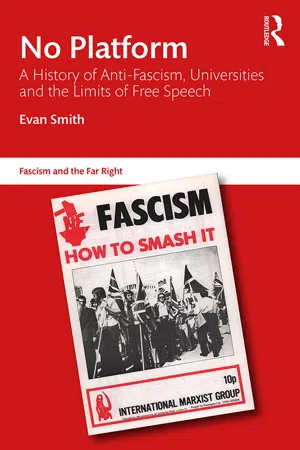
Table of contents

  1. Cover
  2. Half Title
  3. Series Page
  4. Title Page
  5. Copyright Page
  6. Table of Contents
  7. Acknowledgements
  8. 1. ‘No platform’ in historical and contemporary context
  9. 2. Fascism, anti-fascism and free speech before ‘no platform’
  10. 3. The student movement and the prelude to ‘no platform’
  11. 4. The National Union of Students and ‘no platform’ in the 1970s
  12. 5. Expanding ‘no platform’ in the 1980s
  13. 6. Hard right politicians and student protests at universities in the 1980s
  14. 7. Into the twenty-first century
  15. 8. Why ‘no platform’ matters
  16. Index