- 320 pages
- English
- ePUB (mobile friendly)
- Available on iOS & Android
eBook - ePub
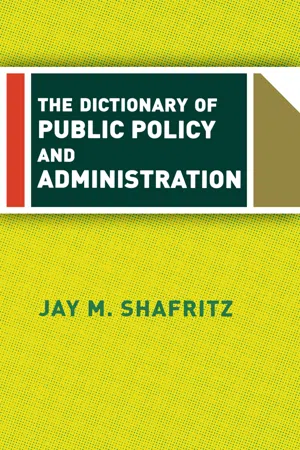
The Dictionary Of Public Policy And Administration
About this book
The Dictionary of Public Policy and Administration offers definitions of all the key terms, concepts, processes and practices of contemporary public policy and administration. Included are brief biographies of major scholars and influential practitioners, summaries of major rulings by the U.S. Supreme Court, overviews of significant laws, descriptions of important government agencies, and explanations of historical trends and governing doctrines. The Dictionary is designed to be the single most useful tool that a student or practitioner of public administration could have—the book to keep at their side while they are reading other textbooks in the field.
Information
C
cabinet The heads of the executive departments of a jurisdiction who report to and advise its chief executive; for example, the presidents cabinet, the governors cabinet, the mayors cabinet.
cabinet government 1. The British parliamentary system, whereby the cabinet as a whole, rather than the prime minister who heads it, is considered the executive, and the cabinet is collectively responsible to Parliament for its performance. In addition, whereas in the United States the cabinet secretaries are only of the executive branch, in Britain, the cabinet ministers are typically drawn from among the majority party’s members in Parliament. 2. A concept informally applied to a U.S. presidents assertion that he and his cabinet are going to work together as a team.
cabinet, inner The federal departments of State, Defense, Treasury, and Justice—because they (and their secretaries) tend to be more prominent and influential in every administration than the rest of the (or outer) cabinet. Although all cabinet secretaries are equal in rank and salary, the missions of those in the inner cabinet give them an advantage in prestige, access, and visibility.
cabinet, kitchen The informal advisors of a chief executive. First used derisively for some of President Andrew Jacksons advisors: kitchen implying they were not respectable enough to meet in the more formal rooms of the White House. Over the years, the term has lost its derisive quality.
cabinet, war An informal term for those cabinet secretaries, agency heads, and officials who are the presidents primary source of policy advice and military action during wartime.
cadre 1. The most dedicated members of a political party. 2. The founding members of a political organization who thereupon expand the organization by enlisting new members. 3. A detachment from an existing organization capable of being the training nucleus about which a new organizational unit can be built. In a military context, cadres of commissioned as well as noncommissioned officers have always been critical for rapidly expanding an army.
camel’s nose One of the principal strategies bureaucrats use to obtain funding for a new program. They begin with an appropriation request that appears insignificant until it becomes part of the agency’s base and must be funded at a much higher level if the program is to be completed.
capacity building 1. All systems, efforts, and processes that strengthen the capability of government officials to better plan, implement, manage, and evaluate programs. 2. The development of the physical and human infrastructure for economic advancement. The term is used in the context of the THIRD WORLD to refer to the needs for better ports, bridges, and roads, as well as for a highly trained and well-educated workforce.
capital 1. The city in which a central government is located. New York City became the first capital of the United States (1789); Philadelphia became the capital in 1790; since 1800, the capital has been Washington, D.C. Compare to CAPITOL. 2. Wealth; one of the three traditional factors of production, the others being land and labor. See HUMAN CAPITAL.
capital campaign A nonprofit organizations fund-raising effort that focuses on raising money for major projects; for example, a new building, the repair or expansion of an old one, or an increase in an endowment.
capital flight 1. The removal of financial capital from a state to safer places where interest rates are higher and inflation is lower, or to escape confiscation by a government. 2. The illegal movement of stolen funds across international borders to escape taxation or other unpopular economic conditions.
capital intensive A production process requiring a large proportion of capital relative to labor.
capital investment 1. Generally, new plants and equipment. 2. In the public sector, a major expense that provides benefits beyond a single budget cycle, such as bridges and buildings. Less clear is whether intangible investments in education and training programs, for example, should be classified as a capital investment. This is a significant issue because capital spending is often financed by borrowing. See also BUDGET, CAPITAL.
capital punishment The death penalty. The word capital is derived from caput, the Latin word meaning “head”; thus, the term head punishment once meant that you had to give up your head—that it would be cut off.
capital sector The international economy as a whole wherein investment funds flow relatively unobstructed across national borders.
capitalism An economic system characterized by a combination of private ownership of most means of production and trade, a generally unrestricted marketplace of goods and services, and a general assumption that the bulk of the workforce will be engaged in employment by private (nongovernmental) companies engaged in producing goods and providing services to sell at a profit. The Scottish economist ADAM SMITH (1723–1790) provided the first systematic analysis of the economic phenomena of laissez-faire capitalism. In The Wealth of Nations (1776), Smith discovered an “invisible hand” that automatically promotes the general welfare as long as individuals are allowed to pursue their self-interest. To believers in capitalism, this form of economic organization provides the greatest chance of maximizing economic performance and defending political liberty while securing something approaching equality of opportunity. However, classic unrestrained laissez-faire capitalism is today only a theory because all modern capitalistic societies have mixed economies that temper capitalism with government regulation and social welfare measures. Compare to MARXISM.
Capitol 1. The domed building in which the Congress of the United States meets. 2. The building in which a state legislature meets; also called a state-house. Compare to CAPITAL.
capture theory The argument that when public services become “captured” by special constituencies, the end result is a suboptimal allocation of resources in the interests of those constituencies. This means that public funds will tend to be spent in the interests of those constituencies—and not in the interests of the general public.
cartel 1. An alliance or arrangement among industrial, commercial, or state-controlled enterprises in the same field of business aimed at securing a monopoly. A cartel usually seeks to control production so as to raise prices and maximize profits. Cartels almost always fail in their goals if there are ample supplies of the commodity or available substitutes. In the end even temporarily successful cartels fail because they often drive prices up to where new sources enter the market. 2. An agreement between belligerents to arrange for specified non-hostile relations such as an exchange of wounded.
case 1. A legal dispute, whether criminal or civil, that goes to court. 2. A courts opinion deciding a case. 3. The evidence and arguments presented by each side in a legal dispute. 4. A systematic presentation of arguments in favor of, or in opposition to, a position or circumstances.
case law All recorded judicial and administrative agency decisions.
case study A research design that focuses upon the indepth analysis of one subject. It is particularly useful for the understanding of dynamic processes over time. Most traditional news stories use the case study approach. Note that aspiring journalists are taught that a story should contain all the essential elements of a case study: “who, what, why, when, where, and how.” The first case studies examined battles and wars. Thucydides’s History of the Peloponnesian War (404 B.C.E.) is the progenitor of these military case studies. Military colleges—and general staffs—have long used the case study method to review battles and study generalship. This same technique is now widely used in a civilian context to examine how policy proposals become law, how programs are implemented, and how special interests affect policy development. College courses in business and public administration often use a case study approach. An entire course may consist of case studies (frequently combined into a casebook) of management situations that are to be reviewed. The goal is to inculcate experience artificially. A manager rich in years of service will have lived through a lifetime of “cases.” By having students study many cases, each of which may have extended over many years, the case study course compresses time and experience. The relatively young student should then gain the insight and wisdom of an experienced manager.
casework 1. The services performed by legislators and their staffs at the request of and on behalf of constituents. For example, a U.S. senator may be asked to discover why a social security check has been delayed or why a veterans claim for benefits has been denied. Casework is an important means by which legislators maintain oversight of the bureaucracy and solidify their political base with constituents. 2. Generally, a method of providing services through a case-by-case treatment of individuals or groups, as in social work or medicine.
caseworker An employee of a government welfare agency resposible for determining and administering individual ENTITLEMENT BENEFITS.
catch-22 Contradictory bureaucratic requirements. This “catch” from Joseph Hellers 1961 novel of the same name about U.S. bomber crews during World War II meant that you could avoid flying combat missions if you were insane. All you had to do was ask. But if you asked, you were not insane, because seeking to avoid combat was a rational, not an insane, act. In Hellers words, a pilot “would be crazy to fly more missions and sane if he didn’t, but if he was sane, he had to fly them. If he flew them he was crazy and didn’t have to, but if he didn’t, he was sane and had to.” The “catch” is beautifully circular in its perversity. Because the book was such an enormous bestseller, catch-22 entered the language as the code word for the essence of bureaucratic dysfunctionalism, for being trapped between contradictory bureaucratic regulations. A common example of catch-22 is this double bind: A person can’t get a job without having experience but can’t get experience without first having a job. See also BUREAUCRATIC INCAPACITY.
cause The reason given for removing someone from an office or job (short for just cause). The cause cited may or may not be the real reason for the removal.
CBO See CONGRESSIONAL BUDGET OFFICE.
CEA See COUNCIL OF ECONOMIC ADVISERS.
cease-and-desist order A ruling, frequently issued in unfair labor practice and regulatory cases, that requires the charged party to stop conduct held to be illegal and to take specific action to remedy the unfair or illegal practice. Compare to CONSENT ORDER.
census In ancient Rome, the registration of citizens and their property to determine who owed what taxes and who was entitled to vote. The modern census seeks a vast array of statistical information and is not directly concerned with taxation or suffrage. Article I, Section 2, of the U.S. Constitution requires that a census be conducted every ten years so that seats in the U.S. House of Representatives can be appropriately apportioned among the states.
census undercount The contention that people are missed by the census count because they move, are fearful of filling out government forms, are illiterate, or other reasons. Because the count is critical for congressional districting and for the funding level of many intergovernmental grant programs, jurisdictions are apt to make an issue of what they consider to be an undercount.
central bank In most countries, the central monetary authority. Functions may include issuing a country’s currency, carrying out a nations monetary policy, and managing the country’s foreign exchange reserves and the external value of its currency. In the United States, the Federal Reserve System functions as the nation’s central bank, although it is not formally a central bank and is subject only to limited influences by the executive and legislative branches.
central clearance The Office of Management and Budget’s (OMB) coordination and assessment of recommendations and positions taken by the various federal departments and agencies on legislative matters as they relate to a president’s program. The first form of central clearance is substantive bill clearance. Drafts of bills from departments and agencies must clear the OMB before going to the U.S. Congress. Congressional committees also solicit views from interested agencies on substantive legislative bills emanating from sources other than the executive branch; however, executive agency responses are expected to be cleared by the OMB. The second form of central clearance is financial bill clearance. Since the Budget and Accounting Act of 1921, federal agencies have not had the authority to decide what appropriations to ask of the Congress. Instead, their proposed spending measure must clear the OMB. The third form of central clearance is enrolled bill clearance. When enrolled bill enactments come from the Congress to the president for signature or veto, the OMB solicits agency opinion on the merits of the congressionally approved legislation, evaluates these opinions, and prepares its own report to the president recommending either approval or veto and the reasons.
centrally planned economy A socialist or communist economic system wherein the government owns most means of production (factories) and makes all significant economic decisions.
certification of eligibles The procedure whereby those who have passed competitive civil service examinations have their names ranked in order of score and placed on a list of those eligible for appointment. When a government agency has a vacancy, it requests its personnel arm to provide a list of eligibles for the class to which the vacant position has been allocated. The personnel arm then certifies to the appointing authority the names of the highest-ranking eligibles. Usually, only a few of the qualified eligibles are certified. An agency requirement that three eligibles be certified to the appointing authority is called the rule of three.
certification proceeding A process by which the National Labor Relations Board and other administrative agencies determine whether a particular labor union is the majority choice and thus the exclusive bargaining agent for a group of employees in a given bargaining unit. Decertification is the opposite process.
certify To attest to the truth or accuracy of something; to guarantee that a standard on quantity or quality has been met; to make a legal determination. Some examples of things that are certified: a certified financial statement has been examined and reported upon with an opinion expressed by an independent public accountant; certified ...
Table of contents
- Cover
- Half Title
- Title
- Dedication
- Contents
- Foreword
- Preface
- A
- B
- C
- D
- E
- F
- G
- H
- I
- J
- K
- L
- M
- N
- O
- P
- Q
- R
- S
- T
- U
- V
- W
- Z
Trusted by 375,005 students
Access to over 1.5 million titles for a fair monthly price.
Study more efficiently using our study tools.
Frequently asked questions
Yes, you can cancel anytime from the Subscription tab in your account settings on the Perlego website. Your subscription will stay active until the end of your current billing period. Learn how to cancel your subscription
No, books cannot be downloaded as external files, such as PDFs, for use outside of Perlego. However, you can download books within the Perlego app for offline reading on mobile or tablet. Learn how to download books offline
Perlego offers two plans: Essential and Complete
- Essential is ideal for learners and professionals who enjoy exploring a wide range of subjects. Access the Essential Library with 800,000+ trusted titles and best-sellers across business, personal growth, and the humanities. Includes unlimited reading time and Standard Read Aloud voice.
- Complete: Perfect for advanced learners and researchers needing full, unrestricted access. Unlock 1.5M+ books across hundreds of subjects, including academic and specialized titles. The Complete Plan also includes advanced features like Premium Read Aloud and Research Assistant.
We are an online textbook subscription service, where you can get access to an entire online library for less than the price of a single book per month. With over 1.5 million books across 990+ topics, we’ve got you covered! Learn about our mission
Look out for the read-aloud symbol on your next book to see if you can listen to it. The read-aloud tool reads text aloud for you, highlighting the text as it is being read. You can pause it, speed it up and slow it down. Learn more about Read Aloud
Yes! You can use the Perlego app on both iOS and Android devices to read anytime, anywhere — even offline. Perfect for commutes or when you’re on the go.
Please note we cannot support devices running on iOS 13 and Android 7 or earlier. Learn more about using the app
Please note we cannot support devices running on iOS 13 and Android 7 or earlier. Learn more about using the app
Yes, you can access The Dictionary Of Public Policy And Administration by Jay Shafritz in PDF and/or ePUB format, as well as other popular books in Politics & International Relations & Politics. We have over 1.5 million books available in our catalogue for you to explore.