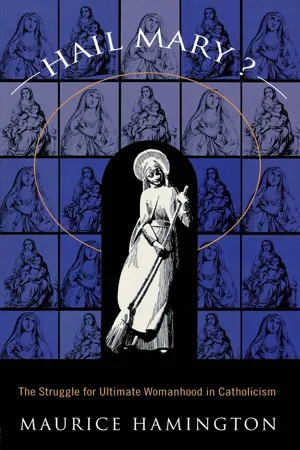
Hail Mary? examines the sexist and misogynist themes that underlie the socially constructed religious imagery of Mary, the mother of Jesus. Maurice Hamington explores the sources for three prominent Marian images: Mary as the "the blessed Virgin," Mary, the "Mediatrix"; and Mary, "the second Eve." Hamington critiques these images for the valorization of sexist forces with the Catholic Church that serve to maintain systems of oppression against women. In challenging dominant, religious representations of Mary, Hamington surveys a variety of emerging reinterpretations of Mary. He then provides a framework for further study of "non-alienating" images of Mary.
- 216 pages
- English
- ePUB (mobile friendly)
- Available on iOS & Android
eBook - ePub
About this book
Information
1
The History and Social Construction of Mary
“Mary”: the product of a tug of war lasting centuries.
—Els Maeckelberghe1
Understanding the history of the Cult of Mary is the key to unlocking the evolution of Marian images and, subsequently, their implication for modern Catholics. Whatever the role-defined image—Mary, the Virgin; Mary, the Mediatrix; or Mary, the New Eve—there is a particular historical setting, a set of social values, and a theological logic behind its origins. Time and social perspective may add layers of complexity to the rationale for each image, but an unraveling of the history is crucial for even a modicum of comprehension of Mary s complexity. Part of the task of feminist analysis is to question the traditional interpretation of historically specific events and ideas. Therefore, a feminist analysis of Marian imagery must begin with its origins.
Subsequent chapters will focus upon significant events in the history of particular Marian images as they impact current symbolic interpretation, but this chapter will provide the sweeping historical pageant of the Cult of Mary. The general history of Marian devotion provides an important framework for the theoretical and analytical presuppositions of this book. The Marian tradition is a complex weaving of theological logic, medieval Christian devotion, psychology, sexual morality, and politics. However, little in the Marian tradition is based on “facts” known about the life of Mary. I will conclude this chapter by demonstrating that Mary is the ultimate model of a religious social construction of reality.
The history of the Cult of Mary also demonstrates the stratified nature of Catholic theology. It is an error to assume that a unified Catholic perspective concerning the life and meaning of Mary has been preserved for two thousand years. Popular beliefs about Mary have risen from the masses who look upon her with beloved adoration. Church pronouncements and dogma about Mary serve the Christology at the heart of Catholicism. Outside the control of the Church hierarchy, independent theologians provide reflections upon Mary that include ethical analyses and symbolic implications. For Catholics, the symbolism of Mary integrates these various perspectives with another layer of complexity determined by culture and social values. All that Mary represents is bound together in the myths and legends that have been preserved. Feminist theologian Els Maeckelberghe describes Mary as a “patchwork quilt,” with every century adding another patch of cloth.2 If the modern understanding of Mary is considered the finished or latest quilt, one must gain knowledge of the historical pieces before the current quilt can be fully conceptualized. Therefore, viewing Mary in a historical perspective enables us to understand the evolution of Marian images into the multivariate symbol that is the Madonna today. These images involve an abundance of contradictions—handmaiden/queen, virgin/mother, role model/unattainable purity. Nevertheless, Mary continues to be a dominant force in Catholic tradition and theology, particularly for neo-conser-vative forces in the hierarchy.3
While the thesis of this book is that Mary is the linchpin for the future of Catholic feminists, and perhaps the Roman Catholic Church itself, it should be noted that she is a significant figure for other Christian denominations as well.4 Much has been written about Mary in the past several years by non-Catholic Christian feminists who discuss the role she should play in their theology and spirituality.5 Nevertheless Mary is primarily a Catholic phenomenon, although the negation of her role in Protestantism did not exonerate non-Catholic Christians from patriarchal behavior. For example, Rosemary Radford Ruether states that while liberal Protestantism has ordained women for several decades, there has been resistance to the commensurate rethinking of theological symbolism and ecclesiastical organization. Ordained Protestant women still appear in token numbers and are relegated to low-paid, marginal positions.6 The ecumenical search for female expression and experience of the divine that is harmonious with women’s experience fuels the feminist analysis of Mary.
While this book focuses upon Catholic feminism, the range of influence religion has in this society gives Mary s impact a wider social significance. Mary is part of western civilization s cultural experience, and she informs the social relations of men and women as they reflect upon religion and history. Nevertheless, this book centers upon Catholic experiences.
The Growth of the Cult of Mary
Overwhelming evidence exists that the early Cult of Mary was in continuity with the worship of ancient earth mothers and fertility goddesses of the pre-Christian era. Thus, in one sense, Mary’s history actually predates the Christian movement. Historians such as E. Ann Matter, for example, find that the Christianity of the first centuries denied the possibility of a feminine deity that was previously worshipped in ancient Europe in the forms of Epona, Freya, Herth, Mokosh, and others.7 As the followers of Christianity increased, and it was later mandated as a state religion, previous goddess worshippers merely supplanted or infused their spirituality with the Christian Mary. Antiquity scholar Stephen Benko refers to Marian piety as a direct continuation of the ancient goddess cult.8
There is evidence that some early Christian communities, such as the Collyridians, practiced rituals that honored Mary over Jesus.9 The Collyridian sect (some translate as “Collyrians” or “Kollyridians”) was recorded in the Panarion, or Medicine Chest, of St. Epiphanius of Salamis as the 79th heresy of the Church. He denounced the cult as “foolish, crazy idolatry and the work of the devil,” consisting of women who praise Mary “more than they ought.”10 The Collyridians worshipped Mary as a goddess and ordained women into their priesthood, although there is some evidence that they were antihierarchical. Geoffrey Ashe speculates that this community can be likened to early Christian feminists.11 The Collyridians appear to have had a lasting and widespread following. Reports of the sect spread from the south and west of the Black Sea to Arabia. Stephen Benko translates St. Epiphanius’s description of a Collyridian ceremony:
For some women decorate a carriage or a square chair by covering it with fine linen, and on a certain definite day of the year they set forth bread and offer it as a sacrifice in the name of Mary12
The bread or small cake referred to is a “collris,” thus giving the group its name. However, like most sects of the era, members probably simply referred to themselves as Christians.13 Benko speculates that the Collyridians were another example of goddess worship being absorbed into Christianity. Early Christian scholar Vasiliki Limberis supports this view because the locations of Collyridian devotion were long-standing places of worship to Rhea and Demeter. Many Collyridian practices paralleled Demeter cult rituals.14 Because of its extension of pre-Christian goddess religion, Collyridian devotion to Mary was elevated to the level of formal deity worship rather than subordinated to Christology.
This goddess assimilation was actually encouraged by the Church because it was an excellent missionary marketing strategy to pagan populations. In exchange for tolerating widespread devotion to Mary, the Church received a greater following. However, for the convert, the exchange was not always equal. Mary was not officially a Christian deity, although she replaced goddesses. Nevertheless, in the minds of the new Christians, Marian identification with the goddess remained.15 Many temples, titles, and iconography previously dedicated to popular goddesses were transferred over to Mary. For example, the image of Isis with Horus, the infant God-King on her lap was replaced by the Madonna imagery in artistic representations.16 Other examples of Goddess transference to Mary can be drawn from the cultural history of Christianized nations. In an analysis of female religious tradition in Celtic Ireland, for example, Mary Condren describes the historical transition of devotion from the powerful Irish goddess Brigit to the Christian Mary.17 Like Mary, Brigit was a complex multivariate figure (Triple Goddess, Virgin Mother, Lawmaker, and Virgin Saint) who represented a number of pre-Christian traditions in Ireland. Over time, Mary supplanted Brigit, but the transformation required some ecclesial intervention. In the seventh century, Pope Sergius ordered that feast days dedicated to the Virgin Mary be held on pagan holy days formerly dedicated to Brigit. Although Brigit faded into the religious background, she was not entirely forgotten. Brig-it’s final manifestation was as a fifth-century saint of Christianity.18
A belief in the goddess has existed as long as religion has been recorded in human civilization.19 The history of goddess worship made Mary’s assumption of various goddess legends anything but a simple transition occurring upon the dawn of Christianity. Faith in the ancient goddesses was strong and pervasive, with a variety of manifestations. In certain instances, Mary did not become associated with goddess legends until the Marian revival of the Middle Ages. Pamela Berger, for example, describes the myth of the “Grain Protectoress,” which had existed since the beginning of agriculture. Under a variety of names, and in many different cultures, the grain protectoress had been a goddess who, according to legend, at one time had been responsible for a miraculous growth of grain. Annual rituals of worship and honor developed around the Grain Protectoress. During the early middle ages, rural communities in Europe began to Christianize the grain goddess by associating Mary with this role; an apocryphal story described Mary as responsible for a grain miracle during her exile to Egypt.20 The Grain Protectoress is but one manifestation of the goddess tradition in the evolving Cult of Mary. This manifestation demonstrates another contradiction that is part of Mary s enigmatic tradition. Mary replaced pagan goddesses, but she never gained their status. There is no sanctioned goddess in the monotheism of Christianity. However, in actual practice, Mary was revered as a goddess much more than the ecclesial authorities would have liked.21 This issue will be explored in Chapter Four in an examination of Mary s religious power. From the beginning, the sublime Mary provided the Church with a means of consolidating power. Mary was a transitional figure for goddess worship who helped to bring non-Christians into the fold.22
The popular veneration of Mary is almost as old as Christianity itself Mary is mentioned in the gospels, but always in a small and limited role. She only appears in a handful of passages of the Second Testament,23 and even these few passages are of questionable historical origin and display the characteristics of a mythologized Mary.24 While specific scriptural analysis will be offered later, there are two significant implications for the rise of the Cult of Mary found in the first-century historical data. The first is that the Cult of Mary drew little from biblical information about the life of Mary. Her historical life remains a mystery that will probably never be solved; indeed a number of scholars have commented on the lack of information on which Mariology was built. Bruce Malina notes that “nearly everything claimed about Mary over the past two thousand years is simply not to be found in the Second Testament."25 Elizabeth Johnson reduces what is known about Mary to the fact that she was the Jewish mother of Jesus who misunderstood and then believed in him.26 Karl Rahner aptly stated, “The Church does not know Mary’s life story.”27 Finally, Geoffrey Ashe has quipped, “If Christ himself existed, Christ’s mother did; but a skeptic who questioned whether we know any more would have a case.”28
The second important implication of Marian origins is that factual data, or lack of it, did not impede the mercurial rise of the Cult of Mary. The gospel writers working in the late first century were already privy to a growing Marian legendary. The earliest known artistic representation of Mary comes from a fresco of the virgin and child painted circa 150 C.E.* in the catacombs of Priscilla in Rome. The first known prayer to Mary, Sub Tuum Praesidium, is dated from the late third to fourth century.29 This prayer was the first instance of public expression of Mary’s intercessory powers.30 Mary was the subject of serious theological meditation as early as the late second century, in works circulated by Justi...
Table of contents
- Cover
- Title Page
- Copyright Page
- Dedication
- Table of Contents
- Acknowledgments
- Introduction
- Chapter 1 The History and Social Construction of Mary
- Chapter 2 The Struggle to Control Mary
- Chapter 3 Catholic Sexual Morality and the Blessed Virgin Mary
- Chapter 4 Mary the Mediatrix and Asymmetrical Gender Power
- Chapter 5 Women and Evil / Mary and Eve
- Chapter 6 The Recasting of Marian Imagery
- Notes
- Index
Trusted by 375,005 students
Access to over 1.5 million titles for a fair monthly price.
Study more efficiently using our study tools.
Frequently asked questions
Yes, you can cancel anytime from the Subscription tab in your account settings on the Perlego website. Your subscription will stay active until the end of your current billing period. Learn how to cancel your subscription
No, books cannot be downloaded as external files, such as PDFs, for use outside of Perlego. However, you can download books within the Perlego app for offline reading on mobile or tablet. Learn how to download books offline
Perlego offers two plans: Essential and Complete
- Essential is ideal for learners and professionals who enjoy exploring a wide range of subjects. Access the Essential Library with 800,000+ trusted titles and best-sellers across business, personal growth, and the humanities. Includes unlimited reading time and Standard Read Aloud voice.
- Complete: Perfect for advanced learners and researchers needing full, unrestricted access. Unlock 1.5M+ books across hundreds of subjects, including academic and specialized titles. The Complete Plan also includes advanced features like Premium Read Aloud and Research Assistant.
We are an online textbook subscription service, where you can get access to an entire online library for less than the price of a single book per month. With over 1.5 million books across 990+ topics, we’ve got you covered! Learn about our mission
Look out for the read-aloud symbol on your next book to see if you can listen to it. The read-aloud tool reads text aloud for you, highlighting the text as it is being read. You can pause it, speed it up and slow it down. Learn more about Read Aloud
Yes! You can use the Perlego app on both iOS and Android devices to read anytime, anywhere — even offline. Perfect for commutes or when you’re on the go.
Please note we cannot support devices running on iOS 13 and Android 7 or earlier. Learn more about using the app
Please note we cannot support devices running on iOS 13 and Android 7 or earlier. Learn more about using the app
Yes, you can access Hail Mary? by Maurice Hamington in PDF and/or ePUB format, as well as other popular books in Teología y religión & Denominaciones cristianas. We have over 1.5 million books available in our catalogue for you to explore.