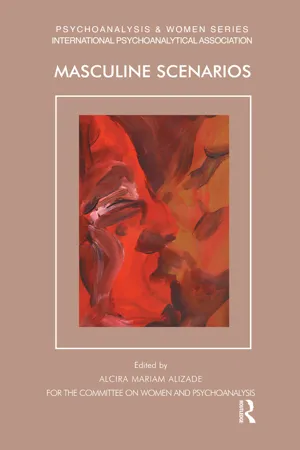
'Human identity, sexual identity, primary and secondary identification, object choice, narcissism - all of these lie on a continuum with homosexuality, transsexualism, transvestism, heterosexuality and asexuality. Concepts on sexuality and gender are outlined anew in an interplay of theoretical and clinical networks, with the aim of increasing the efficiency of analytic praxis freed from prejudice and monolithic convention.'- the author, from the Foreword Masculine Scenarios is the third volume in a unique series edited by the author for the Committee on Women and Psychoanalysis of the International Psychoanalytical Association. Providing a forum for exploration and discussion of diverse issues relating to gender constructs, sexuality, and sexual identity, the series brings together an internationally renowned group of contributors trained in the psychoanalytic tradition. Masculine Scenarios concentrates on issues regarding the psychic world of men and male sexuality. The construction of gender identity, the battle of the sexes, transsexualism, homosexuality and masculinity are some of the topics discussed in this inspiring book.
- 146 pages
- English
- ePUB (mobile friendly)
- Available on iOS & Android
eBook - ePub
Masculine Scenarios
About this book
Information
Chapter One
Sex and gender: the battle between body and soul
Freud stated that all human beings are bisexual in nature, though he did go on to say that each of us belongs a little more to one sex than to the other.
[Science] draws your attention to the fact that portions of the male apparatus also appear in women’s bodies, though in an atrophied state, and vice versa in the alternative case. It regards their occurrence as indications of bisexuality, as though an individual is not a man or a woman but always both—merely a certain amount more the one than the other (1933a, p. 114).
If what Freud said is correct, a struggle between the two sexes is an ongoing feature of every human being’s life. In some people, the dilemma is expressed in a very particular manner: the dichotomy—I would even go as far as to say the antagonism between factions—lies not between certain parts of the body nor between certain states of mind, but between mind and body as a whole. I am referring here, of course, to transsexuals.
In this chapter, I shall first discuss Freud’s concept of bisexuality, then go on to explore how every human being has to process these issues in his or her own mind in order to construct a sense of identity. Finally, I shall develop some ideas concerning the transsexual’s rejection of his or her genetic sex in an attempt to obtain “another” body, a “true” body that mirrors how the body is experienced in the mind.
Freud and bisexuality
Freud, as we know, wrote in German, and the German language does not make it easy to distinguish between “sex” and “gender”, a distinction that first became prevalent in the 1950s. The word Geschlecht means both sex and gender. In a similar vein, German has only one adjective, männlich, for both “male” and “masculine”, and weiblich for both “female” and “feminine”. In French, as in English, it is up to the translator to choose—to interpret—whether to use one or the other pair of contrasting adjectives, male/female or masculine/feminine. This particular feature of the German language reinforced Freud’s way of thinking, which anyway tended to give more weight to the biological aspect of sex rather than to its psychological and cultural dimensions.
It was with reference to embryology that Freud claimed that all human beings are bisexual. The Wolf and Müller ducts, present at the very beginning of intrauterine life, will later follow different paths, with the Wolf ducts developing in the male embryo and atrophying in the female one, while the Müller ducts grow in the female embryo and atrophy in the male. Freud insisted on the fact that the bud which later grows into a penis in the male has an undeveloped residue in the female—the clitoris. Thus, given that for Freud the clitoris is a male organ and not a truly female one, he could maintain that women are more clearly physically bisexual than men are. For this reason, he could make the somewhat surprising claim that, until puberty, “the little girl is a little man” (Freud, 1933a, p. 118), because of clitoral masturbation and of the fact that “for many years the vagina is virtually non-existent and possibly does not produce sensations until puberty” (Freud, 1931b, p. 228).
For Freud, then, if we superimpose the psychological categories of masculine and feminine on their biological counterparts of male and female, they make a perfect fit. Anything that involves the psychological level has to do with social convention and is subject to individual variation. Everything else is a function of the biological characteristics of the sex cells:
You cannot give the concepts of “masculine” and “feminine” any new connotation. The distinction is not a psychological one; when you say “masculine”, you usually mean “active”, and when you say “feminine”, you usually mean “passive”. Now it is true that a relation of the kind exists. The male sex-cell is actively mobile and searches out the female one, and the latter, the ovum, is immobile and waits passively. This behaviour of the elementary sexual organisms is indeed a model for the conduct of sexual individuals during intercourse. The male pursues the female for the purpose of sexual union, seizes hold of her and penetrates into her. [Freud, 1933a, p. 114]
Freud uses the term bisexuality, however, in another sense, relating to homo- and heterosexual tendencies—identification with the father and the mother in their erotic dimension, particularly in the complete version (positive and negative) of the Oedipus complex.
It would appear, therefore, that in both sexes the relative strength of the masculine and feminine sexual dispositions is what determines whether the outcome of the Oedipus situation is an identification with the father or with the mother. This is one of the ways in which bisexuality takes a hand in the subsequent vicissitudes of the Oedipus complex […] Closer study usually discloses the more complete Oedipus complex, which is twofold, positive and negative, and is due to the bisexuality originally present in children: that is to say, a boy has not merely an ambivalent attitude towards his father and an affectionate object-choice towards his mother, but at the same time he also behaves like a girl and displays an affectionate feminine attitude to his father and a corresponding jealousy and hostility towards his mother (Freud, 1923b, p. 33).
Freud did not deal with the particular case of those whom we nowadays call intersexed. In his view, we all possess bisexual components, and it is up to each of us to enable our male and female aspects to coexist within the self. That said, we cannot avoid coming up against the “underlying bedrock” of our biological nature—penis envy in women and, in men, the masculine protest, linked to castration anxiety, and repudiation of femininity (Freud, 1937, p. 252).
The two elements of the opposing male/female couple are not in a symmetrical relationship. There is undoubtedly some extra value attributed to the male/masculine/phallic dimension, whilst the female/feminine/female genital sphere is quite clearly treated as having less value. Freud emphasized the envy women feel with respect to men, but said very little about the envy men may experience with respect to women’s capacity for motherhood.
The construction of gender identity
The concept of identity played no part in Freud’s thinking. Even though all human beings may be bisexual, gender identity in the individual is based on the predominance of one of these dimensions over the other. There is a narcissistic continuity that determines how the individual experiences his or her envy and fear of the opposite sex. The fact that a girl experiences penis envy does not imply that she wants to be a boy; she wants to go on being herself, while at the same time enjoying all the advantages she attributes to boys: thanks to their possession of a penis, they can urinate standing up and play at who can pee the farthest; they can manipulate their genitals and check that masturbation has not damaged them; parents seem to prefer boys (this is undoubtedly the case in some societies, where girl babies may even be put to death); and they enjoy the kind of freedom and social privileges that are denied girls (this has changed in western societies, but only fairly recently).
How do boys and girls reach the conclusion that they are indeed boys or girls? The experience of one’s own body is distinctive. In spite of all the embryonic residues, a baby does not experience his or her body as bisexual in nature, but as something in itself absolute. The baby boy does not realize that his experience is not identical to that of a baby girl, and vice versa. Before he is able to make a connection between this experience and his biological gender, he will have been looked at, handled, encouraged or discouraged in a thousand ways to go on (or to stop) doing such-and-such; and the same is true of the baby girl. Babies are shaped by their parents and bombarded with conscious and unconscious messages that they then have to interpret. Some children are more resilient and unwilling to submit, others are more easily influenced. Parents unwittingly give both positive and negative reinforcement to behaviour patterns they consider to be masculine- or feminine-oriented in their children. It is only later that the infant becomes able to establish a connection between his or her experience and the label “boy” or “girl”. The distinction comes from outside the self. The discovery that there are two sexes is a traumatic one. The fact that boys and girls have different genitalia is acknowledged at some point between eighteen-months and two-years of age (Roiphe & Galenson, 1981). Though children know that this is an important difference, for a long time to come they will remain unable to mention it if they are questioned about the differences between boys and girls.
Children have to make the continuity of their experience both meaningful and significant. A feeling of continuity will be possible only if the environment is sufficiently coherent, and it is only if the child is given some feeling of personal value that the ability to love and appreciate him- or herself can arise.
Even though boys and girls are brought up together in kindergarten or nursery school from age two or three onwards, for impromptu games in the playground a spontaneous segregation between the two sexes is quickly established (Maccoby, 1988, 1990). It would appear that once children have made the traumatic discovery that there are two sexes, they stay with their same-sex peer group in order to obtain reassurance and increase their self-esteem while denigrating the opposite sex; Maccoby emphasizes, in particular, the fact that both sexes do not use the same modes of communication. The tendency to denigrate the opposite sex runs from elementary school all the way through to adolescence, at which point sexual attraction and mutual seduction begin to play a role (Baudelot & Establet, 1992).
With the exception of intersexed individuals, in whom the different components of sexuality are at odds with each other—with the resultant dilemma either of having to make a decision as to the gender of the individual at birth (given the fact of genital ambiguity) or of discovering at puberty that development is not following the expected path—no difficulty as regards integrating biological bisexuality exists. It is psychological bisexuality that creates the conflict, the kind of bisexuality that Freud failed to address. It is not simply a matter of sexual orientation via identification with the parental figures, but of identification with the psychological masculine and feminine features of each of the parents and with what society as a whole determines to be masculine and feminine.
The fact, for example, that girls want to follow the same academic courses as boys and take up the same careers cannot, as has been done in the past, be attributed simply to penis envy. A woman can experience herself as female, be happy to be a woman, be heterosexual—and still fight for equal rights. To put it another way, accepting the difference between the sexes, in all of its ramifications, does not preclude the struggle for equal rights.
Nevertheless, a woman often experiences feelings of guilt relating specifically to being, in the fullest sense, a woman and a mother, while at the same time gaining access to the highest levels of skill and competence in her chosen career—possessing not only feminine characteristics, but also those that society over the centuries has defined as distinctively phallic.
Sex and the battle between body and soul
Is it legitimate to think of a sex of the soul, or a sex of the mind? Those who use one or the other of these terms to refer to themselves are thereby indicating that their whole existence—soul and mind—is tied to the contradiction between the identity they feel themselves to possess and their anatomical sex. Their experience is that of a woman trapped inside a man’s body, or of a man similarly trapped inside a woman’s body. They sometimes go as far as to say that “this” body is not in fact their own and that their “true” body ought to be “restored” to them.
From time immemorial, there have been men and women who reject the sex that nature has attributed to them, without this having anything to do with the well-known biological condition called intersex. Some have managed to live as members of the “opposite” sex.
Historically, some civilizations have made allowance for—or at least tolerated—the fact that certain individuals may belong to a third sex or gender, and some contemporary societies still do (Herdt, 1994; Chiland, 1997). Examples of this are the North American Indian berdache, the Inuits, the Hijras, etc.
Transsexualism, as a modern phenomenon, is characterized by the fact that medical practitioners can offer to reassign an individual’s sex by means of hormone treatment and surgery; this has been made possible by our increasing knowledge of hormones and by the development of cosmetic surgery (Hausman, 1995).
The aetiology of transsexualism, however, is still a mystery. Two hypotheses are usually put forward; one is purely biogenetic, the other, while accepting the potential importance of as yet undiscovered biological factors, lays more emphasis on interrelationships. The element common to both hypotheses is the idea that, very early on in life, something happened that caused the individual to identify his or her body as male or female in nature, yet at the same time to refuse to accept it as his or her own, i.e. as in keeping with the mind’s experience of gender and with the self’s subjective identity. Such individuals find themselves in an extremely distressing situation, and communication with other people is undoubtedly difficult.
Communication with medical practitioners is difficult. Transsexuals do not think of themselves as suffering from some mental disorder or other. They consult a doctor because they want reparative treatment, one that will restore their true body, the body that corresponds to their soul and mind. Though the physician may be able to change the outward appearance of the patient’s body to a more or less credible extent, there is no way medicine can change the “inner” body or the patient’s past experience of it.
Some transsexuals—but they are few and far between—seem immediately to grasp this situation and declare themselves satisfied to “live as a woman” (in the case of male-to-female transsexualism) or “as a man” (in the case of female-to-male transsexualism). Others make the slow and painful discovery that anatomical change is limited in scope; they may not regret having had surgery, but they are, nevertheless, to some extent dissatisfied and find themselves still having to cope with many difficult issues.
The media proclaim: “Nowadays, a man can be changed into a woman, and a woman into a man!” On their television screens, they present people who are histrionic—and far removed from those who have no wish to publicize their condition.
Militants advocate the surgical solution and argue for it to be more widely available. But in claiming “I’m a woman (or a man), and I’ve always been a woman (a man)”, all they are really doing is trying to eliminate the complex nature of the problem they face.
Transsexuals are sometimes said to belong to both sexes, in the sense that they embody one sex while in their mind they feel they belong to the opposite sex. But, in fact, they are highly intolerant of psychic bisexuality: they try above all to get rid of anything that might remind them of the sex they loathe and to forget everything that has to do with their past life as members of the sex they reject.
As regards the libidinal bisexuality of their sexual orientation, some transsexuals have no sex life at all; those who have sexual relations with partners of the same biological sex as theirs see these relations as heterosexual—because it is as members of the opposite sex that they love people who belong to the same biological sex as they do. There are very few transsexuals who claim to be homosexual—for example, a man changed into a woman who calls h/self “lesbian” and has sexual relations exclusively with women.
In an attempt to understand the enigma of transsexualism, a fair amount of research has been undertaken, including post-mortem anatomo-pathological examination of the brain in male-to-female transsexuals (Zhou et al., 1995) and the study of the consequences of in utero hormone impregnation in animals (Goy et al., 1988). These studies would appear to indicate that transsexuals are in fact intersexed individuals who have not been identified as such.
The findings of these studies are, as yet, difficult to interpret. Zhou et al.’s research is based on the acknowledged importance in animals of the central subdivision of the bed nucleus of the stria terminalis—this is particularly true of rodents, where it is known to control sexual posturing. Its role in human beings, however, is much less clear, and the authors agree that there is no accepted animal model for gender identity. Furthermore, only six brains were available for examination over an eleven-year period; it proved impossible to show that the volume of the central subdivision of the bed nucleus of the stria terminalis—smaller in these transsexuals than that found in men, comparable to or smaller than that found in women—had not changed since birth, and was a cause rather than a consequence of the transsexual lifestyle and treatment programmes.
Zhou et al. argue that the variation in volume of this tiny brain area is compatible with potential hormone influence in utero such as that discovered by Goy et al. in female rhesus macaques.
Here again, having recourse to animal models in order to study gender identity is not without problems, even though monkeys have mo...
Table of contents
- Cover
- Half Title
- Title
- Copyright
- CONTENTS
- FOREWORD
- CONTRIBUTORS
- CHAPTER ONE Sex and gender: the battle between body and soul
- CHAPTER TWO Men and their bedrock: “repudiation of femininity”
- CHAPTER THREE What do men want?
- CHAPTER FOUR Male sexuality and mental void
- CHAPTER FIVE Offending gender—being and wanting in male same-sex desire
- CHAPTER SIX The battle of the sexes
- CHAPTER SEVEN The loneliness of the homosexual
- CHAPTER EIGHT The presence of males in abortion discourse and practices
- CHAPTER NINE The sexed body and the real—its meaning in transsexualism
- CHAPTER TEN Masculinity revisited: a self-deconstruction
- CHAPTER ELEVEN Boy’s envy of mother and the consequences of this narcissistic mortification
- REFERENCES
Trusted by 375,005 students
Access to over 1.5 million titles for a fair monthly price.
Study more efficiently using our study tools.
Frequently asked questions
Yes, you can cancel anytime from the Subscription tab in your account settings on the Perlego website. Your subscription will stay active until the end of your current billing period. Learn how to cancel your subscription
No, books cannot be downloaded as external files, such as PDFs, for use outside of Perlego. However, you can download books within the Perlego app for offline reading on mobile or tablet. Learn how to download books offline
Perlego offers two plans: Essential and Complete
- Essential is ideal for learners and professionals who enjoy exploring a wide range of subjects. Access the Essential Library with 800,000+ trusted titles and best-sellers across business, personal growth, and the humanities. Includes unlimited reading time and Standard Read Aloud voice.
- Complete: Perfect for advanced learners and researchers needing full, unrestricted access. Unlock 1.5M+ books across hundreds of subjects, including academic and specialized titles. The Complete Plan also includes advanced features like Premium Read Aloud and Research Assistant.
We are an online textbook subscription service, where you can get access to an entire online library for less than the price of a single book per month. With over 1.5 million books across 990+ topics, we’ve got you covered! Learn about our mission
Look out for the read-aloud symbol on your next book to see if you can listen to it. The read-aloud tool reads text aloud for you, highlighting the text as it is being read. You can pause it, speed it up and slow it down. Learn more about Read Aloud
Yes! You can use the Perlego app on both iOS and Android devices to read anytime, anywhere — even offline. Perfect for commutes or when you’re on the go.
Please note we cannot support devices running on iOS 13 and Android 7 or earlier. Learn more about using the app
Please note we cannot support devices running on iOS 13 and Android 7 or earlier. Learn more about using the app
Yes, you can access Masculine Scenarios by Mariam Alizade in PDF and/or ePUB format, as well as other popular books in Psychology & History & Theory in Psychology. We have over 1.5 million books available in our catalogue for you to explore.