- 252 pages
- English
- ePUB (mobile friendly)
- Available on iOS & Android
eBook - ePub
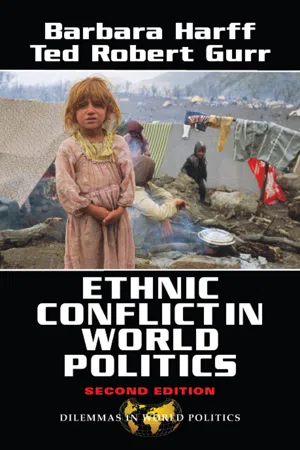
Ethnic Conflict In World Politics
About this book
This second edition of Ethnic Conflict in World Politics is an introduction to a new era in which civil society, states, and international actors attempt to channel ethnic challenges to world order and security into conventional politics. From Africa's post-colonial rebellions in the 1960s and 1970s to anti-immigrant violence in the 1990s the authors survey the historical, geographic, and cultural diversity of ethnopolitical conflict. Using an analytical model to elucidate four well-chosen case studies?the Kurds, the Miskitos, the Chinese in Malaysia, and the Turks in Germany?the authors give students tools for analyzing emerging conflicts based on the demands of nationalists, indigenous peoples, and immigrant minorities throughout the world. The international community has begun to respond more quickly and constructively to these conflicts than it did to civil wars in divided Yugoslavia and genocide in Rwanda by using the emerging doctrines of proactive peacemaking and peace enforcement that are detailed in this book. Concludes by identifying five principles of international doctrine for managing conflict in ethnically diverse societies. The text is illustrated with maps, tables, and figures.
Information
1
Ethnopolitical Conflict and the Changing World Order
Protracted conflicts over the rights and demands of ethnic and religious groups have caused more misery and loss of human life than has any other type of local, regional, and international conflict since the end of World War II. They are also the source of most of the world’s refugees. In 2002 about two-thirds of the world’s 15 million international refugees were fleeing from ethnopolitical conflict and repression. At least twice as many others have been internally displaced by force and famine. At the beginning of the new millennium millions of people in impoverished countries are in need of assistance, hundreds of thousands of desperate emigrants from conflict-ridden states are knocking at the doors of Western countries, and, to make things worse, donor fatigue among rich states threatens to perpetuate inequalities and misery.
Ethnopolitical conflicts are here to stay. Figure 1.1 shows that the number of countries with major ethnic wars increased steadily from a handful in the early 1950s to thirty-one countries in the early 1990s. We also know that between the mid-1950s and 1990 the magnitude of all ethnopolitical conflicts increased nearly fourfold—an astonishing increase in light of what was hoped for in the aftermath World War II.
The Holocaust should have enlightened us about what ethnic and religious hatred can do when used by unscrupulous leaders armed with exclusionary ideologies. Many people hoped that with the end of colonialism we could look forward to a better world in which nation-states would guarantee and protect the basic freedoms of their peoples. When the United Nations came into existence, were we wrong to believe that a new world order would emerge, one in which minimum standards of global justice would be observed and violators be punished? Is it still possible that a civil society will emerge in which citizens eschew narrow ethnic interests in favor of global issues?
Instead we have witnessed more genocides and mass slaughters, an increase in ethnic consciousness leading to deadly ethnic conflicts, and religious fanaticism justifying the killing of innocent civilians in faraway lands. Some progress has been made to check ethnic wars since the mid-1990s, but we badly need more innovative ideas about how to fight the scourges that plague mankind. To top it off, the international political will to act has been waning in the wake of Somalia, Bosnia, Rwanda, Liberia, Burundi, the Democratic Republic of Congo, and other conflicts that need international attention. There is also the risk that, in the aftermath of the September 11 terrorist attacks on the World Trade Center in New York, the Western “war on terrorism” will divert international attention away from enduring problems.

FIGURE 1.1 Numbers and Proportions of Countries with major ethnic wars, 1946–2001
So why write a book about ethnic conflict? This is what we hope for: If we understand the factors that contribute to the onset of ethnic conflicts, we may be able to suggest ways to stop escalation and find solutions by peaceful political means. We have ample evidence that deadly ethnic conflicts are not inevitable and can be contained or deterred, often without using force or the involvement of major powers. We hope that this book helps to further knowledge about ethnic conflicts and provides some guidelines about how to prevent, deter, or stop escalation.
DEFINING AND MAPPING THE WORLD OF ETHNIC GROUPS
Ethnic groups like the Kurds, Miskitos of Central America, and the Turks in Germany are “psychological communities” whose members share a persisting sense of common interest and identity that is based on some combination of shared historical experience and valued cultural traits—beliefs, language, ways of life, a common homeland. They are often called identity groups. A few, like the Koreans and the Icelanders, have their own internationally recognized state or states. Most, however, do not have such recognition, and they must protect their identity and interests within existing states.
Some religious groups resemble ethnic groups insofar as they have a strong sense of identity based on culture, belief, and a shared history of discrimination. Examples are Jews and the various sects of Shi’i Islam. Politically active religious groups, such as offshoots of the Muslim Brotherhood, are motivated by grievances similar to ethnic groups.
Many ethnic groups coexist amicably with others within the boundaries of established states. The Swedish minority in Finland, for example, has its own cultural and local political institutions, which are guaranteed by a 1921 international agreement between Sweden and Finland. For eighty years the Swedish minority has had no serious disputes with the Finnish people or government. Since the 1960s the Netherlands has welcomed many immigrants from the Third World with relatively little of the social tension or discrimination aimed at immigrants in Britain, France, and Germany. Even in these tolerant countries the explosive growth of asylum seekers has led to some antiforeign political movements and xenophobic attacks.
If peaceful relations prevail among peoples for a long time, their separate identities may eventually weaken. For example, Irish-Americans were a distinctive minority in mid-nineteenth-century North America because of their immigrant origins, their concentration in poor neighborhoods and low-status occupations, and the deep-rooted prejudice most Anglo-Americans had toward them. After a century of upward mobility and political incorporation, Irish descent has little political or economic significance in Canada or the United States, although many Irish-Americans still honor their cultural origins.
The ethnic groups whose status is of greatest concern in international politics today are those that are the targets of discrimination and that have organized to take political action to promote or defend their interests. A recent study, directed by the second author, surveys politically active national peoples and ethnic minorities throughout the world. As of 2001, the project has identified and profiled 275 sizable groups that have been targets of discrimination or are organized for political assertiveness or both.1 Most larger countries have at least one such ethnic group, and in a few countries like South Africa and Bolivia, they comprise half or more of the population. Taken together the groups involve more than 1 billion people, or a sixth of the world’s population. Figure 1.2 shows how these groups were distributed among the regions of the world in 2001. When the Soviet Union dissolved into fifteen independent republics at the end of 1991, the political demands of ethnonationalists like the Latvians, Ukrainians, and Armenians were met. Since then, however, at least thirty additional ethnic groups in the new republics have made new political demands.

FIGURE 1.2 Politically active ethnic groups by region, 2001
The Minorities at Risk survey shows that about 80 percent of the politically active ethnic groups in the 1990s were disadvantaged because of historical or contemporary discrimination. Forty percent of these groups (111 out of 275) surveyed face discriminatory policies and practices harmful to their material well-being. For example, almost all indigenous peoples in the Americas have high infant mortality rates due in part to limited pre- and post-natal health care; Tamil youth in Sri Lanka have long been discriminated against by university admission policies that favor the majority Sinhalese. The survey also identified 135 minorities subjected to contemporary political discrimination. For example, Turkish governments have repeatedly banned and restricted political parties that sought to represent Kurdish interests; in Brazil people of African descent make up more than 40 percent of the country’s population but hold less than 5 percent of seats in the national congress. Cultural restrictions also have been imposed on at least 116 minorities. Muslim girls attending French secondary schools have been expelled for wearing head scarves; principals of Hungarian-language schools in Slovakia have been dismissed for not speaking Slovak at Hungarian teachers’ meetings. Such restrictions may seem petty but symbolically their effects can be a painful and enduring reminder that the dominant society disvalues a minority’s culture.
Ethnic groups that are treated unequally resent and usually attempt to improve their condition. Three-quarters of the groups in the survey were politically active in the 1990s. They did not necessarily use violence, however. On the contrary, most ethnic groups with a political agenda use the strategies and tactics of interest groups and social movements, especially if they live in democratic states. Figure 1.3 shows the highest level of political action among minorities in 1995. One-quarter were politically inactive (some of them had a history of intense activism), half were mobilizing for or carrying out political action, and only one-quarter used violent strategies of small-scale rebellion (including terrorism) or large-scale rebellion. The latter include the most serious and enduring of all conflicts within states, including ethnic wars between Hutus and Tutsis in Burundi and Rwanda, civil wars by southerners in Sudan and Muslim Kashmiris in India, and wars of independence by Kurds in Turkey and Iraq and by Palestinians in Gaza and the West Bank.
Figure 1.3 also shows the relative frequency of different kinds of political action among world regions. The highest level of mobilization in 1995 was in Latin America—mainly among indigenous peoples. Ethnic rebellions were uncommon in Europe and the Americas and when they did occur were mainly terrorist campaigns. Rebellions were much more numerous in Africa, Asia, and the Middle East. The Appendix lists forty-six of the most serious contemporary ethnic conflicts, including some nonviolent conflicts that are potentially disruptive.
THE CHANGING GLOBAL SYSTEM AND ETHNIC CONFLICT
Ethnic conflict is not solely or even mainly a consequence of domestic politics. The potential for ethnic conflict, the issues at stake, and even the lines of cleavage between contending groups have been shaped and reshaped by international factors. In this section we introduce three general issues to which we return later, especially in Chapters 8 and 9—the tension between the state system and ethnic identities, the impact the end of the Cold War has had on conflicts among nations and peoples, and the changing nature of international responses to ethnic conflict.

FIGURE 1.3 Strategies of political action used by ethnopolitical minorities in 1995
States or Peoples?
Historically, ethnic groups, nations, states, empires, and other forms of large-scale social organization—for example, Islam and Christendom—have coexisted, but since the seventeenth century the dominant form of social organization has been the state system—the organization of the world’s people into a system of independent and territorial states, some of which controlled overseas colonial empires.
Despite attempts to change the existing world order by insisting that the state was obsolete, as Marxists proclaimed, the state remains the key actor in international relations. Key, because the state at the very minimum controls the principal means of coercion. Ethnic groups rarely are equal in terms of power, legitimacy, or economic resources. But it is wrong to suggest that the state is a single monolithic enterprise. Instead, we may want to think of the state as a recognized territorial entity in flux. It is one thing to think of England as an established state since the Middle Ages, yet Germany in something like its present form has existed only since 1870. The new states that emerged in the Middle East, Asia, and Africa following the demise of empires were often just creations of the former colonizers, endowed with neither historical nor cultural continuity, nor boundaries that recognized the living space of ethnic groups. Thus for example, we have states such as Burundi and Rwanda in both of which a Tutsi minority rules a Hutu majority, which led to major conflicts and postindependence genocidal killings in both countries.
Some would argue that certain states should have no independent existence, either because the notion of territory was not part of their people’s culture or because they would be better off within the boundaries of established states. Indeed, one could ask how viable, necessary, or rational is the division of the Arabian peninsula into many sheikdoms, some of which have emerged as independent states only since the 1960s. But, what are the alternatives? In tribal communities, local loyalties were very well developed, but rarely extended beyond the narrow boundaries of family or clan, thus leaving local communities at the mercy of would-be conquerors and usurpers. Necessity may have been the force that unified some warring tribes, laws and coercion are the means that have kept them together.
We do not intend to cover in any comprehensive fashion the historical development of the state system but instead offer a brief glimpse into what led to its emergence and what factors may lead to the demise of some existing states.
On the one side, states act independently of their constituent parts, such as peoples and institutions. After all, we talk about the economic viability or capabilities of states, not of the people who reside within the state. Today most states control capital through either public ownership or state-owned enterprises. But some theorists still see the state as passive, reacting mainly to pressures emanating from society. Though scholars disagree on the extent of cooperation and conflict between the state and society, it is still a fact that the state is a legally recognized sovereign entity in international law, endowed with rights and obligations vis-à-vis other states, groups, and its own citizens. Whatever the reasons that gave birth to specific states, the nation-state is today the primary actor in international relations. It is the state that defines, provides, and controls the public good, through regulation and institutions. It is the state that enforces the rules through coercion and punishment.
Let us apply some of these arguments to the historical situation of the Kurds, whose situation is symptomatic of many other ethnonationalists. After the demise of the Ottoman Empire following World War I, they were the largest ethnic group within the former empire without a state of their own. Instead, Kurds came to live within five other states, the largest segment of them now citizens of the new Republic of Turkey. Ever since, the Turkish government has tried through incentives, coercion, discrimination, and punishment to undermine Kurdish ethnic consciousness, hoping to deter any attempts to secede. Here the state became omnipotent, using all means at its disposal to subdue Kurdish national aspirations.
An essential question is whether or not a people have rights to a territory on which they resided for many centuries. International law today recognizes that it is inadmissible to acquire territory by waging an aggressive war, but the reality is somewhat different. International law, often invoked but seldom enforced, was used to bolster the legality of the Gulf War in 1990, ostensibly to free Kuwait from Iraqi occupation, as well as U.S. intervention in Panama and Vietnam. Israel, invoking its defensive posture in the 1967 war, holds on to territory inhabited by Palestinians for centuries. The Abkhaz in Georgia have technically won an independence war, but are not recognized by the international community of nation-states. What does this mean for the rights of groups vis-à-vis states? It means that sometimes group rights are recognized by individual states and the international community and sometimes, depending on various power constellations, they are not. However, international law can provide the justification or the means to establish claims to specific territory. Let us look briefly at the state as arbiter, problem-solving agent, or restricter or denier of the rights of collectivities.
Indeed, few states are able to unite a multitude of ethnies into a harmonious unit. Although long-established liberal democracies probably are more successful than autocracies in doing so, problems persist. Recall the situation of African-Americans prior to the Civil Rights movement and current issues ranging from outright discrimination to disenfranchisement. Consider that Native Americans are a people organized into a number of self-governing segments or “nations” within the greater American nation yet are economically and politically dependent on the United States.
One of the more heretical thoughts that comes to mind is whether the institutionalized state has a future, given the many ethnic groups that clamor for independence. The answer has to be yes, because what is it that these ethnic groups demand? They seek the right to govern their own territory, which they hope will become a sovereign, internationally recognized state. What this suggests is that the current international system may fragment into hundreds of mini-states unless ethnic demands can be satisfied within existing states. In fact more than a dozen ethnic wars were settled in the 1990s by granting autonomy to ethnonationalists within existing states. Successful settlements like these depend on the political system. Democracies are better able to accommodate ethnic demands than autocracies. But it is also true that in newly emerging democracies, ethnic demands may exceed the capacity of state structures, thus leading to failure of existing states.
The ascendance and expansion of the state system has meant that states are parties to most deadly conflicts: wars between states, civil wars within states, and genocides and political mass murders by states. But here we find a different phenomena at work. States wage war, but people decide to make war. Here the collective can triumph over state str...
Table of contents
- Cover
- Half Title
- Title Page
- Copyright Page
- Table of Contents
- Tables and Illustrations
- Acronyms
- Preface
- 1 Ethnopolitical Conflict and the Changing World Order
- 2 The World of Ethnopolitical Groups
- 3 The Pursuit of Autonomy: The Kurds and Miskitos
- 4 Protecting Group Rights in Plural Societies: The Chinese in Malaysia and Turks in Germany
- 5 A Framework for Analysis of Ethnopolitical Mobilization and Conflict
- 6 The Internal Processes of Ethnic Mobilization and Conflict: Four Cases
- 7 The International Dimensions of Ethnopolitical Conflict: Four Cases
- 8 Ethnic Groups in the International System: State Sovereignty Versus Individual and Group Rights
- 9 Responding to Ethnopolitical Challenges: Five Principles of Emerging International Doctrine
- Appendix
- Notes
- Suggested Readings and Research Sources
- Glossary
- About the Book and Authors
- Index
Trusted by 375,005 students
Access to over 1.5 million titles for a fair monthly price.
Study more efficiently using our study tools.
Frequently asked questions
Yes, you can cancel anytime from the Subscription tab in your account settings on the Perlego website. Your subscription will stay active until the end of your current billing period. Learn how to cancel your subscription
No, books cannot be downloaded as external files, such as PDFs, for use outside of Perlego. However, you can download books within the Perlego app for offline reading on mobile or tablet. Learn how to download books offline
Perlego offers two plans: Essential and Complete
- Essential is ideal for learners and professionals who enjoy exploring a wide range of subjects. Access the Essential Library with 800,000+ trusted titles and best-sellers across business, personal growth, and the humanities. Includes unlimited reading time and Standard Read Aloud voice.
- Complete: Perfect for advanced learners and researchers needing full, unrestricted access. Unlock 1.5M+ books across hundreds of subjects, including academic and specialized titles. The Complete Plan also includes advanced features like Premium Read Aloud and Research Assistant.
We are an online textbook subscription service, where you can get access to an entire online library for less than the price of a single book per month. With over 1.5 million books across 990+ topics, we’ve got you covered! Learn about our mission
Look out for the read-aloud symbol on your next book to see if you can listen to it. The read-aloud tool reads text aloud for you, highlighting the text as it is being read. You can pause it, speed it up and slow it down. Learn more about Read Aloud
Yes! You can use the Perlego app on both iOS and Android devices to read anytime, anywhere — even offline. Perfect for commutes or when you’re on the go.
Please note we cannot support devices running on iOS 13 and Android 7 or earlier. Learn more about using the app
Please note we cannot support devices running on iOS 13 and Android 7 or earlier. Learn more about using the app
Yes, you can access Ethnic Conflict In World Politics by Barbara Harff,Ted Robert Gurr in PDF and/or ePUB format, as well as other popular books in Politics & International Relations & Human Rights. We have over 1.5 million books available in our catalogue for you to explore.