- 224 pages
- English
- ePUB (mobile friendly)
- Available on iOS & Android
eBook - ePub
About this book
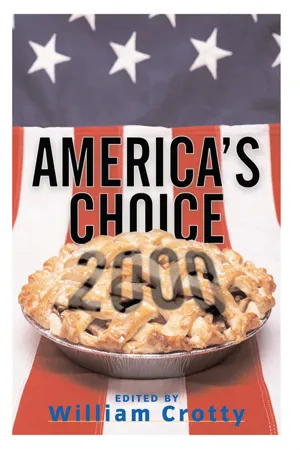
America's Choice 2000 attempts to make sense of the longest running, most fiercely contested and, ultimately, closest race in the history of presidential elections. What had been an earnest if predictable general election campaign morphed into a post-election day series of controversies that tested the nation's electoral processes, its courts, and its democratic culture. Eventually, of course, a winner was declared and the nation went about its business, however not before fundamental questions were raised as to the nature of the vote and voter intent and both the standards and processes used to decide elections. These issues will be with us for years to come. By any standard, it was a historic election whose full consequences are yet to be appreciated.America's Choice 2000 carefully sifts through the competing claims and strategies, reviews what occurred and offers some assessments as to the quality of the campaign, the nature of the final decision and the meaning this has to the nation. Crotty includes chapters devoted to the Courts' unprecedented role in Election 2000, an examination of the public opinion during the key events of the general campaign, as well as a chapter detailing the results of key state and local elections as well as the congressional races.
Information
Two
Elections by Judicial Fiat: The Courts Decide
The Long Count
There were two related but distinct aspects to the 2000 election. One, of course, was the lengthy campaign and the choice to be made between competing candidates, political parties, and policy agendas. Clearly, this is of enormous importance to the country in deciding its future direction, whose concerns are best addressed by the White House and the Congress, who is to wield a power that touches all of us, and the conditions under which we live and work. Normally, and in the United States with only very few exceptions, this decision is made on Election Day.
Such was not the case in 2000 and, in fact, the aftermath of the election is what gives it a distinction and, beyond others, a historic place in American politics. The decisions made, the court cases argued, and the problems raised directed national attention like no other election in living memory to the way in which we elect presidents; the determining influences of a basically archaic and poorly understood institution, the Electoral College; and the problems and different approaches to counting and recounting votes that goes to the very heart of the operations of American democracy.
This chapter attempts to sift through the conflicting claims and the welter of events that marked the post-election effort to declare a winner and, at the same time, do so in a manner that fairly reflected the electorate's wishes and provided the incoming administration the legitimacy needed to govern. Through it all, a sense of the political fragility and vulnerability of the most fundamental of institutions in the world's oldest democracy emerged from the conflict. At the same time the public demonstrated a confidence in the fairness of the eventual outcome and a calmness in the midst of bitter political divisions, and the differing philosophies put forward as to what constituted a credible election count, that was both impressive and ultimatley reassuring. The spectacle was mesmerizing, reemphasizing (if it were needed) the fundamental soundness and strength of America's democratic culture, while at the same time focusing attention on procedures long taken for granted. The long-run consequences of the 2000 election as to a reform of election procedures, with proposals ranging from a standardization of ballots and national criteria as to how votes are tallied (functions of the states in the American system), to a modernization or elimination of the Electoral College, changes that would require constitutional amendments, were left to the future. The inability to achieve agreement as to how the electoral system should operate in relation to the most basic of tasks, counting votes, and as to what constituted a valid expression of voter preference had to be troubling. Such issues are likely to be a focus of debate, and a battleground between differing philosophies and proponents, in the years to come. In one way or another, they will need to be given considered attention. The aftermath of the 2000 election will linger on for years to come.
This chapter examines the conflicting claims, political infighting, court interpretations and the continual fight to win public support and approval, the most fundamental battle of them all. It provides a guide to the events that occurred, the processes that eventually elected the nation's next president, and the standards employed to determine what exactly a "vote" was and when it counted towards determining the election's outcome.
The Aftermath
Americans in general viewed die proceeding on election night and in the days and weeks to follow with an intensity of interest that was unusual for contemporary politics. They appeared to have faith in the election process and in the courts and to be amused and on occasion angered by the arguments made by the two camps and the actions of the election officials involved in the recount. The drama was continuing and offered the public a spectacle no one had ever experienced. Commentators and political operatives were, in turn, amused, less tolerant, more cynical and more partisan. Dire consequences were frequently predicted for the process and the nation. We call on one account:
Whatever the election's outcome, the result is likely to be the same anyway. If Mr. Bush wins, especially without taking the popular vote, the Democrats will de-legitimize the election in any way they can, taking particular delight in pursuing the Sunshine State Evita, Katherine Harris—a political gift who will keep on giving. Should Mr. Gore win, that old band of Vincent Foster [a Clinton White House official who committed suicide] conspiracy theorists will reunite to target Palm Beach county Commissioner Carol Roberts and the rest of her chad-counters; [Republican Congressman] Dan Burton will lead the investigation into what the Wall Street Journal has already labeled an attempted Democratic coup d'etat. Two years from now, the party that controls the White House is likely to lose untold seats in Congress as well, frustrating the 'winning' president's ability to govern even further. If an economic downturn is thrown into the mix, the president who presides over it may find himself and his party consigned to long-term political oblivion
This is one year when it's probably better to be a sore loser than a sore winner. But such is the narrow vision of both contenders that they may be the last people in America to figure that out (Rich, November 18, 2000).
The questions raised in the election's aftermath ranged from the seemingly petty to the most fund...
Table of contents
- Cover
- Half Title
- Title
- Copyright
- CONTENTS
- Preface
- ONE The Election of 2000: Close, Chaotic, and Unforgettable
- TWO Elections by Judicial Fiat: The Courts Decide
- THREE Political Participation in American Elections: Who Decides What?
- FOUR The Presidential Primaries: Triumph of the Frontrunners
- FIVE The Curious and Close Presidential Campaign of 2000
- SIX The Congressional Races: Continuing Battleground for the Parties
- SEVEN The State and Local Elections: Politics Beyond the Beltway
- EIGHT The Election in Perspective: Two Nations, Four Parties
- Biographical Sketches of Contributors
- Index
Trusted by 375,005 students
Access to over 1.5 million titles for a fair monthly price.
Study more efficiently using our study tools.
Frequently asked questions
Yes, you can cancel anytime from the Subscription tab in your account settings on the Perlego website. Your subscription will stay active until the end of your current billing period. Learn how to cancel your subscription
No, books cannot be downloaded as external files, such as PDFs, for use outside of Perlego. However, you can download books within the Perlego app for offline reading on mobile or tablet. Learn how to download books offline
Perlego offers two plans: Essential and Complete
- Essential is ideal for learners and professionals who enjoy exploring a wide range of subjects. Access the Essential Library with 800,000+ trusted titles and best-sellers across business, personal growth, and the humanities. Includes unlimited reading time and Standard Read Aloud voice.
- Complete: Perfect for advanced learners and researchers needing full, unrestricted access. Unlock 1.5M+ books across hundreds of subjects, including academic and specialized titles. The Complete Plan also includes advanced features like Premium Read Aloud and Research Assistant.
We are an online textbook subscription service, where you can get access to an entire online library for less than the price of a single book per month. With over 1.5 million books across 990+ topics, we’ve got you covered! Learn about our mission
Look out for the read-aloud symbol on your next book to see if you can listen to it. The read-aloud tool reads text aloud for you, highlighting the text as it is being read. You can pause it, speed it up and slow it down. Learn more about Read Aloud
Yes! You can use the Perlego app on both iOS and Android devices to read anytime, anywhere — even offline. Perfect for commutes or when you’re on the go.
Please note we cannot support devices running on iOS 13 and Android 7 or earlier. Learn more about using the app
Please note we cannot support devices running on iOS 13 and Android 7 or earlier. Learn more about using the app
Yes, you can access America's Choice 2000 by William Crotty in PDF and/or ePUB format, as well as other popular books in Politics & International Relations & American Government. We have over 1.5 million books available in our catalogue for you to explore.