- 245 pages
- English
- ePUB (mobile friendly)
- Available on iOS & Android
eBook - ePub
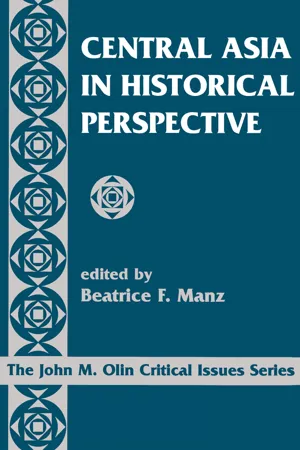
Central Asia In Historical Perspective
About this book
Since the demise of Soviet power, the newly independent republics are redefining their identities and their relations with the world at large. In Central Asia, which lies at the crossroads of several cultures, the emerging trends are complex and ambiguous. In this volume leading experts explore factors that have driven the region's historical development and that continue to define it today: Overlapping Islamic, Russian, and steppe cultures and their impact on attempts to delimit national borders and to create independent states; the legacy of Soviet and earlier imperial rule in economic and social relations', and the competition between Uzbek, Tajik, and other group identities. The authors make few predictions, but their original and thought-provoking analyses offer readers new insight into those aspects of Central Asia's past that may shape its future.
Part One
The Shaping of Central Asian Identities and Politics
Chapter 1
The Legacy of the Mongols
Morris Rossabi
The Mongol eruption in the thirteenth century was without question the most significant impact of the nomadic peoples of Inner Asia on the sedentary world. Mongol troops reached west all the way to Hungary and Poland and south all the way to Southeast Asia and the Middle East. China and Central Asia, as the Mongols' two nearest neighbors, had greater and longer exposure than other regions to the descendants of Chinggis Khan. Most works on the Mongol impact on China and Central Asia have stressed the destruction and dislocation generated by the initial conquests. Setting aside such a one-sided view, a study of the Mongol legacy in Central Asia needs to consider two different perspectives. First, the immediate consequences of the conquest and occupation of Central Asia require investigation. The Mongols governed much of Central Asia for about a century, and their Turkic-speaking descendants dominated the region for at least another century and a half. Later still, in the seventeenth and eighteenth centuries, a powerful new Mongol confederation influenced the peoples and lands of Central Asia. Second, certain patterns of Mongol culture and society appear to have influenced the societies of Central Asia. Such shared patterns are the enduring legacies of Mongol relations with Central Asian peoples and societies.
The Mongol Conquest and Its Aftermath
The Mongols' initial encounter with Eastern Turkestan, their closest neighbor in Central Asia, was peaceful.1 The Uighurs, the principal inhabitants of the region, submitted voluntarily and as a result were accorded a special status in the Mongol domains. Having the most literate and sophisticated population among the Turks, the Uighurs were eagerly recruited into government service.2 A Turkic group from Central Asia had, in this case, a dramatic impact on its Mongol overlords. Uighurs adapted their vertical script to provide the first written language for Mongolian and served as tutors, secretaries, translators, interpreters, and government officials. Other Turkish groups, including Önggüd and Kipchaks, were granted positions in the Mongol military, central government, or local administration.3
During the century or so in which they controlled Uighuristan, the Mongols conducted censuses, devised a regular system of taxation, and organized postal stations to facilitate the speedy conveyance of official mail and incidentally to promote travel and trade.4 The immediate Mongol legacy in eastern Central Asia was thus not destructive. By surrendering without a struggle, the Uighurs escaped the possibility of a devastating assault. Indeed, they benefited from Mongol policies. The caravan trade that had lain relatively dormant after the tenth century revived as a result of Mongol control of much of Eurasia and Mongol encouragement of commerce.5 The flow of merchants and goods traversing Eurasia increased appreciably during the Mongol era, and caravans coming to or from China naturally traveled via the oases of Central Asia, offering numerous economic opportunities for the inhabitants. Judging from the adverse reaction to efforts made by the early Ming dynasty, the Chinese successors to the Mongols, to limit trade and so-called tribute, the Uighurs had made striking gains as a result of Mongol promotion of trade.6
This relatively rosy assessment of the meaning of Mongol rule in East Turkestan does not apply to the western regions of Central Asia. The Khorezm-Shah, who ruled much of this area, was much less docile than the Uighur iduq-qut.7 In 1218 he even condoned the killing of an envoy dispatched by Chinggis Khan—a direct challenge to the Mongols to whom "the person of an ambassador . . . was sacrosanct."8 Chinggis Khan now needed to avenge himself against the Khorezm-Shah and thus had a pretext to launch an invasion. The Khorezm-Shah, in any case, had a precarious hold on his domain. His army was wracked with strife; many of his subjects, particularly those in Iran who had been subjugated during his campaigns in the early 1200s, were not loyal to him, and he could not count upon support from the religious leadership.9
Capitalizing on the Khorezm-Shah's weaknesses, Chinggis Khan initiated an attack against Transoxiana in Central Asia in 1219. Encountering resistance, the Mongol armies responded violently and brutally. Persian historians acknowledge that the Mongol campaigns in Transoxiana were not as destructive as the ones in Eastern Persia and Iraq. Even so, they describe deliberate massacres and destruction. Juvayni, one of the greatest Persian historians, writes about one Turkish group in Bukhara that "no male was spared who stood higher than the butt of a whip and more than thirty thousand were counted amongst the slain." He quotes one refugee from Bukhara that the Mongols "came, they sapped, they burnt, they slew, they plundered and they departed."10 According to these Islamic sources, Bukhara and Samarkand, the twin centers of culture in Transoxiana, were savaged, many of their inhabitants were killed, and thirty thousand craftsmen from Samarkand were forced, virtually as slaves, to go eastward to Northern China and Mongolia to serve the Mongols.11
Yet a Chinese Taoist invited by Chinggis Khan to accompany him on his Central Asian campaigns offered a somewhat different assessment than the Persian sources. Arriving in Samarkand a year and a half after its conquest by the Mongols, he reported that the occupiers were repairing bridges and boats and that "wherever we went we came to terraces, lakes, pagodas, and towers ..." His escorts told him that the population had fallen from 100,000 to 25,000 which no doubt overstates the casualties, but nonetheless indicates that he did not ignore the results of warfare. He also found that farm land had either not been damaged or that there had been a remarkable recovery within a brief time span, for as he noted, "fruit and vegetables were very abundant."12 A leading historian of Central Asia also subscribes to this view when he notes that:
the opinion that the Mongols did not appreciate culture and would have turned all the land into grazing grounds is contradicted by the facts. The Mongol rulers, at least, were bound to realize that from town-dwellers and land-owners they could obtain better revenue than from nomads.13
Additional confirmation derives from Mongol attempts to govern Bukhara and the surrounding Central Asian regions. The Mongols recruited reliable Chinese and Khitan advisers to help them develop a stable administration. Eventually Khorezmians joined in devising the fiscal and defense structures of the region. One of the Khorezmians, in fact, persuaded his Mongol overlords not to raze Bukhara after a rebellion against Mongol rule.14 Still another indication that the Mongols did not aspire simply to wipe out Central Asians was their recruitment of Muslims from the region for administrative responsibilities in China.15 Numerous Central Asians served the Mongol rulers of the Middle Kingdom.16 The Central Asian Ahmad became a leading official, with responsibility for financial administration, in Khubilai Khan's government in Peking. The Mongols encouraged Muslims from Central Asia to form merchant associations (known as ortogh) to promote trade and to revive the caravan trade to the West.17 The caravan trade, in turn, traversed Central Asia and no doubt contributed to the prosperity of the region.
Mongol domination thus left an ambiguous rather than purely negative legacy. The revival of trade was certainly a boon, and the Mongols' support of merchants contributed to the commercial prosperity of Central Asia. After the initial attacks and conquest, the Mongols wanted to achieve order, not merely to exploit the region. Their motive was to generate stability so that the local economy could recover and the Mongols could secure more revenue.18 Yet a more alarming legacy was military encroachment on civilian authority. The military dominated Central Asia, and the government reflected the preponderance of military influence, a situation which inevitably generated conflicts. The Chaghatay Khans, descended from Chinggis Khan's second son, fought with local leaders as well as with the Mongol khanates in Persia and China. The conflicts occasionally had damaging effects. Bukhara, for example, was severely devastated in 1273 as a result of an attack by the Mongol khanate of Persia.19
Internal strife weakened the descendants of Chinggis Khan and eventually permitted the rise of new powers. The most important of these in the region of Central Asia was the Turkic leader Tamerlane (Temür), who rose to power near Samarkand in 1370. Tamerlane inherited practices and ideas belonging to what has been called the "Turco-Mongolian tradition."20 The principal characteristic of this tradition was adaptation of the steppe culture and institutions to those of the Mongols' sedentary subjects.
Tamerlane proved to be adroit in using this Turco-Mongolian tradition to buttress his rule. Though he derived from a nomadic background, he "based his strength on the exploitation of settled populations."21 He was, for example, a fervent Muslim rather than a shamanist (a religion based on a shaman's direct links to ancestral spirits or gods) of nomadic heritage. On the other hand, he persisted in identifying with nomadic history by seeking to associate himself with Chinggis Khan and the Chinggisid dynasty.22 In his effort to gain control, he followed traditional Mongol organization and strategy. Like Chinggis, he started his campaigns based on tribes, but also like the great Mongol conqueror, his objective was to place his own sons and loyal retainers in positions of power and to remove tribal leaders from such positions. He attempted to acquire control over and to elicit support from both the sedentary and the nomadic populations of Central Asia, and, following the example of Chinggis Khan, he recruited foreign troops for his army once he had subjugated their lands. Then he used them to continue his expansionist policies. Finally, he incorporated foreign systems of administration in his attempt to govern, a policy similar to the one pioneered by the early Mongols. He attempted to balance an Arabo-Persian system with its emphasis on bureaucracy and regular administration with a Turco-Mongolian system relying on military organization. Internal strife, once again, weakened the empire of his descendants, permitting the nomadic Chinggisid Uzbek Turks to conquer them in 1505-1507. The Uzbeks would then become the dominant force in the formation of modern Central Asia.
Another group that influenced Central Asia was the Zunghars. Residing in Western Mongolia and in what is now northern Xinjiang, the Zunghars were the last in a long line of Mongols to seek to unite their people to recreate the glorious past represented by Chinggis Khan and his thirteenth-century empire. Their leaders repeatedly invoked the legends and history of Chinggis Khan's exploits and made explicit comparisons with their illustrious forebears. Their ruler Galdan suffered severe setbacks in his efforts to unite the Mongols. He aimed to gain support from the Khalkha or Eastern Mongols, but they lacked allegiance to a single leader. At least three khans competed for control among the Khalkha, and the presence of the Living Buddha (Jebtsundamba Khutughtu) and his effort to seek power contributed to the turmoil in Eastern Mongolia, further impeding Galdan's grandiose plan for a unified Mongol world under his command. Without a strong base among the Mongols, he was vulnerable in his war with Ch'ing China, particularly after the Manchu dynasty in the Middle Kingdom made an accommodation with Tsarist Russia, robbing Galdan of this potential European ally. No longer fearful of a joint Zunghar alliance with the Russians, the Ch'ing could focus on dispatching Galdan's troops. By 1696 Galdan had been defeated, and the following year he died. With his death, Mongol influence in Central Asia declined considerably, though the Zunghars, under different leadership, continued in combat with China until the 1750s when a Ch'ing military leader wiped out the remnants of the enemy.23
Shared Patterns Among Mongols and Central Asians
The direct historical links between the Mongols and Central Asia were without question significant, but perhaps the shared patterns of organization, structure, and ideology are as vital in identifying the Mongol legacy in Central Asia. The clearest impression derived from the study of the history of the Mongol Empire and its successor states is the difficulties encountered by the Mongols in achieving unity. The pastoral nomadic lifestyle did not lend itself to groups larger than tribes, since "any would-be supratribal ruler had to bring to heel a highly mobile population, who could simply decamp and ignore his claims to authority."24 Unity that transcended the tribal group was rare and fleeting. Mongols and the pastoral nomads who preceded them in Mongolia owed loyalty to a tribal chief. When they emerged from the steppes to challenge the sedentary peoples, in particular the Chinese, they required a larger unit than the tribe. Disputes with the sedentary states over trade or land or property necessitated the development of unions of tribes. Individual tribes could engage in hit-and-run raids against their more settled neighbors, but they had to forge alliances composed of numerous tribes to make permanent and substantia...
Table of contents
- Cover
- Half Title
- Title
- Copyright
- Contents
- Preface
- Map of Contemporary Central Asia
- Introduction
- Historical Background
- PART ONE THE SHAPING OF CENTRAL ASIAN IDENTITIES AND POLITICS
- PART TWO RELIGION AND ETHNIC RELATIONS IN 20TH-CENTURY CENTRAL ASIA
- PART THREE CENTRAL ASIA AND RUSSIA
- About the Book and Editor
- About the Contributors
- Index
Trusted by 375,005 students
Access to over 1.5 million titles for a fair monthly price.
Study more efficiently using our study tools.
Frequently asked questions
Yes, you can cancel anytime from the Subscription tab in your account settings on the Perlego website. Your subscription will stay active until the end of your current billing period. Learn how to cancel your subscription
No, books cannot be downloaded as external files, such as PDFs, for use outside of Perlego. However, you can download books within the Perlego app for offline reading on mobile or tablet. Learn how to download books offline
Perlego offers two plans: Essential and Complete
- Essential is ideal for learners and professionals who enjoy exploring a wide range of subjects. Access the Essential Library with 800,000+ trusted titles and best-sellers across business, personal growth, and the humanities. Includes unlimited reading time and Standard Read Aloud voice.
- Complete: Perfect for advanced learners and researchers needing full, unrestricted access. Unlock 1.5M+ books across hundreds of subjects, including academic and specialized titles. The Complete Plan also includes advanced features like Premium Read Aloud and Research Assistant.
We are an online textbook subscription service, where you can get access to an entire online library for less than the price of a single book per month. With over 1.5 million books across 990+ topics, we’ve got you covered! Learn about our mission
Look out for the read-aloud symbol on your next book to see if you can listen to it. The read-aloud tool reads text aloud for you, highlighting the text as it is being read. You can pause it, speed it up and slow it down. Learn more about Read Aloud
Yes! You can use the Perlego app on both iOS and Android devices to read anytime, anywhere — even offline. Perfect for commutes or when you’re on the go.
Please note we cannot support devices running on iOS 13 and Android 7 or earlier. Learn more about using the app
Please note we cannot support devices running on iOS 13 and Android 7 or earlier. Learn more about using the app
Yes, you can access Central Asia In Historical Perspective by Beatrice Manz in PDF and/or ePUB format, as well as other popular books in History & Central Asian History. We have over 1.5 million books available in our catalogue for you to explore.