This valuable resource helps institutional leaders understand and implement a data strategy at their college or university that maximizes benefits to all creators and users of data. Exploring key considerations necessary for coordination of fragmented resources and the development of an effective, cohesive data strategy, this book brings together professionals from different higher education experiences and perspectives, including academic, administration, institutional research, information technology, and student affairs. Focusing on critical elements of data strategy and governance, each chapter in Data Strategy in Colleges and Universities helps higher education leaders address a frustrating problem with much-needed solutions for fostering a collaborative, data-driven strategy.
eBook - ePub
Data Strategy in Colleges and Universities
From Understanding to Implementation
- 202 pages
- English
- ePUB (mobile friendly)
- Available on iOS & Android
eBook - ePub
About this book
Information
Part I
Structure
Chapter 1
The Value of Creating a Data Strategy
INTRODUCTION
What is a data strategy anyway? And why would anyone want one? Colleges and universities already invest significantly in both data (dedicated staff, information technology systems, etc.) and strategy (planning, budgeting, etc.). Isn’t there enough emphasis on data and strategy? What more can be done in this space? There are plenty of books and articles devoted to either data or strategy, but oddly enough, this is the first to address the two combined—data strategy—in the context of higher education.
This chapter focuses on why institutions should care about creating a data strategy and the gains achieved by having one. In particular, we begin by describing what a data strategy is and why institutions should have one. We then outline the characteristics of a data strategy. Examining the benefits of a data strategy and the risks of not having one is vital to securing buy-in from senior leaders. Thus, we conclude the chapter with five key steps to securing commitment to an institution-wide data strategy. While these steps are geared towards senior leaders, they can be used with key stakeholder groups as well.
THE PROBLEM: MORE DATA, FEWER ANSWERS
Leaders across organizations—including institutions of higher education—concur that data are critical to management and decision-making. Over the past two decades, data has expanded into every corner of colleges and universities. At this point, it is difficult to find a department that has not become more data-driven.
As the number of data creators and users has increased, so too has the variety of approaches to providing leaders with data and analyses. In more than a few instances, that dynamic has created conflicting information. Such inconsistencies can frustrate senior leaders, who are ultimately responsible for the success (or failure) of their institution. They are left wondering which numbers are the “right” ones and how to sift through the volumes of reports to know which numbers really matter.
In an era of “big data,” why does it feel as if there is an inverse relationship between volume and quality of data? Many leaders have been patiently awaiting the fulfillment of promises of improved tools for data-driven decision making. However, in most cases, technology “enhancements” have led to what seem to be fewer answers and increased wait times for pressing inquiries.
One of the root problems is that many data analysts spend only 20% of their time actually analyzing data (the rest is spent on data preparation). This issue is only going to get worse without change (Aiken & Harbour, 2017). Perhaps because of the increased availability of data and the improved tools for analyzing it, ensuring the integrity and effective use of data are becoming more and more of a challenge for colleges and universities.
It is a reasonable expectation that senior leaders should be able to ask both simple and complex questions and get comprehensive answers in a realistic timeframe. After all, smart, capable, qualified, experienced professionals have been employed to do this work. This prompts the question: What is the magic formula that allows data creators to work together, avoid duplication, and focus on strategic priorities? This seems like a tall task—and it is—without a data strategy for colleges and universities.
WHAT IS A DATA STRATEGY?
While most people in higher education are familiar with terms such as “strategic planning” and “data analysis,” the term “data strategy” may be new to many. However, it is not new to those in industries outside of higher education. Here is a simple and straightforward definition: “A plan to help set direction relative to data and how the organization will use it in direct support of their organizational strategy” (Aiken & Harbour, 2017, p. 14).
Lahanas’s (2014) definition of what a data strategy is not may enhance the discussion:
■ A data strategy is not a list of generic principles or obvious statements (such as “data are an enterprise asset”).
■ A data strategy is not merely a laundry list of technology trends that might somehow influence the organization in coming years.
■ A data strategy is not a vague list of objectives without a clear guiding vision or path for actualization.
■ A data strategy is not merely the top-level vision either, it can expand into critical data domains such as “business intelligence” and eventually represent a family of strategies.
(Lahanas, 2014, p. 1)
The responsibility for establishing a data strategy should not fall to an individual department. Rather, the impetus must occur at the institutional level, much like other strategic efforts, such as planning, budgeting, building, and capital campaigns; Chapter 2 elaborates on this with a deep dive into the key elements of a data strategy.
THE VALUE OF CREATING A DATA STRATEGY
Creating a data strategy requires a coordinated effort that efficiently and effectively marshals resources in pursuit of institutional goals rather than the needs of individual departments or units. Attempts to achieve the same results by establishing “one source of the truth” have failed because these systems stifle the very thing desired: use of data by many. More contemporary solutions leverage collaboration and organizational strategies to manage a complex problem.
For example, typically when there is a valued resource, such as money, it is managed at the highest level, in this case by the chief financial officer. It would be counterproductive for each department to develop its own budget policies and procedures independently. Yet institutions frequently have multiple approaches to collecting, producing, and analyzing data.
An institutional data strategy integrates data collection and analysis elements from throughout the entire organization into one unified plan and set of goals. Similar to an institutional strategic plan, a data strategy allows different units the flexibility to develop their own data and analysis goals while aligning with those of the institution. This approach respects the individuality of departments while minimizing the haphazardness of having multiple systems and processes.
Goals are not attained by accident. Coordination of resources, both human and financial, increases the chances of success. Institutions invest in strategy because it is too costly not to efficiently coordinate resources pivotal to achieving goals. Data resources merit the same level of attention given to people and money.
BENEFITS OF A (GOOD!) DATA STRATEGY
“A good data strategy is not determined by what data is readily or potentially available—it’s about what your business wants to achieve, and how data can help you get there” (Marr, 2017, p. 21). Organizations have invested heavily in data efforts over the last decade to enable data-driven decision making that maximizes the efficient and effective use of resources. Key among those investments are personnel and infrastructure (such as data warehouses).
In a multi-decade era of “doing less with more,” using data to meet unfunded mandates was a logical approach. And it worked. Institutions are making more decisions based on data. Now they need to adopt a data strategy to ensure that the right data are produced at the right time and in the right way.
The U.S. Department of Defense’s Chief Data Officer noted that “Direction is more important than speed. If you’re pointed in the wrong direction, it doesn’t matter how fast you’re traveling. Inversely, if you’re locked on to your desired destination, all progress is positive, no matter how slow you’re going” (Conlin, 2019, p. 1). We can’t emphasize this enough: it is important to create a good data strategy, not just any data strategy.
Collect Only Useful Data
Adelman, Moss, and Abai (2005) found that “most major corporations and large government organizations have three-to four-fold needless data redundancy—data that exists for no other reason than failure to properly plan and implement” (p. xxiii). The value of routine reporting is too seldom questioned, consuming personnel time that could be better spent on more high-value efforts that produce information on which decisions can be based. Data needs evolve over time, whether due to changes in leadership or changes in the world around us—or both. And yet, all too frequently, routine data reporting keeps flowing, leading to reports that no one reads and thus no one acts upon.
“Having a clear data strategy is also critical when you consider the sheer volume of data that is available these days” (Marr, 2017, p. 17). The sheer volume of data reporting can overwhelm managers. An effective data strategy will periodically analyze whether more streamlined or otherwise refocused data reporting would lead to more and better actionable information for decision makers.
Misguided data collection and reporting is also a factor with ad hoc efforts, such as the use of surveys within a college or university. A group wishing to send out a survey on a particular topic (student experience, satisfaction with a service, ideas for new programs or services, etc.) will draft a series of questions. More often than not, at least a few of these questions will produce data of uncertain value. Survey designers do not always ask, “How will I use the information I am going to collect?” Some are driven to ask questions just because they can! Equally misguided is the rationale: “We thought it would be nice to know” or “we are collecting it just in case.” In case of what?
With electronic surveys, people can fall into the illusion that data collecting is free—so why not collect everything? However, burdensome surveys reduce response rates. Analyzing, storing, and reporting data have costs that are not justifiable if the data are not used. And managers in receipt of survey reports that include data elements of uncertain value may discredit other aspects of the survey results. One of the benefits of a data strategy is that it pushes the institution to seriously discuss and create collection criteria so that all data gathered has value—and is used. Moreover, leadership must have the discipline to ensure that such discussions take place at regular intervals.
Leverage Expanded Data Literacy
As the ability to access data using technology has expanded, so too has data literacy among employees. Over the last few decades, it has become common to find data-literate people sprinkled throughout an institution rather than being housed in one or two offices. While it is good news that more people have these skill sets, ability levels vary widely.
An unintended consequence of this distributed data model is that multiple people can and do work on the same request without others knowing. Worse yet, they often arrive at different results (which frustrates presidents considerably; see Chapter 8). Having a data strategy in place ensures that all data makers and users (essentially the entire college or university) work in an integrated manner that aligns with the institution’s mission and strategic planning goals.
Bring Data Creators Together
A data strategy melds data analysis efforts from multiple departments into a cohesive plan; otherwise, “The absence of a data strategy gives a blank check to those who want to pursue their own agendas” (Adelman, Moss, & Abai, 2005, p. 3). Most colleges and universities currently have a disaggregated set of departments using data, with perhaps a few working together from time to time, as shown in Figure 1.1. Overall, they each have their own independent and unaligned data strategy—whether written or not.

FIGURE 1.1 Disaggregated and Disconnected Data Strategy Model
In Figure 1.2, departments or functions maintain their independence, but their data strategies are all aligned to the institution’s rather than fragmented. We are not suggesting that all data creators and users need to report to one vice president. If that works for your institution, great. However, there are precedents for not having all similarly focused staff report to one vice president. For example, all employees who spend institutional dollars do not report to the chief financial officer, and institutions still find ways to develop and implement a budget. The same is true of people who use computers and information technology.
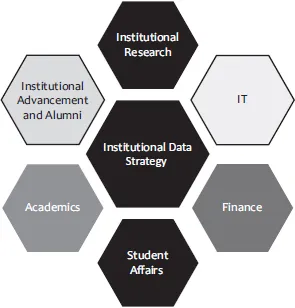
FIGURE 1.2 Disaggregated ...
Table of contents
- Cover
- Half Title
- Title Page
- Copyright Page
- Dedication
- Table of Contents
- List of Figures
- List of Tables
- Preface
- Acknowledgments
- PART I: Structure
- PART II: Implementation
- PART III: Perspectives
- Biographies
- Index
Trusted by 375,005 students
Access to over 1.5 million titles for a fair monthly price.
Study more efficiently using our study tools.
Frequently asked questions
Yes, you can cancel anytime from the Subscription tab in your account settings on the Perlego website. Your subscription will stay active until the end of your current billing period. Learn how to cancel your subscription
No, books cannot be downloaded as external files, such as PDFs, for use outside of Perlego. However, you can download books within the Perlego app for offline reading on mobile or tablet. Learn how to download books offline
Perlego offers two plans: Essential and Complete
- Essential is ideal for learners and professionals who enjoy exploring a wide range of subjects. Access the Essential Library with 800,000+ trusted titles and best-sellers across business, personal growth, and the humanities. Includes unlimited reading time and Standard Read Aloud voice.
- Complete: Perfect for advanced learners and researchers needing full, unrestricted access. Unlock 1.5M+ books across hundreds of subjects, including academic and specialized titles. The Complete Plan also includes advanced features like Premium Read Aloud and Research Assistant.
We are an online textbook subscription service, where you can get access to an entire online library for less than the price of a single book per month. With over 1.5 million books across 990+ topics, we’ve got you covered! Learn about our mission
Look out for the read-aloud symbol on your next book to see if you can listen to it. The read-aloud tool reads text aloud for you, highlighting the text as it is being read. You can pause it, speed it up and slow it down. Learn more about Read Aloud
Yes! You can use the Perlego app on both iOS and Android devices to read anytime, anywhere — even offline. Perfect for commutes or when you’re on the go.
Please note we cannot support devices running on iOS 13 and Android 7 or earlier. Learn more about using the app
Please note we cannot support devices running on iOS 13 and Android 7 or earlier. Learn more about using the app
Yes, you can access Data Strategy in Colleges and Universities by Kristina Powers in PDF and/or ePUB format, as well as other popular books in Education & Education General. We have over 1.5 million books available in our catalogue for you to explore.