- 112 pages
- English
- ePUB (mobile friendly)
- Available on iOS & Android
eBook - ePub
About this book
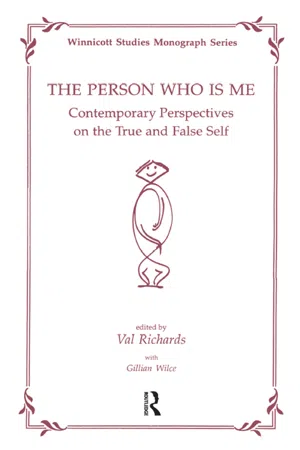
This book focuses on one of D. W. Winnicott's most enduring and resonant formulations, the True and False Self. It is a salutary reminder of Winnicott's capacity as the acclaimed advocate of maternal "holding"—also for sharpness and for the sudden piercing stab of recognition.
Information
CHAPTER ONE
Ego distortion in terms of True and False Self
One recent development in psycho-analysis has been the increasing use of the concept of the False Self. This concept carries with it the idea of a True Self.
History
This concept is not in itself new. It appears in various guises in descriptive psychiatry and notably in certain religions and philosophical systems. Evidently a real clinical state exists which deserves study, and the concept presents psycho-analysis with an aetiological challenge. Psycho-analysis concerns itself with the questions:
(1) How does the False Self arise?
(2) What is its function?
(3) Why is the False Self exaggerated or emphasized in some cases?
(4) Why do some persons not develop a False Self system?
(5) What are the equivalents to the False Self in normal people?
(6) What is there that could be named a True Self?
It would appear to me that the idea of a False Self, which is an idea which our patients give us, can be discerned in the early formulations of Freud. In particular I link what I divide into a True and a False Self with Freud’s division of the self into a part that is central and powered by the instincts (or by what Freud called sexuality, pregenital and genital), and a part that is turned outwards and is related to the world.
Personal contribution
My own contribution to this subject derives from my working at one and the same time
(a) as a paediatrician with mothers and infants and
(b) as a psycho-analyst whose practice includes a small series of borderline cases treated by analysis, but needing to experience in the transference a phase (or phases) of serious regression to dependence.
My experiences have led me to recognize that dependent or deeply regressed patients can teach the analyst more about early infancy than can be learned from direct observation of infants, and more than can be learned from contact with mothers who are involved with infants. At the same time, clinical contact with the normal and abnormal experiences of the infant-mother relationship influences the analyst’s analytic theory since what happens in the transference (in the regressed phases of certain of his patients) is a form of infant-mother relationship.
I like to compare my position with that of Greenacre, who has also kept in touch with paediatrics while pursuing her practice of psycho-analysis. With her too it seems to be clear that each of the two experiences has influenced her in her assessment of the other experience.
Clinical experience in adult psychiatry can have the effect on a psycho-analyst of placing a gap between his assessment of a clinical state and his understanding of its aetiology. The gap derives from an impossibility of getting a reliable history of early infancy either from a psychotic patient or from the mother, or from more detached observers. Analytic patients who regress to serious dependence in the transference fill in this gap by showing their expectations and their needs in the dependent phases.
Ego-needs and id-needs
It must be emphasized that in referring to the meeting of infant needs I am not referring to the satisfaction of instincts. In the area that I am examining the instincts are not yet clearly defined as internal to the infant. The instincts can be as much external as can a clap of thunder or a hit. The infant’s ego is building up strength and in consequence is getting towards a state in which id-demands will be felt as part of the self, and not as environmental. When this development occurs, then id-satisfaction becomes a very important strengthener of the ego, or of the True Self; but id-excitements can be traumatic when the ego is not yet able to include them, and not yet able to contain the risks involved and the frustrations experienced up to the point when id-satisfaction becomes a fact.
A patient said to me: “Good management” (ego care) “such as I have experienced during this hour is a feed” (id-satisfaction). He could not have said this the other way round, for if I had fed him he would have complied and this would have played into his False Self defence, or else he would have reacted and rejected my advances, maintaining his integrity by choosing frustration.
Other influences have been important for me, as for instance when periodically I have been asked for a note on a patient who is now under psychiatric care as an adult but who was observed by myself when an infant or small child. Often from my notes I have been able to see that the psychiatric state that now exists was already to be discerned in the infant-mother relationship. (I leave out infant-father relationships in this context because I am referring to early phenomena, those that concern the infant’s relationship to the mother, or to the father as another mother. The father at this very early stage has not become significant as a male person.)
Example
The best example I can give is that of a middle-aged woman who had a very successful False Self but who had the feeling all her life that she had not started to exist, and that she had always been looking for a means of getting to her True Self. She still continues with her analysis, which has lasted many years. In the first phase of this research analysis (this lasted two or three years), I found I was dealing with what the patient called her “Caretaker Self”. This “Caretaker Self”:
(1) found psycho-analysis;
(2) came and sampled analysis, as a kind of elaborate test of the analyst’s reliability;
(3) brought her to analysis;
(4) gradually after three years or more handed over its function to the analyst (this was the time of the depth of the regression, with a few weeks of a very high degree of dependence on the analyst);
(5) hovered round, resuming caretaking at times when the analyst failed (analyst’s illness, analyst’s holidays, etc.);
(6) its ultimate fate will be discussed later.
From the evolution of this case it was easy for me to see the defensive nature of the False Self. Its defensive function is to hide and protect the True Self, whatever that may be. Immediately it becomes possible to classify False Self organizations:
(1) At one extreme: the False Self sets up as real and it is this that observers tend to think is the real person. In living relationships, work relationships, and friendships, however, the False Self begins to fail. In situations in which what is expected is a whole person the False Self has some essential lacking. At this extreme the True Self is hidden.
(2) Less extreme: the False Self defends the True Self; the True Self is, however, acknowledged as a potential and is allowed a secret life. Here is the clearest example of clinical illness as an organization with a positive aim, the preservation of the individual in spite of abnormal environmental conditions. This is an extension of the psycho-analytic concept of the value of symptoms to the sick person.
(3) More towards health: the False Self has as its main concern a search for conditions which will make it possible for the True Self to come into its own. If conditions cannot be found then there must be reorganized a new defence against exploitation of the True Self, and if there be doubt then the clinical result is suicide. Suicide in this context is the destruction of the total self in avoidance of annihilation of the True Self. When suicide is the only defence left against betrayal of the True Self, then it becomes the lot of the False Self to organize the suicide. This, of course, involves its own destruction, but at the same time eliminates the need for its continued existence, since its function is the protection of the True Self from insult.
(4) Still further towards health: the False Self is built on identifications (as for example that of the patient mentioned, whose childhood environment and whose actual nanny gave much colour to the False Self organization).
(5) In health: the False Self is represented by the whole organization of the polite and mannered social attitude, a “not wearing the heart on the sleeve”, as might be said. Much has gone to the individual’s ability to forgo omnipotence and the primary process in general, the gain being the place in society which can never be attained or maintained by the True Self alone.
So far I have kept within the bounds of clinical description. Even in this limited area recognition of the False Self is important, however. For instance, it is important that patients who are essentially False Personalities shall not be referred to students of psycho-analysis for analysis under a training scheme. The diagnosis of False Personality is here more important than the diagnosis of the patient according to accepted psychiatric classifications. Also in social work, where all types of case must be accepted and kept in treatment, this diagnosis of False Personality is important in the avoidance of extreme frustration associated with therapeutic failure in spite of seemingly sound social work based on analytic principles. Especially is this diagnosis important in the selection of students for training in psycho-analysis or in psychiatric social work, that is to say, in the selection of case-work students of all kinds. The organized False Self is associated with a rigidity of defences which prevents growth during the student period.
The mind and the False Self
A particular danger arises out of the not infrequent tie-up between the intellectual approach and the False Self. When a False Self becomes organized in an individual who has a high intellectual potential there is a very strong tendency for the mind to become the location of the False Self, and in this case there develops a dissociation between intellectual activity and psychosomatic existence. (In the healthy individual, it must be assumed, the mind is not something for the individual to exploit in escape from psychosomatic being. I have developed this theme at some length in “Mind and Its Relation to the Psyche-Soma”, 1949a.)
When there has taken place this double abnormality, (i) the False Self organized to hide the True Self, and (ii) an attempt on the part of the individual to solve the personal problem by the use of a fine intellect, a clinical picture results which is peculiar in that it very easily deceives. The world may observe academic success of a high degree, and may find it hard to believe in the very real distress of the individual concerned, who feels “phoney” the more he or she is successful. When such individuals destroy themselves in one way or another, instead of fulfilling promise, this invariably produces a sense of shock in those who have developed high hopes of the individual.
Aetiology
The main way in which these concepts become of interest to psycho-analysts derives from a study of the way a False Self develops at the beginning, in the infant-mother relationship, and (more im portant) the way in which a False Self does not become a significant feature in normal development.
The theory relative to this important stage in ontogenetic development belongs to the observation of infant-to-mother (regressed patient-to-analyst) living, and it does not belong to the theory of early mechanisms of ego-defence organized against id-impulse, though of course these two subjects overlap.
To get to a statement of the relevant developmental process it is essential to take into account the mother’s behaviour and attitude, because in this field dependence is real, and near absolute. It is not possible to state what takes place by reference to the infant alone.
In seeking the aetiology of the False Self we are examining the stage of first object-relationships. At this stage the infant is most of the time unintegrated, and never fully integrated; cohesion of the various sensori-motor elements belongs to the fact that the mother holds the infant, sometimes physically, and all the time figuratively. Periodically the infant’s gesture gives expression to a spontaneous impulse; the source of the gesture is the True Self, and the gesture indicates the existence of a potential True Self. We need to examine the way the mother meets this infantile omnipotence revealed in a gesture (or a sensori-motor grouping). I have here linked the idea of a True Self with the spontaneous gesture. Fusion of the motility and erotic elements is in process of becoming a fact at this period of development of the individual.
The mother’s part
It is necessary to examine the part played by the mother, and in doing so I find it convenient to compare two extremes; by one extreme the mother is a good-enough mother and by the other the mother is not a good-enough mother. The question will be asked: what is meant by the term “good-enough”?
The good-enough mother meets the omnipotence of the infant and to some extent makes sense of it. She does this repeatedly. A True Self begins to have life, through the strength given to the infant’s weak ego by the mother’s implementation of the infant’s omnipotent expressions.
The mother who is not good enough is not able to implement the infant’s omnipotence, and so she repeatedly fails to meet the infant gesture; instead she substitutes her own gesture which is to be given sense by the compliance of the infant. This compliance on the part of the infant is the earliest stage of the False Self, and belongs to the mother’s inability to sense her infant’s needs.
It is an essential part of my theory that the True Self does not become a living reality except as a result of the mother’s repeated success in meeting the infant’s spontaneous gesture or sensory hallucination. (This idea is closely linked with Sechehaye’s [1951] idea contained in the term “symbolic realization”. This term has played an important part in modern psycho-analytic theory, but it is not quite accurate since it is the infant’s gesture or hallucination that is made real, and the capacity of the infant to use a symbol is the result.)
There are now two possible lines of development in the scheme of events according to my formulation. In the first case the mother’s adaptation is good enough and in consequence the infant begins to believe in external reality which appears and behaves as by magic (because of the mother’s relatively successful adaptation to the infant’s gestures and needs), and which acts in a way that does not clash with the infant’s omnipotence. On this basis the infant can gradually abrogate omnipotence. The True Self has a spontaneity, and this has been joined up with the world’s events. The infant can now begin to enjoy the illusion of omnipotent creating and controlling, and then can gradually come to recognize the illusory element, the fact of playing and imagining. Here is the basis for the symbol which at first is both the infant’s spontaneity or hallucination, and also the external object created and ultimately cathected.
In between the infant and the object is some thing, or some activity or sensation. In so far as this joins the infant to the object (viz. maternal part-object), so far is this the basis of symbol-formation. On the other hand, in so far as this something separates instead of joins, so is its function of leading on to symbol-formation blocked.
In the second case, which belongs more particularly to the subject under discussion, the mother’s adaptation to the infant’s hallucinations and spontaneous impulses is deficient, not good enough. The process that leads to the capacity for symbol-usage does not get started (or else it becomes broken up, with a corresponding withdrawal on the part of the infant from advantages gained).
When the mother’s adaptation is not good enough at the start the infant might be expected to die physically, because cathexis of external objects is not initiated. The infant remains isolated. But in practice the infant lives, but lives falsely. The protest against being forced into a false existence can be detected from the earliest stages. The clinical picture is one of general irritability, and of feeding and other function disturbances which may, however, disappear clinically, only to reappear in serious form at a later stage.
In this second case, where the mother cannot adapt well enough, the infant gets seduced into a compliance, and a compliant False Self reacts to environmental demands and the infant seems ...
Table of contents
- Cover
- Half Title
- Title Page
- Copyright Page
- Table of Contents
- ACKNOWLEDGEMENTS
- CONTRIBUTORS
- Introduction
- CHAPTER ONE Ego distortion in terms of True and False Self
- CHAPTER TWO Hunt the slipper
- CHAPTER THREE Winnicott and Lacan: selfhood versus subjecthood
- CHAPTER FOUR The emergence of a sense of Self, or, The development of “I-ness”
- CHAPTER FIVE Looking after the Self
- CHAPTER SIX The Self: what is it?
- REFERENCES
- INDEX
Trusted by 375,005 students
Access to over 1.5 million titles for a fair monthly price.
Study more efficiently using our study tools.
Frequently asked questions
Yes, you can cancel anytime from the Subscription tab in your account settings on the Perlego website. Your subscription will stay active until the end of your current billing period. Learn how to cancel your subscription
No, books cannot be downloaded as external files, such as PDFs, for use outside of Perlego. However, you can download books within the Perlego app for offline reading on mobile or tablet. Learn how to download books offline
Perlego offers two plans: Essential and Complete
- Essential is ideal for learners and professionals who enjoy exploring a wide range of subjects. Access the Essential Library with 800,000+ trusted titles and best-sellers across business, personal growth, and the humanities. Includes unlimited reading time and Standard Read Aloud voice.
- Complete: Perfect for advanced learners and researchers needing full, unrestricted access. Unlock 1.5M+ books across hundreds of subjects, including academic and specialized titles. The Complete Plan also includes advanced features like Premium Read Aloud and Research Assistant.
We are an online textbook subscription service, where you can get access to an entire online library for less than the price of a single book per month. With over 1.5 million books across 990+ topics, we’ve got you covered! Learn about our mission
Look out for the read-aloud symbol on your next book to see if you can listen to it. The read-aloud tool reads text aloud for you, highlighting the text as it is being read. You can pause it, speed it up and slow it down. Learn more about Read Aloud
Yes! You can use the Perlego app on both iOS and Android devices to read anytime, anywhere — even offline. Perfect for commutes or when you’re on the go.
Please note we cannot support devices running on iOS 13 and Android 7 or earlier. Learn more about using the app
Please note we cannot support devices running on iOS 13 and Android 7 or earlier. Learn more about using the app
Yes, you can access The Person Who Is Me by Val Richards in PDF and/or ePUB format, as well as other popular books in Psychology & History & Theory in Psychology. We have over 1.5 million books available in our catalogue for you to explore.