![]()
1
The What and Why of STEAM
The Jargon Jungle: Makers, STEM, and STEAM – What’s the Difference?
The world of STEAM and making has exploded onto the educational scene in the past year. It seems that everywhere you turn, you are hearing about some form of making being implemented in schools. The terms STEM, STEAM, STREAM, makerspaces, FabLabs, Hackerspaces, MakerEd, Design Thinking, and more are bandied about in casual conversation but can be very confusing to those new to the movement. Billy and Meredith believe that many of these terms can be blended together. We will take a look at those terms in more detail shortly.
First, some background about what we have done, our philosophies with STEAM, and why sometimes STEAM can be blended with other terminology. Billy and Meredith both have experience in blending both STEAM and making in their respective roles in education, and are constantly developing new ways to combine these two types of hands-on education. Billy has worked to develop STEAM periods in his school and is currently working on developing STEAM during indoor recess. Meredith has developed a full-blown STEAM Lab for one school, and is currently developing a Technology and Makerspace program for the project-based learning school she currently teaches at. She also consults with schools and districts on how to develop and implement STEAM and maker programs in their own buildings.
Getting started blending STEAM and Making in education can seem intimidating and expensive. Billy and Meredith are aware of the funding issues facing most schools, and believe in finding the most cost-effective ways of incorporating STEAM/Making into schools. It is not only possible but easy to create a blended STEAM and Making program with very little financial expenditure.
Before we dive into the whys and hows of getting started with STEAM and Making, it’s important to understand what those two terms mean, and the definitions of several related terms you may hear used in conjunction with them. The terms listed in the rest of this chapter will give you more of a background into what the terminology is and the ways in which we define these words.
STEM
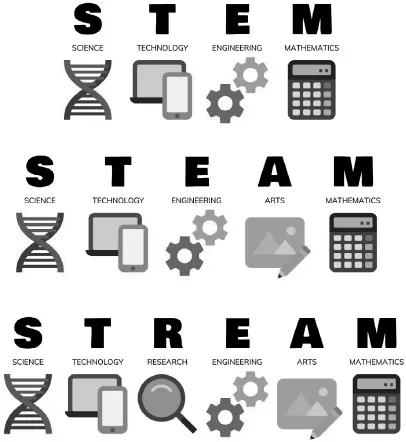
STEM stands for Science, Technology, Engineering, and Math. While these subjects are often taught in schools, the philosophy behind STEM is integrating these subjects in meaningful ways instead of teaching them in isolated classes. STEM is a way of showing students how these core topics are interconnected to each other in the real world. STEM lessons and labs tend to be more structured than the more interest-driven makerspaces.
STEAM
STEAM stands for Science, Technology, Engineering, Arts and Math. The philosophy behind STEAM is integrating the arts into these subjects in a creative way. The arts is not just limited to the creative arts (drawing, painting, sculptures, 3D printing, music) but can include language arts as well. STEAM leads students to apply design and the arts as part of problem-solving. STEAM also encourages students to explore their creativity as part of their learning.
STREAM
STREAM is a newer iteration of STEAM. The R most often stands for either Research or wRiting. The philosophy behind STEAM is integrating research and/or writing into problem-solving. Research fits particularly well into many STEAM projects, particularly where students are asked to support their decisions as part of a project or activity. Writing, of course, is a necessary skill across all disciplines and parts of a project, from writing a proposal through recording data, all the way through to sharing a conclusion and presenting results (Figure 1.1).
Makerspaces
The term makerspace has many definitions and can be interpreted differently by each individual. The main idea behind a makerspace is that it is an OPEN area for students to explore and learn. Makerspaces tend to be more unstructured, and often have people working on widely varied types of projects. In schools, makerspaces are usually an area where students have more choice, and have the opportunity to explore their own interests and ideas.
FabLabs
A FabLab (short for fabrication laboratory) is a workshop area that can be used by members of the public for small-scale fabrication projects and activities. People looking to create new products either for personal use or for limited sale or distribution can use a FabLab to access tools that have traditionally been restricted to mass-production factories and labs. Tools such as laser cutters, CNC routers, 3D printers, metalworking tools, and others can be found in FabLabs around the world.
Hackerspaces
A Hackerspace is a community-operated place for people to come together to tinker and learn from one another, often with an emphasis on technology. Hackerspaces tend to emphasize learning by doing and collaboration among peers.
MakerEd
Makerspaces have been around for a while in public spaces, but have only recently become incorporated into the educational world. MakerEd is a term that references both the inclusion of making in school subjects, but also the growing community of educators involved in the movement that provide resources and support fellow MakerEd teachers.
Design Thinking
Design Thinking is a relatively new term in the education world, but is rapidly becoming a hot topic. Design Thinking is a way to bring empathy into the classroom by teaching students to use their STEM and Making skills to meet the needs of others, instead of just themselves. Students often use Design Thinking to help solve real-world problems for their communities and the wider world.
These are the terms that are currently being used by many educators who are in the K–12 classroom. As you can see from the definitions above, there tends to be a lot of overlap between terms and many people use them interchangeably. The two main terms we are focusing on in this book are STEAM and Making. We believe that these terms are most applicable in an educational setting, and can be blended with one another with great results.
Maker is a mindset, more than it is a space. By Amanda Kavanagh
What? An area, space, place or concept where materials are available to be used for a creative process. This can include low-tech material such as paper-towel rolls, rubber bands, popsicle sticks, duct tape, paper and glue and/or 3D printers, iPads, Chromebooks, Ozobots, Sphero, Raspberry Pi, Little Bits, or other high-tech devices.
Where? A makerspace can be anywhere. The corner of a classroom, the center of a classroom, within a Library Media Center, a stand-alone room designed for this purpose, or even a portable maker cart that can be moved from room to room. It can also be a way of thinking in a classroom where any materials are fair game and the teacher lets the students use the design process to construct a representation of their knowledge.
What happens in a makerspace? Depends on the grade level, materials and individuals occupying the space. Everything from self-directed creations to curriculum-aligned projects.
Our Approach (Hewlett-Woodmere Public Schools):
♦ Start with library media specialists (LMS) in the library in three buildings and a stand-alone makerspace in one of the buildings.
♦ Provide time for the LMS to write curriculum with assistance and support from the building principals and director of technology. Approximately 20% of the Library curriculum is dedicated to Technology Education (digital citizenship, maker, engineering, digital design, coding).
♦ This led to the creation of a roadmap to guide the LMS through the first year. A list of items that we needed to get this off the ground was made and purchased. This included:
◦ Green screen
◦ iPads
◦ Chromebooks
◦ 3D Printer
◦ Bloxels
◦ Code and Go Mouse (early elementary)
◦ Doodle Pens
◦ Osmo Kits
◦ Ozobots (early elementary)
◦ Sphero Robots (higher elementary grades)
◦ Little Bits
◦ Low-tech materials
◦ Breakout EDU boxes.
♦ The process has not looked the same in each building. Professional learning is ongoing for the LMS and they are transferring knowledge to the teachers in the buildings and working to make connections with the curriculum in conjunction with our Technology Integration Lead Teachers (TILTs).
How is a makerspace different and/or similar to a STEM/STEAM/Innovation Lab?
I wouldn’t say that they are different or the same because each makerspace, even within one district, can be utilized differently. The main difference, from what I have seen, is who occupies this space and what the district’s vision is for this type of learning. The most critical thing for Hewlett-Woodmere Public Schools (HWPS) was getting all of our stakeholders together to have a conversation about what this would look like in HWPS. What would this mean for our students and teachers? Although we started with our elementary buildings, our middle-school LMS has been bringing these concepts into her library for several years. We are now in the process of purchasing materials for our high school library. We are letting this grow naturally to meet the students and teachers where they are.
Now You Have the WHAT, Let’s Find Out the WHY
Even more important than knowing what these terms mean is understanding why they have become such a strong force in the educational community. Before implementing any new program in a school or district, it’s important to make sure that it has a strong pedagogical reason for being added. There are many powerful reasons for starting a MakerEd and STEAM program for your students. One reason it is important development these programs in our education system is because these will potential job fields for students to go into in the future. According to the United States Department of Commerce – Economic and Statistic Administration:
Employment in STEM occupations grew much faster than employment in non-STEM occupations over the last decade (24.4 percent versus 4.0 percent, respectively), and STEM occupations are projected to grow by 8.9 percent from 2014 to 2024, compared to 6.4 percent growth for non- STEM occupations.1
If these will be the potential jobs for our students, we should be teaching our students these skills at an early age and exposing them to the different mindset of thinking in STEM-related fields. What is even more interesting is that “In 2015, there were 9.0 million STEM workers in the United States. About 6.1 percent of all workers are in STEM occupations, up from 5.5 percent just five years earlier.2” These numbers show why we need to make sure we start to develop a STEM program in our schools. The question or the argument can be: then why do we need to discuss STEAM or STREAM? In our view, making sure you add the “A” into STEM is important to help students have a better understanding of how all the subject areas tie in together.
Why add “A” in STEM
Often we discuss what the A in STEAM stands for, and the response is the arts. Let’s make that arts–not just the creative arts but creative writing and the PERFORMING arts as well.
There is a buzz in schools around the Science, Technology, Engineering, and Mathematics, or STEM. Schools across the country are adopting or finding ways to incorporate STEM into children’s school days. Often there is a discussion about whether or not it should be STEM or as some people call it, STEAM (Science, Technology, Engineering, Art and Mathematics). What the difference is often comes down to the ways in which people will interpret the meaning behind it. In my mind, the A is important to add to the discussion when we are talking about STEM. It makes sense to add the A; from this educator’...