In this seminal work on the clinical, archetypal and spiritual dimension of trauma, the author offers a compelling vision of the transformative potential of suffering and the dialectic of Dying and Becoming. Wirtz outlines a healing path from fragmentation to integration and illuminates the resilience of the human spirit in the face of severe trauma. Trauma and Beyond will be essential reading and a valuable resource for counsellors, therapists and Jungian analysts who are challenged in their practice with individual and collective traumata.
- 358 pages
- English
- ePUB (mobile friendly)
- Available on iOS & Android
eBook - ePub
About this book
Information
Part I
DOI: 10.4324/9781003139201-2
Part I Opening The Spiritual Lens: Dying and Becoming
DOI: 10.4324/9781003139201-3
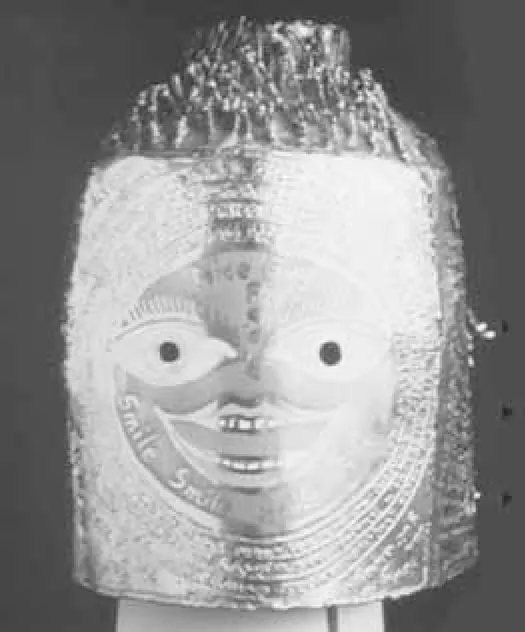
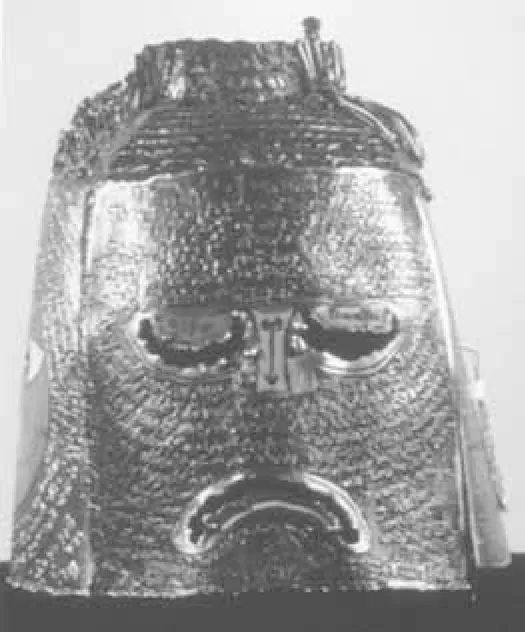
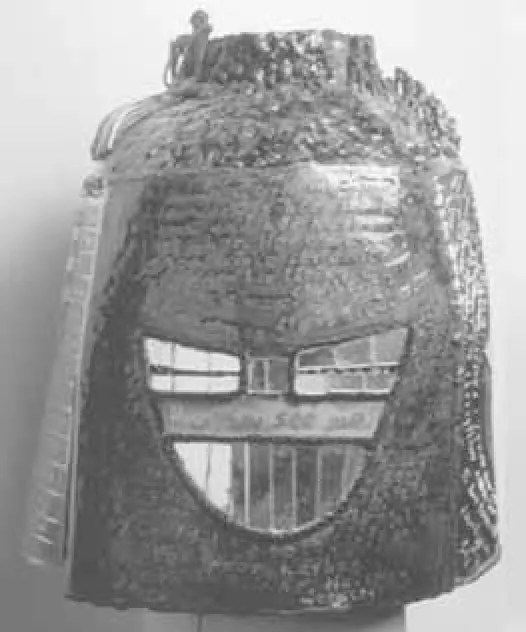
When I first encountered the etched and enameled four-sided mask, All My Faces, by the German artist Hede von Nagel, who grew up in Nazi Germany, my first thought was that I had witnessed the unveiling of the many faces of trauma. The shiny, gold-plated “Nice Guy” face (figure 1.1), inscribed with superficial clichés and small-talk lines and the artificial smile contrasting with the penetrating, staring eyes, reminded me of patients defensively hiding their inner core, sacrificing their true self in order to survive. As I read the inscriptions on the “How They See Me” face (figure 1.3), with their haunting messages, surrounding the mirror fragments, the trauma gradually unfolded and revealed the “Depressed Face” (figure 1.2) with the words Love and Death inscribed on the eyelids. The poignant, meticulously etched sentences covering the face sounded like the lamentations of trauma survivors I had so often heard:
I am so sick and tired of life—I survived. They threw bombs at me—I survived. They tried to starve me—I survived. They tried to put me down—I survived. They made me obedient and submissive—I survived. They made me forget who I am—I survived. They made me feel guilty all the time—I survived…. They did not teach me how to live and love—I survived. I hate them because they helped me survive. I hate myself—why did I survive? Will I survive? I would like to kill myself—kill them.
The fourth side of the helmet, “The Real Me” (figure 1.4), is a hinged panel that can be opened to reveal the artist’s true face. When it is closed, one can read what she is yearning for: “serenity, courage, honesty,” and above all: “I want to be the woman I really am.” I include these photographs of this fine, award-winning work to amplify the many faces of trauma.1

NOTES
- All My Faces won the Award of Excellence for Enamels at Artist-Craftsmen of New York, Lever House, New York, September 19 to October 1971.
Chapter One Unveiling the Face of Trauma
DOI: 10.4324/9781003139201-4
In exploring the many faces of trauma and the divergent claims that have been made with regard to it, what comes to mind is the old Sufi parable of the blind men and the elephant, in which five blind men encounter an elephant and examine it by feeling its body parts. Each likens the elephant to an object that is familiar to him, based on the body part he touches, and each is convinced that he knows what an elephant is, yet none of them has any idea what the elephant looks like as a whole.
Trauma has similarly been conceptualized in multifarious ways. Mardi Horowitz holds that traumatic life events have the traumatic effect that they do because they cannot be assimilated into the victim’s inner schemata of self in relation to the world.1 According to Ronnie Janoff-Bulman, traumatic events destroy the victim’s fundamental assumptions about the safety of the world, undermine the positive value of the self, and cause a disturbance of affectivity, a state Thomas Ogden calls “formless dread.”2 Henry Krystal asserts that trauma produces a regression in affect, a deficit in the capacity for symbolic representation, and fantasy formation.3 D. W. Winnicott emphasizes the necessity of a good “holding environment” to deal with the disintegration anxiety caused by traumatic events with their menacing threat of nonexistence.4 Heinz Kohut’s self-psychology model speaks of the dissolution of a coherent self under the influence of trauma.5 In analytical psychology, Donald Kalsched shows how trauma ruptures the transitional processes of human relatedness that constitute meaning.6 As Robert Jay Lifton sees it, trauma victims suffer from impaired human relationships, from what he calls “the broken connection,” which results in a state of being outside of culture, “our means of symbolizing death and continuity.”7 Lifton believes that trauma disrupts the capacity to develop images and symbolic forms that provide a sense of continuity. He claims that these symbols must be transformed and reanimated in order to find new meaning.
The common thread in these various views is that the ego’s central role as a planning, controlling authority is powerfully exploded by trauma. Traumatic experiences may thus lead to a radical breaking in and breaking apart of existing ego structures, resulting in a disintegration of the previous psychic structure. The psychological concept of self-regulation and control and the consciousness of being an autonomous, intentional human agent no longer hold. Being helpless, handed over, determined by outside forces, these are the coordinates of traumatic experience. In a traumatic event, ego boundaries are overrun, and one learns that the everyday ego is utterly insubstantial. As a result, the ego undergoes a monstrous relativization, being degraded to meaninglessness and threatened with fragmentation and destruction. The ego, which once guaranteed one’s identity, seems to have no use any more. One is overcome by a sense of extreme vulnerability. For the annihilation of the ego is a form of dying.
This “passing away” of the ego also appears in mystical writings, in which it characterizes transpersonal states of awareness. Thus, the loss of boundaries and the sense of emptiness caused by trauma can be experienced as a liberation from attachments, in which enmeshment in the material world loses its importance. The immaterial may take on an overpowering numinosity, giving rise to developments previously unthinkable. Boundary experiences in the face of impending death can give rise to states of transparency. Jung attested to this following his near-fatal illness, in a letter he wrote to Dr. Kristine Mann while recovering:
The only difficulty is to get rid of the body, to get quite naked and void of the world and the ego-will. When you can give up the crazy will to live and when you seemingly fall into a bottomless mist, then the truly real life begins with everything which you were meant to be and never reached. It is something ineffably grand.8
Confronted by the outer limits of life, one loses the familiar sense of being physically in the world. Then consciousness of another reality seems to shine forth. This beyond cannot be put into words, but it can be felt to be meaningful, to surpass the ego.
Traumatic experiences activate archaic levels of the psyche and constellate an archetypal landscape highly charged with affect. Often the experience of archetypal suffering inspires the use of religious and mythological language as a means of expressing the inexpressible. We refer to trauma as an experience of “hell,” of “God in exile.” We describe it as a terrifying encounter with the dark side of God; we imagine a “Deus absconditus,” whose absence makes us perceive “heaven as an abyss” and inflicts on us the archetypal experience of being cast out and forsaken, like the biblical Job.9 The yawning abyss is an often-used metaphor for the aftermath of a trauma experience, the “black hole,” the “void,” the experience of “anti-creation,” the severing of the thread of life, the creating of an “irreparable tear between self and reality,” a deep rift in the psyche.10
Trauma can be seen as a meaning disorder in which the vessel is broken and the ego-Self axis is disrupted. But it can also be a potential catalyst for a new orientation in life. In her seminal work on trauma, writing about how repeated trauma forms and deforms the personality, Judith Herman emphasizes that trauma can force “the development of extraordinary capacities, both creative and destructive.”11 When trauma strikes, our perception of the world and ourselves undergoes a radical reorganization. The English word catastrophe is derived from a Greek word that originally signified a turning point, and it is precisely at such turning points that an enantiodromia can occur.12 In dynamic systems theory, such turning points are known as phase transitions, which occur when a given variable reaches a certain critical threshold. This concept is explored by Jungian analyst George Hogenson in terms of “symbolic density.”13
My experience with survivors of trauma has given me some understanding of the paradox of “dying and becoming” (“Stirb and werde”), which gives soul to every living thing and binds together the cycle of coming into being and departing from it; it is the rhythm of loss and gain, darkness and light, of getting stuck and transcending to a different plane of consciousness. The poles of death and life belong together as a paradoxical unity; as Jung said, “waxing and waning make one curve.”14 This principle of an eternal movement between polar opposites is part of the Jungian understanding of the psyche’s self-regulation. In trauma therapy, I have come to experience this dynamic principle that nothing stays the way it is—this “grim law of enantiodromia”—as a comfort.15 If I see, with Heraclitus, that the deepest reality is to be found in constant flux, then I know that even the greatest despair and the deepest suffering are subject to this dynamic and can turn around. My work is rooted in the paradoxical wisdom of enantiodromia, that whatever exists will be destroyed and replaced by something new, that becoming and dying are two aspects of the same process.
In the spiritual borderland of traumatic loss of meaning, in the black hole of despair and hopelessness, human beings no longer feel in relationship with the totality of being, but alone, having fallen out of all familiar, meaning-creating connections. The frightening, unfamiliar, numinous dimension into which their experience has thrown them produces a far-reaching estrangement from ego and the world. Traumatized individuals have become lost to themselves and to their environment, helplessly at the mercy of a silent cosmos.
Trauma therapy is a path on which there are multiple points of access to bring home the estranged parts, to move from fragmentation to integration, on three levels: the intrapsychic level, where broken-off aspects of one’s person can be pulled together into a whole; the interpersonal level, in which contact is once again resumed with the Thou of the other person; and the transpersonal level, where one can flow back into the stream of life.
I have encountered people on the margin who have borne witness to the human capacity to transcend one’s limitations. Some are people of faith who, finding themselves in situations of greatest distress and danger, have nevertheless not lost their awareness of an ultimate spiritual security. Dietrich Bonhoeffer, before he was hanged on April 9, 1945, in a concentration camp, was able to say to Payne Best, with his execution in mind, “This is the end, for me the beginning of life.”16 From prison he wrote powerful poems about resistance and surrender, among them the wonderfully comforting message to his family, later set to music:
With every power for good to stay and guide me,comforted and inspired beyond all fear,I’ll live these days with you in thought beside me,and pass, with you, into the coming year.17
The archetype of the wounded healer, who heals through his or her own wounds and personal acquaintance with liminality, always comes to life for me when I meet victims of torture in recovery centers, working with therapeutic teams who themselves have survived torture and persecution. The healers, themselves traumatized men and women, have made spiritual care-giving their life’s work. They live in consciousness of a calling, a mission in the best sense of the word, to assist others in becoming human again, and in so doing, they become a bit more human themselves.
Spiritual people feel they have a task to accomplish in this life. Their starting point is the conviction th...
Table of contents
- Cover Page
- Half-Title Page
- Title Page
- Copyright Page
- Dedication
- Table of Contents
- Acknowledgments
- Permissions
- Sources and Abbreviations
- Introduction
- Part I The Spiritual Lens: Dying and Becoming
- Part II The Clinical Lens
- Conclusion
- Index
Trusted by 375,005 students
Access to over 1.5 million titles for a fair monthly price.
Study more efficiently using our study tools.
Frequently asked questions
Yes, you can cancel anytime from the Subscription tab in your account settings on the Perlego website. Your subscription will stay active until the end of your current billing period. Learn how to cancel your subscription
No, books cannot be downloaded as external files, such as PDFs, for use outside of Perlego. However, you can download books within the Perlego app for offline reading on mobile or tablet. Learn how to download books offline
Perlego offers two plans: Essential and Complete
- Essential is ideal for learners and professionals who enjoy exploring a wide range of subjects. Access the Essential Library with 800,000+ trusted titles and best-sellers across business, personal growth, and the humanities. Includes unlimited reading time and Standard Read Aloud voice.
- Complete: Perfect for advanced learners and researchers needing full, unrestricted access. Unlock 1.5M+ books across hundreds of subjects, including academic and specialized titles. The Complete Plan also includes advanced features like Premium Read Aloud and Research Assistant.
We are an online textbook subscription service, where you can get access to an entire online library for less than the price of a single book per month. With over 1.5 million books across 990+ topics, we’ve got you covered! Learn about our mission
Look out for the read-aloud symbol on your next book to see if you can listen to it. The read-aloud tool reads text aloud for you, highlighting the text as it is being read. You can pause it, speed it up and slow it down. Learn more about Read Aloud
Yes! You can use the Perlego app on both iOS and Android devices to read anytime, anywhere — even offline. Perfect for commutes or when you’re on the go.
Please note we cannot support devices running on iOS 13 and Android 7 or earlier. Learn more about using the app
Please note we cannot support devices running on iOS 13 and Android 7 or earlier. Learn more about using the app
Yes, you can access Trauma and Beyond by Ursula Wirtz in PDF and/or ePUB format, as well as other popular books in Psychology & Mental Health in Psychology. We have over 1.5 million books available in our catalogue for you to explore.