- 280 pages
- English
- ePUB (mobile friendly)
- Available on iOS & Android
eBook - ePub
About this book
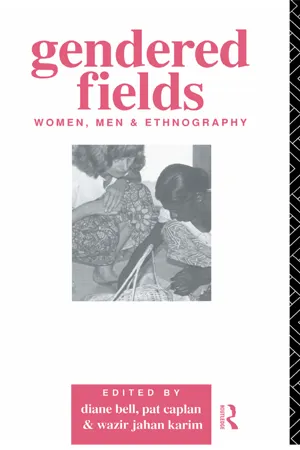
Virtually all anthropologists undertaking fieldwork experience emotional difficulties in relating their own personal culture to the field culture. The issue of gender arises because ethnographers do fieldwork by establishing relationships, and this is done as a person of a particular age, sexual orientation, belief, educational background, ethnic identity and class. In particular it is done as men and women. Gendered Fields examines and explores the progress of feminist anthropology, the gendered nature of fieldwork itself, and the articulation of gender with other aspects of the self of the ethnographer.
Information
Introduction 1
The context
What does the ethnographer do? he writes.
(Geertz 1973: 19)
While anthropology questioned the status of the participant-observer, it spoke from the position of the dominant and thus for the ‘other’. Feminists speak from the position of the ‘other’.
(Mascia-Lees et al. 1989: 11)
WOMEN, MEN AND ETHNOGRAPHY*
The dilemma confronting the ethnographer who, as participant-observer, is both detached and engaged, an element in the field of study and the instrument of its articulation has generated a considerable body of literature. Some have opted for increased methodological rigour in an attempt to purge fieldwork of its subjective taint (see Radcliffe-Brown 1958; Friedrichs and Lüdtke 1975).1 Others have stood aloof (Lévi-Strauss 1961), noted the ‘bankruptcy of the mere observer position’ (Rabinow 1982: 174) and cast the ethnographer as marginal native (Freilich 1970) or professional stranger (Agar 1980). Still others, declaring the demise of ethnographic authority, have urged stylistic experimentation and issued calls for ethical writing (Clifford 1988; Marcus and Fischer 1986; Clifford and Marcus 1986), looked out from behind a multiplicity of masks (Berreman 1962), explored the intertwining of the hierarchies of colonialism and the academy (Asad 1973) and heard the challenge of the indigenous voice (Deloria 1969). Particularly influential has been Clifford Geertz’s (1973, 1988) notion of anthropology as an interpretative quest, ethnography as ‘thick description’ and ‘anthropologist as author’. For the most part, however, these authors have been silent on the issue of gender. The gendered nature of our fields has been left to women anthropologists to ponder and feminist scholars to critique, and even then their work has been largely ignored. Neither the burgeoning body of ethnographic literature by women writers nor feminist theorising about the difference gender makes have set the disciplinary agenda.2
The issue of gender arises because we (ethnographers) do fieldwork by establishing relationships, and by learning to see, think and be in another culture, and we do this as persons of a particular age, sexual orientation, belief, educational background, ethnic identity and class. In particular, as far as this volume is concerned, we also do it as women and as men. Women have been conspicuous for their consideration of the impact of their presence in the field as an element in their ethnography. Theirs is the gender-inflected voice, which cannot masquerade as universal: they have a standpoint and cannot pretend otherwise (Barry 1989; Bujra 1973; Gordon 1988; Mohanty 1987; Warren 1988). Women have written of their personal biographies, their age, marriages and children as integral to their ethnography (Cassell 1987; Cesara 1982; Wax 1979; Golde 1986; Powdermaker 1966). Female anthropologists working with women in societies where the sexual division of labour prescribes separate spaces for women and men in daily and ritual life have been especially clear regarding the relational nature of their enterprise (see Papanek 1964; Dube 1975; Weiner 1976; Dwyer 1978; Bell 1983; Scheper-Hughes 1983; Ardener 1986). Such reflections on the gendered nature of fieldwork and fieldworkers have made significant contributions towards mapping the terrain on which we might begin to explore experientially based knowledge (Abu-Lughod 1990; Stacey 1988) and cultures as complex, dynamic collages of intersecting interests of gender, race, ethnicity, class and sexuality (Moore 1988). It is in this context that this volume was conceived, first as an attempt to consider the gendered nature of fieldwork and, secondly, the articulation of gender with other aspects of the self of the ethnographer.
Lila Abu-Lughod (1990), reviewing feminists’ critiques of scientific objectivity, traces a shift from their early concerns with constraints on objectivity to the more radical analyses of objectivity as an epistemological stance. Furthermore, profound political critiques of the possibility of a gender-neutral anthropology are raised by the deconstruction of ‘objectivity’ by Catharine MacKinnon (1987), Donna Haraway’s (1988) exploration of the privilege of partial perspective, and proposals regarding women’s contextualised, relational moral reasoning by Alison Jaggar (1989) and Seyla Benhabib (1987). Feminist theorising has generated philosophical speculation about a feminist successor science (Keller 1985; Harding 1986), and we are to beginning to speak of the possibility of declaring a feminist epistemology (Hartsock 1983; Mascia-Lees et al 1989; Bell, this volume).
Given that anthropology has a long-standing interest in the relations between the sexes (marriage, kinship, rites of passage), it is ironic that its observations still reflect what are for the most part male standpoints presented as the ‘norm’. Male ethnographers need fear no challenge to the legitimacy of their knowledge as case material from one locale is generalised for entire regions, while women’s ethnographies remain particularised.3 For example, the ethnography of male anthropologists such as Lloyd Warner (1937) working in Arnhemland is frequently cited as the ‘Australian case’ of gender relations in Aboriginal society, while Phyllis Kaberry’s (1939) ethnography is usually known as a study of women in the Kimberleys. While women have explored their gendered fields, men have remained free to write of the generic ‘he’. It took the postmodern proclamation of a ‘crisis of representation’ to put the critique of objectivity and the scrutiny of ethnographic authority onto the disciplinary agenda. Those anthropologists who have taken the postmodern turn into textual analyses and plurivocality are forthright in their attention to ‘native’ as ‘other’, but tracing a genealogy entirely through males – such as Bob Scholte (1972), Dell Hymes (1969), Talad Asad (1973), Paul Rabinow (1977), Jay Ruby (1982), James Clifford and George Marcus (1986) and George Marcus and M. Fischer (1986) – are silent on the matter of woman as ‘other’.4 Their problematising of the ethnographic endeavour bears a striking similarity to the feminist debates mentioned above, but they appear ignorant of or uninterested in this scholarship (see Mascia-Lees et al. 1989; Caplan 1988; Strathern 1987; also Back, and Macintyre, this volume).
Why has mainstream anthropology been so recalcitrant in acknowledging that gender makes a difference to ethnography? Why have the practitioners clung so tenaciously to a gender-neutral neo-positivist paradigm or jumped on the postmodern bandwagon? Why has it been so difficult for feminists to be heard? The tendency to associate engagement with the feminine, and the feminine with the emotional, has locked women out of mainstream anthropology and removed them from accounts in the postmodern schema. Regardless of its rigour and innovative nature, such work will be deemed ‘women’s’, treated as a special case, and placed within the genre of ‘confessional literature’, or simply labelled ‘self-indulgent’. It has been men’s excursions into these domains that have informed disciplinary accounts of reflexivity. Meanwhile, feminists’ questions have been appropriated, and their experimental moments erased (see Mies 1983; Clifford and Marcus 1986: 19–20; Gordon 1988; Viswaswaran 1988). The self-awareness of the situatedness of the knower, so carefully analysed by feminists (see Hawkesworth 1989; Mascia-Lees et al. 1989), often translates in practice into marginality to the academy, the discipline and the curriculum (see Stanley 1990; Lutz 1990).
However, if those with an interest in critiquing and challenging the asymmetry of our gendered fields are not to subscribe to an essentialist conspiracy theory, we need to delve deeper. What is to be done to transform gender-inflected questions into disciplinary concerns? We might look to the so-called awkward relationship between anthropology and feminism, and ask whether that should be characterised as one of mocking incompatibility (Strathern 1987), a source of invigorating tension (Caplan 1988), or an expression of institutional power to set the academic agenda (Jennaway 1990; Lutz 1990; Stanley 1990). We might seek ways in which women and their contributions can be re-inscribed as central to the discipline by considering a two-pronged approach. First, we need to reclaim the voices of those whose insights and experiments are absent from mainstream genealogies, and, secondly, we need an analysis of the practices and presumptions that have erased, trivialised and marginalised their voices. Pioneering women anthropologists left clear traces for contemporary scholars: feminist scholars have given us the analytical tools.
A GENDERED GENEALOGY
There is a long and honourable tradition of ethnographic writing in which the voice of the ethnographer pondering her situation, the impact of her presence on the people with whom she is working, and the problematic nature of being both observer and participant is audible. In short, there is a reflexive tradition in which the voices of women are critical. It is summed up well by Margaret Mead’s comment that as an ethnographer, one must first ‘know thyself (1976: 905–7). Listen, for example, to Hortense Powdermaker in Stranger and Friend (1966) as she takes the reader into four different fields (Lesu, Mississippi, Hollywood, Zambia), and shifts from detached to engaged, even suggesting that the nature of our projects reflects the needs and personalities of the ethnographer quite as much as the problems that the field might pose. This is not to suggest that all women anthropologists saw things in the same way, but that there were the makings of a debate embedded in the ethnographies of the first generations of trained women anthropologists.5 Attention to the structural and epistemological implications of the insider/outsider positioning of the woman ethnographer constitutes a central feature of the later literature.
Women have sought to contextualise their work both autobiographically, as with Margaret Mead’s Letters from the Field (1977) and Blackberry Winter (1972), and biographically, as with the inclusion of correspondence between herself and her friend and colleague, in An Anthropologist at Work: The Writings of Ruth Benedict (Mead 1959). One notable facet of the biographical materials within which we may seek further readings of the ethnographic voice is that, for the most part, women’s letters, diaries, biographies and autobiographies reveal high levels of integration of personal and professional selves (see Cesara 1982). By way of contrast, Malinowski’s Diary in the Strict Sense of the Term (1967) raises a host of questions about the gap between his professional pronouncements and private preoccupations.
Women anthropologists’ own biographies are as revealing of academia as they are of themselves. For example, Benedict’s work draws on her unerring sense of the power of juxtaposing the familiar with the exotic in cultural critique. Her work contains lyric poetry, Swiftian discoursing on the ‘Uses of cannibalism’ (Mead 1959: 44–8) and, as Modell (1984) has noted, attention to the aesthetic dimension of human life. None the less, her extraordinary stylistic range has received scant attention from the postmodernists. Geertz (1988: 105–6) suggests that her ‘mordant’ themes and ‘conflation’ with Margaret Mead may explain the lack of appreciation of her contribution to the discipline, but perhaps more convincing is Margaret Caffrey’s (1989) depiction of Benedict as a woman working in a hostile academic environment at Columbia University where, despite her prodigious output, she was not promoted to full professor until 1948, the year she died6.
Women have indeed experimented with the ethnographic style, but their achievements in this regard are, with a few notable exceptions, undervalued and under-reported. Nisa (1981) by Marjorie Shostak is often cited as a dialogical text (Marcus and Fischer 1986: 58–9; Clifford 1988: 42) but many other innovative texts are ignored (see Schrijvers 1988, this volume; Marshall 1976). Writing of the American South in the 1930s, in a style that captures the rhythms of local speech, the black American anthropologist Zora Neale Hurston provides a fine ethnography of black kinship systems and social experience in Their Eyes Were Watching God (1937). In her next book, Tell My Horse (1938), she writes of her fieldwork on folk rituals and sex roles in Jamaica and Haiti. However, scholarly anthropologists resisted Hurston’s ‘personal’ writing style and ‘engaged’ field-work (including participation in voodoo cults), claiming that she lacked ‘objectivity’ (see Mikell 1988). Although her work addressed gender issues and was reflexively inclined and experimental, Hurston has no place in the postmoder...
Table of contents
- Cover
- Half Title
- Title Page
- Copyright Page
- Dedication
- Contents
- List of contributors
- Preface
- Acknowledgements
- Introduction 1: The context
- Introduction 2: The volume
- 1 Yes Virginia, there is a feminist ethnography: reflections from three Australian fields
- 2 Fictive kinship or mistaken identity? Fieldwork on Tubetube Island, Papua New Guinea
- 3 Between autobiography and method: being male, seeing myth and the analysis of structures of gender and sexuality in the eastern interior of Fiji
- 4 With moyang melur in Carey Island: more endangered, more engendered
- 5 Facework of a female elder in a Lisu field, Thailand
- 6 A hall of mirrors: autonomy translated over time in Malaysia
- 7 Among Khmer and Vietnamese refugee women in Thailand: no safe place
- 8 Breaching the wall of difference: fieldwork and a personal journey to Srivaikuntam, Tamilnadu
- 9 Motherhood experienced and conceptualised: changing images in Sri Lanka and the Netherlands
- 10 Perception, east and west: a Madras encounter
- 11 Learning gender: fieldwork in a Tanzanian coastal village, 1965–85
- 12 The mouth that spoke a falsehood will later speak the truth: going home to the field in Eastern Nigeria
- 13 Sexuality and masculinity in fieldwork among Colombian blacks
- 14 Gendered participation: masculinity and fieldwork in a south London adolescent community
- 15 Sisters, parents, neighbours, friends: reflections on fieldwork in North Catalonia (France)
- Epilogue: the ‘nativised’ self and the ‘native’
- Name index
- Subject index
Trusted by 375,005 students
Access to over 1.5 million titles for a fair monthly price.
Study more efficiently using our study tools.
Frequently asked questions
Yes, you can cancel anytime from the Subscription tab in your account settings on the Perlego website. Your subscription will stay active until the end of your current billing period. Learn how to cancel your subscription
No, books cannot be downloaded as external files, such as PDFs, for use outside of Perlego. However, you can download books within the Perlego app for offline reading on mobile or tablet. Learn how to download books offline
Perlego offers two plans: Essential and Complete
- Essential is ideal for learners and professionals who enjoy exploring a wide range of subjects. Access the Essential Library with 800,000+ trusted titles and best-sellers across business, personal growth, and the humanities. Includes unlimited reading time and Standard Read Aloud voice.
- Complete: Perfect for advanced learners and researchers needing full, unrestricted access. Unlock 1.5M+ books across hundreds of subjects, including academic and specialized titles. The Complete Plan also includes advanced features like Premium Read Aloud and Research Assistant.
We are an online textbook subscription service, where you can get access to an entire online library for less than the price of a single book per month. With over 1.5 million books across 990+ topics, we’ve got you covered! Learn about our mission
Look out for the read-aloud symbol on your next book to see if you can listen to it. The read-aloud tool reads text aloud for you, highlighting the text as it is being read. You can pause it, speed it up and slow it down. Learn more about Read Aloud
Yes! You can use the Perlego app on both iOS and Android devices to read anytime, anywhere — even offline. Perfect for commutes or when you’re on the go.
Please note we cannot support devices running on iOS 13 and Android 7 or earlier. Learn more about using the app
Please note we cannot support devices running on iOS 13 and Android 7 or earlier. Learn more about using the app
Yes, you can access Gendered Fields by Diane Bell,Pat Caplan,Wazir Jahan Karim in PDF and/or ePUB format, as well as other popular books in Social Sciences & Anthropology. We have over 1.5 million books available in our catalogue for you to explore.