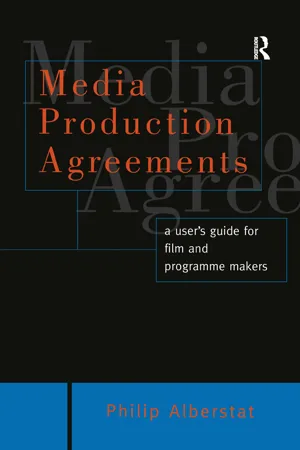
Media Production Agreements is an invaluable reference tool for film, television and video producers and has been written specifically for all those involved in the media industry. Providing legal information and sound advice on the structuring of deals and negotiated agreements, this authoritative guide identifies potential pitfalls in the drafting and arrangement of contracts and proposals.
Media Production Agreements contains legal agreements which independent producers, writers and all those involved in the film and television industry are faced with at the outset of a project. Typical agreements and sample contracts are presented in the text and practical explanatory notes provide clarification, caveats and advice.
Contracts and agreements discussed include:
* option and literary purchase
* writer's and director's agreement
* co-production agreement
* distribution agreement
* location agreement
* non-disclosure agreement
* release from a living person
* release for extras
* name product and logo release agreement
* licence to reproduce still photographs.
eBook - ePub
Media Production Agreements
A User's Guide for Film and Programme Makers
- 336 pages
- English
- ePUB (mobile friendly)
- Available on iOS & Android
eBook - ePub
About this book
1
Option and Literary Purchase Agreement
Film and television producers rely upon many sources of material for their films and programmes. This chapter deals with source works which are already in existence and which will form the underlying basis for a film or programme. They may be in the form of a published book, a book still in manuscript form, a script, a treatment or a combination of the above materials.
The cost of making films and television programmes is sometimes prohibitive. Instead of paying large acquisition prices up front it is customary for producers to seek an option on a source work for a sum usually around 10 per cent of the eventual purchase price.
An option is an agreement with the rights owner where, in return for payment, the rights owner grants to the producer for a limited period of time the exclusive opportunity to acquire certain rights in the source work for a specified price. The benefit of an option is that it is less expensive for the producer to take out an option than to buy the rights immediately outright. From the perspective of the rights owner, if the producer does not exercise the option then the rights owner will be able to sell or re-option these rights to someone else.
Option agreements should always be confirmed in writing. The following points should always be specified in an option agreement:
- The length of the option.
- Payment in respect of the option.
- The rights being optioned.
- What the payment will be for the underlying rights when the option is exercised.
It is essential that if the option is exercised then the terms of the acquisition or assignment of rights are not left open but are settled at the same time that the option agreement is concluded. The buyer and seller should always be clear as to what the actual arrangement is. If this is not done there will be confusion, uncertainty and possibly further expense incurred.
Option periods normally run anywhere from six to eighteen months. There can also be an arrangement where this period is renewable upon further payment of a fee. The producer should keep in mind that the longer the period of time that rights are tied up the more expensive it will be. In some circumstances an extension to the option will only be granted if the producer can prove that some progress has been made in trying to produce the project. However, this is something that should be negotiated prior to signing the option.
When trying to acquire rights, one should be certain that the work is still in copyright. If a work is out of copyright then it will be referred to as in the public domain. It is essential that the person acquiring the rights in a work are certain that they are acquiring the necessary rights from the proper owner.
In the United Kingdom there is no central registry which sets out who owns a literary work and whether a literary work is still in copyright. In the United States it is possible for producers and others to search the US Copyright Office at the Library of Congress in Washington to determine who has proper ownership and whether a specific work is still in copyright. At one time it was a pre–requisite for copyright protection in the United States to register copyright at the US Copyright Office. Although no longer a requirement, all American literary works and most foreign literary works which are exploited in the US are still registered at the US Copyright Office. This register contains details of transactions in relation to the recorded literary work and makes reference to any assignments or licences granted regarding rights contained in those works.
Although the US Copyright Office does not absolutely ensure that a literary work’s title is in order, it will usually indicate whether there is some problem as to who the rightful owner is. A search may show that the copyright belongs to someone else or that certain rights have been previously granted. It is always worth spending money at the outset to determine whether problems exist.
Since an option is a contract there must be some consideration (i.e. money) for it to be legally binding. It should be noted that consideration is usually in the form of payment; however, promising to do something in return for granting an option on the rights can also be considered a form of consideration. Options should never be free, since under US and UK contract law the option may not be enforceable.
Usually the first fee paid in an option agreement is made in advance and on account of the final purchase price which should be set out in the acquisition agreement. The first fee is usually not returnable. The second fee payable is often around 5 per cent of the purchase price and is in most cases not on account of the final purchase price.
The underlying reason for the option period is to enable a producer to put together the creative elements for his/her production without committing a large amount of money before he/she can interest distributors and other financiers in backing his/her project.
In the event that the producer is not successful then his/her losses are limited to the option fee and perhaps some development costs. If the rights to a book or film script had been sold outright then the above scenario would not be as pleasant for a producer who was unable to interest any distributors or financiers in his/her project and had spent thousands of pounds on an acquisition.
It is essential for producers and rights owners to specify which rights are being optioned. The contract found in this chapter offers a typical form of option agreement and shows essential elements which are needed as well as a standard form of assignment. The agreement assumes that the buyer (or producer) will take all available rights whereas some options and assignments will only make reference to one set of rights (i.e. television rights only). This agreement is a combination of a UK and US document and must be adapted according to the circumstances of each transaction. It should be noted that this type of agreement should not be relied on without further specialist legal advice and is for reference purposes only.
Option and Literary Purchase Agreement
THIS AGREEMENT is made and entered into as of __________________(date), by and BETWEEN:
_____________________________________________________
(name and address of Writer) (‘the Writer’) and
_____________________________________________________
(name and address of Producer) (‘the Producer’).
1. Writer’s Representations and Warranties
(a) | Sole Proprietor: the Writer represents and warrants to the Producer that the Writer is the sole and exclusive proprietor, throughout the world of an original work written by_______________________ entitled_______________________ (‘the Work’ or ‘Literary Property’). | |
(b) | The Writer represents and warrants to Producer that the following statements are true and correct in all respects with respect to said Work: | |
[(i) | Writer is the sole author of the Work.] | |
(ii) | The Work was first published on (date) by _________________________ [under the title] and was registered for copyright in the name of ________________________ [under copyright registration number__________________, in the Office of the United States Register of Copyrights, Washington, DC] (if applicable). | |
No Motion Picture or dramatic version of the Literary Property, or any part of it, has been manufactured, produced, presented or authorized; no radio or television development, presentation or programme based on the Literary Property, or any part of it, has been manufactured, produced, presented, broadcast or authorized; and no written or oral agreements or commitments at all with respect to the Literary Property or with respect to any right therein, have previously been made or entered by or on behalf of the Writer (except with respect to the publication of the Work as set forth above).
Option and Literary Purchase Agreement: Notes
PREAMBLE (A) WRITER
The Writer will usually be the rights owner or the owner of the copyright in the literary property or work being sold. In most cases this will not usually be the publisher. It should be the author or writer of the literary property or work. Producers should ensure that they are contracting with the proper owner. See notes regarding US Copyright Office and registration below.
1. Writer’s Representations and Warranties
(a) | One of the most essential warranties given by the writer to the producer is that the writer owns all the rights they are selling free and clear of any other obligation and that they own the rights being granted and are in a position to enter into the agreement. | |
(b) | The writer may not be the sole author of the literary property or work and therefore it is essential that the identity of the author be stated. For clarity, it should be stated when the literary material or work was first published. Sometimes the title may have changed and therefore the literary material or work was published under a different name. Reference should also be made to the United States Copyright Office. Copyright law in the United States used to be different in a number of important respects to the copyright law of the United Kingdom. At one time, copyright law in the US was something of a minefield for copyright materials, particularly since the term of copyright was split into two terms of twenty-eight years and copyright could not be acquired for the duration of the total term of copyright in a straightforward manner. In recent years there have been significant changes in the law and in 1989 the US joined the Berne Convention. Thus copyright protection in the US is now much more in line with the protection afforded in the UK. There used to be a requirement that in order to have protection in the US, copyright material had to be registered at the Library of Congress in Washington and carry a copyright notice. Registration can still be made, but it is optional as is the bearing of copyright notice. In the UK copyright exists without having to be recorded in a central register. Producers wishing to exploit any copyright work in the US should, however, register their work at the US Copyright Office. The advantage undertaking registration is that under certain US laws if there is, at a later date, a copyright infringement then an author can prove that the registered work is actually theirs. Producers should be aware that if a literary property or work is eventually fully financed for | |
(c) | No Infringement or Violation of Third Party Rights: the Writer represents and warrants to the... |
Table of contents
- Cover
- Half Title
- Title Page
- Copyright Page
- Table of Contents
- Preface
- 1. Option and Literary Purchase Agreement
- 2. Writer’s Agreement
- 3. Director’s Agreement
- 4. Co-Production Agreement
- 5. Distribution Agreement
- 6. Finder Agreement
- 7. Presenter Agreement
- 8. Production Manager Agreement
- 9. Location Agreement
- 10. Non-Disclosure Agreement
- 11. Submission Release
- 12. Release from a Living Person
- 13. Standard Form Licence to Reproduce Still Photographs
- 14. Release Form (Extras)
- 15. Name/Product/Logo Release
- Appendix A: List of important addresses
- Appendix B: Definitions of gross and net receipts/income/profits
- Appendix C: Inducement letter/agreement
- Appendix D: Examples of credits
- Index
Trusted by 375,005 students
Access to over 1.5 million titles for a fair monthly price.
Study more efficiently using our study tools.
Frequently asked questions
Yes, you can cancel anytime from the Subscription tab in your account settings on the Perlego website. Your subscription will stay active until the end of your current billing period. Learn how to cancel your subscription
No, books cannot be downloaded as external files, such as PDFs, for use outside of Perlego. However, you can download books within the Perlego app for offline reading on mobile or tablet. Learn how to download books offline
Perlego offers two plans: Essential and Complete
- Essential is ideal for learners and professionals who enjoy exploring a wide range of subjects. Access the Essential Library with 800,000+ trusted titles and best-sellers across business, personal growth, and the humanities. Includes unlimited reading time and Standard Read Aloud voice.
- Complete: Perfect for advanced learners and researchers needing full, unrestricted access. Unlock 1.5M+ books across hundreds of subjects, including academic and specialized titles. The Complete Plan also includes advanced features like Premium Read Aloud and Research Assistant.
We are an online textbook subscription service, where you can get access to an entire online library for less than the price of a single book per month. With over 1.5 million books across 990+ topics, we’ve got you covered! Learn about our mission
Look out for the read-aloud symbol on your next book to see if you can listen to it. The read-aloud tool reads text aloud for you, highlighting the text as it is being read. You can pause it, speed it up and slow it down. Learn more about Read Aloud
Yes! You can use the Perlego app on both iOS and Android devices to read anytime, anywhere — even offline. Perfect for commutes or when you’re on the go.
Please note we cannot support devices running on iOS 13 and Android 7 or earlier. Learn more about using the app
Please note we cannot support devices running on iOS 13 and Android 7 or earlier. Learn more about using the app
Yes, you can access Media Production Agreements by Philip Alberstat in PDF and/or ePUB format, as well as other popular books in Law & Contract Law. We have over 1.5 million books available in our catalogue for you to explore.