Dramatic changes in political institutions and behavior over the past three decades have underscored the dynamic nature of American politics, confronting political scientists with a new and pressing intellectual agenda. The pioneering work of early postwar scholars, while laying a firm empirical foundation for contemporary scholarship, failed to consider how American politics might change or recognize the forces that would make fundamental change inevitable. In reassessing the static interpretations fostered by these classic studies, political scientists are now examining the underlying dynamics that generate transformational change. Transforming American Politics is a series that brings together texts addressing four closely related aspects of change. A first concern is documenting and explaining recent changes in American politics—in institutions, processes, behavior, and policymaking. A second is reinterpreting classic studies and theories to provide a more accurate perspective on postwar politics. The series looks at historical change to identify recurring patterns of political transformation within and across the distinctive eras of American politics. Last and perhaps most important, the series presents new theories and interpretations that explain the dynamic processes at work and thus clarify the direction of contemporary politics. All of the books focus on the central theme of transformation—transformation in both the conduct of American politics and in the way we study and understand its many aspects.
- 354 pages
- English
- ePUB (mobile friendly)
- Available on iOS & Android
eBook - ePub
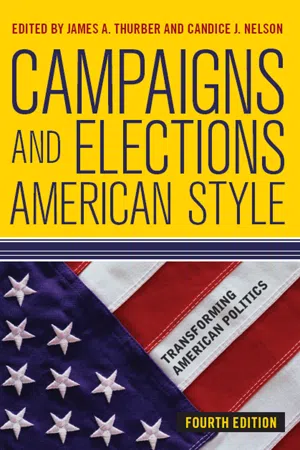
Campaigns and Elections American Style
About this book
Information

Understanding the Dynamics and the Transformation of American Government
This book, a study of campaign management and elections, marries academic wisdom and the practical knowledge of professional political consultants, although the two worlds rarely overlap. Academics use explicit hypotheses and scientific methods for making systematic observations about campaigns and elections, whereas professionals draw generalizations based on direct experience. Campaign consultants “test hypotheses” by winning and losing elections. Both use theoretical perspectives about campaigns and voters, although one is academic and one practical. The common dimension to both worlds is the major changes that have occurred in the way campaigns are waged and elections won or lost in the past twenty years, as especially shown in the 2012 election campaign of President Barack Obama and his opponent, former governor Mitt Romney. This book analyzes the impact of the changes in the 2012 presidential election cycle from a variety of perspectives. The authors show the evolution and innovation in campaign strategy, the use of survey research, the changes in fundraising strategies, the role of communications and media, the use of digital and social media, the advancements in microtargeting and fieldwork, as well as the stability and changes in election law and turnout in 2012.
Academics use large data sets and systematically test hypotheses to make careful statements about voters and elections. They attempt to explain individual and collective political behavior and try to answer questions about who votes and why. When political scientists write about campaigns and how candidates get elected, their approach is based on scholarly analysis rather than experience (Polsby et al. 2012; Kenski et al. 2010; Nelson 2011; Dulio and Nelson 2005; Thurber and Nelson 2000; Thurber 1998). Other political scientists forecast election outcomes, not by the strategies and tactics of the candidates, but by using basic variables in their models that are known before the election and cannot easily be changed in a campaign, such as measures of the state of the economy or the popularity of the incumbent president or party (PS Symposium 2012). Because the state of the economy and the popularity of the president were very poor in this election, many predicted a Romney victory, but strategies, tactics, messages, and innovations in the Obama and Romney campaigns made a difference in the outcome of the election. In short, campaigns matter—a basic conclusion of this book.
Campaign professionals focus on who votes and why, but to develop a winning strategy to attract voters to their candidate, knowing full well that factors such as the state of the economy and the popularity of the candidates make a difference, they try to change voter perceptions in order to win over those barriers, as shown in 2012. When campaign consultants write about campaigns, it is to explain why their candidates have won and to give general advice in how-to-win “manuals,” or to offer anecdotal “insider” accounts of campaigns (Jamieson 2009; Napolitan 1972; Shea 1996). They are hired activists who develop strategies and tactics to influence voters and election results (Dulio and Nelson 2005; Thurber 2001; Thurber and Nelson 2000). They focus solely on how to win. While political scientists try to understand voters, candidates, elections, and the consequences of electoral battles for purposes of governing and developing public policy, campaign professionals use the vast knowledge gained from their previous campaigns. They know what works through their experience of winning or losing elections and are seasoned by their involvement with campaigning (Thurber and Nelson 2000). The strategies and tactics of campaigns are constantly evolving through innovating and testing what works and what does not work in each election cycle. Campaign consultants learn from each other and bring change to each election cycle. In this book we describe and analyze those changes, looking at the 2012 election from a variety of perspectives from both political scientists and campaign professionals.
Campaign consultants often assert that the academic literature on campaigns and elections is either obvious or wrong (Thurber and Nelson 2000), while also admitting that they lack time to read the latest political science research findings. Academics often argue that campaign professionals promote the latest folk wisdom about campaign tactics and do not know what works and what does not until it is too late. The winners possess the “truth,” creating new “geniuses” of campaign management each election cycle, and the wisdom gained by the losers is often even more important. All successful consultants try to learn from their mistakes and from the mistakes of others. Winning consultants pick up more clients and business, while the losers often leave the campaign business and move into issue campaigns and advocacy or public relations.
Academics study campaigns and elections but rarely talk with campaign professionals about what they believe regarding their electoral track record. Academics often may not be aware of the latest developments in campaign strategies, tactics, and tools until an election is over (recent exceptions to this are the studies of Dulio and Nelson 2005; Nelson, Dulio, and Medvic 2002; Johnson 2007; Thurber 2001; Thurber and Nelson 2000). Political scientists study campaign professionals but rarely enter the world of political campaigning. When they do, they bring important contributions to the literature (Johnson 2007).
Mutual distrust often characterizes relations between campaign professionals and academics. Many professionals feel that academic research is not applicable to the real world of election campaigns. On the other hand, academics consider professionals’ practical how-to knowledge unscientific and their general narratives of campaigns simply descriptive histories. They are critical of claims not based on the systematic collection of data and the testing of hypotheses that are part of a broader theory of campaigns and elections. And when commentary from political pundits, journalists, and retired political leaders is added to the mix, it becomes difficult to distinguish reality from myth, marketing, and self-centered political spin.
When the worlds of academics and professionals do converge, however, insights result, as shown in this book. Whether explaining or managing campaigns, whether treating campaign management as a science or an art, academics, professionals, and pundits all agree that American election campaigns have been especially transformed in the last twenty years. Every campaign cycle reveals new strategies and tactics, as shown so clearly in the 2012 election.
In these pages, campaign professionals and political scientists confront each other’s perspectives. They examine changes in the organization and operation of campaigns and the impact of campaign strategies and tactics at the local, state, and national levels that have had a significant impact on American elections in the last three decades. Political consultants are using recent technological advances in microtargeting, the social media, and the Internet to make campaigns operate smarter and faster and often more cheaply. Chapters by campaign professionals and political scientists cover the major elements of campaign advancements and provide different perspectives on the same campaign topic. Our contributors do not always agree. Dialogue between campaign consultants and political scientists offers a new, more complete view of election campaigns that is essential to an understanding of twenty-first-century American campaigns and elections.
Election Campaigns Are Wars: The Battle of 2012
The 2012 campaign was a war between the Democrats and the Republicans. It was a battle for the hearts and minds—and the votes—of the American people. The word “campaign” comes from military usage: a connected series of military operations forming a distinct phase of a war or a connected series of operations designed to bring about a particular result. An election is like a war, complete with “war rooms” and campaign managers. Candidates and campaign organizations are fighting to capture government control and to advance their policies. Campaigns are battles to define public problems and develop policy solutions and, of course, to persuade voters to support those ideas.
For candidates and professionals, campaigns are zero-sum games, or even minus-sum games: there are always winners and losers, and more campaigners are disappointed by the election outcome than pleased by it. For academics, on the other hand, campaigns are objects of analysis; they do not represent a personal gamble, a deeply felt ambition, or a commitment to the objective of winning. Campaigns are not political causes but rather a focus of intellectual interest. Academics are interested in why people vote (e.g., explanations of turnout); professionals are interested in how to get them to vote for a particular candidate (e.g., field and microtargeting tactics). Academics study who contributes money to campaigns and why; professionals persuade people to give funds to their candidates. Both need to know the legal framework of campaign finance law. This book joins these two worlds and shows how both the academic and campaign professional perspectives are needed in order to understand election campaigns.
Those who manage election campaigns, be they presidential, congressional, or down-ballot races (local and state candidates), evaluate the existing political environment, develop strategies and plans within that political environment, pursue a strategic theme and message for a candidate, establish an organization, solicit and use campaign money, buy advertising and attempt to use free (news) media, schedule candidates, organize and use a field organization, use opposition research, and conduct survey research and focus group analysis, among a variety of other activities. In the last three decades the basic elements of campaigning have changed dramatically due to the power of the media (especially television and social media), technological advancements, and the professionalization of campaigns. What has not changed is that successful campaigns need to develop an explicit strategy, theme, and message, linked to appropriate tactics.
Campaign Strategy and Message, Funding, and Organization
Campaigns do not happen in a vacuum and they are not predetermined by economic and political circumstances. Prevailing economic and political conditions influence a campaign, and candidates and campaigns in turn can have an impact on those conditions, as was the case with the 2012 election of President Barack Obama.
There are three fundamental elements of campaigning: strategy and message, organization, and funding. On the strength of these three elements, Barack Obama ran a second nearly perfect campaign in 2012. His strategy and message were focused. This contrasted with Mitt Romney’s lack of discipline and wavering message during the primaries and the general election, which depicted him as uncaring about the middle class in America. President Obama’s campaign cultivated a positive image of a president caring about the middle class and the unemployed, and it projected an unfavorable perception of Governor Romney as uncaring and out of touch with the American people.
Some analysts suggested that the widespread disapproval of President Obama during his first term predetermined a loss for him in the 2012 election (PS Symposium 2012). But these analysts and Romney’s campaign consultants underestimated the effects of a candidate’s campaign strategy, tactics, and message on the outcome. A winning campaign pays close attention to campaign fundamentals (Dulio and Nelson 2005; Thurber and Nelson 2000; Medvic 2001, 2006). The most important elements of a campaign are strategy, theme, and message. Raising money, setting the candidate’s schedule, doing opposition research, linking resources to campaign tactics, preparing for debates, advertising on television and radio, and mobilizing supporters to vote all follow from the campaign’s strategy, theme, and message. In a well-run campaign, the message is expressed in communications with voters: television and radio ads, social media, and the direct mail campaign.
Campaign Strategy and Message
Obama’s strategy encompassed a commitment to the fundamentals of campaigning (Thurber and Nelson 2000)—a clear strategy, theme, and message linked to appropriate tactics. Obama’s campaign rarely wavered from its central theme and message. When the Obama campaign faced challenges, such as his poor first debate performance, he returned to the central theme and message of the campaign.
Running a campaign involves a variety of functions, such as scheduling and advance work, press arrangements, issue research and debate preparation, speech writing, polling and focus group analysis, voter targeting and mobilization, print and electronic media advertising and placement, campaign budgeting, legal analysis, and party and interest group action. These demands require a highly disciplined campaign organization (Thurber and Nelson 2004). A campaign manager must know how many votes are needed to win and where these votes will come from. This is not as simple as it may sound. Many pundits thought Obama would not win in 2012 because of the poor economy, but the Obama campaign’s early focus on building a national campaign finance operation with “ground” and “air” operations in the battleground states paid off. By methodically focusing on the battleground states through advertising, social media, microtargeting, get-out-the-vote mobilization, campaign visits, and other tactics, the Obama campaign was able to overtake the early advantage that Mitt Romney had because of the economy and the low rating of the president.
Obama also ran a nearly perfect campaign in terms of message discipline and quick response to criticism or attack. The campaign never let a news cycle go by without responding, often within hours or even minutes. The campaign strategy and message were driven by defining Romney as insensitive to the middle class and out of touch with the needs of the American people. David Axelrod, Obama’s chief strategist, and David Plouffe, the campaign manager, had an obsessive focus on the message of contrasting the president to a negative image of Romney. Romney was not able to finesse the perpetual problem of Republican presidential politics: needing one message to win over a party’s ardent supporters in the primaries and another when trying to capture women, moderates, independents, Hispanics, and the few up-for-grab voters who helped decide the 2012 general election.
The Strategic Raising and Use of Campaign Funds
How a campaign spends money is just as important as how much money is raised. Much has been written about the fundraising prowess of the Obama campaign in 2008 and 2012. In many ways, Obama has changed the way that money is raised in presidential elections. Any serious campaign for federal office requires a sophisticated online fundraising component. Obama and Romney both raised a record of over a billion dollars (which includes money raised during both the primary and general election).
Campaign Organization
President Obama’s organization dominated the media “air war” early, with overwhelming investment in the 2012 battleground states through television, cable, radio, direct mail, social media, and even advertising in video games. He also dominated in the “ground war,” including the organization of field staff and offices. Obama had more staff and offices in more states than Romney in 2012, repeating what he did in 2008 against McCain.
Obama’s staff (paid and volunteer) advantage allowed him to get his message out to more people and to organize more supporters than the Romney campaign did. Campaign staff members worked in local offices that served as gathering places for local volunteers and supporters. Some campaign offices operated phone banks, some served as the gathering point for volunteer door-to-door canvasses, and many served as storefronts where locals could get campaign literature, buttons, and stickers. The campaign’s field staff (which typically makes up the bulk of a campaign’s in-state operation) identified and contacted potential voters, persuaded them to become supporters, and then got them to vote, especially in the target states.
The Obama campaign organization at the national level was made up of experienced, disciplined people who had gone through the 2008 campaign battle. The discipline of their internal organization and message was directly linked to the candidate and a group of well-tested professionals. This was often not the case for Romney.
The Obama campaign’s online organizing tools that had been honed in 2008 were improved, tested, and changed in 2012. The campaign advanced the use of technology and used new social media forums to communicate the message and to recruit volunteers. Obama’s website served as a recruiting tool for volunteers and donors, and the campaign was constantly reaching out to supporters through its e-mail list, social networking sites such as Facebook and Twitter, and other innovative methods of reaching volunteers and voters. These techniques helped turn out volunteers and also crowds at his rallies. Campaign staff and volunteers positioned themselves at these events to get names of supporters and to recruit them to volunteer.
The Obama campaign outperformed the Romney campaign in voter contact. Studies of voter contact efforts indicate that mobilization works. Randomized field experi...
Table of contents
- Cover
- Half Title
- Title Page
- Copyright Page
- Dedication
- Table of Contents
- Acknowledgments
- 1 Understanding the Dynamics and the Transformation of American Government,
- 2 Creating a Winning Campaign Strategy,
- 3 The Use of Survey Research in Campaigns,
- 4 Money, Politics, and Policy: Campaign Finance Before and After Citizens United,
- 5 Fundraising Strategies in the 2012 Presidential Campaign,
- 6 Differences of Degree: Issue Agendas in a Polarized Media Environment,
- 7 How the Media Covered the 2012 Election: The Role of Earned Media,
- 8 Dimensions of Campaigns in the Age of Digital Networks,
- 9 The Ground Game: Fieldwork in Political Campaigns,
- 10 The Evolution of Microtargeting,
- 11 Voter Turnout in the 2012 Election,
- 12 Election Law Is the New Rock ’n’ Roll,
- 13 Republican Strategies and Tactics in the 2012 Primary and General Elections,
- 14 Campaigns Matter,
- About the Contributors
- Index
Trusted by 375,005 students
Access to over 1.5 million titles for a fair monthly price.
Study more efficiently using our study tools.
Frequently asked questions
Yes, you can cancel anytime from the Subscription tab in your account settings on the Perlego website. Your subscription will stay active until the end of your current billing period. Learn how to cancel your subscription
No, books cannot be downloaded as external files, such as PDFs, for use outside of Perlego. However, you can download books within the Perlego app for offline reading on mobile or tablet. Learn how to download books offline
Perlego offers two plans: Essential and Complete
- Essential is ideal for learners and professionals who enjoy exploring a wide range of subjects. Access the Essential Library with 800,000+ trusted titles and best-sellers across business, personal growth, and the humanities. Includes unlimited reading time and Standard Read Aloud voice.
- Complete: Perfect for advanced learners and researchers needing full, unrestricted access. Unlock 1.5M+ books across hundreds of subjects, including academic and specialized titles. The Complete Plan also includes advanced features like Premium Read Aloud and Research Assistant.
We are an online textbook subscription service, where you can get access to an entire online library for less than the price of a single book per month. With over 1.5 million books across 990+ topics, we’ve got you covered! Learn about our mission
Look out for the read-aloud symbol on your next book to see if you can listen to it. The read-aloud tool reads text aloud for you, highlighting the text as it is being read. You can pause it, speed it up and slow it down. Learn more about Read Aloud
Yes! You can use the Perlego app on both iOS and Android devices to read anytime, anywhere — even offline. Perfect for commutes or when you’re on the go.
Please note we cannot support devices running on iOS 13 and Android 7 or earlier. Learn more about using the app
Please note we cannot support devices running on iOS 13 and Android 7 or earlier. Learn more about using the app
Yes, you can access Campaigns and Elections American Style by James A Thurber in PDF and/or ePUB format, as well as other popular books in Politics & International Relations & Politics. We have over 1.5 million books available in our catalogue for you to explore.