eBook - ePub
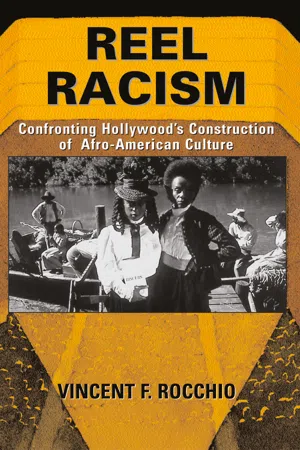
Reel Racism
Confronting Hollywood's Construction Of Afro-american Culture
- 256 pages
- English
- ePUB (mobile friendly)
- Available on iOS & Android
eBook - ePub
About this book
This study looks beyond reflection theories of the media to examine cinema's active participation in the operations of racism - a complex process rooted in the dynamics of representation. Written for undergraduates and graduate students of film studies and philosophy, this work focuses on methods and frameworks that analyze films for their production of meaning and how those meanings participate in a broader process of justifying, naturalizing, or legitimizing difference, privilege, and violence based on race. In addition to analyzing how the process of racism is articulated in specific films, it examines how specific meanings can resist their function of ideological containment, and instead, offer a perspective of a more collective, egalitarian social system - one that transcends the discourse of race.
Information
Part One
Of Racism and Representation
1
Introduction: Revisiting Racism and Cinema
On March 4, 1991, Americans tuning into the nightly news were shocked by what appeared on their televisions: a dark and grainy home videotape recording of Los Angeles police officers beating an unarmed black motorist named Rodney King. When the case against the officers went to court, the trial was moved out of racially diverse Los Angeles and into predominantly white Simi Valley. The officers were acquitted, and rioting ensued.
A little less than four years later, in October 1995, America found itself once more glued to the TV (as it had been for almost nine months), waiting for the verdict of what many called the trial of the century: the murder trial of O. J. Simpson, famous athlete and celebrity, accused, then acquitted, of murdering his ex-wife. The torrent of media punditry and pseudo-debate that raged around the incident found its source in a wellspring of emotions about race. Those emotions were fed by witness for the prosecution Mark Fuhrman, a Los Angeles police detective who lied under oath about his use of racially derogatory remarks, specifically the word “nigger.” Defense lawyers exposed his perjury by playing a tape recording of Fuhrman referring to blacks as “niggers” and bragging about his mistreatment of black suspects. The taped interviews showed that he had used the slur at least forty-one times. Fuhrman also bragged that he enjoyed lining up “niggers against the wall and shooting them.”1
Four years after Fuhrmans chilling pronouncements, an elite street-crimes unit of the New York City Police Department nearly did just that, shooting unarmed west African immigrant Amadou Diallo as he stood outside his Bronx apartment building. The shooting was particularly notorious for the manner in which the four police officers, none of whom lived in the city, fired forty-one rounds at the defenseless twenty-two-year-old, hitting the victim nineteen times. Shortly after Diallos death, protests and demonstrations erupted all over the city, frequently drawing over a thousand people. Like the Rodney King trial, however, the case was moved out of the large, racially diverse metropolis and into a nearby city. Unlike the Rodney King trial, however, the national media fairly ignored the trial, despite evidence of demonstrated interest. Another distinct difference from the Rodney King trial contributed to this neglect: there was no videotape to be played over and over on the nightly news, or frame by frame from the witness stand, with each side battling over the meaning contained within. Further, the trial and the trial judge went to great lengths to keep the issue of race out of the trial, a seemingly impossible, but nonetheless accomplished, task. When the officers were acquitted, despite having to prove that each individual bullet in the forty-one-round shooting was itself justified, there was no rioting, due chiefly to Afro-American leaders organizing and urging restraint, but also due to the fact that the media had stayed away. Their neglect provided an important support for race to be rendered a nonissue.
These examples, only three in what could be a very long list, demonstrate one rather obvious—though frequently denied—fact about contemporary American society, succinctly expressed by Cornel West: Race matters. These examples also demonstrate an equally obvious fact: the contemporary status of race in mainstream American culture is intimately bound to the process of representation within and through the mass media. As the King trial so clearly demonstrated, the meanings generated by images are neither inherent, nor ideologically neutral. What first popped up on American TVs seemed self-evident, but was later rendered differently, first by situating the “meaning” of the tape within a broader context—the high-speed chase that preceded the police actions—then through the imposition and application of different codes and modes of interpretation applied frame by frame.
What this book will demonstrate is that race matters precisely because racism is a social institution within American culture, and representation is the foundation upon which it stands. Indeed, racism has been an integral component of American culture since its founding upon the genocide of Native Americans, and the forced slavery of Africans and Afro-Americans. Contemporary American society is multiethnic and multiracial, but it is not color-blind—much as it would like to claim to be.2
Although it is morally reprehensible, racism is not just a moral problem, the result of people who are morally inferior clinging to immoral attitudes and beliefs. Neither is racism only a political problem: it cannot be made to disappear through a series of laws. Racism functions in and through specific meanings and beliefs, a domain in which the law has little power to change or effect, as the continuing public debate over abortion makes clear. For racism to be “dealt with,” as such, it needs first to be conceived as a complex, multidimensional, and evolving social phenomenon that affects everyone on an individual basis. In this sense, racism is also a dialectical operation, because racism as a social dimension effects individual beliefs, attitudes, and actions, but these individual beliefs, attitudes, and actions—separately and collectively—become the support and foundation for social dimensions.
As a social dimension, racism—in its current context—is highly dependent on the conduct and the specific messages of the mass media. No other social institution engaged in the construction and distribution of public discourse has the pervasiveness and volume of consumption as the mass media, two characteristics that themselves are cause for continuing investigation. As several studies have indicated, individuals within contemporary mass society receive most of their information indirectly and through mediated texts rather than through direct experience. Individual media texts, the means by which the information is disseminated, are thus significant sites for the production and integration of meanings through which societies maintain themselves and evolve. Precisely because racism remains a pervasive component of American society, the meanings about race that are disseminated by and through the mass media demand investigation as active participants.
The study of the mass media is a complex affair, and a variety of methods and approaches are employed to understand it: history, aesthetics, economic organization, and rhetoric, to name a few. This book combines several different theories in order to analyze the messages that the mass media disseminate throughout society. It combines these theories to create methods for interpreting and analyzing individual media “texts” for how they use communication—or to use a more precise term, discourse—to reinforce the status quo of racism. Several books have already taken this approach to analyzing the content of media messages, but they are limited in their approaches and theories. Just as racism operates through several different means, and manifests itself in several different ways in society, it functions in a variety of complex and implicit ways in media texts. It is for this reason that Robert Stam and Louise Spence argue for developing new and sophisticated methods for analyzing film and television with respect to racism.
In their article, “Colonialism, Racism, and Representation,” Stam and Spence demonstrate that the relationship between racism and representation is not a simple matter, as one-dimensional approaches make it seem.3 Rather, this relationship is complex and cunning, powerful and pervasive, and—in the final analysis—unacknowledged and accepted. The work of Stam and Spence was a clarion call for the field of media studies to move beyond the “search for stereotypes,” and develop the kinds of tools that would allow everyone to see these complex relationships. Their call went largely unanswered, as the work of bell hooks—one of America’s leading scholars on race and culture—testifies.4 Racism remains an entrenched problem in American society, and the medias role in the problem still goes largely unchallenged and unacknowledged by mainstream culture, which seems intent on believing the mass medias ruse that it simply reflects the culture it finds itself within.
This book attempts to make the study of racism and media accessible to everyone, not by taking overly simplistic approaches like positive-negative image analysis, conspiracy theories of media, and the search for stereotypes, but by defining terms and discussing methods that help develop more critical perspectives towards the messages of the mass media in general, and towards race specifically. An emphasis on terms is not just an intellectual exercise. Perhaps nothing is more lacking in public debates on race than common terms and definitions. The airwaves are full of debate on whether a specific incident is due to racism or certain remarks were racist, but surprisingly, there is very little discussion on what racism actually is: How do we define it, how is it characterized, how do we come to know it? It is as if those questions were long ago answered and agreed to, though history certainly testifies to the opposite. Not coincidentally, other words have come to be associated with issues of race, and have had their meanings distorted such that they stand in for, or are equivalent to, racism—among them, discrimination and prejudice. As Lola Young argues, “Racism is not attributable to a single factor such as capitalism, the colonial enterprise or personal prejudice.”5 Rather, as further discussion will demonstrate, racism is not the equivalent of discrimination or prejudice, and in fact, is not involved with either term so much as it is involved with the exercise of power and violence.
The distortion and confusion over terms in public discourse is not accidental, but rather serves several purposes, not least of which is helping the process of racism endure. As long as mainstream society lacks specific ideas on what racism is, then it will be susceptible to a high degree of uncertainty as to how and where it manifests itself within society. As a result, society will be less able to take remedial action. In contemporary American society, this has led to an endless stream of punditry over specific incidents and issues, like the King and Simpson trials (complete with oversimplifications, overgeneralizations, and finger-pointing), that has left the complexity of the broader social process of racism virtually undisturbed.
The King trial, for example, seemed to accomplish little towards curbing police violence, especially violence against people of color. For all its popular outcry over the issue of race and police racism, little to nothing was accomplished in terms of the structure and operation of law enforcement, within the Los Angeles police department or broader society. Indeed, the facts that came out of the Diallo trial with respect to the New York City police department showed increasing amounts of police violence, not less. Thus, as Angela Ards reports:
From July 1993 to June 1997, complaints against the police rose 45 percent and monetary settlements by the city increased 38 percent. In 1996 Amnesty International investigated more than ninety allegations of NYPD misconduct dating from the late eighties to early 1996. Its report found that the root of the problem was not ‘rogue’ cops but the police culture—with its aggressive tactics that disproportionately target racial minorities, its unaccountability and its code of silence.6
In addition to the police silence that Ards references, another kind of silence pervades the problem of increasing police violence and its disproportionate effect on people of color: the near silence of the mass media, which is far more oriented to achieving profits by hyping individual racial incidents and tragedies than it is towards analyzing racism as a broader, complex social institution.
This book starts, therefore, by defining its terms, though in a manner very much distinct from the way in which mainstream culture has come to define social phenomena. In contemporary society, the function of defining social phenomena is to limit and contain them: to put things in their place, lest they disturb the balance of a society of inequity. In this book, the function of defining terms and concepts is to expand our understanding of them: to raise questions rather than to provide succinct answers. As Cornel West has demonstrated, succinct answers about race and racism are becoming an increasing part of the problem. West argues, “most of us remain trapped in the narrow framework of the dominant liberal and conservative views of race in America, which with its worn-out vocabulary leaves us intellectually debilitated, morally disempowered, and personally depressed.”7 West thus concludes that “Our truncated public discussions of race suppress the best of who and what we are as a people because they fail to confront the complexity of the issue in a candid and critical manner.”8 West’s conclusion provides important criteria for establishing a definition of racism: it must be broad in scope, confront the complexity of the issue, and be able to do so in a critical manner that will not shirk its investigation or conclusions.
Fulfilling such criteria and remaining accessible is not a particularly easy task, however. In his insightful work on race and ideology, for example, Arthur K. Spears defines racism as “behaviors which indirectly or directly support the inequality of racial hierarchy.”9 In attempting to construct a definition that is broad enough, however, Spears does not provide for the kind of precision that can analyze racism as a complex process. In this respect, Stam and Spence’s work is important for their attempt to advance a more precise definition of racism that engenders a critical approach. In their work, Stam and Spence put forward Albert Memmis multidimensional definition of racism. For Memmi, racism is not just feelings, attitudes, or actions based on race. Instead, racism is “the generalized and final assigning of values to real or imaginary differences, to the accuser’s benefit, and at his victim’s expense, in order to justify the former’s own privilege or aggression.”10
What is particularly important about the multiple components that comprise Memmi’s definition is that together they define racism as a complex process, not a thing. Further, what Memmi’s definition demonstrates is that representation is at the heart of racism. Precisely what Memmi means by “the generalized and final assigning of values” is the process of symbolism and signification; that we assign meaning (which is laden with value judgments) to the phenomena that surround us. Indeed, it is difficult, if not impossible, to refrain from assigning meaning to what we see and hear—even if that process is conducted in an unacknowledged way. Psychoanalyst Jacques Lacan has argued that we are constantly engaged in this symbolic—naming—process, not only as children learning language, but as functioning adults negotiating their position and situation within a complex, dynamic, and evolving social reality. As a few media scholars have indicated, this “naming” process is at the heart of the talk-show formats, from Oprah to the more fabricated Jerry Springer. Indeed, the outrageous topics and situations on the talk shows demonstrate Lacan’s point that when specific phenomena resist symbolization, they are conceived of as threatening and as a source of anxiety. Thus it is that a primary function for the talk show is to frame topics, no matter how outrageous, into some evaluative (and implicitly moral) term: to symbolize it so as to render it nonthreatening.
The anxieties attending phenomena resistant to a culture’s symbolization are evident in the earliest, indeed foundational, instance of American racism: the destruction of Native American peoples. It is not difficult to see why early white settlers in North America conceived of the Native Americans as “savages” and closely aligned with the “devil.” As members of a pre-Enlightenment society, white settlers lived and thought within what is frequently described as a “sacral society”: where religion—and in this case a tightly constricted religion—is the center and dominant source of meaning for the social-symbolic system. The existence of Native Americans was fairly beyond the scope of that meaning system. Standing, as they were, outside the boundaries of the meaning system, Native Americans could logically be placed as outside the sacred, and thus belong to the profane—the devil. Furthermore, the Native American way of life constituted a threat to the white settlers’ social system: Native American culture was communal in its social organization (which meant it was egalitarian and lacking in private ownership) and sacral in its ideology (the world was a sacred place and had to be treated as such). Native American culture constituted a threat to European social organization precisely because it engendered the significant aspects of Christianity that European societies had worked so hard to eradicate: communalism (which threatened the nation-state mode of social organization), egalitarianism (which threatened hierarchical modes of social organization), and sacral affinity with the natural world (which threatened certain productive modes of organization). White European settlers—though not consciously—had to assign meaning to this significant discrepancy, and they did: the Native Americans were “savages,” beings without civilization (the concept of civilization neatly explaining why the radical egalitarianism and sacral ideology of Christianity cannot be applied to a social system). Further, what this example shows—as semiotics (the study of signs) will explain more fully in a later discussion—is that the meanings assigned by a culture are in no way ideologically neutral. Rather, they are replete with value judgments and a whole set of ideas about the world lie behind them.
Memmi’s definition of racism challenges us to look at our own society and see the same process conducting itself today, even though the players may have changed. Thus, in the first part of his definition, Memmi identifies what earlier approaches to racism have emphasized—the act of stereotyping. The meaning that is assigned attempts to remove individuality and assign traits (or meaning)...
Table of contents
- Cover
- Half Title
- Title
- Copyright
- Dedication
- Contents
- Acknowledgments
- Part I: Of Racism and Representation
- Part II: Cinema and the Maintenance of Privilege
- Part III: Confronting Racism and Representation
- Epilogue: Racism, Representation, and the Role of Theory
- Bibliography
- Index
Trusted by 375,005 students
Access to over 1.5 million titles for a fair monthly price.
Study more efficiently using our study tools.
Frequently asked questions
Yes, you can cancel anytime from the Subscription tab in your account settings on the Perlego website. Your subscription will stay active until the end of your current billing period. Learn how to cancel your subscription
No, books cannot be downloaded as external files, such as PDFs, for use outside of Perlego. However, you can download books within the Perlego app for offline reading on mobile or tablet. Learn how to download books offline
Perlego offers two plans: Essential and Complete
- Essential is ideal for learners and professionals who enjoy exploring a wide range of subjects. Access the Essential Library with 800,000+ trusted titles and best-sellers across business, personal growth, and the humanities. Includes unlimited reading time and Standard Read Aloud voice.
- Complete: Perfect for advanced learners and researchers needing full, unrestricted access. Unlock 1.5M+ books across hundreds of subjects, including academic and specialized titles. The Complete Plan also includes advanced features like Premium Read Aloud and Research Assistant.
We are an online textbook subscription service, where you can get access to an entire online library for less than the price of a single book per month. With over 1.5 million books across 990+ topics, we’ve got you covered! Learn about our mission
Look out for the read-aloud symbol on your next book to see if you can listen to it. The read-aloud tool reads text aloud for you, highlighting the text as it is being read. You can pause it, speed it up and slow it down. Learn more about Read Aloud
Yes! You can use the Perlego app on both iOS and Android devices to read anytime, anywhere — even offline. Perfect for commutes or when you’re on the go.
Please note we cannot support devices running on iOS 13 and Android 7 or earlier. Learn more about using the app
Please note we cannot support devices running on iOS 13 and Android 7 or earlier. Learn more about using the app
Yes, you can access Reel Racism by Vincent F. Rocchio in PDF and/or ePUB format, as well as other popular books in Media & Performing Arts & Film History & Criticism. We have over 1.5 million books available in our catalogue for you to explore.