The key question at the heart of this book is to what extent political activists in mainland China, Taiwan and Hong Kong have made progress in their quest to liberalise and democratise their respective polities. Taking a long historical perspective, the book compares and contrasts the political development trajectory in the three regions from the early 1970s—from the election-driven liberalisation in Taiwan from 1969, the Democracy Wall Movement in mainland China in 1978, and the top-down political reforms of Governor Patten in Hong Kong after 1992—until the present day. More specifically, it sets out the different strategies and tactics political activists have taken, assesses the lessons activists have learned from both successes and failures and considers how these experiences have informed their struggles for democracy. Importantly, the book demonstrates that at the same time, throughout the period and earlier, the Chinese Communist Party has been making use of "sharp power" —penetrating the political and information environments in Western democracies to manipulate debate and suppress dissenters living both inside and outside China—in order to strengthen its domestic position. The book discusses the nature of this sharp power, explores the rise of the security state within mainland China and examines the effectiveness of the approach, arguing that in Taiwan and Hong Kong the approach has been counterproductive, with civil society, campaigns for greater democracy and the flourishing of religion in part stimulated by the Chinese Communist Party's sharp power practices.
eBook - ePub
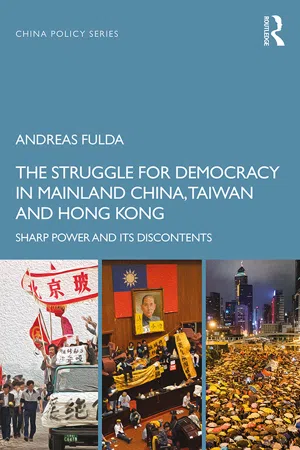
The Struggle for Democracy in Mainland China, Taiwan and Hong Kong
Sharp Power and its Discontents
- 246 pages
- English
- ePUB (mobile friendly)
- Available on iOS & Android
eBook - ePub
The Struggle for Democracy in Mainland China, Taiwan and Hong Kong
Sharp Power and its Discontents
About this book
Information
1
INTRODUCTION
On 16 December 2017 the Economist published its widely cited cover story “Sharp power. The new shape of Chinese influence”.1 Sharp power in this context is understood as an approach taken by authoritarian regimes such as Russia and China’s “that pierces, penetrates, or perforates the political and information environments in the targeted countries”.2 The Economist’s editorial critiqued efforts by the Chinese Communist Party (CCP) to manipulate debate in Western democracies such as Australia, New Zealand, Britain or Canada through covert activities coordinated by its United Front Work Department. In this book I argue that while the CCP’s sharp power approach has captured the global imagination, the united front approach itself is actually not a new phenomenon. Since the founding of the autocratically governed People’s Republic of China (PRC, henceforth mainland China) in 1949, CCP organs and CCP members had close to 70 years to perfect its united front work,3 which has consistently targeted Chinese opposition groups both at home and abroad.
While the Economist has been using the term sharp power to refer to the CCP’s international power projection through non-conventional hard power, in this book I argue that the sharp power approach is essentially an extension of the united front methodology, which was formulated as early as December 1935 and was put into practice by 1937. Van Slyke has described it as “an early stage development of a set of policies and techniques for gaining popular support, for isolating opponents, for expressing the communist programme in nationalist terms, and for deferring (but not forsaking) revolutionary objectives”.4 This means that in the context of this book I will extend the meaning of sharp power and apply it to the CCP’s governing philosophy at home and abroad. I argue that the CCP has been effective in its application of sharp power tactics to contain political opposition to the party-state in mainland China. The CCP’s fine-tuning of Leninist forms of governance over the past decades has also informed united front tactics employed at the periphery of mainland China, most notably the democratic and self-governing Republic of China on Taiwan (henceforth Taiwan) and the semi-democratic Hong Kong Special Administrative Region (henceforth Hong Kong). Law professor Zhang Xuesheng has succinctly pointed out that:
the concept of communist dictatorship that the CCP adhered to then and now, in principle, stands in fundamental contrast to the constitutional government of a liberal democracy. This means that the continuation of the CCP’s rule must be predicated on the elimination of the concepts of freedom, democracy, and the rule of law.5
This also means that it is in the CCP’s organisational self-interest to undermine the development and consolidation of liberal democratic polities at mainland China’s periphery. CCP-led efforts to frustrate democracy in Taiwan and Hong Kong are driven by the fear among top CCP leaders that a successful liberalisation and democratisation in both regions will inspire mainland Chinese citizens to demand the same liberties for themselves. While there is a growing body of literature on China’s authoritarian political system, Taiwan’s democratisation process and Hong Kong’s struggle for greater political autonomy under the “One Country, Two Systems” formula, up-to-date research which offers a critical comparison of political development in all three regions is noticeably absent. The research puzzle at the heart of this book is to what extent political activists in mainland China, Taiwan and Hong Kong have made progress in their quest to liberalise and democratise their respective polities. More specifically, this book addresses the following research questions: What kind of lessons have democracy activists in all three regions drawn from their struggles for democracy? Which kind of lessons learned have arguably advanced their political causes? Are there also cases of pathological learning? And to what extent can critical scholarship advance our analytical understanding of long-term democratisation processes whilst simultaneously enhancing practitioner reflexivity?
It is important to note that Chinese societies in Taiwan and Hong Kong have been at the receiving end of the CCP’s sharp power approach for many decades. In the past two decades, however, Taiwanese and Hong Kong citizens have mounted a robust defence of liberal democratic values and practices, primarily in the form of social and political movements but also through the ballot box. This means that attempts by the CCP to influence the political development on mainland China’s periphery have been much less successful and, in fact, have accelerated the struggle for democracy in Taiwan and Hong Kong. In this book the struggle for democracy in all three regions is understood as an ongoing and open-ended historical process marked by deliberate attempts by activists to liberalise and democratise political institutions and political culture with the help of reform strategies and tactical approaches. A closer inspection of the different political development trajectories in mainland China, Taiwan and Hong Kong offers new and novel insights on sharp power and its discontents. Findings from this book will not only help inform the global debate about “exporting authoritarianism with Chinese characteristics”6 but also highlight the in-built limitations and lack of sustainability of sharp power approaches as a means to consolidate authoritarian rule in mainland China.
China as a longitudinal study
This book is informed by a historical perspective which compares and contrasts the political development trajectory in mainland China, Taiwan and Hong Kong from the early 1970s to the present day. This time frame is chosen as democracy movements in the three regions were kick-started by an election-driven liberalisation in Taiwan in 1969, the Democracy Wall movement in mainland China in 19787 and the top-down political reforms of Governor Patten in Hong Kong after 1992. In her keynote address to the 2018 Annual Conference of the British Association for Chinese Studies, former BBC China correspondent Carrie Gracie reminded her audience that “China is a longitudinal study and you need to stick with it over the long term.”8 Such a historically grounded approach, Gracie mused, could provide greater historical awareness for the cyclical nature of China’s development. In this book I not only concur with Gracie’s suggestion but would add that a comparative perspective is vital to a better understanding of China and its periphery. While this book will show that political change in mainland China, Taiwan and Hong Kong has followed different trajectories, the refusal of the CCP to allow democratisation processes to unfold, either in mainland China or at its periphery, has major implications for all three territories. Xi Jinping’s decision to declare himself leader for life in 2018 has been widely interpreted as a rejection of international convergence. China’s hard authoritarian turn under Xi has thrown into disarray the entire academic discourse about institutionalised leadership succession and authoritarian resilience.
As I will argue in Chapter 2 the strategic decision to block any conceivable pathway to mainland China’s liberalisation and democratisation did not occur in 2018 but had already been made by top CCP leaders in June 1989. From an even longer historical perspective it can be argued that since its establishment in Shanghai in 1921 the CCP has been a political organisation whose monistic ideology has been diametrically opposed to liberal democratic thought and practice. He Baogang has pointed out that:
[according] to the official ideology of China, which is based on Marxism-Leninism and Mao Zedong Thought, the dominant concept of democracy is not that of liberal democracy. Instead, democracy is seen in Mao’s terms: the masses keeping watch of the bureaucracy under the monocratic guidance of a national leader. It is also seen as good government “serving the people” … China has sought to combine democracy with authority, dictatorship and centralism rather than with freedom.9
Discussing the struggle for democracy raises the question of political legitimacy of the authoritarian political regimes. While the CCP has ruled mainland China autocratically since 1949, Taiwan was under one-party rule by the Nationalist Party (KMT) from 1945 until 2000 and liberalised and democratised in the late 1980s and early 1990s. Hong Kong was a British Crown Colony from 1843 until 1997. Incremental reforms to the political system were introduced by the last British governor Chris Patten prior to Hong Kong’s return under mainland Chinese sovereignty in 1997, leaving the newly established Hong Kong Special Administrative Region in a semi-autocratic and semi-democratic limbo.
The question whether or not an authoritarian political regime such as mainland China’s party-state enjoys political legitimacy, and if so, to what extent, helps to illuminate some of the major tensions in the academic field of Chinese studies in general and social and political science research on China’s political system in particular. In this book I argue that research on contemporary Chinese politics is dominated by three different camps of researchers, which can be described as normativists, positivists and academic practitioners (see Table 1.1).
TABLE 1.1 Key perspectives on the CCP’s political legitimacy (or lack thereof)
| Camp | Key perspectives on the CCP’s political legitimacy |
|---|---|
| Normativists(Judgement-oriented perspective) | CCP lacks democratic political legitimacy |
| Positivists(Compartmentalised perspective) | CCP enjoys popular support due to its output capacity (e.g. economic growth) |
| Practitioners(Improvement-oriented perspective) | CCP lacks political legitimacy, but the latter could be enhanced with the help of social policies |
Each camp follows different axiomatic systems, understood “as the set of undemonstrated (and indemonstrable) ‘basic beliefs’ accepted by convention or established by practice as the building blocks of some conceptual or theoretical structure or system”.10 In the following I will use the salient issue of CCP political legitimacy (or lack thereof) as a yardstick to highlight the different axiomatic bases and conceptual roots of each of the three camps. I will also explain what the differences between these camps mean for our discussion about the struggle for democracy in mainland China, Taiwan and Hong Kong.
Normativists
Normativist scholars argue that the CCP does not enjoy democratic political legitimacy. They point to the fact that the CCP gained political power through the barrel of a gun and as the victor in the civil war with the Nationalist Party in 1949. Since constitutional “and other legal acts do not contain any provisions concerning the legal nature of the CCP”,11 normativists would also argue that the CCP lacks a legal foundation. Furthermore, in the absence of free and fair elections on the regional and/or national level, the CCP has not obtained regular and renewed democratic legitimacy since 1949. An example of a normative China scholar is Frank Dikoetter. Such normative critiques of the CCP, however, have not gone uncontested. Critics maintain that normativists engage in “wishful thinking”12 and measure mainland China’s political system against an ideal-type democracy, rather than trying to understand the way it is actually governed. This critique of normative scholarship highlights the problem of mirroring. Seen in this light, normativist scholars stand accused that their scholars...
Table of contents
- Cover
- Half Title
- Series Page
- Title Page
- Copyright Page
- Table of Contents
- List of illustrations
- Preface
- Abbreviations
- 1. Introduction
- 2. Mainland China’s incomplete modernisation
- 3. Dissecting the dynamics of the struggle for democracy
- 4. Theories of and for political change
- 5. The calamity of Chinese Communist Party rule in mainland China
- 6. The trials and tribulations of mainland China’s democracy movement
- 7. The rise and demise of the KMT party-state in Taiwan
- 8. Taiwan’s election-driven democratisation
- 9. Origins of Hong Kong’s semi-democratic status
- 10. Hong Kong’s democracy movement: a canary in the coal mine?
- 11. Sharp power and its discontents
- Appendix
- Index
Trusted by 375,005 students
Access to over 1.5 million titles for a fair monthly price.
Study more efficiently using our study tools.
Frequently asked questions
Yes, you can cancel anytime from the Subscription tab in your account settings on the Perlego website. Your subscription will stay active until the end of your current billing period. Learn how to cancel your subscription
No, books cannot be downloaded as external files, such as PDFs, for use outside of Perlego. However, you can download books within the Perlego app for offline reading on mobile or tablet. Learn how to download books offline
Perlego offers two plans: Essential and Complete
- Essential is ideal for learners and professionals who enjoy exploring a wide range of subjects. Access the Essential Library with 800,000+ trusted titles and best-sellers across business, personal growth, and the humanities. Includes unlimited reading time and Standard Read Aloud voice.
- Complete: Perfect for advanced learners and researchers needing full, unrestricted access. Unlock 1.5M+ books across hundreds of subjects, including academic and specialized titles. The Complete Plan also includes advanced features like Premium Read Aloud and Research Assistant.
We are an online textbook subscription service, where you can get access to an entire online library for less than the price of a single book per month. With over 1.5 million books across 990+ topics, we’ve got you covered! Learn about our mission
Look out for the read-aloud symbol on your next book to see if you can listen to it. The read-aloud tool reads text aloud for you, highlighting the text as it is being read. You can pause it, speed it up and slow it down. Learn more about Read Aloud
Yes! You can use the Perlego app on both iOS and Android devices to read anytime, anywhere — even offline. Perfect for commutes or when you’re on the go.
Please note we cannot support devices running on iOS 13 and Android 7 or earlier. Learn more about using the app
Please note we cannot support devices running on iOS 13 and Android 7 or earlier. Learn more about using the app
Yes, you can access The Struggle for Democracy in Mainland China, Taiwan and Hong Kong by Andreas Fulda in PDF and/or ePUB format, as well as other popular books in Politics & International Relations & Asian Politics. We have over 1.5 million books available in our catalogue for you to explore.