- 222 pages
- English
- ePUB (mobile friendly)
- Available on iOS & Android
eBook - ePub
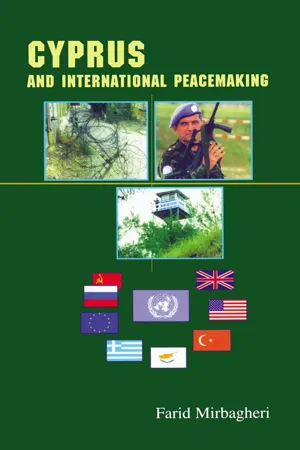
Cyprus and International Peacemaking 1964-1986
About this book
This book traces the international community's attempts to achieve a solution to the Cyprus problem from 1964-86, and analyzes why it has failed. It also discusses the deep mutual distrust between Turks and Greeks throughout the Eastern Mediterranean, which hampers all attempts to reach a satisfactory solution to this intractable problem. Mirbagheri also examines the divergent policies of the key external players and how they have contributed to the current stalemate.
Information
1
MEDIATION AND THE UNITED NATIONS
‘The parties to any dispute, the continuance of which is likely to endanger the maintenance of international peace and security, shall, first of all, seek a solution by negotiation, enquiry, mediation, conciliation, arbitration, judicial settlement, resort to regional agencies, or arrangements, or other peaceful means of their own choice.’1
What is mediation?
Mediation is an art and not a science. As a branch of diplomacy used to settle or resolve disputes among conflicting parties it is important in its own right. Although certain elements are necessary when intermediary assistance is to be applied, there is no set of rules or laws which allows any certainty about the outcome. Compared with other forms of conflict resolution, such as arbitration or adjudication, mediation is less formal and more flexible. It seeks to accommodate conflicting interests by persuasion and the exchange of concessions rather than by determination of the rights and obligations involved. There are no procedural requirements as such, and the consent of the parties is essential throughout. And it is flexible because the negotiations can be tailored to suit each occasion as the circumstances may demand.
Mediation can be either passive or active. Passive mediation seeks to bring the disputants together in the presence of a third party. In the active mode a mediator participates at some stage to effect a settlement by undertaking some responsibilities. UN mediation in Cyprus since 1965 in the role of the special representative of the Secretary-General exemplifies the passive category of mediation.2 The role played by Ellsworth Bunker in the West Irian controversy in 1962 represents the active category.3
Certain features associated with the mediatory process distinguish it from other kinds of conflict resolution. First, since all mediation involves negotiations among the conflicting parties themselves, as well as between them and the intermediary, the granting of concessions from both sides is an essential requirement. Of course this may place certain limitations on the mediator, and here too informality and flexibility as needed. Another important feature of the process is that it does not carry a sense of finality in the determination of the rights and obligations of the parties. This encourages the disputants to seek intermediary assistance, because they do not see themselves committed to any particular solution by virtue of having asked for it.
Also central to the diplomatic forum of mediation is the endeavour to develop perceptions of common interest. As put by one writer:
In international mediation, the peace-maker’s function is not to expound to those involved an indivisible, immutable truth, but to help them create a new truth about their relationships by finding firm ground for agreements that will benefit both parties and bring their vital interests into closer harmony.4
The importance attributed by parties to what they initially asserted to be vital does at times suggest the improbability of accommodating their conflicting claims. The following aspect of the India-Pakistan question illustrates this point:
The Minister for Foreign Affairs [of Pakistan] dwelt at length on economic and strategic considerations. He argued that India, if it has control of Jammu and Kashmir, would be in a position to divert all five rivers of the Punjab…Jhelum, under Indian control and thus could reduce to a desert one-third of the irrigated areas of the west Punjab.5
The Indian government replied:
the strategic interests of a country like India, with its big land mass in the Indian Ocean, are at least as vital in the world as the strategic interest of its neighbour.6
These incompatible claims were later reconciled through the submission of alternative proposals by a mediator in the India-Pakistan dispute, Sir Owen Dixon, who attempted to narrow the areas of interest each held to be of ‘strategic importance’.7
Maintaining the confidentiality of negotiations is another important aspect of intermediary assistance, as premature disclosure of the position of the disputants may lead to domestic pressure in their home countries. This means that governments find it very difficult to retreat from positions which have been made public.
In such cases concessions, which are often essential to any successful mediation, are not forthcoming. The conflicting parties may even succumb to the temptation of making capital at home at the risk of failure in the negotiations by taking public positions and stubbornly adhering to them. However, when confidentiality is observed, parties feel free to approach the mediator with their genuine views of the problems in dispute. This aspect has a significant bearing in the case of Cyprus, as will be explained in the following chapters.
Observing, clarifying and elaborating are all routine procedures of the intermediary process. This can provide the background to concessions and rationalise them by justifying the reasons for them. One writer has noted:
The mere fact of a mediator’s entrance into a dispute provides the parties with a means for rationalising retreats from previously held positions, particularly if the mediator can be made to appear to take part of the responsibility for any settlement.8
Factors affecting the outcome of mediation
Once parties in dispute accept third-party assistance, certain factors come into play to shape the outcome. Some of these factors relate to the conflict itself and some to the performance of the mediator. The most important of them are identified below.
Advantages gained on the battlefield are an important bargaining-counter at the negotiating table. The party that has the upper hand militarily may only be willing to negotiate if it anticipates political gains from this advantage. By the same token the weaker side may be unyielding to pressure for talks from outside until the balance in the military arena has been restored. In such cases, obtaining the consent of the disputants for third party assistance may prove a difficult and lengthy task.
Some conflicts are potentially more threatening to international peace and security than others. The degree of involvement by world or regional superpowers is an index of the dangers inherent in such conflicts, and is a factor which cannot be ignored by the third party. A mediator also has to take into account the gravity of the situation and the nature of the conflict. All these considerations are important when devising the appropriate procedure for negotiations.
‘Concretisation of issues’ is also important: a clear understanding of the various claims of the mediator and the parties themselves is needed to establish common ground. Issues must be clearly defined and separated from one another, and when necessary redefined by the mediator to help bring about new perceptions of the parties’ common interest.9 Sometimes this change of perception is essential to the whole process of mediation, as the disputants tend to view their conflict in zero-sum terms.10
Before any attempt at mediation is made, a cease-fire must be established, since a continuation of hostilities is usually seen as incompatible with negotiations. For example, in the Indonesian situation the success of the Committee of Good Offices in bringing about a settlement was said to depend on the prior establishment of a truce.
It seems obvious that an effective truce is a prerequisite to fruitful negotiations and that therefore the effectiveness of our Committee of Good Offices will be substantially prejudiced by the failure of the parties to reach an agreement regarding the cessation of hostilities.11
When in 1948 the UN Security Council appointed a commission to find out the facts of the Kashmir dispute and lend its good offices to India and Pakistan, it called on the governments of both countries ‘to take immediately all measures within their power…to refrain from making any statement and from doing or causing to be done or permitting any acts which might aggravate the situation’.12
Although sought for its own sake, a cease-fire naturally does not imply a resolution of the conflict, but it may pave the way for a comprehensive arrangement which will eventually lead to one. As a means of conflict resolution a cease-fire does not in itself stand much of a chance and can be very fragile. Ideally, there will be a close link between cease-fire proposals and an agreement to negotiate on the underlying differences. For instance, the cease-fire proposals in the India-Pakistan case in 1965 were viewed by Pakistan as deficient because procedures for settlement of the dispute were not agreed at the same time.13
Any mediator must maintain the confidence of the parties in order to remain a viable channel of communication for the disputants to exchange views. The parties to a conflict are more likely to approach a prospective mediator, confident that their bargaining positions during negotiation will not be turned against them.
The proper conduct of intermediary procedures requires the participation of all parties to a dispute. As the long-term effectiveness of a settlement may largely depend on the degree to which it commands their cooperation, participation by all the interested parties becomes imperative for success. The absence of an interested party may thus weaken the authority of the decisions reached. A classic example is the failure of early mediation attempts in Cyprus. In March 1957 Paul H. Spaak, then Secretary-General of the North Atlantic Treaty Organisation (NATO), offered to mediate between Britain, Greece and Turkey — all members of NATO and directly concerned with the fate of Cyprus. However this offer was rejected by Greece on the ground that no settlement could come about without a representative of the Cypriot people participating. Turkey, on the other hand, was adamantly opposed to any negotiation that included Archbishop Makarios, the Greek Cypriot leader, and threatened to boycott it.14
‘Negotiability’ is a term which refers to various aspects of bargaining. Usually, when a party claims that an issue is not negotiable, it means that achievement of its objective is more important than an agreed settlement of that particular issue with the other disputants.15 The mediator’s task in such cases is to persuade the party to change its perception that the problems are not subject to discussion and compromise.16 ‘Non-negotiability...
Table of contents
- Cover
- Half Title
- Title Page
- Copyright Page
- Preface and Acknowledgements
- Table of Contents
- Chronology of Cyprus since Independence
- Chapter 1. Mediation and the United Nations
- Chapter 2. The Origins of the Cyprus Problem from Independence to 1964
- Chapter 3. The United Nations Attempt at Mediation in Cyprus, 1964–1965
- Chapter 4. International Peacemaking in Cyprus, 1965–July 1974
- Chapter 5. International Peacemaking in Cyprus, July 1974–1980
- Chapter 6. International Peacemaking in Cyprus, 1980–1986
- Chapter 7. After 1986: New Actors
- 8. Conclusions
- Appendixes
- Bibliography
- Index
Trusted by 375,005 students
Access to over 1.5 million titles for a fair monthly price.
Study more efficiently using our study tools.
Frequently asked questions
Yes, you can cancel anytime from the Subscription tab in your account settings on the Perlego website. Your subscription will stay active until the end of your current billing period. Learn how to cancel your subscription
No, books cannot be downloaded as external files, such as PDFs, for use outside of Perlego. However, you can download books within the Perlego app for offline reading on mobile or tablet. Learn how to download books offline
Perlego offers two plans: Essential and Complete
- Essential is ideal for learners and professionals who enjoy exploring a wide range of subjects. Access the Essential Library with 800,000+ trusted titles and best-sellers across business, personal growth, and the humanities. Includes unlimited reading time and Standard Read Aloud voice.
- Complete: Perfect for advanced learners and researchers needing full, unrestricted access. Unlock 1.5M+ books across hundreds of subjects, including academic and specialized titles. The Complete Plan also includes advanced features like Premium Read Aloud and Research Assistant.
We are an online textbook subscription service, where you can get access to an entire online library for less than the price of a single book per month. With over 1.5 million books across 990+ topics, we’ve got you covered! Learn about our mission
Look out for the read-aloud symbol on your next book to see if you can listen to it. The read-aloud tool reads text aloud for you, highlighting the text as it is being read. You can pause it, speed it up and slow it down. Learn more about Read Aloud
Yes! You can use the Perlego app on both iOS and Android devices to read anytime, anywhere — even offline. Perfect for commutes or when you’re on the go.
Please note we cannot support devices running on iOS 13 and Android 7 or earlier. Learn more about using the app
Please note we cannot support devices running on iOS 13 and Android 7 or earlier. Learn more about using the app
Yes, you can access Cyprus and International Peacemaking 1964-1986 by Farid Mirbagheri in PDF and/or ePUB format, as well as other popular books in Politics & International Relations & Diplomacy & Treaties. We have over 1.5 million books available in our catalogue for you to explore.