- 186 pages
- English
- ePUB (mobile friendly)
- Available on iOS & Android
eBook - ePub
About this book
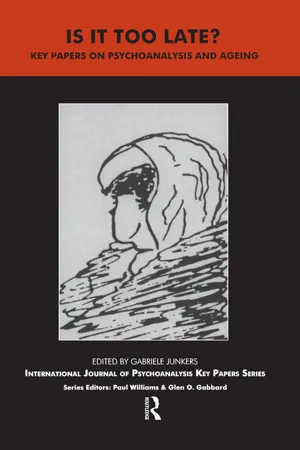
This book brings together a selection of classic psychoanalytical papers related to ageing, dying and death that have appeared in the renowned International Journal of Psychoanalysis (IJP). Two papers address the analysis of an elderly patient directly and bring the work and the challenges it brings vividly to life. Also explored are such issues as death and the midlife crisis, loneliness and the ageing process, ageing and psychopathology, fear of death, transference and countertransference issues, and the final stage of the dying process. 'The idea behind this monograph is to alert interested psychoanalysts, students and those working from an interdisciplinary standpoint to the possibility of a better understanding of the ageing process as well as a group of potential analysis that seem to exist in the shadow of our professional communications. 'Each stage of life has its own somatic and psychic normality as well as pathology.
Information
Chapter One
Death and the mid-life crisis*
In the course of the development of the individual there are critical phases which have the character of change points, or periods of rapid transition. Less familiar perhaps, though nonetheless real, are the crises which occur around the age of thirty-five—which I shall term the mid-life crisis—and at full maturity around the age of sixty-five. It is the mid-life crisis with which I shall deal in this paper.
When I say that the mid-life crisis occurs around the age of thirty-five, I mean that it takes place in the middle-thirties, that the process of transition runs on for some years, and that the exact period will vary among individuals. The transition is often obscured in women by the proximity of the onset of changes connected with the menopause. In the case of men, the change has from time to time been referred to as the male climacteric, because of the reduction in the intensity of sexual behaviour which often occurs at that time.
Crisis in genius
I first became aware of this period as a critical stage in development when I noticed a marked tendency towards crisis in the creative work of great men in their middle and late thirties. It is clearly expressed by Richard Church in his autobiography The Voyage Home:
There seems to be a biological reason for men and women, when they reach the middle thirties, finding themselves beset with misgivings, agonizing inquiries, and a loss of zest. Is it that state which the medieval schoolmen called accidie, the cardinal sin of spiritual sloth? I believe it is.
This crisis may express itself in three different ways: the creative career may simply come to an end, either in a drying-up of creative work, or in actual death; the creative capacity may begin to show and express itself for the first time; or a decisive change in the quality and content of creativeness may take place.
Perhaps the most striking phenomenon is what happens to the death rate among creative artists. I had got the impression that the age of thirty-seven seemed to figure pretty prominently in the death of individuals of this category. This impression was upheld by taking a random sample of some 310 painters, composers, poets, writers, and sculptors, of undoubted greatness or of genius. The death rate shows a sudden jump between thirty-five and thirty-nine, at which period it is much above the normal death rate. The group includes Mozart, Raphael, Chopin, Rimbaud, Purcell, Baudelaire, Watteau. … There is then a big drop below the normal death rate between the ages of forty and forty-four, followed by a return to the normal death rate pattern in the late forties. The closer one keeps to genius in the sample, the more striking and clearcut is this spiking of the death rate in mid-life.
The change in creativity which occurs during this period can be seen in the lives of countless artists. Bach, for example, was mainly an organist until his cantorship at Leipzig at thirty-eight, at which time he began his colossal achievements as a composer. Rossini’s life is described in the following terms:
His comparative silence during the period 1832–1868 (i.e. from 40 to his death at 74) makes his biography like the narrative of two lives—swift triumph, and a long life of seclusion.
Racine had thirteen years of continuous success culminating in Phèdre at the age of thirty-eight; he then produced nothing for some twelve years. The characteristic work of Goldsmith, Constable, and Goya emerged between the ages of thirty-five and thirty-eight. By the age of forty-three Ben Jonson had produced all the plays worthy of his genius, although he lived to be sixty-four. At thirty-three Gauguin gave up his job in a bank, and by thirty-nine had established himself in his creative career as a painter. Donatello’s work after thirty-nine is described by a critic as showing a marked change in style, in which he departed from the statuesque balance of his earlier work and turned to the creation of an almost instantaneous expression of life.
Goethe, between the ages of thirty-seven and thirty-nine, underwent a profound change in outlook, associated with his trip to Italy. As many of his biographers have pointed out, the importance of this journey and this period in his life cannot be exaggerated. He himself regarded it as the climax to his life. Never before had he gained such complete understanding of his genius and mission as a poet. His work then began to reflect the classical spirit of Greek tragedy and of the Renaissance.
Michelangelo carried out a series of masterpieces until he was forty: his “David” was finished at twenty-nine, the decoration of the roof of the Sistine Chapel at thirty-seven, and his “Moses” between thirty-seven and forty. During the next fifteen years little is known of any artistic work. There was a creative lull until, at fifty-five, he began to work on the great Medici monument and then later on “The Last Judgement” and frescoes in the Pauline Chapel.
Let me make it clear that I am not suggesting that the careers of most creative persons either begin or end during the mid-life crisis. There are few creative geniuses who live and work into maturity, in whom the quality of greatness cannot be discerned in early adulthood in the form either of created works or of the potential for creating them: Beethoven, Shakespeare, Goethe, Couperin, Ibsen, Balzac, Voltaire, Verdi, Handel, Goya, Dürer, to name but a very few at random. But there are equally few in whom a decisive change cannot be seen in the quality of their work—in whose work the effects of their having gone through a mid-life crisis cannot be discerned. The reactions range all the way from severe and dramatic crisis, to a smoother and less troubled transition—just as reactions to the phase of adolescent crisis may range from severe disturbance and breakdown to relatively ordered readjustment to mental and sexual adulthood—but the effects of the change are there to be discerned. What then are the main features of this change?
There are two features which seem to me of outstanding importance. One of these has to do with the mode of work; the second has to do with the content of the work. Let me consider each of these in turn. I shall vise the phrase “early adulthood” for the pre-mid-life phase, and “mature adulthood” for the post-mid-life phase.
Change in mode of work
I can best describe the change in mode of work which I have in mind by describing the extreme of its manifestation. The creativity of the twenties and the early thirties tends to be a hot-from-the-fire creativity. It is intense and spontaneous, and comes out readymade. The spontaneous effusions of Mozart, Keats, Shelley, Rimbaud, are the prototype. Most of the work seems to go on unconsciously. The conscious production is rapid, the pace of creation often being dictated by the limits of the artist’s capacity physically to record the words or music he is expressing.
A vivid description of early adult type of work is given in Gittings’s biography of Keats:
Keats all this year had been living on spiritual capital. He had used and spent every experience almost as soon as it had come into his possession, every sight, person, book, emotion or thought had been converted spontaneously into poetry. Could he or any other poet have lasted at such a rate? … He could write no more by these methods. He realized this himself when he wished to compose as he said “without fever”. He could not keep this high pulse beating and endure.
By contrast, the creativity of the late thirties and after is a sculpted creativity. The inspiration may be hot and intense. The unconscious work is no less than before. But there is a big step between the first effusion of inspiration and the finished created product. The inspiration itself may come more slowly. Even if there are sudden bursts of inspiration, they are only the beginning of the work process. The initial inspiration must first be externalized in its elemental state. Then begins the process of forming and fashioning the external product, by means of working and re-working the externalized material. I use the term sculpting because the nature of the sculptor’s material—it is the sculptor working in stone of whom I am thinking—forces him into this kind of relationship with the product of his creative imagination. There occurs a process of interplay between unconscious intuitive work and inspiration, and the considered perception of the externally emergent creation and the reaction to it.
In her note, “A character trait of Freud’s”, Riviere (1958) describes Freud’s exhorting her in connexion with some psychoanalytic idea which had occurred to her:
Write it, write it, put it down in black and white … get it out, produce it, make something of it—outside you, that is; give it an existence independently of you.
This externalizing process is part of the essence of work in mature adulthood, when, as in the case of Freud, the initially externalized material is not itself the end product, or nearly the end product, but is rather the starting point, the object of further working over, modification, elaboration, sometimes for periods of years.
In distinguishing between the precipitate creativity of early adulthood and the sculpted creativity of mature adulthood, I do not want to give the impression of drawing a hard and fast line between the two phases. There are of course times when a creative person in mature adulthood will be subject to bursts of inspiration and rapid-fire creative production. Equally there will be found instances of mature and sculpted creative work done in early adulthood. The “David” of Michelangelo is, I think, the supreme example of the latter.
But the instances where work in early adulthood has the sculpted and worked-over quality are rare. Sometimes, as in scientific work, there may be the appearance of sculpted work. Young physicists in their twenties, for example, may produce startling discoveries, which are the result of continuous hard work and experimentation. But these discoveries result from the application of modern theories about the structure of matter—theories which themselves have been the product of the sculpted work of mature adulthood of such geniuses as Thomson and Einstein.
Equally, genuinely creative work in mature adulthood may sometimes not appear to be externally worked over and sculpted, and yet actually be so. What seems to be rapid and unworked-over creation is commonly the reworking of themes which have been worked upon before, or which may have been slowly emerging over the years in previous works. We need look no farther than the work of Freud for a prime example of this process of books written rapidly, which are nevertheless the coming to fruition of ideas which have been worked upon, fashioned, reformulated, left incomplete and full of loose ends, and then reformulated once again in a surging forward through the emergence of new ideas for overcoming previous difficulties.
The reality of the distinction comes out in the fact that certain materials are more readily applicable to the precipitate creativity of early adulthood than are others. Thus, for example, musical composition, lyrical poetry, are much more amenable to rapid creative production than are sculpting in stone or painting in oils. It is noteworthy, therefore, that whereas there are very many poets and composers who achieve greatness in early adulthood—indeed in their early twenties or their late teens—there are very few sculptors or painters in oils who do so. With oil paint and stone, the working relationship to the materials themselves is of importance, and demands that the creative process should go through the stage of initial extemalization and working-over of the externalized product. The written word and musical notation do not of necessity have this same plastic external objective quality. They can be sculpted and worked over, but they can also readily be treated merely as a vehicle for the immediate recording of unconsciously articulated products which are brought forward whole and complete—or nearly so.
Quality and content of creativity
The change in mode of work, then, between early and mature adulthood, is a change from precipitate to sculpted creativity. Let me now consider for a moment the change in the quality and content of the creativity. The change I have in mind is the emergence of a tragic and philosophical content which then moves on to serenity in the creativity of mature adulthood, in contrast to a more characteristically lyrical and descriptive content to the work of early adulthood. This distinction is a commonly held one, and may perhaps be considered sufficiently self-evident to require little explication or argument. It is implied, of course, in my choice of the adjectives “early” and “mature” to qualify the two phases of adulthood which I am discussing.
The change may be seen in the more human, tragic and less fictitious and stage quality of Dickens’s writing from David Copperfield (which he wrote at thirty-seven) onwards. It may be seen also in the transition in Shakespeare from the historical plays and comedies to the tragedies. When he was about thirty-one, in the midst of writing his lyrical comedies, he produced Romeo and Juliet. The great series of tragedies and Roman plays, however, began to appear a few years later; Julius Caesar, Hamlet, Othello, King Lear, and Macbeth are believed to have been written most probably between the ages of thirty-five and forty.
There are many familiar features of the change in question. Late adolescent and early adult idealism and optimism accompanied by split-off and projected hate, are given up and supplanted by a more contemplative pessimism. There is a shift from radical desire and impatience to a more reflective and tolerant conservatism. Beliefs in the inherent goodness of man are replaced by a recognition and acceptance of the fact that inherent goodness is accompanied by hate and destructive forces within, which contribute to man’s own misery and tragedy. To the extent that hate, destruction, and death are found explicitly in early adult creativeness, they enter in the form of the satanic or the macabre, as in Poe and in Baudelaire, and not as worked-through and resolved anxieties.
The spirit of early adult creativeness is summed up in Shelley’s Prometheus Unbound. In her notes on this work, Shelley’s wife has written:
The prominent feature of Shelley’s theory of the destiny of the human species is that evil is not inherent in the system of the Creation, but an accident that might be expelled … God made Earth and Man perfect, till he by his fall “brought death into the world, and all our woe”. Shelley believed that mankind had only to will that there should be no evil in the world and there would be none…. He was attached to this idea with fervent enthusiasm.
This early adult idealism is built upon the use of unconscious denial and manic defences as normal processes of defence against two fundamental features of human life—the inevitableness of eventual death, and the existence of hate and destructive impulses inside each person. I shall try to show that the explicit recognition of these two features, and the bringing of them into focus, is the quintessence of successful weathering of the mid-life crisis and the achievement of mature adulthood.
It is when death and human destructiveness—that is to say, both death and the death instinct—are taken into account that the quality and content of creativity change to the tragic, reflective, and philosophical. The depressive position must be worked through once again, at a qualitatively different level. The misery and despair of suffering and chaos unconsciously brought about by onseself are encountered and must be surmounted for life to be endured and for creativity to continue. Nemesis is the key, and tragedy the theme, of its recognition.
The successful outcome of mature creative work lies thus in constructive resignation both to the imperfections of men and to shortcomings in one’s own work. It is this constructive resignation that then imparts serenity to life and work.
The Divine Comedy
I have taken these examples from creative genius because I believe the essence of the mid-life crisis is revealed in its most full and rounded form in the lives of the great. It will have become manifest that the crisis is a depressive crisis, in contrast to the adolescent crisis, which tends to be a paranoid-schizoid one. In adolescence, the predominant outcome of serious breakdown is schizophrenic illness; in mid-life the predominant outcome is depression, or the consequences of defence against depressive anxiety as reflected in manic defences, hypochondriasis, obsessional mechanisms, or superficiality and character deterioration. Working through the mid-life crisis calls for a re-working through of the infantile depression, but with mature insight into death and destructive impulses to be taken into account.
This theme of working through depression is magnificently expressed in The Divine Comedy. This masterpiece of all time was begun by Dante following his banishment from Florence at the age of thirty-seven. In the opening stanzas he creates his setting in words of great power and tremendous psychological depth. He begins:
In the middle of the journey of our life, I came to myself within a dark wood where the straight way was lost. Ah, how hard it is to tell of that wood, savage and harsh and dense, the thought of which renews my fear. So bitter is it that death is hardly m...
Table of contents
- Cover
- Half Title
- Title
- Copyright
- CONTENTS
- SERIES PREFACE
- ABOUT THE EDITOR
- EDITOR’S PREFACE
- FOREWORD
- CHAPTER ONE Death and the mid-life crisis
- CHAPTER TWO On loneliness and the ageing process
- CHAPTER THREE Comments on Dr Norman A. Cohen’s paper: “On loneliness and the ageing process”
- CHAPTER FOUR On ageing and psychopathology—discussion of Dr Norman A. Cohen’s paper “On loneliness and the ageing process”
- CHAPTER FIVE Fear of death—notes on the analysis of an old man
- CHAPTER SIX The analysis of an elderly patient
- CHAPTER SEVEN The life cycle as indicated by the nature of transference in the psychoanalysis of the middle-aged and elderly
- CHAPTER EIGHT The older analysand: countertransference issues in psychoanalysis
- CHAPTER NINE The final stage of the dying process
- CHAPTER TEN On the generational cycle—an address
Trusted by 375,005 students
Access to over 1.5 million titles for a fair monthly price.
Study more efficiently using our study tools.
Frequently asked questions
Yes, you can cancel anytime from the Subscription tab in your account settings on the Perlego website. Your subscription will stay active until the end of your current billing period. Learn how to cancel your subscription
No, books cannot be downloaded as external files, such as PDFs, for use outside of Perlego. However, you can download books within the Perlego app for offline reading on mobile or tablet. Learn how to download books offline
Perlego offers two plans: Essential and Complete
- Essential is ideal for learners and professionals who enjoy exploring a wide range of subjects. Access the Essential Library with 800,000+ trusted titles and best-sellers across business, personal growth, and the humanities. Includes unlimited reading time and Standard Read Aloud voice.
- Complete: Perfect for advanced learners and researchers needing full, unrestricted access. Unlock 1.5M+ books across hundreds of subjects, including academic and specialized titles. The Complete Plan also includes advanced features like Premium Read Aloud and Research Assistant.
We are an online textbook subscription service, where you can get access to an entire online library for less than the price of a single book per month. With over 1.5 million books across 990+ topics, we’ve got you covered! Learn about our mission
Look out for the read-aloud symbol on your next book to see if you can listen to it. The read-aloud tool reads text aloud for you, highlighting the text as it is being read. You can pause it, speed it up and slow it down. Learn more about Read Aloud
Yes! You can use the Perlego app on both iOS and Android devices to read anytime, anywhere — even offline. Perfect for commutes or when you’re on the go.
Please note we cannot support devices running on iOS 13 and Android 7 or earlier. Learn more about using the app
Please note we cannot support devices running on iOS 13 and Android 7 or earlier. Learn more about using the app
Yes, you can access Is It Too Late? by Gabriele Junkers in PDF and/or ePUB format, as well as other popular books in Psychology & Developmental Psychology. We have over 1.5 million books available in our catalogue for you to explore.