eBook - ePub
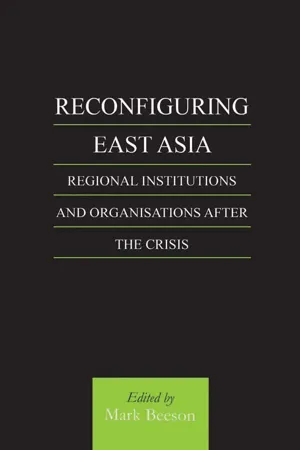
Reconfiguring East Asia
Regional Institutions and Organizations After the Crisis
- 288 pages
- English
- ePUB (mobile friendly)
- Available on iOS & Android
eBook - ePub
About this book
Focuses both on specific regional organizations like ASEAN, The Asian Development Bank and APEC, as well as on key institutions such as East Asian legal systems, the media, organized labour, Asian business systems, and the developmental state.
Information
Chapter One
Theorising Institutional Change in East Asia*
One of the most striking aspects of the turmoil that gripped East Asia in the aftermath of the recent economic crisis was the rapid change in the way the region was perceived. From being primarily associated with ‘miraculous’ development and enlightened public policy, the region rapidly became a synonym for corruption and ‘crony capitalism’. Consequently, many observers – especially, but not exclusively external ones – called for fundamental changes in the way politics and business were conducted in East Asia. Significantly, a particular preoccupation with institutional reform emerged, since appropriate institutions were considered a key element of successful public policy. As the Deputy Managing Director of the International Monetary Fund (IMF) observed:
… the right framework for policy formulation and execution includes the regulations and legislation governing economic activity and all other areas of human interaction Where the rules and regulations are clear, and where institutions apply them predictably and impartially, economic security will flourish, and social justice becomes possible. (Ouattara 1999: 4, emphasis added)
The IMF has been at the forefront of a campaign that has called for ‘vast change in [East Asian] domestic business practices, corporate culture, and government behaviour’ (Fischer 1998: 3), on the grounds that without profound change ‘the causes of the disease’ that precipitated the crisis will not be eradicated (Lane et al. 1999: 123). If successful, it is a reform agenda whose scope would see a fundamental transformation of not simply political practices and economic structures, but of East Asian social relations more generally.
There is no intention here of either presenting an analysis of the crisis itself, or of taking issue with the technical aspects of the IMF’s interpretation and subsequent management of the crisis.1 Of greatest interest here is the IMF’s conviction that not only were the particular configurations of institutions in East Asia somehow to blame for the crisis, but that they must be reformed fundamentally if the region is to return to its former prosperity. Even if we gloss over the fact that precisely the same sets of institutions appear to have been responsible for both the rise and fall of East Asia, the important issue for the purposes of this volume is the preoccupation with institutions as key determinants of social welfare and economic development, and consequently as key targets of reformist pressures.
The key issue to consider here is whether change will occur in East Asia as a consequence of these pressures or, conversely, whether change will be resisted. In either case, institutions provide an important focus of analytical attention with which to consider such possibilities. For if change is occurring in East Asia, it will be manifest in the historically specific institutions that have distinguished the region. Focusing on key institutions allows us both to identify possible sources of, or resistance to change, and provides a way of conceptualising its extent. In this way we can distinguish change that may – or may not – be occurring at the national level, from developments that may be taking place at the sectoral or even the regional level. Moreover, an institutional focus allows us to identify possible sources of, or obstacles to change, and to distinguish those that may be internal to the region from those that may be external. In this way, it is possible to build up a picture of the forces that are shaping the region, allowing us to develop a more accurate picture of post-crisis East Asia that transcends the limitations of country-specific analysis.
This chapter introduces some of the most important variants of institutional theory and attempts to isolate some of the more significant insights that emerge from within it. The first section consequently assesses the contributions to institutional theory from economics, political science, sociology and an historically based form of institutionalism. The second section extends this analysis to look more closely at its applicability in an East Asian context. I suggest that an institutional perspective allows us to identify both the most important structures or relationships that make up a specific national political economy or even region, as well as the internal and external forces that are likely to promote or inhibit change. The central argument here is that traumas like the recent crisis provide moments in which new policy initiatives or ideas – such as those promoted by the IMF – have an opportunity to take hold; whether they will do so depends highly on the way specific institutions are embedded in wider networks of power and interest within the region. Institutional theory provides an important framework with which to try and make sense of the complex dialectic between the national and the transnational, between the ideational and the material, and between the forces of inertia and change.
INSTITUTIONAL THEORY2
In this section I review some of the key varieties of institutional theory. Although the demarcation employed here is somewhat arbitrary – some theorists cross disciplinary boundaries and some distinctions are inevitably somewhat artificial nevertheless, I distinguish between ‘economic’, ‘political’, ‘sociological’ and ‘historical’ forms of institutionalism to organise the subsequent discussion. Before embarking on this endeavour, I offer some preliminary comments about institutions and distinguish them from the ‘organisations’ that feature in the title of this book.
Institutions are notoriously difficult to define, but one of the common distinguishing qualities identified in much of the literature is that they are intimately connected to recurrent patterns of social behaviour. At the outset it is important to stress that the relationship between institutions and social activity is complex and reciprocal; institutions are part of an intricate dialectical process that both shapes and is shaped by contingent human activity. Scott defines institutions this way:
Institutions consist of cognitive, normative, and regulative structures and activities that provide stability and meaning to social behaviour. Institutions are transported by various carriers – cultures, structures, and routines – and they operate at multiple levels of jurisdiction … Although constructed and maintained by individual actions, institutions assume the guise of an impersonal and objective reality. (Scott 1995: 33)
One of the defining qualities of institutions, therefore, is their capacity to regulate human activities and reflect overarching norms and values. This is not, it should be emphasised, to suggest that there is anything ‘natural’ or inevitable about the development of institutions or the values they embody. Clearly, some actors or forces have a greater capacity to determine influential norms and social practices than others (Cox 1991). The important point to make at this stage is that institutions play a crucial role in defining quotidian reality.
It is the routinisation or the institutionalisation of patterns of activity that is such a crucial determinant of ‘the way things happen’ in a particular part of the world. While particular institutions – the law or civil society, for example – may superficially seem universal conceptions, their content and meaning may be very different because of the specific social setting within which they are embodied or realised. By looking at the way particular institutions are manifest in specific locations, and focusing on the norms and values that inform recurrent patterns of behaviour, we can identify what it is that may differentiate say a corporate organisation in the US from one in Japan, or even what may distinguish one region from another. If it makes sense to think of ‘East Asia’ as more than simply a fairly arbitrarily demarcated geographical entity, but rather as a part of the world that shares some distinctive commonalities, it is because particular institutions either resemble each other or perform similar functions.
Finally, before looking at institutional theory in any detail, it is important to distinguish between institutions and organisations. Oran Young (1994: 26) suggests that institutions can be thought of as a ‘set of rules or conventions that define a social practice, assign roles … and guide interactions’, but that organisations, by contrast, are ‘material entities possessing budgets, personnel, offices, equipment, and legal personality’. This is clearly a useful way of differentiating between the sorts of formally constituted organisations considered in this book like the Association of Southeast Asian Nations (ASEAN) or the Asia Pacific Economic Cooperation (APEC) forum. Of course, in general discussion such organisations are invariably also described as ‘institutions’. The important point to emphasise here, however, is that, on the one hand, such organisations will themselves reflect a particular institutional setting that will define their capacities as collective actors (Scott 1995: 55). On the other hand, they may be directly involved in the attempted institutionalisation of particular political and economic practices. While we might want to reserve the term ‘organisation’ to describe formally constituted and recognised entities, they are involved in precisely the same sorts of processes of institutionalisation as are the more loosely defined institutions. Indeed, as the IMF’s prominent role suggests, various organisations have played a key role in attempting to either consolidate existing, or establish new, patterns of behaviour. The remainder of this section considers some of the major contributions to institutional theory. This review is necessarily highly selective and impressionistic; it is intended to highlight some of the key insights that have emerged from institutional theory’s various sub-divisions.
Institutions in Economics
In both the economics and political science disciplines, the standing of institutional theory has waxed and waned. In economics, institutional theory was pioneered by the likes of Thorstein Veblen and John Commons, and despite some important differences between them,3 the early institutionalists were united by a holistic and non-formalist approach that attempted to describe the complexity and multi-dimensionality of historically specific human activity. Much of the ‘new’ institutionalism in economics, by contrast, is centred on the highly abstract assumptions of methodological individualism and consequently develops a very different conception of the dynamics of social activity. In this later form of institutionalism, the theoretical influence of which can be clearly seen in the policy directives of institutions like the IMF and the World Bank, the aggregated actions of individuals making rational choices that reflect their own interests are expected to lead – when permitted – to economically optimal outcomes. Although it is also possible to distinguish a number of sub-divisions in the new economic institutionalism,4 the point to stress is that from the perspective of the new institutional economics it is considered possible to use economic theory, especially the neo-classical variety, to assess and improve the ‘efficiency’ of institutions.
Oliver Williamson has been a major contributor to a theory of institutions derived from such premises. For Williamson (1985: 17), the key concept with which to understand the general development of capitalism is the idea of ‘transaction costs’. Transaction cost economics is ‘mainly concerned with the governance of contractual relations’ (Williamson 1993: 112). Williamson and his followers are primarily concerned with how economic activity is organised and coordinated, the kinds of institutions that are necessary for its continuation, and with identifying the costs that are associated with such activities. In a world in which people are assumed to be rational, utility maximising and individualistic, not only will organisational development be driven by such essentially atomistic forces, but the possible course of development will be fundamentally constrained by the model’s inherent logic and the necessity of reducing costs.
Several points are worth making about this influential perspective. First, the conception of rationality that it assumes, even in its more restricted and ‘bounded’ form, displays an almost teleological view of economic and organisational development. Moreover, it reflects a widely held perspective that shows little appreciation of the possibility that rationality itself may be a socially constructed phenomenon that takes different forms in different circumstances (Taylor 1982). Yet even if we accept that some forms of organisation are clearly more ‘efficient’ than others when judged from the limited calculus of economic rationality, this does not necessarily mean that there is only one way of solving a particular collective action problem. Indeed, when placed in an East Asian context, one of the most interesting questions that emerges from a transaction cost perspective revolves around the possibility that some institutional configurations may be socially embedded in such a way as to reduce transaction costs by replacing the potentially expensive, legalistic enforcement of contracts with a form of ‘trust’ (Fukuyama 1995). Even if the importance of trust-based economic relationships is difficult to demonstrate and needs to be treated with some caution, the idea that institutionalised relationships may reflect broader social forces or a range of social values not simply individualistic, market-centred ones is important; as is the idea that such relationships might persist through time whether ‘efficient’ or not.
The idea that institutional structures endure and display a degree of ‘path-dependency’ has been most fully developed by Douglas North. For North (1990: 384), institutions consist of ‘informal constraints and formal rules and of their enforcement characteristics. Together they provide the rules of the game of human interaction’. While this formulation is in keeping with a number of the other perspectives considered above, what really sets North’s work apart is his stress on the importance of history: institutions are shaped by past actions that effectively delimit and constrain possible actions in the present. The most celebrated example of this form of path dependency is the QWERTY keyboard configuration which, while clearly a less than optimal historical legacy has proved resistant to change (Arthur 1989). While North’s ideas are an important contribution to our understanding of the constraining role of existent institutions and a powerful reminder that the present is ultimately shaped by the past, like Williamson’s, North’s (1996: 5 [1990]) work is underpinned by the ‘choice theoretic approach of neo-classical economic theory’. In other words, despite the sophisticated historical analysis that North develops, ultimately it is the ‘development of efficient economic organisation’ that drives economic development and human history (North and Thomas 1999: 1 [1973]). Like their assumptions about rationality, North’s and Williamson’s views of efficiency reflect the narrow preoccupations of their discipline, which need to be complemented with insights from other areas if institutional theory is to have greater theoretical application.
Institutions in Political Science
The status of institutional theory in political science highlights the importance of the levels of analysis question.5 Institutions operate at various levels and this is reflected in the different centres of analytical attention that have emerged in political science. March and Olsen played an important role in highlighting the importance of, and renewing interest in, institutions, especially at the domestic level. They argued that national polities needed to be unbundled so that their institutional components the bureaucracy, the legislature and the like could be identified, their inter-relationships explored, and their importance as distinct political actors potentially enjoying a degree of autonomy highlighted. For March and Olsen (1984: 739) the internal processes of political institutions had the capacity to ‘affect the flow of history’, determining wider social accommodations. One of the key insights of these authors revolved around the degree of autonomy necessary for political institutions to work effectively:
Ever...
Table of contents
- Cover
- Half Title
- Title Page
- Copyright Page
- Table of Contents
- Notes on Contributors
- Acknowledgements
- List of Abbreviations
- List of Figures
- List of Tables
- Introduction
- 1 Theorising Institutional Change in East Asia
- Part I - Institutions
- Part II - Organisations
- Index
Trusted by 375,005 students
Access to over 1.5 million titles for a fair monthly price.
Study more efficiently using our study tools.
Frequently asked questions
Yes, you can cancel anytime from the Subscription tab in your account settings on the Perlego website. Your subscription will stay active until the end of your current billing period. Learn how to cancel your subscription
No, books cannot be downloaded as external files, such as PDFs, for use outside of Perlego. However, you can download books within the Perlego app for offline reading on mobile or tablet. Learn how to download books offline
Perlego offers two plans: Essential and Complete
- Essential is ideal for learners and professionals who enjoy exploring a wide range of subjects. Access the Essential Library with 800,000+ trusted titles and best-sellers across business, personal growth, and the humanities. Includes unlimited reading time and Standard Read Aloud voice.
- Complete: Perfect for advanced learners and researchers needing full, unrestricted access. Unlock 1.5M+ books across hundreds of subjects, including academic and specialized titles. The Complete Plan also includes advanced features like Premium Read Aloud and Research Assistant.
We are an online textbook subscription service, where you can get access to an entire online library for less than the price of a single book per month. With over 1.5 million books across 990+ topics, we’ve got you covered! Learn about our mission
Look out for the read-aloud symbol on your next book to see if you can listen to it. The read-aloud tool reads text aloud for you, highlighting the text as it is being read. You can pause it, speed it up and slow it down. Learn more about Read Aloud
Yes! You can use the Perlego app on both iOS and Android devices to read anytime, anywhere — even offline. Perfect for commutes or when you’re on the go.
Please note we cannot support devices running on iOS 13 and Android 7 or earlier. Learn more about using the app
Please note we cannot support devices running on iOS 13 and Android 7 or earlier. Learn more about using the app
Yes, you can access Reconfiguring East Asia by Mark Beeson in PDF and/or ePUB format, as well as other popular books in Politics & International Relations & Political Economy. We have over 1.5 million books available in our catalogue for you to explore.