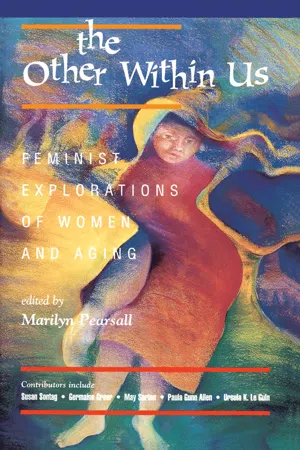
- 288 pages
- English
- ePUB (mobile friendly)
- Available on iOS & Android
eBook - ePub
About this book
Feminist women bequeath to us a powerful critique of our society's obsession with beauty and impossible body ideals. Having refused makeup, high heels, and short skirts in their youth, these women are now entering the most stigmatized stage in a woman's life?old age. As she becomes the ?older woman,? the feminist's rejection of beauty standards and her ability to locate self-worth is being challenged.How will feminists respond to the issues raised in this phase of their lives? By confronting the issues unique to older women in our culture and society, these authors redress the neglect and isolation experienced within contemporary feminism and gerontology.Ultimately, the goal of the book is to inspire the aging woman to more easily embrace the ?older other? within her.
Information
Part One
Situating
1
THE DOUBLE STANDARD OF AGING
For a woman to be obliged to state her age, after “a certain age,” is always a miniature ordeal. … Almost everyone acknowledges that once she passes an age that is, actually, quite young, a woman’s exact age ceases to be a legitimate target of curiosity. After childhood the year of a woman’s birth becomes her secret, her private property. It is something of a dirty secret. To answer truthfully is always indiscreet.
The discomfort a woman feels each time she tells her age is quite independent of the anxious awareness of human mortality that everyone has, from time to time. There is a normal sense in which nobody, men and women alike, relishes growing older. After 35 any mention of one’s age carries with it the reminder that one is probably closer to the end of one’s life than to the beginning. There is nothing unreasonable in that anxiety. Nor is there any abnormality in the anguish and anger that people who are really old, in their 70s and 80s, feel about the implacable waning of their powers, physical and mental. Advanced age is undeniably a trial, however stoically it may be endured. It is a shipwreck, no matter with what courage elderly people insist on continuing the voyage. But the objective, sacred pain of old age is of another order than the subjective, profane pain of aging. Old age is a genuine ordeal, one that men and women undergo in a similar way. Growing older is mainly an ordeal of the imagination—a moral disease, a social pathology—intrinsic to which is the dreary panic of middle-aged men whose “achievements” seem paltry, who feel stuck on the job ladder or fear being pushed off it by someone younger. But they are also denied most of the real satisfactions that men derive from work—satisfactions that often do increase with age.
The double standard about aging shows up most brutally in the conventions of sexual feeling, which presuppose a disparity between men and women that operates permanently to women’s disadvantage. In the accepted course of events a woman anywhere from her late teens through her middle 20s can expect to attract a man more or less her own age. (Ideally, he should be at least slightly older.) They marry and raise a family. But if her husband starts an affair after some years of marriage, he customarily does so with a woman much younger than his wife. Suppose, when both husband and wife are already in their late 40s or early 50s, they divorce. The husband has an excellent chance of getting married again, probably to a younger woman. His ex-wife finds it difficult to re-marry. Attracting a second husband younger than herself is improbable; even to find someone her own age she has to be lucky, and she will probably have to settle for a man considerably older than herself, in his 60s or 70s. Women become sexually ineligible much earlier than men do. A man, even an ugly man, can remain eligible well into old age. He is an acceptable mate for a young, attractive woman. Women, even good-looking women, become ineligible (except as partners of very old men) at a much younger age.
Thus, for most women, aging means a humiliating process of gradual sexual disqualification. Since women are considered maximally eligible in early youth, after which their sexual value drops steadily, even young women feel themselves in a desperate race against the calendar. They are old as soon as they are no longer very young. In late adolescence some girls are already worrying about getting married. Boys and young men have little reason to anticipate trouble because of aging. What makes men desirable to women is by no means tied to youth. On the contrary, getting older tends (for several decades) to operate in men’s favor, since their value as lovers and husbands is set more by what they do than how they look. Many men have more success romantically at 40 than they did at 20 or 25; fame, money, and, above all, power are sexually enhancing. (A woman who has won power in a competitive profession or business career is considered less, rather than more, desirable. Most men confess themselves intimidated or turned off sexually by such a woman, obviously because she is harder to treat as just a sexual “object.”) As they age, men may start feeling anxious about actual sexual performance, worrying about a loss of sexual vigor or even impotence, but their sexual eligibility is not abridged simply by getting older. Men stay sexually possible as long as they can make love. Women are at a disadvantage because their sexual candidacy depends on meeting certain much stricter “conditions” related to looks and age.
Since women are imagined to have much more limited sexual lives than men do, a woman who has never married is pitied. She was not found acceptable, and it is assumed that her life continues to confirm her unacceptability. Her presumed lack of sexual opportunity is embarrassing. A man who remains a bachelor is judged much less crudely. It is assumed that he, at any age, still has a sexual life—or the chance of one. For men there is no destiny equivalent to the humiliating condition of being an old maid, a spinster. “Mr.,” a cover from infancy to senility, precisely exempts men from the stigma that attaches to any woman, no longer young, who is still “Miss.” (That women are divided into “Miss” and “Mrs.,” which calls unrelenting attention to the situation of each woman with respect to marriage, reflects the belief that being single or married is much more decisive for a woman than it is for a man.)
For a woman who is no longer very young, there is certainly some relief when she has finally been able to marry. Marriage soothes the sharpest pain she feels about the passing years. But her anxiety never subsides completely, for she knows that should she re-enter the sexual market at a later date—because of divorce, or the death of her husband, or the need for erotic adventure—she must do so under a handicap far greater than any man of her age (whatever her age may be) and regardless of how good-looking she is. Her achievements, if she has a career, are no asset. The calendar is the final arbiter.
To be sure, the calendar is subject to some variations from country to country. In Spain, Portugal, and the Latin American countries, the age at which most women are ruled physically undesirable comes earlier than in the United States. In France it is somewhat later. French conventions of sexual feelings make a quasi-official place for the woman between 35 and 45. Her role is to initiate an inexperienced or timid young man, after which she is, of course, replaced by a young girl. (Colette’s novella Cheri is the best-known account in fiction of such a love affair; biographies of Balzac relate a well-documented example from real life.) This sexual myth does make turning 40 somewhat easier for French women. But there is no difference in any of these countries in the basic attitudes that disqualify women sexually much earlier than men.
Aging also varies according to social class. Poor people look old much earlier in their lives than do rich people. But anxiety about aging is certainly more common, and more acute, among middle-class and rich women than among working-class women. Economically disadvantaged women in this society are more fatalistic about aging; they can’t afford to fight the cosmetic battle as long or as tenaciously. Indeed, nothing so clearly indicates the fictional nature of this crisis than the fact that women who keep their youthful appearance the longest—women who lead unstrenuous, physically sheltered lives, who eat balanced meals, who can afford good medical care, who have few or no children— are those who feel the defeat of age most keenly. Aging is much more a social judgment than a biological eventuality. Far more extensive than the hard sense of loss suffered during menopause (which, with increased longevity, tends to arrive later and later) is the depression about aging, which may not be set off by any real event in a woman’s life, but is a recurrent state of “possession” of her imagination, ordained by society—that is, ordained by the way this society limits how women feel free to imagine themselves.
To be a woman is to be an actress. Being feminine is a kind of theater, with its appropriate costumes, decor, lighting, and stylized gestures. From early childhood on, girls are trained to care in a pathologically exaggerated way about their appearance and are profoundly mutilated (to the extent of being unfitted for first-class adulthood) by the extent of the stress put on presenting themselves as physically attractive objects. Women look in the mirror more frequently than men do. It is, virtually, their duty to look at themselves—to look often. Indeed, a woman who is not narcissistic is considered unfeminine. And a woman who spends literally most of her time caring for, and making purchases to flatter, her physical appearance is not regarded in this society as what she is: a kind of moral idiot. She is thought to be quite normal and is envied by other women whose time is mostly used up at jobs or caring for large families. The display of narcissism goes on all the time. It is expected that women will disappear several times in an evening—at a restaurant, at a party, during a theater intermission, in the course of a social visit—simply to check their appearance, to see that nothing has gone wrong with their make-up and hairstyling, to make sure that their clothes are not spotted or too wrinkled or not hanging properly. It is even acceptable to perform this activity in public. At the table in a restaurant, over coffee, a woman opens a compact mirror and touches up her make-up and hair without embarrassment in front of her husband or her friends.
All this behavior, which is written off as normal “vanity” in women, would seem ludicrous in a man. Women are more vain than men because of the relentless pressure on women to maintain their appearance at a certain high standard. What makes the pressure even more burdensome is that there are actually several standards. Men present themselves as face-and-body, a physical whole. Women are split, as men are not, into a body and a face—each judged by somewhat different standards. What is important for a face is that it be beautiful. What is important for a body is two things, which may even be (depending on fashion and taste) somewhat incompatible: first, that it be desirable and, second, that it be beautiful. Men usually feel sexually attracted to women much more because of their bodies than their faces. The traits that arouse desire—such as fleshiness—don’t always match those that fashion decrees as beautiful. (For instance, the ideal woman’s body promoted in advertising in recent years is extremely thin: the kind of body that looks more desirable clothed than naked.) But women’s concern with their appearance is not simply geared to arousing desire in men. It also aims at fabricating a certain image by which, as a more indirect way of arousing desire, women state their value. A woman’s value lies in the way she represents herself, which is much more by her face than her body. In defiance of the laws of simple sexual attraction, women do not devote most of their attention to their bodies. The well-known “normal” narcissism that women display—the amount of time they spend before the mirror—is used primarily in caring for the face and hair.
Women do not simply have faces, as men do; they are identified with their faces. Men have a naturalistic relation to their faces. Certainly they care whether they are good-looking or not. They suffer over acne, protruding ears, tiny eyes; they hate getting bald. But there is a much wider latitude in what is esthetically acceptable in a man’s face than what is in a woman’s. A man’s face is defined as something he basically doesn’t need to tamper with; all he has to do is keep it clean. He can avail himself of the options for ornament supplied by nature: a beard, a mustache, longer or shorter hair. But he is not supposed to disguise himself. What he is “really” like is supposed to show. A man lives through his face; it records the progressive stages of his life. And since he doesn’t tamper with his face, it is not separate from but is completed by his body—which is judged attractive by the impression it gives of virility and energy. By contrast, a woman’s face is potentially separate from her body. She does not treat it naturalistically. A woman’s face is the canvas upon which she paints a revised, corrected portrait of herself. One of the rules of this creation is that the face not show what she doesn’t want it to show. Her face is an emblem, an icon, a flag. How she arranges her hair, the type of make-up she uses, the quality of the complexion—all these are signs, not of what she is “really” like, but of how she asks to be treated by others, especially men. They establish her status as an “object.”
For the normal changes that age inscribes on every human face, women are m...
Table of contents
- Cover
- Half Title
- Title
- Copyright
- Dedication
- CONTENTS
- Introduction
- Part One Situating
- Part Two Problematizing
- Part Three Representing
- Part Four Privileging
- List of Credits
- About the Book and Editor
- About the Contributors
Trusted by 375,005 students
Access to over 1.5 million titles for a fair monthly price.
Study more efficiently using our study tools.
Frequently asked questions
Yes, you can cancel anytime from the Subscription tab in your account settings on the Perlego website. Your subscription will stay active until the end of your current billing period. Learn how to cancel your subscription
No, books cannot be downloaded as external files, such as PDFs, for use outside of Perlego. However, you can download books within the Perlego app for offline reading on mobile or tablet. Learn how to download books offline
Perlego offers two plans: Essential and Complete
- Essential is ideal for learners and professionals who enjoy exploring a wide range of subjects. Access the Essential Library with 800,000+ trusted titles and best-sellers across business, personal growth, and the humanities. Includes unlimited reading time and Standard Read Aloud voice.
- Complete: Perfect for advanced learners and researchers needing full, unrestricted access. Unlock 1.5M+ books across hundreds of subjects, including academic and specialized titles. The Complete Plan also includes advanced features like Premium Read Aloud and Research Assistant.
We are an online textbook subscription service, where you can get access to an entire online library for less than the price of a single book per month. With over 1.5 million books across 990+ topics, we’ve got you covered! Learn about our mission
Look out for the read-aloud symbol on your next book to see if you can listen to it. The read-aloud tool reads text aloud for you, highlighting the text as it is being read. You can pause it, speed it up and slow it down. Learn more about Read Aloud
Yes! You can use the Perlego app on both iOS and Android devices to read anytime, anywhere — even offline. Perfect for commutes or when you’re on the go.
Please note we cannot support devices running on iOS 13 and Android 7 or earlier. Learn more about using the app
Please note we cannot support devices running on iOS 13 and Android 7 or earlier. Learn more about using the app
Yes, you can access The Other Within Us by Marilyn Pearsall in PDF and/or ePUB format, as well as other popular books in Social Sciences & Feminism & Feminist Theory. We have over 1.5 million books available in our catalogue for you to explore.