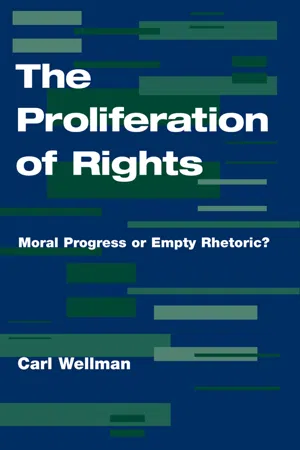
The Proliferation of Rights explores how the assertion of rights has expanded dramatically since World War II. Carl Wellman illuminates for the reader the historical developments in each of the major categories of rights, including human rights, civil rights, women's rights, patient rights, and animal rights. He concludes by assessing where this proliferation has been legitimate and helpful, cases where it has been illusory and unproductive, and alternatives to the appeal to rights.
- 200 pages
- English
- ePUB (mobile friendly)
- Available on iOS & Android
eBook - ePub
About this book
Information
1
Some Critical Questions
Early in the twentieth century, most jurists and moral philosophers assumed that rights and duties were logically correlative. Just as the creditor’s right to be repaid the borrowed sum implies the debtor’s duty to repay the amount borrowed, so a father’s duty to provide for the needs of his child implies the child’s right to financial support from her father. But in 1930, W. D. Ross, a moral philosopher who distinguished radically between the moral rightness of an act and the moral goodness of an action, argued against this assumption by pointing out that we have both moral and legal duties to treat animals humanely. These are duties we owe to the animals, not to our fellow human beings, because they are grounded primarily on our consideration for the feelings of the animals themselves. These duties cannot, however, logically imply any correlative rights of the animals, because we mean by a right something that can be justly claimed, and nonhuman animals are incapable of making any claim to humane treatment from us. As one would expect, this argument was widely accepted in the 1930s as a convincing refutation of the correlation of rights and duties. Almost all philosophers and jurists thought it obvious that animals could be said to have moral rights only in some metaphorical sense.
Today many vegetarians argue that our practice of raising animals merely to gratify our appetite for meat is grossly immoral because slaughtering cattle, sheep, and pigs violates their fundamental moral right to life. Some moral reformers argue seriously that zoos ought not to exist, because confining wild animals in cages or fenced areas violates their moral right to liberty. Environmentalists have even gone so far as to argue that trees and woodlands, such as giant redwoods and virgin forests, can and ought to have legal rights not to be destroyed. These are signs of the times, for during the second half of the twentieth century there has been a vast proliferation of rights.
This recent proliferation of rights is a complex social phenomenon consisting of three interwoven strands. Moral reformers have asserted the existence of a large number of unfamiliar, sometimes strange, moral rights. They normally do not imagine that these are new rights; rather, they take themselves to be describing moral rights that have always existed but have gone unrecognized. Thus the first strand consists in the proliferation of alleged moral rights, rights that may or may not be real. On the other hand, the second strand consists in the proliferation of new legal rights, the creation of real, not merely alleged, rights. The number and variety of legal rights in the United States and in many other countries really have increased rapidly as more and more rights have been introduced by legislation or judicial decision. These two strands have been interwoven in political discourse, for moral reformers often argue for the introduction of some new legal right on the ground that it is required to protect some fundamental moral right. In a similar manner, political conservatives frequently object that the introduction of a new legal right would be a violation of some traditional moral right. Hence, the third strand is the proliferation of the language of rights in political discourse. This book will describe and assess all three strands in the proliferation of rights.
Trouble in Paradise
As this proliferation of rights has spread into more and more areas of modern life, it has produced increasing resistance, both theoretical and political. A few examples may illustrate why so many moral philosophers, jurists, and private citizens find these developments troubling.
Alleged Moral Rights
Article 24 of the United Nations Universal Declaration of Human Rights asserts, “Everyone has the right to rest and leisure, including… periodic holidays with pay.” Although this is an official affirmation by a highly respected international organization, almost everyone has regarded it as suspect. A genuine human right justifies the strongest kind of moral claim, and however much one might desire a paid holiday, holidays with pay are not believed to be something to which every human being has a moral right. By asserting this alleged right, the United Nations has probably encouraged unrealistic expectations and diverted attention from far more urgent and practicable moral claims.
Maurice Cranston, a British political philosopher, has expressed this criticism most emphatically:
A human right is something of which no one may be deprived without a grave affront to justice.… Thus the effect of a Universal Declaration which is overloaded with affirmations of so-called human rights which are not human rights at all is to push all talk of human rights out of the clear realm of the morally compelling into the twilight world of utopian aspirations.1
The most general complaint about the proliferation of moral rights is that this inflation of rights devalues the currency, so that assertions of these merely alleged rights discredit those who claim their genuine moral rights.
Although labor unions have succeeded in obtaining the legal right to strike throughout the United States, in most states it is illegal for workers who are deemed essential, such as teachers in the public schools and firefighters, to strike. Nevertheless, every fall the schools in many cities and towns remain closed for days or even weeks because the teachers are on strike, and occasionally the firefighters in a community will also strike. Teachers and firefighters typically justify their civil disobedience by appealing to their moral right to strike against the unjust terms offered by the school board or the municipal council with which they are negotiating a new contract. Many public officials and private citizens deny that the alleged right of essential workers to strike is real. Such people regard this claim as a purely selfish demand on the part of the teachers and firefighters who refuse to recognize and fulfill their moral responsibilities. Similarly, many moral philosophers argue that because rights are essentially individualistic, the proliferation of moral rights encourages an egoistic pursuit of self-interest and the neglect of social responsibilities.
Legal Rights
The recent proliferation of legal rights strikes many as equally troublesome. Until 1973, it was illegal for a woman to procure an abortion. Then in the landmark case of Roe v. Wade, the United States Supreme Court recognized the legal right of a pregnant woman to have an abortion, at least during the first two trimesters of her pregnancy. Although this new legal right was at first welcomed as a solution to a variety of social problems connected with the birth of unwanted babies—such as the physical and psychological harms, including infertility and death, resulting from large numbers of illegal abortions—many persons have had second thoughts.
The demand for and exercise of this new legal right has caused a backlash that has heightened social conflict and threatens to disrupt law and order in our society. The rhetoric of right-to-life groups has incited some extremists to bomb a number of clinics that provide prenatal medical services and occasionally to murder physicians known to have performed abortions. The absoluteness of legal rights, with their clearly defined contents and ability to override other considerations, has intensified and frozen the conflict between those who insist upon the right of the pregnant woman to have an abortion whenever she so chooses and those who regard abortion as a clear violation of the moral and legal right to life of the unborn child. Thus the introduction of a new legal right has provoked a vehement, often violent, reaction that has prevented any reasonable compromise that might otherwise have constituted an acceptable solution to the social and moral problems posed by undesired pregnancies.
Of course, it may be that the underlying moral dispute is so intractable that no compromise was possible. Still, it is worthy of note that during the years that the Roe case was progressing from trial court upward to the Supreme Court, several state legislatures were introducing the right to therapeutic abortion: abortion to preserve the health of the pregnant woman, to prevent the birth of a seriously defective child, or to terminate a pregnancy resulting from rape or incest. Because this new legal right is more limited than the right to abortion on demand introduced by Roe v. Wade (the right to have an abortion whenever the pregnant woman so chooses for whatever reason, or for no reason at all), some argue that the establishment of this right could have been an acceptable solution to the social problem posed by the most serious unwanted pregnancies.
Another new legal right is equally controversial. A series of decisions in the federal courts from 1977 to 1986 introduced and firmly established in U.S. law the right not to be sexually harassed in the workplace. Few deny that workers are sometimes sexually harassed (typically female employees by male employers or subordinates by supervisors), and most conscientious persons recognize that this is morally wrong. Nevertheless, there is lively debate as to whether the creation of a new legal right is an appropriate remedy for this kind of wrongdoing. When sexual harassment takes a serious form—such as unwelcome physical contact, the threat of force, or the threat of being fired—this new right is usually unnecessary because the female employee can appeal to her existing legal rights against assault and battery under tort law or against sexual discrimination under civil rights law. When sexual harassment takes a less serious form, the best solution is personal negotiation and informal resolution, rather than the intrusion of state regulation and legal enforcement into the interactions of persons within the office or the factory.
To be sure, sexual harassment will often persist in spite of every effort to prevent it by nonlegal means. Still, conferring a legal right not to be sexually harassed upon a female employee is frequently no solution at all. Such an employee often will not be in a position to claim her right, either because she is dependent upon the income she earns from her job (and hence cannot afford to antagonize her employer) or because her employer or supervisor has the power to retaliate should she demand that he cease and desist from sexual harassment. If she has the temerity to claim her legal right, she and her employer or supervisor become adversaries in court; and even if she does not make such a claim, the existence of this legal right transforms them into potential adversaries. In this way, the legal right against sexual harassment perverts what often could and always should be a cooperative and congenial personal relationship in the workplace.
Political Discourse
These two strands in the proliferation of rights, the moral and the legal, go hand in hand, for moral reformers often demand the introduction of some new legal right as necessary in order to protect some alleged moral right. This produces the third strand in the recent proliferation of rights, the expansion of the language of rights in political discourse. More and more social and political debates appeal to alleged moral rights and support the creation of new legal rights. The children’s rights movement, for example, has advocated the introduction of new legal rights against child abuse and has attempted to secure children’s liberties in order to protect the analogous moral rights proclaimed in the UN Declaration of the Rights of the Child (adopted in 1959) and the Convention on the Rights of the Child (adopted in 1989).
Historically the children’s rights movement was born from the development of human rights and the civil rights movement. But many people argue that the rhetoric of rights is inappropriate to the dependent status of children. Colonial peoples, racial minorities, and women in male-dominated societies can sometimes achieve autonomy and equality by claiming their fundamental moral rights against those in power. This achievement is possible because their dependence is imposed upon them arbitrarily by their oppressors, and they already possess the capacities required to exercise their human rights. But the dependence of children upon their parents or guardians is natural, not artificial, and at least young children lack the psychological capacities necessary to exercise or even claim any rights that might be conferred upon them. They must, and typically will, grow out of their dependence as they mature and develop their abilities.
In addition, some moral philosophers argue that the language of rights fails to address the real needs of children. It wrongly assumes that they are already autonomous individuals who can stand on their own feet and claim their rights against their parents. But what children really need is not to be liberated and empowered to live independently as much as to receive loving care and nurture by their parents or guardians. When children or their advocates claim their rights against their parents, this makes them adversaries, undermines what is normally an intimate relationship between them, and destroys the spontaneity that enables their parents to give them the unconditional love and affection they need to develop and maintain the selfesteem essential to becoming competent autonomous adults. As the rhetoric of rights has expanded in political discourse, it has crowded out the different and more relevant voice of the ethic of care. Child neglect and abuse are all too common and grave moral wrongs, but they can be effectively addressed only by defining and insisting upon the moral responsibilities of children’s caregivers. This requires a different language, one that focuses upon personal relationships and upon the unselfish conduct of those responsible for the well-being of children.
The call for changes in the ways we treat animals has also contributed to the proliferation of the language of rights in political discourse. Traditionally many of those most concerned about the mistreatment of nonhuman animals have taken political action through the animal welfare movement. In more recent years, advocates of animal rights have infiltrated this movement, and the language of rights has come to predominate in its political discourse. Many believe this shift in vocabulary is both unnecessary and counterproductive. It is unnecessary because appeals to the welfare of animals have been widely successful in achieving both legal prohibitions against the cruel treatment of domestic animals and the humane regulation of scientific experimentation on all animals. It is counterproductive because it invites comparison with the rights of human beings. The psychological differences between human and nonhuman animals cause many citizens either to doubt that animals have any real moral rights or to discount those rights when they seem to conflict with human rights. In debates about the permissibility of animal experimentation, for example, the comparison of animal with human rights has been effectively exploited in the slogan, “your child or your dog.”
Even worse, the rhetoric of animal rights has proven to be politically dangerous. Its association with radicalism has attracted extremists into what has become the animal rights movement. These extremists have often engaged in violent actions that most animal lovers regard as highly immoral: They have thrown acid upon persons wearing fur coats or jackets, have broken display windows, and have even committed arson in shops selling cosmetics tested upon animals. In England some extremists have gone so far as to attach bombs to the vehicles of scientists who use animals in their medical research. Thus the domination of political discourse by the language of rights is of dubious social value and is perhaps very harmful.
As these three strands in the proliferation of rights continue and even accelerate, jurists, moral philosophers, and citizens debate their theoretical credentials and practical consequences. Are these alleged moral rights genuine or illusory, and in any case, is our increased tendency to claim rights a selfish individualism that damages our most intimate personal relationships and neglects or even denies our social responsibilities? Are these new legal rights solving our urgent social problems and making our legal system more just? Or are they exacerbating the problems we face and, in the process, undermining social cooperation and transforming us into a more and more litigious society? Does the increased use of the language of rights in political rhetoric distort social issues and exclude more useful vocabularies? On the whole, is the recent proliferation of rights moral progress or empty and sometimes dangerous rhetoric? It is to these questions that I will turn in the chapters to follow.
Hohfeld’s Fundamental Legal Conceptions
Before I turn to these questions, however, let me prepare the reader by offering a brief explanation of some expressions used by jurists and moral philosophers. Wesley Newcomb Hohfeld, a jurist who taught in the Yale Law School early in this century, argued that the language of legal rights is confusing and ambiguous because it fails to distinguish between four fundamentally different legal ...
Table of contents
- Cover
- Half Title
- Title
- Copyright
- Contents
- Acknowledgments
- 1 Some Critical Questions
- 2 The Development of Human Rights
- 3 New Civil Rights
- 4 Women’s Rights and Feminist Theory
- 5 Animal Rights and Environmental Ethics
- 6 New Medical Rights
- 7 An Appraisal
- Index
Trusted by 375,005 students
Access to over 1.5 million titles for a fair monthly price.
Study more efficiently using our study tools.
Frequently asked questions
Yes, you can cancel anytime from the Subscription tab in your account settings on the Perlego website. Your subscription will stay active until the end of your current billing period. Learn how to cancel your subscription
No, books cannot be downloaded as external files, such as PDFs, for use outside of Perlego. However, you can download books within the Perlego app for offline reading on mobile or tablet. Learn how to download books offline
Perlego offers two plans: Essential and Complete
- Essential is ideal for learners and professionals who enjoy exploring a wide range of subjects. Access the Essential Library with 800,000+ trusted titles and best-sellers across business, personal growth, and the humanities. Includes unlimited reading time and Standard Read Aloud voice.
- Complete: Perfect for advanced learners and researchers needing full, unrestricted access. Unlock 1.5M+ books across hundreds of subjects, including academic and specialized titles. The Complete Plan also includes advanced features like Premium Read Aloud and Research Assistant.
We are an online textbook subscription service, where you can get access to an entire online library for less than the price of a single book per month. With over 1.5 million books across 990+ topics, we’ve got you covered! Learn about our mission
Look out for the read-aloud symbol on your next book to see if you can listen to it. The read-aloud tool reads text aloud for you, highlighting the text as it is being read. You can pause it, speed it up and slow it down. Learn more about Read Aloud
Yes! You can use the Perlego app on both iOS and Android devices to read anytime, anywhere — even offline. Perfect for commutes or when you’re on the go.
Please note we cannot support devices running on iOS 13 and Android 7 or earlier. Learn more about using the app
Please note we cannot support devices running on iOS 13 and Android 7 or earlier. Learn more about using the app
Yes, you can access The Proliferation Of Rights by Carl Wellman in PDF and/or ePUB format, as well as other popular books in Philosophy & Ethics & Moral Philosophy. We have over 1.5 million books available in our catalogue for you to explore.