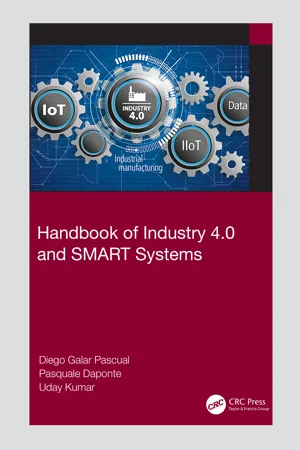
Industry 4.0 refers to fourth generation of industrial activity characterized by smart systems and internet-based solutions. This book describes the fourth revolution based on instrumented, interconnected and intelligent assets. The different book chapters provide a perspective on technologies and methodologies developed and deployed leading to this concept. With an aim to increase performance, productivity and flexibility, major application area of maintenance through smart system has been discussed in detail. Applicability of 4.0 in transportation, energy and infrastructure is explored, with effects on technology, organisation and operations from a systems perspective.
eBook - ePub
Handbook of Industry 4.0 and SMART Systems
- 374 pages
- English
- ePUB (mobile friendly)
- Available on iOS & Android
eBook - ePub
Handbook of Industry 4.0 and SMART Systems
About this book
Information
1
Fundamentals of Industry 4.0
CONTENTS
1.1 Introduction
1.2 Industry 4.0
1.2.1 Definition of Industry 4.0
1.2.2 What Is Industry 4.0?
1.2.2.1 Industry 4.0—What Is It?
1.2.2.2 Talking about a Revolution: What Is New in Industry 4.0?
1.2.2.3 On the Path to Industry 4.0: What Needs to Be Done?
1.2.3 Key Paradigm of Industry 4.0
1.2.4 Industry 4.0 Conception
1.2.4.1 Five Main Components of Networked Production
1.2.5 Framework of Industry 4.0: Conception and Technologies
1.2.6 Nine Pillars of Technological Advancement
1.2.6.1 Big Data and Analytics
1.2.6.2 Autonomous Robots
1.2.6.3 Simulation
1.2.6.4 Horizontal and Vertical System Integration
1.2.6.5 Industrial IoT
1.2.6.6 Cybersecurity
1.2.6.7 The Cloud
1.2.6.8 Additive Manufacturing
1.2.6.9 Augmented Reality
1.2.7 Macro Perspective of Industry 4.0
1.2.8 Micro Perspective of Industry 4.0
1.2.9 Industry 4.0 Components
1.2.9.1 Cyber-Physical Systems (CPS)
1.2.9.2 Internet of Things
1.2.9.3 Internet of Services
1.2.9.4 Smart Factories
1.2.10 Industry 4.0: Design Principles
1.2.10.1 Interoperability
1.2.10.2 Virtualization
1.2.10.3 Decentralization
1.2.10.4 Real-Time Capability
1.2.10.5 Service Orientation
1.2.10.6 Modularity
1.2.11 Impact of Industry 4.0
1.2.11.1 Quantifying the Impact: Germany as an Example
1.2.11.2 Producers: Transforming Production Processes and Systems
1.2.11.3 Manufacturing-System Suppliers: Meeting New Demands and Defining New Standards
1.2.12 The Way Forward
1.2.12.1 Producers Must Set Priorities and Upgrade the Workforce
1.2.12.2 Manufacturing-System Suppliers Must Leverage Technologies
1.2.12.3 Infrastructure and Education Must Be Adapted
1.3 RAMI 4.0 (Reference Architecture Model Industry 4.0)
1.3.1 RAMI 4.0
1.3.2 Additional Details of RAMI 4.0
1.3.2.1 Function of Layers on Vertical Axis
1.3.2.2 Function of Layers on the Horizontal Left Axis
1.3.2.3 Hierarchical System Architecture in Industry 4.0
1.3.3 Industry 4.0 Component Model
1.3.3.1 Specification of the Industry 4.0 Component Model
1.4 Servitization
1.4.1 The Concept of Servitization
1.4.2 Defining Servitization
1.4.2.1 Drivers of Servitization
1.4.3 Features of Servitization
1.4.4 Current State of Servitization and Impacts from Industry 4.0
1.4.5 Industry 4.0 Services
1.4.5.1 Industry 4.0 Servitization Framework
1.5 Product Service-System (PSS)
1.5.1 Definition of a PSS
1.5.2 Features of a PSS
1.5.2.1 Product-Oriented PSS (PoPSS)
1.5.2.2 Use-Oriented PSS (UoPSS)
1.5.2.3 Result-Oriented PSS (RoPSS)
1.5.3 Why PSS?
1.5.3.1 Environmental Rationales
1.5.3.2 Economic Rationales
1.5.3.3 Customer-Driven Rationales
1.5.3.4 Technological Drivers
References
LIST OF FIGURES
Figure 1.1 Main technologies of Industry 4.0
Figure 1.2 Nine advances transforming industrial production
Figure 1.3 Industry 4.0 is changing traditional manufacturing relationships
Figure 1.4 Macro perspective of Industry 4.0
Figure 1.5 Micro perspective of Industry 4.0
Figure 1.6 In Germany, Industry 4.0 will generate significant productivity gains
Figure 1.7 In Germany, Industry 4.0 will lead to increased manufacturing employment
Figure 1.8 RAMI 4.0 model
Figure 1.9 New control pyramid of RAMI 4.0
Figure 1.10 Industry 4.0 component model
Figure 1.11 Industry 4.0 component
Figure 1.12 Repository of the digital factory
Figure 1.13 I4 servitization framework
Figure 1.14 Evolution of the product-service system concept
Figure 1.15 (a) Traditional purchase of photocopier; (b) purchase of a document management capability
Figure 1.16 Product-service systems
Figure 1.17 PSS exemplification
Figure 1.18 Smiling curve in a servitization perspective
LIST OF TABLES
Table 1.1 Trends and expected developments in value creation factors
Table 1.2 Design principles of each industry 4.0 component
Table 1.3 Servitization definitions
Table 1.4 Popular definitions of a product-service system
1.1 Introduction
Industry 4.0 is one of the most frequently discussed topics among practitioners and academics today. For example, the German federal government announced Industry 4.0 as one of the key initiatives of its high-tech strategy in 2011 (Kagermann et al., 2013). Since then, numerous academic publications, practical articles and conferences have focused on the topic (Hermann et al., 2015).
The fascination for Industry 4.0 is twofold. First, for the first time, an industrial revolution has been predicted a priori, not observed ex-post (Drath, 2014). This provides opportunities for companies and research institutes to actively shape the future. Second, the economic impact of this industrial revolution is supposed to be huge, as Industry 4.0 promises substantially increased operational effectiveness as well as the development of entirely new business models, services and products (Kagermann et al., 2013; Kagermann et al., 2014; Kempf et al., 2014). A recent study has estimated that these benefits will have contributed as much as 78 billion euros to the German GDP by the year 2025 (Bauer et al., 2014). Germany will not be the sole country to profit; similar benefits are expected throughout the world.
With Industry 4.0 becoming a top priority for many research centers, universities and companies within the past three years, the manifold contributions from academics and practitioners have made the meaning of the term more blurry than concrete (Bauernhansl et al., 2014). Even the key promoters of the idea, the “Industry 4.0 Working Group” and the “Plattform Industry 4.0,” only describe the vision, the basic technologies the idea aims at and selected scenarios (Kagermann et al., 2013). They do not provide a clear definition. As a result, a generally accepted definition of Industry 4.0 has not been published to date (Bauer et al., 2014).
According to Jasperneite et al. (2012), scientific research is always impeded if clear definitions are lacking, as any theoretical study requires a sound conceptual and terminological foundation. Companies also face difficulties when trying to develop ideas or take action, but are not sure what exactly for. “Even though Industry 4.0 is one of the most frequently discussed topics these days, I could not explain to my son what it really means,” a production site manager with automotive manufacturer Audi puts it. This comment reflects the finding of a recent study that “most companies in Germany do not have a clear understanding of what Industry 4.0 is and what it will look like” (eco—Verband der deutschen Internetwirschaft, 2014).
As the term is unclear, companies are struggling when it comes to identifying and implementing Industry 4.0 scenarios. Design principles explicitly address this issue by providing a “systemization of knowledge” (Gregor et al., 2009) and describing the constituents of a phenomenon. In this way, design principles support practitioners by developing appropriate solutions. From an academic perspective, design principles are the foundation of design theory (Gregor et al., 2002). However, we could not find any explicit Industry 4.0 design principles during our search of the literature (Hermann et al., 2015).
This chapter aims to fill this gap in the research. Based on a literature review, it provides a definition of Industry 4.0 and identifies six design principles that companies should consider when implementing Industry 4.0 solutions (Hermann et al., 2015).
1.2 Industry 4.0
The term “Industry 4.0” is used for the industrial revolution taking place currently. This industrial revolution has been preceded by three other industrial revolutions. The first was the introduction of mechanical production facilities starting in the second half of the eighteenth century; this intensified throughout the nineteenth century. The introduction of electricity and the division of labor (i.e., Taylorism) in the 1870s led to the second industrial revolution. The third industrial revolution, also called “the digital revolution,” started in the 1970s, when advanced electronics and information technology (IT) developed the automation of production processes (Hermann et al., 2015).
The term “Industry 4.0” was introduced in Germany in 2011, when an association of representatives from business, politics and academia promoted the idea as an approach to strengthening the competitiveness of the manufacturing industry (Kagermann et al., 2011). The German federal government supported the idea by announcing that Industry 4.0 would be an integral part of its “High-Tech Strategy 2020 for Germany” initiative, aimed at technological innovation leadership. The subsequently formed “Industry 4.0 Working Group” developed recommendations for implementation; these were published in April 2013 (Kagermann et al., 2013). In this publication, Kagermann et al. (2013) describe their vision of Industry 4.0 as follows.
In the future, businesses will establish global networks that incorporate their machinery, warehousing systems and production facilities in the shape of cyber-physical systems (CPS). In the manufacturing environment, these CPS comprise smart machines, storage systems and production facilities capable of autonomously exchanging information, triggering actions and controlling each other independently. This facilitates fundamental improvements to the industrial processes involved in manufacturing, engineering, material usage and supply chain and life cycle management. The smart factories that are already beginning to appear employ a completely new approach to production. Smart products are uniquely identifiable, may be located at all times and know their own history, current status and alternative routes to achieving their target state. The embedded manufacturing systems are vertically networked with business processes within factories and enterprises and horizontally connected to dispersed value networks that can be managed in real time—from the moment an order is placed right through to outbound logistics. In addition, they both enable and require end-to-end engineering across the entire value chain (Kagermann et al., 2013).
These ideas built the foundation for the Industry 4.0 manifesto published in 2013 by the German National Academy of Science and Engineering (Acatech, 2013).
The term is currently used globally. At the European level, the public–private partnership for Factories of the Future (FoF) addresses and develops Industry 4.0-related topics (European Com...
Table of contents
- Cover
- Half Title
- Title Page
- Copyright Page
- Table of Contents
- Preface
- Authors
- 1. Fundamentals of Industry 4.0
- 2. SMARTness and Pervasive Computing
- 3. The Industry 4.0 Architecture and Cyber-Physical Systems
- 4. Cloud Computing, Data Sources and Data Centers
- 5. Big Data Analytics as Service Provider
- 6. IoT and the Need for Data Rationalization
- 7. OPERATOR 4.0
- 8. Cybersecurity and Risk
- 9. Industry 4.0 across the Sectors
- Index
Trusted by 375,005 students
Access to over 1.5 million titles for a fair monthly price.
Study more efficiently using our study tools.
Frequently asked questions
Yes, you can cancel anytime from the Subscription tab in your account settings on the Perlego website. Your subscription will stay active until the end of your current billing period. Learn how to cancel your subscription
No, books cannot be downloaded as external files, such as PDFs, for use outside of Perlego. However, you can download books within the Perlego app for offline reading on mobile or tablet. Learn how to download books offline
Perlego offers two plans: Essential and Complete
- Essential is ideal for learners and professionals who enjoy exploring a wide range of subjects. Access the Essential Library with 800,000+ trusted titles and best-sellers across business, personal growth, and the humanities. Includes unlimited reading time and Standard Read Aloud voice.
- Complete: Perfect for advanced learners and researchers needing full, unrestricted access. Unlock 1.5M+ books across hundreds of subjects, including academic and specialized titles. The Complete Plan also includes advanced features like Premium Read Aloud and Research Assistant.
We are an online textbook subscription service, where you can get access to an entire online library for less than the price of a single book per month. With over 1.5 million books across 990+ topics, we’ve got you covered! Learn about our mission
Look out for the read-aloud symbol on your next book to see if you can listen to it. The read-aloud tool reads text aloud for you, highlighting the text as it is being read. You can pause it, speed it up and slow it down. Learn more about Read Aloud
Yes! You can use the Perlego app on both iOS and Android devices to read anytime, anywhere — even offline. Perfect for commutes or when you’re on the go.
Please note we cannot support devices running on iOS 13 and Android 7 or earlier. Learn more about using the app
Please note we cannot support devices running on iOS 13 and Android 7 or earlier. Learn more about using the app
Yes, you can access Handbook of Industry 4.0 and SMART Systems by Diego Galar Pascual,Pasquale Daponte,Uday Kumar in PDF and/or ePUB format, as well as other popular books in Technology & Engineering & Operations. We have over 1.5 million books available in our catalogue for you to explore.