- 264 pages
- English
- ePUB (mobile friendly)
- Available on iOS & Android
eBook - ePub
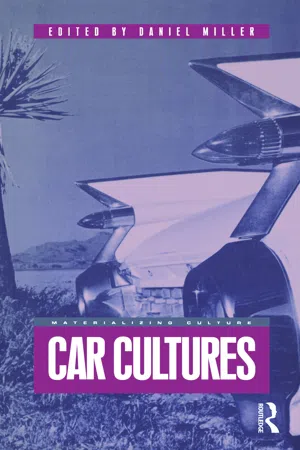
Car Cultures
About this book
Anyone who assumes that a car is simply a means to get from point A to point B, or who even thinks that they know what a car is, should read this book. Profoundly shaped by culture, the car gives rise to a wide range of emotions, from guilt about the environment in the UK to aboriginal concerns with car corpses, to struggles to keep the creatures alive with everything but the proper spare parts in West Africa. Cars and their landscapes prove central to human life from its most intimate to the widest sense of global crisis, and are capable of inspiring epic passions. From road rage in Western Europe to the struggles of cab driving in Africa to the emergence of Black identity in the US, this book examines the essential humanity of the car, which includes the jealousies, gender differences, fears and moralities that cars give rise to. Firmly grounded in detailed ethnographic and historical scholarship, this is the first book to provide an informed sense of cars as one of the most familiar and significant forms of material culture.
Information
one
Driven Societies
The Humanity of the Car
When I used to accompany my daughter to her school bus I often made up stories to amuse her as we walked. One was a description of the earth and its inhabitants as told by an alien examining us from a space ship above London. This alien had observed that the earth is inhabited by strange creatures called cars mainly with four wheels although some are great beasts with twelve wheels and some little creatures with only two. These creatures are served by a host of slaves who walk on legs and spend their whole lives serving them. The slaves constantly ensure that the cars are fed their liquid foods whenever they are thirsty and are cured if they have accidents: but the slaves also help in the reproduction and disposal of cars. The slaves are deposited in boxes set up almost everywhere a car wants to go and are always ready to be taken away as soon as the car makes up its mind to go somewhere else. Cars were never seen to go anywhere without at least one slave. The slaves build and maintain long and complex networks of clear space so that cars have little trouble travelling from place to place. Indeed the earth’s creatures seems constantly pampered by their fawning army of slaves.
My point is that I can’t think of any other object for which such a story could sound half so convincing. We may not be enthralled to cars, but the relationship of much of humanity to the world became increasingly mediated in the course of the last century by a single machine – the car. To such an extent that it is the car and its associated infrastructure rather more than the human that seems to dominate the landscape seen from the sky. Certainly there are many environ-mentalists who would be entirely happy with this perspectival conceit. For them, but also in both colloquial and journalistic accounts, one does have a sense of the car as the sign of our alienation, in particular, from something which by opposition is seen as nature. The car is the villain that has separated us from the world and threatens to take over as we come to serve it more than it serves us.
Yet what this book will demonstrate is just how simplistic a concept such as ‘alienation’ appears to be when set against a relationship to cars which is not just contradictory but convoluted in the extreme. In this introduction I want to defend an approach which will remain critical but by starting from the opposite extreme. Perhaps for the first time this is a book that seeks to reveal and consider the evident humanity of the car. This should not be taken as some mark of adulation or defence of the car. To take seriously the humanity of the car must imply a perspective that examines the car as a vehicle for class, oppression, racism and violence, all evident products of our humanity. The car’s humanity lies not just in what people are able to achieve through it, nor yet in its role as a tool of destruction, but in the degree to which it has become an integral part of the cultural environment within which we see ourselves as human. This includes both senses of the word – humanity as an expression signifying the totality of all people and humanity as a term that touches the specific and inalienable individuality of any particular person. The car today is associated with the aggregate of vast systems of transport and roadways that make the car’s environment our environment, and yet at the same time there are the highly personal and intimate relationships which individuals have found through their possession and use of cars.
The title ‘car cultures’ is in turn intended to evoke the diverse, unexpected, sometimes tragic, contradictory humanity of cars; the taken-for-granted mundane that hides the extraordinary found in this material expression of cultural life. Indeed for all their freedom of imagination and resources the vast amount of television advertising which attempts to aestheticize the car within wondrous terrains of visual imagination tend to look bland and tedious against the fascination of what the observers who contribute to this book can document as the car’s use in objectifying personal and social systems of value.
To speak of the humanity of cars is merely to foreground the proper difficulty of confining that concept to any simple definition. My foot could as easily be analysed as a technical construction of bone and flesh that provides me with means of mobility, as it could be seen as integral to my humanity. Quite often it rests on the pedal of a car, which in turn could be viewed as a mechanical achievement of metal and plastic that in turn gives me new means of mobility. But it is not so much of an extension beyond my foot, either physically or conceptually, for us to consider its humanity. Both foot and car are the basis of extensive entailments; both evoke the agency that mobilizes them, and the networks of relationships that walking and driving permit. Both have metaphorical and idiomatic reach. The foot is hopefully more permanent, the car more amenable to personalization and social appropriation (that is to say I suspect a whole lot more people think of their cars than of their feet as ‘a kind of’ person). But both fit that felicitous term ‘second-nature’ the habituated extension of ourselves that feels like nature in requiring no conscious mediation in their daily employment. Their humanity lies above all in the degree to which so many of us are socialized to take them for granted, so that we think our world through a sense of the self in which driving, roads, and traffic are simply integral to who we are and what we presume to do each day.
Nevertheless the mere idea of the car having humanity is not something that is easily accepted; indeed many readers may be revolted at the suggestion. For this reason Chapter Two by Diana Young, on the Pitjantjatjara of Australia, provides the ideal starting point for the wider intentions of this volume. It seems from the evidence she presents that it would be just as unnatural for these people to deny this manifest humanity to the car as it would seem unnatural for most people in Britain to acknowledge such a thing. In a very short period this Aboriginal society has assimilated the car into their material culture, so that today it is hard to hold a sacred ceremony without the car screening this from intrusive viewers, or to mark one’s sacred sites without the car as the means to visit them. They follow and interpret the tracks made by cars in the landscape and they navigate cars through their sense of cardinal directions in ways that non-Aboriginal people are quite incapable of doing. In short the use of the car to facilitate one’s phenomenological and cosmological relationship to the environment does not detract from that relationship which remains just as fundamental to Aboriginal life. The car has become more a means to resist alienation than a sign of alienation. Its materiality is no more of a problem than the materiality of the landscape itself which an extensive literature has documented to be foundational to Aboriginal societies.
This is why in Young’s chapter, as also in Chapter Seven by Jojada Verrips and Birgit Meyer, a core problem is the car as a living and a dead being. The humanity of the car is expressed in the detailed issues raised by making the corpse of a car in some ways both analogous and symbolic of the human, and especially of a previous owner. The problem being that the dead carcass of the car, unlike other objects, is not so easily swallowed up by the soft sands of the Australian desert. In a similar fashion Verrips and Meyer reveal how many people’s lives in Ghana are spent in the struggle to bring cars back to life, because a dead car is a threat to their ability to earn a ‘living’. It is not surprising that there is a resonance with Christian concepts of miraculous resurrections such that a car mechanic needs spiritual as much as technical proficiency to keep a car on the road.
In Chapter Three, Mike Michael rests much of his argument on the problems that face us when we fail to acknowledge the integrity of such human–machine relationships. When our resolute dualism that separates off the humanity of people by contrasting it with the object nature of the inanimate prevents us from appreciating the hybridity of discourse and practice. The central point that emerges from his discussion of road rage is that the problems that arise from current discourses about such behaviour are exacerbated to the degree to which we oppose ourselves to the car and refuse to acknowledge its role in the formation and manifestation of such behaviour. Accounts of road rage are purified into two separate components – human behaviour and the technical effects of cars. By contrast a sense of hybridity allows us both to acknowledge and come to a more profound understanding of such genres as road rage. Road rage as discourse and practice can only be confronted from the depth of our now inseparable relationship with the machine in which we are socialized and through which we carry out our daily lives.
Those two chapters also constitute a helpful introduction to this volume in that they respectively represent two literatures within which it makes sense to treat the car from this perspective; a perspective which transcends an opposition of subjects and objects. Young is writing from the tradition of anthropological studies of material culture, in which the refusal of this dualism has been a foundational component of the discipline at least since the time of Mauss’s (1966) influential work The Gift, where the basis of human sociality was seen as founded in the exchange of the humanity objectified in the objects given as gifts but also through his studies of technology and the cultural construction of the environment (Mauss 1979). This is a tradition that was fostered more recently by the work of Bourdieu and other theories of practice, and in the specific sub-discipline of material culture studies as exemplified in the Journal of Material Culture.
By contrast Michael is writing from within a strictly sociological trajectory which until recently had less interest in the specific issue of materiality, but which in the last few years has emerged into this particular light through the influence of science studies and most particularly the work of Latour. Latour’s (e.g. 1993 and 1999) enormously influential critique of the dualism of science and nature has been extended through topics such as actor network theory, and work on monsters and hybrids to more generally challenge the distinction between persons and objects or between society and materiality. As a result although Young’s paper is based on the classic anthropological techniques of ethnography and empathy with Aboriginal cosmology and social relations, while Michael’s is an extended analysis of discourse and ideology that could in turn be described as classic sociological methodology, the final conclusions of both papers with respect to developing a new perspective on the car are very similar. Neither permits what may appear to be a common-sense separation of the car from a social or human context. Instead both offer an acknowledgement of a world of practice and discourse in which we can talk in terms of car cultures.
After establishing the humanity of the car as a starting point I will now address three approaches to studying car cultures. The first summarizes the dominant genres in which the car used to be presented to us in history and social science and considers the limitations of those genres. The second is a recent literature that is characterized as focusing on the problem of externalities, and the benefits and lacunae in that approach. Finally the chapters of this volume are considered as a series of studies of entailments, which complement and extend previous approaches to the study of cars.
Speeding Towards the Wrong Conclusions
In surveying the extant literature on the car within the social sciences and humanities (as against the more technical concerns of literatures such as transport studies which will not be addressed in this volume), I will adopt a critical tone. There certainly exist exemplary studies of the car (Brilliant 1989; Moorehouse 1991; Sachs 1984, to name but a few) but in a survey of the literature there soon emerges a sense of a dominant genre. This comprises two main tendencies. The first is a presentation of the history of car production and design which is understood largely in terms of the roles of major personalities and events. The second element is a presentation of the consequences of the car mainly in terms of aggregate statistics or universalizing traits. These seem to have developed largely in the absence of any sub-discipline concerned with the car per se, so that the car appears most often as a case-study within the history of industrial production, design history and environmentalist critiques. By contrast, the mainstream disciplines that might have addressed what has been introduced here as the humanity of the car – that is, anthropology or sociology – have neglected the topic to a quite extraordinary degree, especially when compared to other examples of material culture such as food, clothing and the house. It would be very hard to exaggerate the disparity between the voluminous literature on those three topics and the lack of any comparable consideration of the car. There would be dozens of books equivalent to this volume already available for any one of those other objects.
The dominant genre tends to emphasize core events and persons. Most books start with the ‘birth’ of the car, the choice of which varies considerably from the steam-powered vehicle tried out in Britain in 1801 or the French combustion engine mounted on a coach in 1886 by Daimler (Wolf 1996: 67). But the key figure in the history of car production is always Henry Ford. We are informed of various crucial dates between 1 October 1908 when the first Model T went on the market for 825 dollars (Nadis and MacKenzie 1993: 3) and 1927 when the last of 15 million Model Ts rolled off the assembly line at a mere 290 dollars (Fink 1975: 67). Ford is seen as responsible for the US dominance in car production and ownership such that by 1930 there was 1 car for every 1.3 households (Nadis and MacKenzie 1993), although as O’Connell (1998) points out another factor was that the US had longer distances and lesser coverage by railways than for example the UK.
Given the generally anti-car tone of most recent writings, apart from being told how undemocratic Ford was (and the irony of the evidence that he was better known in the Soviet Union than Stalin in 1927 (Fink 1975: 71)), the other figure that is regarded as of equivalent influence in Europe is Hitler, who is credited with developing the modern auto-bahn system in Germany and promoting a Volkeswagen in emulation of the Model T in the US, though obviously at a later date. For the middle period of the century attention tends to turn to the history of car design and major figures such as Sloane or Harley Earle who influenced the development of companies such as Ford and General Motors (e.g. Gartman 1994) and shaped what became the dominant genre of car styling. Relatively little consideration is given to more recent events, such as the rise of the Japanese car industry, outside of the more technical and business literature where this is the focus of many studies.
Most of the recent texts move from these events in the history of car production to a flood of anti-car statistics for the present. For example, we learn that in the UK ‘the initial production of every car involves 25 tonnes of waste (Graves Brown 97 25), that 11 million cars are retired annually in the US, and 240 million tyres junked each year (Nadis and MacKenzie 1993), creating 2 million tonnes of toxic waste. That in 1990, 420,000 people were killed and 9 million were injured globally as a result of car use (Whitelegg 1997) and that between 1960 and 1994 around 5 million people lost their lives in road accidents (for other examples see Davis 1992/3, Holtz Kay 1997, Whitelock 1971, Wolf 1996). These literatures on the history of car as a symbol of production and the current evidence for the car as a symbol of destruction along with a technical literature on areas such as transport systems, dwarf other writings about the car.
Occasionally the rather relentless tone of these trajectories is relieved by asides. These take two forms. One demonstrates the degree to which car-associated problems may have arisen prior to the car. We may think of our road system as a system for cars, but much of it existed prior to the existence of the car. For example there are several authors who note the huge increase in the extent and number of roadways in US cities at the turn of the century and the effects of horses on congestion. McShane (1994: 49) cites a gruesome practice of lighting fires under horses stomachs to get them to pull heavy loads, and Flink (1975: 34) records that ‘In New York City alone at the turn of the century, horses deposited an estimated 2.5 million pounds of manure and 60,000 gallons of urine on the streets every day. Traffic was often clogged by the carcasses of overworked dray horses who dropped in their tracks during summer heat waves or were destroyed after stumbling on slippery pavements and breaking their legs. On the average, New York City removed 15,000 dead horses from its streets each year’. The other asides take ...
Table of contents
- Cover
- Half Title
- Series Page
- Title Page
- Copyright Page
- Dedication Page
- Contents
- Acknowledgments
- List of Illustrations
- Notes on Contributors
- 1 Driven Societies
- 2 The Life and Death of Cars: Private Vehicles on the Pitjanjatjara Lands, South Australia
- 3 The Invisible Car: The Cultural Purification of Road Rage
- 4 Driving While Black
- 5 Raggare and the Panic of Mobility: Modernity and Hybridity in Sweden
- 6 Driving, Drinking and Daring in Norway
- 7 Kwaku’s Car: The Struggles and Stories of a Ghanaian Long-Distance Taxi-Driver
- 8 Soundscapes of the Car: A Critical Ethnography of Automobile Habitation
- 9 Negotiating Car Use in Everyday Life
- 10 The Colonizing Vehicle
- Index
Trusted by 375,005 students
Access to over 1.5 million titles for a fair monthly price.
Study more efficiently using our study tools.
Frequently asked questions
Yes, you can cancel anytime from the Subscription tab in your account settings on the Perlego website. Your subscription will stay active until the end of your current billing period. Learn how to cancel your subscription
No, books cannot be downloaded as external files, such as PDFs, for use outside of Perlego. However, you can download books within the Perlego app for offline reading on mobile or tablet. Learn how to download books offline
Perlego offers two plans: Essential and Complete
- Essential is ideal for learners and professionals who enjoy exploring a wide range of subjects. Access the Essential Library with 800,000+ trusted titles and best-sellers across business, personal growth, and the humanities. Includes unlimited reading time and Standard Read Aloud voice.
- Complete: Perfect for advanced learners and researchers needing full, unrestricted access. Unlock 1.5M+ books across hundreds of subjects, including academic and specialized titles. The Complete Plan also includes advanced features like Premium Read Aloud and Research Assistant.
We are an online textbook subscription service, where you can get access to an entire online library for less than the price of a single book per month. With over 1.5 million books across 990+ topics, we’ve got you covered! Learn about our mission
Look out for the read-aloud symbol on your next book to see if you can listen to it. The read-aloud tool reads text aloud for you, highlighting the text as it is being read. You can pause it, speed it up and slow it down. Learn more about Read Aloud
Yes! You can use the Perlego app on both iOS and Android devices to read anytime, anywhere — even offline. Perfect for commutes or when you’re on the go.
Please note we cannot support devices running on iOS 13 and Android 7 or earlier. Learn more about using the app
Please note we cannot support devices running on iOS 13 and Android 7 or earlier. Learn more about using the app
Yes, you can access Car Cultures by Daniel Miller in PDF and/or ePUB format, as well as other popular books in Social Sciences & Anthropology. We have over 1.5 million books available in our catalogue for you to explore.