Fibres to Smart Textiles
eBook - ePub

Fibres to Smart Textiles

Advances in Manufacturing, Technologies, and Applications

  1. 390 pages
  2. English
  3. ePUB (mobile friendly)
  4. Available on iOS & Android
eBook - ePub

Fibres to Smart Textiles

Advances in Manufacturing, Technologies, and Applications

About this book

Fibres to Smart Textiles: Advances in Manufacturing, Technologies, and Applications offers comprehensive coverage of the fundamentals and advances in the textile and clothing manufacturing sectors. It describes the basics of fibres, yarns, and fabrics and their end use in the latest developments and applications in the field and addresses environmental impacts from textile processes and how to minimize them.

This book serves as a single comprehensive source discussing textile fibres, yarn formation, filament formation techniques, woven fabric formation, knitting technologies, nonwoven manufacturing technologies, braiding technologies, and dyeing, printing, and finishing processes. Testing of textile materials, environmental impacts of textile processes and use of CAD and CAM in designing textile products are also included. The book also discusses applications including textile composites and biocomposites, technical textiles, smart textiles, and nanotextiles.

With chapters authored by textile experts, this practical book offers guidance to professionals in textile and clothing manufacturing and shows how to avoid potential pitfalls in product development.
Frequently asked questions

Yes, you can cancel anytime from the Subscription tab in your account settings on the Perlego website. Your subscription will stay active until the end of your current billing period. Learn how to cancel your subscription.
No, books cannot be downloaded as external files, such as PDFs, for use outside of Perlego. However, you can download books within the Perlego app for offline reading on mobile or tablet. Learn more here.
Perlego offers two plans: Essential and Complete
  • Essential is ideal for learners and professionals who enjoy exploring a wide range of subjects. Access the Essential Library with 800,000+ trusted titles and best-sellers across business, personal growth, and the humanities. Includes unlimited reading time and Standard Read Aloud voice.
  • Complete: Perfect for advanced learners and researchers needing full, unrestricted access. Unlock 1.4M+ books across hundreds of subjects, including academic and specialized titles. The Complete Plan also includes advanced features like Premium Read Aloud and Research Assistant.
Both plans are available with monthly, semester, or annual billing cycles.
We are an online textbook subscription service, where you can get access to an entire online library for less than the price of a single book per month. With over 1 million books across 1000+ topics, we’ve got you covered! Learn more here.
Look out for the read-aloud symbol on your next book to see if you can listen to it. The read-aloud tool reads text aloud for you, highlighting the text as it is being read. You can pause it, speed it up and slow it down. Learn more here.
Yes! You can use the Perlego app on both iOS or Android devices to read anytime, anywhere — even offline. Perfect for commutes or when you’re on the go.
Please note we cannot support devices running on iOS 13 and Android 7 or earlier. Learn more about using the app.
Yes, you can access Fibres to Smart Textiles by Asis Patnaik, Sweta Patnaik, Asis Patnaik,Sweta Patnaik in PDF and/or ePUB format, as well as other popular books in Technology & Engineering & Chemical & Biochemical Engineering. We have over one million books available in our catalogue for you to explore.

1

Textile Fibres and Recent Developments

Doice Moyo and Asis Patnaik
Cape Peninsula University of Technology

CONTENTS

1.1Introduction
1.2Fibre Classes
1.2.1Classification Based on the Length of Fibres
1.2.2Classification Based on the Origin and Source of Fibres
1.3Natural Fibres
1.3.1Plant Fibres
1.3.1.1Cotton
1.3.1.2Other Cellulosic Fibres
1.3.2Animal Fibres
1.3.2.1Wool
1.3.2.2Silk Fibres
1.3.3Mineral Fibres (Ceramics and Basalt)
1.3.3.1Ceramic Fibres
1.3.3.2Basalt Fibres
1.4Man-Made Fibres
1.4.1Rayon
1.4.2Cellulose Acetate
1.4.3Alginate
1.4.4Synthetic Fibres
1.4.4.1Nylon
1.4.4.2Polyester
1.4.4.3Polyolefins
1.4.4.4Elastomeric Fibres
1.4.5High-Performance Fibres
1.4.5.1CeraTex® Ceramic Fibres
1.5Fibre Morphological Structures, Physics and Properties
1.6Recent Developments
1.6.1Regenerated Silk Fibres
1.6.2Shape Memory Materials
1.6.3Cell Solution® Polymer
1.6.4Ultra-High Molecular Weight PE
1.6.5Alumina Silica
1.6.6Microsupreme® Fibres
1.6.7Bemberg Microporous Membrane
1.6.8OASIS Fibres
1.6.9TEIJIN CONEX Fibres
1.6.10Aoshen Spandex
1.6.11Japan KBS Belltron Fibres
1.6.12Total Heat® Fibres
1.6.13Graphene Nylon Fibres
1.6.14Copper Nylon Fibres
1.6.15Coffee Ground Nylon Fibres
1.6.16Thincell Fibres
1.6.17Lyocell Bamboo Fibres
1.7Summary and Conclusion
References

1.1INTRODUCTION

A textile fibre can be defined as a tiny hair-like material having a length that is hundred times larger than its thickness (or diameter). The dimensions where the length is relatively larger than the thickness are critical for fibre characteristics such as flexibility and fineness (Denton and Daniels 2002). Textile fibres are the most important element of any textile material, and these fibres contribute significantly to the macro properties of the material. There are different types of fibres that are used in the textile and clothing industries, and consequently, their selection is critical for specific engineering applications and performance requirements. Textile fibres are spun into yarns, and these yarns are subsequently used in weaving, knitting and braiding techniques. Other textile products are made directly from fibres, such as non-woven, without passing through the route of spinning. The desired textile product functionality can be achieved with a good understanding of the physical, mechanical, chemical and performance properties of the constituent fibres. There are plenty of ongoing research and development on fibres in many different countries to meet the increasing demand of textile products (Fangueiro and Rana 2016). This chapter discusses different fibre classes, namely the natural, man-made and inorganic fibres that are commonly used in the textile industry. Furthermore, the chapter provides valuable resource information on the latest developments in textile fibre science. New fibres are presented, and their specialized application areas discussed. This chapter discusses the current list of textile fibres, their physical, mechanical, chemical and performance properties and their future prospects.

1.2FIBRE CLASSES

Textile fibres differ in many aspects and can be classified or grouped according to broad criteria such as fibre length and fibre source or origin. This classification of the nature of fibres differs from the classification of individual fibre properties (Karthik and Rathinamoorthy 2018).

1.2.1CLASSIFICATION BASED ON THE LENGTH OF FIBRES

When textile fibres are spun to yarns or directly processed to non-woven fabrics, the length of the fibre plays an important role in determining the characteristics of the material. The fibre length is an important fibre property with two major categories of either short or long lengths (Chandramohan and Marimuthu 2011; Kalebek and Babaarslan 2016). Fibres that are in these two common categories are referred to as follows:
  1. Staple fibre refers to fibres of short length. Most of the natural fibres such as cotton, flax, hemp, wool, except silk, are staple fibres.
  2. Filament fibre refers to relatively very long or continuous length fibres that can range from hundred metres to kilometres.

1.2.2CLASSIFICATION BASED ON THE ORIGIN AND SOURCE OF FIBRES

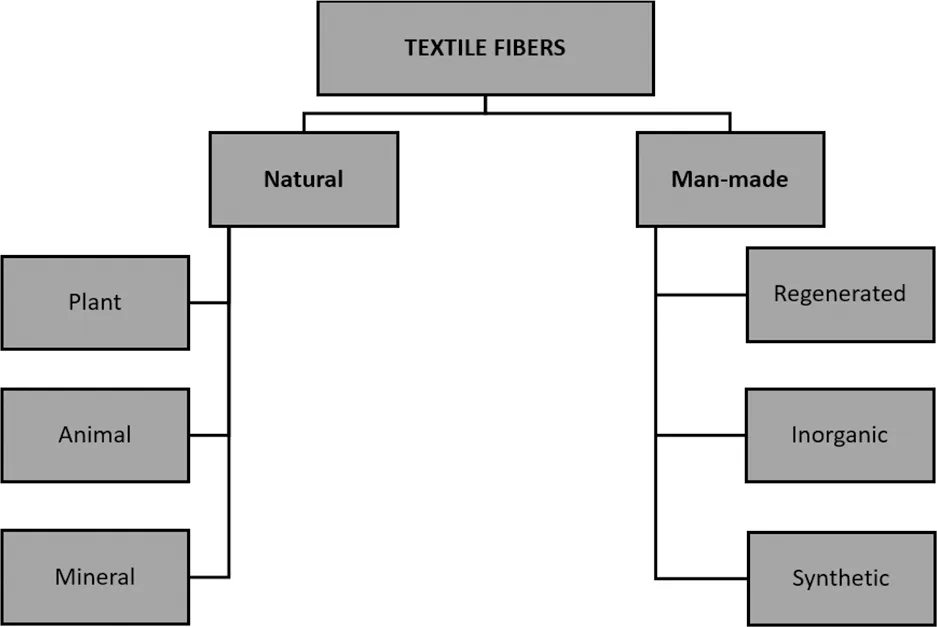
Figure 1.1 shows a simplified synoptic classification of the textile fibres, which are broadly classified as natural and man-made/synthetic fibres.
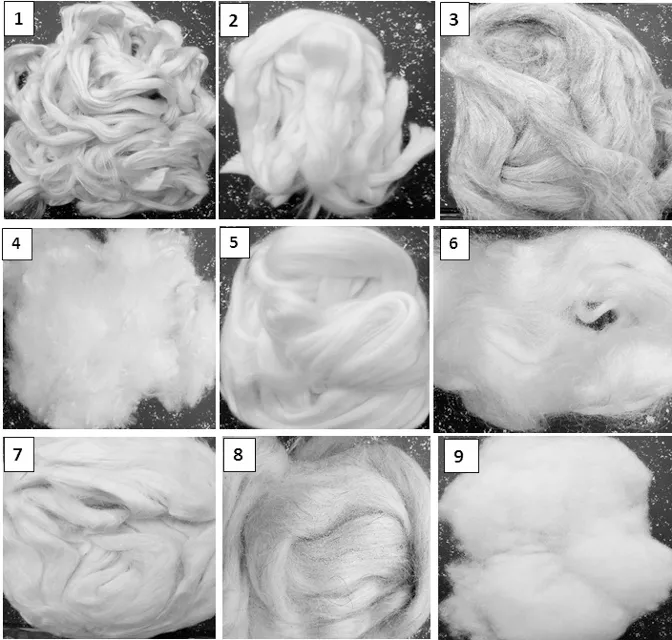
The appearance of some different types of natural fibres is shown in Figure 1.2.

1.3NATURAL FIBRES

Natural fibres are subdivided according to their origin into subgroups of plant, animal and mineral fibres. They are obtained directly from plants, animals or mineral sources and are suitable for textile uses because they can be spun or twisted into yarn to make woven, knitted and non-woven fabrics. Generally, plant fibres possess adequate strength and durability, high moisture absorption capacity, provide excellent comfort and aesthetic properties (Chandramohan and Marimuthu 2011; Karthik and Rathinamoorthy 2018).
Images
FIGURE 1.1Textile fibres’ classification.
Images
FIGURE 1.2Appearance of different types of textile fibres. 1. Mulberry silk, 2. Cotton, 3. Flax, 4. Recycled PET, 5. Banana, 6. Trilobal PET, 7. Hemp, 8. Mohair, 9. Acetate.

1.3.1PLANT FIBRES

Plant fibres mainly consist of cellulose compounds and are extracted from different parts of plants such as the bast or stem, seed hair, leaf or husk and fruit. The different parts of plants where the fibres are extracted provide the basis for further subdivisions of the plant fibres. The bast fibres are extracted from the bast or skin surrounding the stem of the plants such as kenaf, hemp, flax, jute, roselle and coir (Fangueiro and Rana 2016). Generally, bast fibres possess high tensile strength compared with other plant fibres. An example of a plant fibre obtained from the seed is cotton, a leaf is sisal and fruit is coir or coconut. The chemical composition of all plant fibres is the cellulosic polymeric structure as the main constituent of the fibres. Cellulose is a long-chain molecule produced in nature by means of photosynthesis and is aggregated into fine microfibrils (Karthik and Rathinamoorthy 2018). Cellulose is a polymer made of repeating glucose molecules that are in attached end-to-end configuration. The fibre is made from ether or esters of cellulose, which can be obtained from any part of a plant like the bark, wood or leaves of plants, or from a plant-based material. The cellulose chain consists of linked carbon (-C-), hydrogen (-H) and oxygen (-O-) atoms. The six hydroxyl (-OH) groups that protrude from the chain provide the site for inter- and intramolecular linkage with other hydroxyl (-OH) groups by hydrogen bonds (Morton and Hearle 2008).
1.3.1.1Cotton
Cotton is a natural cellulosic fibre that is used extensively in the apparel textile sector. The morphology of the fibre is characterized by a long, flat, irregular and convoluted or twisted tube-like structure. The cross section has a narrow collapsed visible lumen. The fine structure consists of helically oriented molecules and fibrils with spirality angles ranging from 20° to 35°.
...

Table of contents

  1. Cover
  2. Half Title
  3. Series Page
  4. Title Page
  5. Copyright Page
  6. Dedication Page
  7. Table of Contents
  8. Series Preface
  9. Preface
  10. Editors
  11. Contributors
  12. Chapter 1 Textile Fibres and Recent Developments
  13. Chapter 2 Filament Formation and Recent Developments
  14. Chapter 3 Yarn Formation and Recent Developments
  15. Chapter 4 Fabric Formation and Recent Developments
  16. Chapter 5 Knitting and Recent Developments
  17. Chapter 6 Non-Woven Fabrics: Technology, Applications and Recent Developments
  18. Chapter 7 Braiding and Recent Developments
  19. Chapter 8 Preparatory Chemical Processes and Recent Developments
  20. Chapter 9 Dyeing and Recent Developments
  21. Chapter 10 Printing and Recent Developments
  22. Chapter 11 Finishing Processes and Recent Developments
  23. Chapter 12 Testing of Fibres, Yarns and Fabrics and Their Recent Developments
  24. Chapter 13 Recent Developments to Reduce Environmental Impacts of Textile and Apparel
  25. Chapter 14 Use of CAD and CAM and Its Recent Developments in Textiles
  26. Chapter 15 Recent Developments in Textile-Reinforced Composites and Biocomposites
  27. Chapter 16 Technical Textiles and Recent Developments
  28. Chapter 17 Smart Textiles and Recent Developments
  29. Chapter 18 Nanotextiles and Recent Developments
  30. Index