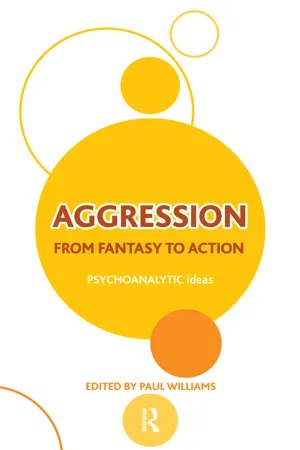
This book is a result of the 2nd International Psychoanalytic Conference: "Aggression: From Fantasy to Action", held in May 2010.It contains papers that were delivered to the conference, together with edited summaries of discussions from the floor that followed each paper. The standard of the papers given was extremely high. What was noticeable from the outset of the conference was the intensity of focus on understanding the origins of aggression and violence, from a psychoanalytic perspective. This intensity persisted throughout the two days, leading to a number of the fascinating discussions that are summarized in this book.
- 256 pages
- English
- ePUB (mobile friendly)
- Available on iOS & Android
eBook - ePub
About this book
Information
Chapter One
The nature and function of aggression
Donald Campbell
Dr Richard Ingram introduces Mr Donald Campbell
“Well, it is an unexpected pleasure for me, in the absence of Siobhan O’Connor, to introduce our keynote speaker, Don Campbell. For those of you who do not know about Don’s career, it is a very distinguished psychoanalytic career. Don has been a past president of the British Psychoanalytic Society, Secretary General of the International Psychoanalytic Association and has worked for over thirty years in the National Health Service at the Portman Clinic in London. Within the British Society, he is a training analyst, and he has published widely on a range of topics, including violence, suicide, perversion, and adolescence. It is with great pleasure that I pass over to Don to speak to us today.”
Donald Campbell: “Good morning everyone. I hope you can all hear me and get used to this way of communicating with each other. When I thought about having to present my paper to you over the phone, I thought back to my days as a child listening to the radio, and I hope this will be a bit like listening to a good radio programme. I want to thank the organizers for inviting me to present this keynote address to what I think is an unusually well organized conference. By that I mean it has brought together people who have had clinical experience with violent and aggressive patients and this is true, I think, of everyone who is presenting. I am very impressed with the way this conference has been organized. I want to thank Nora McNairney and Lisa Losty for their really stalwart efforts to pull things together when the volcanic ash curtailed our flights to Belfast and to give you my apologies for not being with you today. I have not only had my flight cancelled, but I have been extremely anxious about being able to get back from Belfast, even if I had got to see you there, in order to get back for my son’s wedding, which is this weekend. So it has been a fraught time on many fronts.”
Introduction
Mr Davis was one of the first violent patients that I saw at the Portman, thirty-seven years ago. His father had left home in his first year. As a youngster, Mr Davis’s antisocial behaviour was too much to manage for his depressed mother and the local school. He was sent to a boarding school when he was nine years old. There were hints that he had been sexually abused by one of the teachers. Mr Davis was a loner who occasionally worked on building sites. He was referred to the Portman because he was habitually getting into pub fights after bouts of drinking. When I brought my early sessions with Mr Davis to a peer supervision group, I was made aware that I was defending against the anxieties I felt about his potential for violence towards me to such an extent that I was out of touch with Mr Davis’s potential for violence in the consulting room. I was asked if I thought it was safe to have a glass ashtray on my desk within easy reach of Mr Davis. (You can tell how long ago this was by the fact that smoking was still allowed in NHS establishments.) I was embarrassed and alarmed that I had not thought about it. I removed the ashtray immediately.
As he sat down for the start of the next session, Mr Davis said, with a barely disguised sense of triumph, “I noticed you removed the ashtray.” I cannot remember whether I said anything in reply or kept silent. But to this day I remember feeling that I had been caught out and I felt ashamed that my fear of Mr Davis’s violence had been publicly exposed.
Aggression is, by definition, hostile and destructive. I do not have to remind the citizens of Northern Ireland that aggression, particularly its physical expression in violence, is, in reality, dangerous. It can hurt. It can wound. It can kill. So, when we are with someone who has been violent, it is not the probability of violence, but the possibility, the chance of it occurring, that eats away at our minds. That is the rock bottom reason why we mental health professionals unconsciously and consciously defend ourselves against the violent individuals we are working with. We can try to put that fear out of our mind, or we can use the “small dull smears of meditative panic”, as the writer Don DeLillo put it in Point Omega, to sharpen our attention in the here and now. The peer supervision group and I first thought of ourselves as potential victims and acted in a self-protective way, initially by denial, on my part, and by recommending action on the group’s part. In addition, I had felt shamed by my exposure in the peer supervision group. These responses undermined my thinking about the perpetrator and led to action. I would not be surprised if we all struggle against these reactions during the conference.
For many mental health professionals, the word “unthinkable” starts us thinking. So, when I thought further about this incident, I could see that I reacted to the group’s projection of their anxiety about Mr Davis’s violence. Neither the group nor I were able to use our anxiety to think about what was going on between Mr Davis and me. Instead, I relied upon action to protect myself. It is not uncommon for the victim to defend him or herself by identifying with the aggressor. To the extent that I acted by removing the ashtray, I was unconsciously identifying with the aggressor, Mr Davis. I think this is a common mistake, which often occurs unconsciously. As you can see, there were consequences for my therapeutic work with Mr Davis.
First, I had failed to appreciate how dangerous I was as a transference figure for Mr Davis and the importance of a weapon for ensuring Mr Davis’s safety. He had often used broken glass beer bottles in his pub fights. Removing the glass ashtray, an act that was intended to help me feel safe, had effectively disarmed Mr Davis, increased his feelings of defencelessness, and put me more at risk. Second, Mr Davis now knew that beneath my professional exterior and neutral façade I was personally anxious about his violence. And this made Mr Davis more anxious. I knew that behind his triumphant tone, Mr Davis was anxious that my fear of his violence obscured my view of him as a whole person, and diminished my capacity to help him. I knew enough about Mr Davis to know that he resorted to violence when he felt his paranoid projections were confirmed. In subsequent sessions, it emerged that by acting as I did, I confirmed his expectation that I was like him, that I also dealt with my fears by resorting to action. In addition, I confirmed Mr Davis’s fear that I, like all the authorities he had faced before, could not and would not think about his violence with him, but that I would have to do something about it. I wanted to begin this presentation the way I will end it, with a reference to what it is like working with violent individuals. As you can see, if I had thought more about the transference, and, especially, been more sensitive to my countertransference, I could have been more helpful to Mr Davis.
Hale (2008) maintains that the defining characteristic of the psychopath is the capacity to bring out the worst in the individual clinician and the institution to which he or she belongs. That was my experience of Mr Davis. But we should not feel too bad about this. It is inevitable, especially when we are inexperienced, because we are working with individuals who are dependent upon projection to get rid of a devastating sense of their badness. It is the patient’s reliance upon projection that makes our countertransference such an essential diagnostic and therapeutic tool, whether we are working in an outpatient clinic, a prison, or a secure hospital.
Hale (2008) describes a vicious cycle that most of you are familiar with, which, in over-simplified terms, goes something like this: chronic and intense projections generate an active paranoid state, which is itself a prodromal psychotic state. The individual acts violently to subdue the now life-threatening objects of his projections. This leads to confinement in prison, which drastically reduces the prisoner’s opportunities to defend against psychotic anxieties with violence. This, in turn, leads to a shift from chronic to acute psychosis and a transfer to a secure hospital with a diagnosis of schizophrenia and the prescription of neuroleptic drugs, which often bring about a rapid decrease in violent behaviour. However, as the psychosis recedes and the psychopathic state predominates again, the nursing staff, who bear the brunt of the patient’s intimidations, question the previous diagnosis of schizophrenia. The point Hale makes is that the nurses and psychiatrists are both right and that a dual diagnosis of an underlying psychosis and a defence against its emergence by psychopathy, which presents as a kind of pseudo normality. From the point of view of our conference theme, the psychopathic orientation to the outside world, underpinned by violence, is the preferred state of mind because it is far less frightening than the paranoia of psychosis.
After lunch, Dr Carine Minne will talk about her psychotherapeutic work with the kind of patient I have been referring to, patients at Broadmoor who have murdered. You will see that their inability to use violence to project intolerable internal states leads them to murder their memories and their reflective selves. Dr Minne will describe how she helped her patients move from a personality disordered or a psychotic presentation to a post traumatic stress disorder that leaves them feeling worse, but helps them recover a capacity to think about who they are and what they have done to others and to themselves.
I will consider violent acts, that is, aggression that breaks the body boundary, from the individual perpetrator’s point of view. Bearing in mind the impact that violence has on the victim and witness, it is easy to think of the perpetrator as merely a violent person, but our aim should be to consider the perpetrator as a whole person. That is why we need to remind ourselves that there are broader social and political factors that contribute to violent acts. But I will leave the presentation of these issues to John Alderdice, that rare psychiatrist who is also a respected and effective politician. In fact, this conference on “Aggression: from fantasy to action” mirrors John’s multi-dimensionality by bringing together a refreshing variety of perspectives from esteemed psychoanalysts who write from their clinical experience with violent child, adolescent, and adult patients and adult prisoners. I have read the papers and I am impressed by the links they have to each other while also making distinct contributions, which I will refer to during my Keynote Address.
The self-preservative function of the ego
I view aggression as an instinct that is available to the ego in the pursuit of its primary function—the preservation of the self. This view of aggression and its relation to the ego is based on Freud’s remarks in 1915 in “Instincts and their vicissitudes”: when considering hate, he wrote,
the relation to unpleasure seems to be the sole decisive one. The ego hates, abhors and pursues with intent to destroy all objects, which are the source of unpleasurable feeling for it, without taking into account whether they mean a frustration of sexual satisfaction or of the satisfaction of self-preservative needs. Indeed, it may be asserted that the true prototypes of the relation of hate are derived . .. from the ego’s struggle to preserve and maintain itself. [Freud, 1915c, p. 138]
We share this primary aim with all living creatures. Modern Darwinism has confirmed that within all species a constitutional predisposition to replicate one’s genes is the primary motive for the individual’s aggressive and reproductive behaviour.
Returning now to homo sapiens, when I view the ego’s primary function as the preservation of the self, I am referring to anything that constitutes a threat to physical or psychological homeostasis. This includes, narcissistic equilibrium, that is, good enough feelings about oneself, appropriate self-esteem, and psychological integrity. The aim is to maintain a dynamic balance; a steady state of physical health and psychological well-being at optimum levels. You can consider this as the psychoanalytic equivalent of James Lovelock’s ecological hypothesis, the Gaia principle, which views the biosphere and the physical components of the Earth as a complex interacting system that maintains itself in a preferred homeostasis. By 1920, Freud suggested that there was a self-destructive “daemonic force” (Freud, 1920g, p. 35) that opposed the pleasure principle and worked, instead, to return the living organism to its previous, inorganic state. Freud referred to this search for quiescence as the “Nirvana principle”, which led to his concept of the death instinct (ibid.). Then, in 1930, Freud maintained that “aggressive instinct is the derivative and the main representative of the death instinct” (Freud, 1930a, p. 122)
As you can see, I do not have a place in my theory for the death instinct. Many psychoanalysts ignore the concept, as Anna Freud did, or consider it to have been a detour in Freud’s thinking, as Black (2001) does. Winnicott said,
I have never been in love with the death instinct and it would give me happiness if I could relieve Freud of the burden of carrying it forever on his atlas shoulders . .. while he knew all we know about human psychology . .. he did not know what borderline cases and schizophrenics were going to teach us in the three decades after his death. [Winnicott, 1969, p. 242]
In my clinical experience, I have never had to turn to the death instinct to make sense of a violent act, however destructive and apparently random and “evil” it appeared to be. In the broader perspective, the death instinct seems to me to contradict the modern Darwinian view that the aim of every individual animal is to reproduce its gene pool, not to destroy itself.
The ego’s task is to solve problems that threaten to destabilize us. Therefore, the “best” solution negotiated by the ego is that which creates and maintains a feeling of physical safety and psychological well-being. A violent act, a neurotic or psychotic state, a symptom, or a character trait, a defence mechanism or a perversion, however maladapted in the outside world, may be the “best” solution the ego can negotiate given the external circumstances and the ego’s internal resources (Sandler & Sandler, 1992). Sexuality and aggression, with their accompanying fantasies and enactments, are our most fundamental resources for the resolution of our problems.
In psychoanalysis, we can see that current fantasies, developed as solutions to conflicts in the present, are permeated to a greater or lesser extent by primitive fantasies representing solutions to earlier developmental conflicts. For instance, paranoid fantasies in response to no real threat are likely to be based on earlier anxieties about safety. These archaic fantasies define our character, aims, and behaviour, including violent behaviour.
Ruthless aggression
Following Glasser (1998), I distinguish between two types of aggression: first, ruthless aggression, which is primary, and, second, sadistic aggression, which is derived by modifying ruthless aggression. Bio-physiologists such as Cannon (1939) have shown that the body has an elaborate reflexive reaction pattern that prepares it for fight or flight in the presence of danger. This reflexive fight/flight mechanism, which we share with all living organisms, is our most primitive defence and serves the ego’s self-preservative instincts. The fight mechanism is a primary aggression, which I will refer to as ruthless aggression. In the psychic sphere, all aggression is self-preservative. All of us as infants and adults are capable of self-preservative aggression. When ruthless aggression is enacted in relation to an object, it becomes ruthless violence.
Ruthless violence is a fundamental, immediate, and substantial response to any threat to the self with the aim of negating this source of danger. Here is an example: if you suddenly found yourself being stalked by a lion in the African bush and unable to run, you would normally react with self-preservative aggression with the aim of getting rid of the lion. Self-preservative aggression has a single-minded, narrow-vision quality, like a laser beam, which focuses on the dangerousness of the object rather than the object itself. If the victim’s look is experienced as threatening through accusation, it is the ...
Table of contents
- Cover
- Half Title
- Title
- Copyright
- Contents
- ABOUT THE EDITOR AND CONTRIBUTORS
- PREFACE
- INTRODUCTION
- CHAPTER ONE The nature and function of aggression
- Discussion of Donald Campbell's paper
- CHAPTER TWO Which violence and whose violence? Questions arising in the psychotherapy of aggressive children
- Discussion of Anne Alvarez's paper
- CHAPTER THREE Violence to body and mind: treating patients who have killed
- Discussion of Carine Minne's paper
- CHAPTER FOUR The interpretation of violence
- Discussion of James Gilligan's paper
- CHAPTER FIVE From action to communication: the transformation of aggression in childhood
- CHAPTER SIX Aggression and violence in adolescence
- Discussion of Marianne Parsons' paper
- CHAPTER SEVEN The perverse fascination of destructiveness
- Discussion of Paola Capozzi and Franco De Masi's paper
- CHAPTER EIGHT Aggression: social and political aspects
- Discussion of Lord Alderdice's paper
- CHAPTER NINE Plenary session
- Closing remarks by Philip McGarry
- INDEX
Trusted by 375,005 students
Access to over 1.5 million titles for a fair monthly price.
Study more efficiently using our study tools.
Frequently asked questions
Yes, you can cancel anytime from the Subscription tab in your account settings on the Perlego website. Your subscription will stay active until the end of your current billing period. Learn how to cancel your subscription
No, books cannot be downloaded as external files, such as PDFs, for use outside of Perlego. However, you can download books within the Perlego app for offline reading on mobile or tablet. Learn how to download books offline
Perlego offers two plans: Essential and Complete
- Essential is ideal for learners and professionals who enjoy exploring a wide range of subjects. Access the Essential Library with 800,000+ trusted titles and best-sellers across business, personal growth, and the humanities. Includes unlimited reading time and Standard Read Aloud voice.
- Complete: Perfect for advanced learners and researchers needing full, unrestricted access. Unlock 1.5M+ books across hundreds of subjects, including academic and specialized titles. The Complete Plan also includes advanced features like Premium Read Aloud and Research Assistant.
We are an online textbook subscription service, where you can get access to an entire online library for less than the price of a single book per month. With over 1.5 million books across 990+ topics, we’ve got you covered! Learn about our mission
Look out for the read-aloud symbol on your next book to see if you can listen to it. The read-aloud tool reads text aloud for you, highlighting the text as it is being read. You can pause it, speed it up and slow it down. Learn more about Read Aloud
Yes! You can use the Perlego app on both iOS and Android devices to read anytime, anywhere — even offline. Perfect for commutes or when you’re on the go.
Please note we cannot support devices running on iOS 13 and Android 7 or earlier. Learn more about using the app
Please note we cannot support devices running on iOS 13 and Android 7 or earlier. Learn more about using the app
Yes, you can access Aggression by Paul Williams in PDF and/or ePUB format, as well as other popular books in Psychology & History & Theory in Psychology. We have over 1.5 million books available in our catalogue for you to explore.