- 240 pages
- English
- ePUB (mobile friendly)
- Available on iOS & Android
eBook - ePub
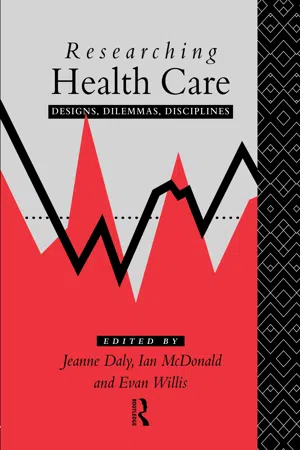
Researching Health Care
About this book
First Published in 1992. Health care is currently under intense pressure both to be cost-effective and to deliver a service its users want. This text is an important contribution to the debate about the most appropriate research method for evaluating its effectiveness.
Information
Part I
Issues of policy
1 The perspective of the policy maker on health care research and evaluation
David Hailey
This contribution is given from the perspective of the Australian Institute of Health, an agency which informs the policy process rather than formulating policy itself. Probably the best customers for the various evaluation and statistical development activities at the Institute are policy areas in government. Policy areas outside health authorities are also important but government agencies tend to dominate consideration because of their close ness to decisions that will eventually affect the funding of health care programs.
Although most of this publication is concerned with the details of evaluation methodology, it is worth setting part of the scene by com menting on the nature of the policy process and the climate in which those responsible for formulating policy have to operate. After all, much of the purpose for attempting the difficult and costly process of health care evaluation is to influence the decisions taken by governments and others. To succeed in this dubious task it is as well to have some appreciation of the nature of the target.
CHARACTERISTICS OF POLICY AREAS
Pressing concerns for the policy makers in health authorities include the immediate directions of the Minister and the wishes of the government of the day, limited budgets for an apparently ever-expanding set of responsibilities, the relationship to coordinating departments and the short time scale in which decisions often have to be taken and results judged. Policy areas will often be under pressure to come up with something definite relatively quickly.
Other realities are that the policy maker will have to take on board a very broad perspective of the requirements in the health portfolio (considerably beyond the range envisaged by the typical researcher), and will need to respond to pressures, not only from the political arena, but also from professional groups. Typically, providers will be seeking access to government funds while health authorities will be defending their budgets.
Resulting action after a policy decision is taken may be difficult to reverse or adjust - for example, alteration to levels of reimbursement may be cumbersome to achieve. Another characteristic seems to be a relatively rapid turnover of policy staff, perhaps associated with an increasing trend towards use of generalists. There may be capacity only for limited review and analysis and while control of health care programs may be significant there are limitations as to what can be achieved by a health authority. These features contribute to the caution shown in some policy making areas.
In recent years cost containment has been a dominant theme, often at the expense of any major consideration of benefit from provision of health care programs. Frequently the constraints on the policy maker are such that a new initiative may be acceptable only if some alternative program can be reduced or given up. While policy makers may need to respond quickly they may also, in the interests of budgets or other government commitments, need to delay introduction of new health programs. There can be an interesting tension between the need for immediate advice and a bureaucratic preference for delay.
The policy maker will need to consider if the new health initiative will replace old methods or supplement them, or if it will have a significant effect on infrastructure. If so, will it be the responsibility of the area serviced by the health authority or can it be passed over to another level of government or to health insurance funds? In Australia, the split in responsi bilities between Commonwealth and states adds to the complexity.
EVALUATION AND THE POLICY PROCESS
Evaluation may often be seen by the policy maker as something of a wild card. Potentially, evaluation can help by providing data that can contribute to better-informed decision-making. Difficulties are that the evaluation data may not be easily assimilated into policy decisions, and in some cases may be regarded as embarrassing if they point to a need for significant change.
Evaluation is only one input to the policy making process. There are dangers for those who assess health care if it is not appreciated that the most elegant and detailed analysis may have no impact on the policy process and any subsequent action by government if the timing is wrong, the results are not presented in a way that is intelligible to policy makers or the recom mendations are unrealistic in political terms.
The recent experience in Australia of introduction of Magnetic Resonance Imaging (MRI) services provides an illustration. Future policy on this expensive technology will be informed by the results of the Australian assessment program and by relevant data from overseas, but other impacts on the policy process will include pressures from coordin ating departments, states, professional bodies, consumer organisations, manufacturing industry and various vested interest groups.
At present we are dealing with perhaps the fourth generation of persons in the relevant policy area since the MRI program started. Such turnover does not help in establishing some sort of understanding of the methods, strengths and constraints of evaluation.
I have noted elsewhere (Hailey, 1985) that in a climate where governments want results of assessments quickly, perhaps within 12 months and in appropriately brief form, it is difficult to encourage an appreciation of the need for detailed evaluation. The ‘quick and nasty’ approach can easily become the norm and carry greater weight with the policy maker than more detailed studies. Excellent proposals for evaluations will not necessarily attract support, and clinical studies of several years’ duration do not sit easily with the imperatives implicit in the policy making process.
SOME ATTITUDES TO EVALUATION
Comments made at the recent evaluation meeting organised by the Public Health Association (PHA) and the National Health and Medical Research Council (NHMRC) (PHA, 1989) provide some interesting insights into the perspectives of policy makers, though some of the views expressed may not be very comforting for researchers or evaluators.
The point was made that policy making in the health area has a relationship to the political process, which will include party politics. It is also closely related to power plays within the bureaucracy or involving it. It was suggested that one view of evaluation is that it helps the health authority to push away the problem - this is the idea of deferring the evil day when hard decisions might need to be made about support of a particular health care program. NHMRC was not seen as very relevant to the short term needs of the Commonwealth Department of Community Services and Health.
Consultants were seen as useful, as being able to generate quick opinions which departmental officers could choose to use or not, as required - with no one else involved. (A counter view expressed was that often too little briefing and definition of tasks were provided to consultants and that insufficient funds were made available to them.) Perhaps more worrying, lack of control of evaluators was seen as a concern.
With these sort of attitudes, it may be difficult for researchers to judge the success of their work in terms of the health authority’s view. From the policy maker’s perspective, success through evaluation was seen in terms of providing new information, informing the policy process (including synthesis of available...
Table of contents
- Cover
- Half Title
- Title Page
- Copyright Page
- Contents
- Illustrations
- Contributors
- Acknowledgements
- Introduction
- Part I Issues of policy
- Part II The randomised controlled trial
- Part III Non-experimental quantitative study designs
- Part IV Qualitative research methods
- Part V Conclusion
- Index
- Subject index
Trusted by 375,005 students
Access to over 1.5 million titles for a fair monthly price.
Study more efficiently using our study tools.
Frequently asked questions
Yes, you can cancel anytime from the Subscription tab in your account settings on the Perlego website. Your subscription will stay active until the end of your current billing period. Learn how to cancel your subscription
No, books cannot be downloaded as external files, such as PDFs, for use outside of Perlego. However, you can download books within the Perlego app for offline reading on mobile or tablet. Learn how to download books offline
Perlego offers two plans: Essential and Complete
- Essential is ideal for learners and professionals who enjoy exploring a wide range of subjects. Access the Essential Library with 800,000+ trusted titles and best-sellers across business, personal growth, and the humanities. Includes unlimited reading time and Standard Read Aloud voice.
- Complete: Perfect for advanced learners and researchers needing full, unrestricted access. Unlock 1.5M+ books across hundreds of subjects, including academic and specialized titles. The Complete Plan also includes advanced features like Premium Read Aloud and Research Assistant.
We are an online textbook subscription service, where you can get access to an entire online library for less than the price of a single book per month. With over 1.5 million books across 990+ topics, we’ve got you covered! Learn about our mission
Look out for the read-aloud symbol on your next book to see if you can listen to it. The read-aloud tool reads text aloud for you, highlighting the text as it is being read. You can pause it, speed it up and slow it down. Learn more about Read Aloud
Yes! You can use the Perlego app on both iOS and Android devices to read anytime, anywhere — even offline. Perfect for commutes or when you’re on the go.
Please note we cannot support devices running on iOS 13 and Android 7 or earlier. Learn more about using the app
Please note we cannot support devices running on iOS 13 and Android 7 or earlier. Learn more about using the app
Yes, you can access Researching Health Care by Jeanne Daly,Ian McDonald,Evan Willis in PDF and/or ePUB format, as well as other popular books in Medicine & Health Care Delivery. We have over 1.5 million books available in our catalogue for you to explore.