- 208 pages
- English
- ePUB (mobile friendly)
- Available on iOS & Android
eBook - ePub
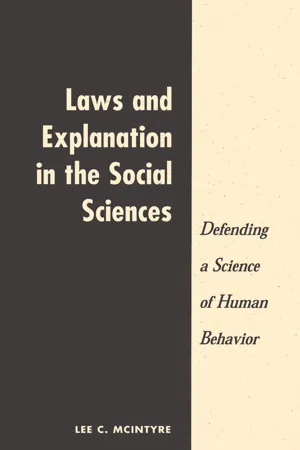
Laws And Explanation In The Social Sciences
About this book
The first full-length defense of social scientific laws to appear in the last twenty years, this book upholds the prospect of the nomological explanation of human behavior against those who maintain that this approach is impossible, impractical, or irrelevant. By pursuing an analogy with the natural sciences, Mclntyre shows that the barriers to nomological inquiry within the social sciences are not generated by factors unique to social inquiry, but arise from a largely common set of problems that face any scientific endeavor. All of the most widely supported arguments against social scientific laws have failed largely due to adherence to a highly idealized conception of nomologicality (allegedly drawn from the natural sciences themselves) and the limited doctrine of "descriptivism." Basing his arguments upon a more realistic view of scientific theorizing that emphasizes the pivotal role of "redescription" in aiding the search for scientific laws, Mclntyre is optimistic about attaining useful law-like explanations of human behavior.
Trusted by 375,005 students
Access to over 1.5 million titles for a fair monthly price.
Study more efficiently using our study tools.
Information
Subtopic
Philosophy History & TheoryIndex
Social Sciences1
The Nomological Ideal
What it demands is that the sociologist put himself in the same state of mind as the physicist, chemist, or physiologist when he probes into a still unexplored region of the scientific domain. When he penetrates the social world, he must be aware that he is penetrating the unknown; he must feel himself in the presence of facts whose laws are as unsuspected as were those of life before the era of biology; he must be prepared for discoveries which will surprise and disturb him.
—Emile Durkheim
It has long been debated whether we can use the same method of inquiry in social science that has been used in natural science. Central to this debate has been the question of the role of laws in the explanation of human behavior. Many philosophers and social scientists alike have felt that the social sciences deal with phenomena so disparate from that of the natural sciences that fruitful inquiry requires a kind of methodological independence.1 Specifically, many have thought that the unique subject matter of the social sciences forces a break in the kind of explanatory accounts one could use in social inquiry suggesting that law-like explanation is here impossible or impractical to pursue. Moreover, some have made the stronger claim that the difference in subject matter is bound up with the fact that we want something different explained about human behavior than we want explained about natural phenomena, which laws, even if available, could not capture. Nomological explanations on this account are thereby held to be irrelevant. Despite their surface diversity concerning the scope of these implications, however, it is important to note that all of these claims are rooted in a commitment to the uniqueness of the subject matter of social science and purport to militate against the explanatory value of social scientific laws on these grounds.2
But can one nevertheless defend the use of laws in the explanation of human behavior against its critics? Have the arguments concerning the complexity of social phenomena, the openness of human systems, and the non-repeatable and non-coritrollable aspects of social experimentation really shown that there is a difference "in kind" between the subject matters of natural arid social science, thus requiring a correspondingly different type of explanation? If not, what do such considerations imply about our ability to use law-like explanations when investigating human behavior? Do they impose potential restrictions or limitations, or otherwise significantly hamper us, in devising law-like accounts? Does the cumulative effect of such factors impose special constraints in the case of social science? And would we even want nomological explanations in social science should they be available? What account of explanation is appropriate in social science in the face of these considerations?
In this book I will deal with the above issues by considering some of the most prevalent arguments against the use of law-like explanation in social science rooted in the alleged intractability of its subject matter.3 I will examine not only those arguments that purport to have shown that the goal of law-like explanation is impossible, but also those that have attempted to show that, even if law-like explanation is not in principle impossible, there are factors endemic to social inquiry that so severely restrict the use of laws as to render them effectively useless and undesirable for social scientific explanation. In short, I will attempt to defend the use of law-like explanations in social science against those arguments that purport to show that, due to certain unique features of its subject matter, such laws are impossible, impractical, or irrelevant. But before I launch into a dispute with such views, it is first important to be clear about the position that they are attacking. What is "law-like explanation," and how might it be employed in practice?
There are, of course, a whole constellation of possible criteria for nomologicality: a law has been variously held to be a well-confirmed general regularity, that is embedded in a theory, confirmable by its instances, that supports its counterfactuals, and that is used for explanation. Moreover, some also have held that laws must reflect exceptionless regularities, immutable over time and place, that are universal in scope, and capture non-contingent relationships. Some have also held that laws should be derivable from larger regularities, must yield predictions, and unify diverse phenomena
Naturally, there are few examples even within physics that may fit all of these criteria, and there has been an interesting and heated debate in the philosophy of science concerning what the proper criteria may be.4 But the question I will be concerned with in this book is not whether any one or combination of these factors properly define what we may legitimately call "social scientific laws." Instead, I will focus on the arguments that purport to show that no matter which criteria correctly define the conditions for nomologicality in natural science, social science cannot live up to them. That is, I am not interested in defending any particular view of a social scientific law, hoping to show that if we pick out a suitably restricted set of criteria we are in business. Rather, I seek to determine whether social scientific explanation can live up to the standards for what has been extensionally deemed a "law" in natural scientific explanation.
In order to understand the nature of such a comparison, however, we must first examine the role that laws play in scientific explanation. What is the role of laws in natural science? A variety of different rationales have been given for laws. It has been argued, for instance, that laws are useful because they: (1) help us to unify diverse phenomena, (2) aid us in the identification of causal mechanisms, (3) serve an instrumental role in accounting for observed regularities, or (4) fulfill our desire for explanation by satisfying the criterion of "nomic expectability."5 It is not my intent here, however, to adjudicate the dispute about the role of laws in scientific explanation, but only to suggest that laws have a potentially important role to play in the explanation of scientific phenomena. That is, just as it is not my interest to defend any particular view of what a law is, my task does not require me to choose between alternative accounts of what role laws play in the explanation of scientific phenomena.
It is important, however, to examine in more detail the view that has been historically most influential in the debate about the status of laws in social science and that has captured the imagination of so many social scientists. In their 1948 paper "Studies in the Logic of Explanation,"6 Carl Hempel and Paul Oppenheim outline the classic version of what was later to be called the "covering law model" of scientific explanation.7 Roughly, the idea put forth is that one has not fully explained an event until one has shown that it could be derived from a set of scientific laws and antecedent conditions; that is, one aims to show that the phenomena to be explained was "to be expected" (and could have been predicted) on the basis of the covering laws, if the laws and antecedent conditions had been known in sufficient detail in advance.8 The goal therefore is to show that the event to be explained is merely an instantiation of some larger general regularity, and thus one seeks to account for it by describing the regularity and showing that the event to be explained is a consequence of it.
Of course, there has been great controversy during the last several decades of the philosophy of science over the internal adequacy of Hempel and Oppenheim's model and its applicability to natural scientific explanation.9 The logical symmetry between explanation and prediction, for example, has been singled out for much criticism, as have various other aspects of the model, such as its ability to contend with probabilistic phenomena and the adequacy of Hempel's account of "explanation sketches."10 But although it is important to be aware of the controversy that has surrounded the adequacy of the covering law model in capturing what goes on in natural scientific explanation, it is also true to say that despite these problems, the covering law model has nevertheless framed the aspirations of those social scientists who have sought to bring their methods of explanation up to the standards of rigor represented in natural science. Thus, I will focus on the question of whether or not there would be problems in trying to employ covering laws in social scientific explanation, while leaving aside the question of what refinements would be necessary before Hempel's account of them might adequately capture the role that laws play in scientific explanation. For one thing seems clear: whatever the status of any particular model of natural scientific explanation, it is widely agreed that natural science does indeed make use of laws.11 Those who have criticized Hempel's version of the covering law model of natural scientific explanation have not, for the most part, denied that laws play a role in the explanation of natural phenomena but instead have questioned whether Hempel's version of the model adequately captures what that role in fact is. However, for all the disagreement, it is important to remember that the classic version of the covering law model captures at least the spirit of the crucial role that laws play in scientific explanation.12 And to the extent that its critics remain committed to some version (albeit revised) of the covering law model, the arguments provided by those who have argued that the model is not appropriate in social science would hardly differentiate between different versions of it.13
Thus, whether Hempel's model adequately captures what goes on in detail in natural scientific explanation is for our purposes a side issue. The issue immediately before us is whether or not social science can make any use of laws at all—whether it can do whatever it is that natural science has done in explanation, not whether Hempel's account of nomological explanation is fully adequate in all of its detail. Indeed, it is important to note that it is the intuition behind the covering law model, rather than its detail, that has captured the imagination of social scientists. The nomological ideal has proven to be a powerful prototype for social scientific explanation. And even if the ideal picture sketched out in any particular version of it is somewhat problematic, the saliency of the practical success of laws in natural scientific explanation has lent this ideal tremendous credibility in the eyes of social science. Perhaps through an example we might better understand the nature of its appeal.
Before Newton's derivation of Kepler's Laws from his theory of universal gravitation, astronomers were unsure how best to explain the small perturbations in the orbit of the planets. According to Kepler's first law, the path of each planet around the sun should be an ellipse, with the sun at one focus. Yet it was later found that the actual paths of the planets deviated slightly from this predicted route. After Newton presented his law of universal gravitation, however, which holds that not only the sun but also "every body in the universe attracts every other body," one could explain these perturbations as a result of the small attractive force (when compared with the sun's) between each of the planets. Indeed, given Newton's law of universal gravitation, such perturbations are to be expected.
In testament to the success of this explanation we note that it was on the basis of Newton's account that Adams and Leverrier were able to predict the existence and path of the planet Neptune. The inability to account for the perturbations in the orbit of the planet Uranus as a function of the attractive forces of the known planets led them to posit the existence of an eighth planet, which was later found, close to the place predicted.14
Within this account we can begin to see the elegant way in which nomological models have been instrumental in helping us to explain scientific phenomena. The search for an explanation of the perturbations in the orbit of the planets, for instance, is answered when one can subsume it under a more general regularity; one hopes to be able to show that this previously anomalous and puzzling phenomenon is actually an expected outcome of a well-ordered regularity. We therefore aim at subsuming such events under a causal law—we strive to explain them by accounting for the laws and initial conditions from which they inevitably result.15 In the simplest terms, we want to show that the occurrence of the thing to be explained was "no accident."
The desire to repeat the success enjoyed by this paradigm has long informed the methodology of social inquiry. It has been hoped since the time of the early positivists that by imitating the successful components of natural scientific methodology, one might arrive at accurate predictions and law-like explanations of human behavior. The success of natural scientific explanations, through the use of nomological models, has provided the social sciences with a "nomological ideal" to which they might aspire. But what is behind such a desire for a "successful" social science? In part, it is simply the goal of providing better explanations. But a significant impetus has also been the conviction that there is something terribly wrong with the social world as we now find it, and that through the emulation of the nomological model of explanation in natural science we can better move towards increased knowledge of how to improve human affairs.16
It is no secret that as far as our ability to foresee—and therein move towards control over—the tragedies of our social world, we have not been very successful. We live in a world where war, crime, and poverty are accepted by many as incurable ills, inflicted upon us by factors beyond our control or comprehension. Many have accepted the status quo, either openly or tacitly, and have supposed that our power to change such things is either minuscule or, perhaps, dangerous.17 Yet others have thought that at the root of such social problems might be our inadequate knowledge of what causes them. Is it possible to repeat the success of the natural sciences by employing a broadly similar methodology of explanation in the study of social behavior?
The ability of physical scientists to arrive at the sort of knowledge that resulted in the Industrial Revolution, when humans first began to assert their control over nature on a vast scale, must have made the nomological paradigm quite attrac...
Table of contents
- Cover
- Half Title
- Title
- Dedication
- Contents
- Preface
- 1 The Nomological Ideal
- 2 Fundamental Objections to Social Scientific Laws
- 3 Practical Objections to Social Scientific Laws
- 4 The Role of Laws in Scientific Understanding: The Case of Evolutionary Biology
- 5 A Question of Relevance
- 6 Metaphysical Interlude
- 7 Prospects and Limitations of a Nomological Social Science
- Bibliography
- About the Book and Author
- Index
Frequently asked questions
Yes, you can cancel anytime from the Subscription tab in your account settings on the Perlego website. Your subscription will stay active until the end of your current billing period. Learn how to cancel your subscription
No, books cannot be downloaded as external files, such as PDFs, for use outside of Perlego. However, you can download books within the Perlego app for offline reading on mobile or tablet. Learn how to download books offline
Perlego offers two plans: Essential and Complete
- Essential is ideal for learners and professionals who enjoy exploring a wide range of subjects. Access the Essential Library with 800,000+ trusted titles and best-sellers across business, personal growth, and the humanities. Includes unlimited reading time and Standard Read Aloud voice.
- Complete: Perfect for advanced learners and researchers needing full, unrestricted access. Unlock 1.5M+ books across hundreds of subjects, including academic and specialized titles. The Complete Plan also includes advanced features like Premium Read Aloud and Research Assistant.
We are an online textbook subscription service, where you can get access to an entire online library for less than the price of a single book per month. With over 1.5 million books across 990+ topics, we’ve got you covered! Learn about our mission
Look out for the read-aloud symbol on your next book to see if you can listen to it. The read-aloud tool reads text aloud for you, highlighting the text as it is being read. You can pause it, speed it up and slow it down. Learn more about Read Aloud
Yes! You can use the Perlego app on both iOS and Android devices to read anytime, anywhere — even offline. Perfect for commutes or when you’re on the go.
Please note we cannot support devices running on iOS 13 and Android 7 or earlier. Learn more about using the app
Please note we cannot support devices running on iOS 13 and Android 7 or earlier. Learn more about using the app
Yes, you can access Laws And Explanation In The Social Sciences by Lee C Mcintyre in PDF and/or ePUB format, as well as other popular books in Social Sciences & Philosophy History & Theory. We have over 1.5 million books available in our catalogue for you to explore.