eBook - ePub
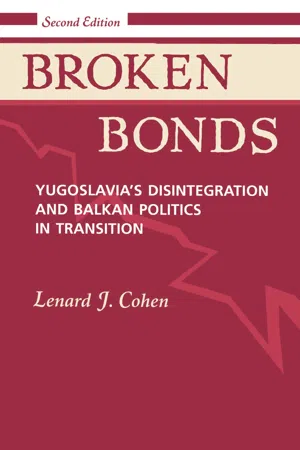
Broken Bonds
Yugoslavia's Disintegration And Balkan Politics In Transition, Second Edition
- 440 pages
- English
- ePUB (mobile friendly)
- Available on iOS & Android
eBook - ePub
Broken Bonds
Yugoslavia's Disintegration And Balkan Politics In Transition, Second Edition
About this book
Struggling against high odds, Yugoslavia managed to survive from its inception in 1918 until the early 1990s. But now, tragic ethnic and regional conflicts have irrevocably fragmented the country. In his timely book, Lenard Cohen explores the original conception and motives underlying the ?Yugoslav idea,? looking at the state's major problems, achievements, and failures during its short and troubled history.Cohen answers a broad range of questions concerning contemporary Yugoslavia: How did the state plunge from its position as a positive model to an essentially negative case of socialist reform? What measures for recovery were proposed by the country's ethnically and regionally segmented one-party elite? What were the reasons for the eventual abandonment of reform socialism, the elimination of the single party's monopoly, and the rapid delegitimation of the country's federal political institutions? What programs have been offered by the noncommunist and ?born again? communist leaders elected to power during the revival of multiparty pluralism in 1990? How did their efforts to achieve regional and ethnic sovereignty place the country in such a precarious and ultimately fatal position?The concluding chapters of the book offer an analysis of the causes and horrifying consequences of the military conflict and civil war from 1991 to 1994, including a discussion of the impotent efforts at peacekeeping, the dynamics of the complex and savage struggle in Bosnia-Hercegovina, and an examination of the problems faced by Yugoslavia's successor states.
Information
1
The Evolution of the Yugoslav Idea: 1830-1980
You cannot understand Yugoslavia without a thorough knowledge of its history even before its official birth in 1918. This, because the reasons for its birth were the same as those for its death.
—Dobrica Cosic
Justas in earlier centuries the ideas of Croato-Serbian national (linguistic) unity and Yugoslavism grew from common interests in the face of foreign threats…so too did this century’s Croato-Serbian conflicts emerge because of different conceptions of Yugoslavism, and especially the contrasting impact of the common Yugoslav state on their national beings.
—Franjo Tudjman
THROUGHOUT THE EXISTENCE of the Yugoslav state from 1918 to 1991, survival against the odds was its quintessential feature. Viewing Yugoslavia’s highly diverse regional, religious, and ethnic composition, both foreign and domestic observers typically drew attention to the country’s innate fragility or, sometimes less generously, its basic illegitimacy and artificiality. Indeed, convinced that Yugoslavia was doomed to disintegrate, the most hostile commentators plotted to ensure the realization of their prophecy. During the interwar period, for example, Adolf Hitler’s hectoring propaganda chief, Joseph Goebbels, described Yugoslavia as “a questionable patchwork of states” whose demise might be hastened if Berlin would “do something with the Croats.”1 Meanwhile, in Rome, Benito Mussolini’s son-in-law and foreign minister, Count Galeazzo Ciano, schemed to detach Croatia from Yugoslavia and yearned to organize the Albanians of Kosovo “into a dagger pointed at the side of Belgrade.”2 Having connived to destabilize Yugoslavia for years, the German and Italian fascist regimes eventually collaborated (along with their Hungarian and Bulgarian junior partners) to invade and dismember the young state in March 1941.
Following the bloody resistance struggle and ethnopolitical civil war during World War II, the Yugoslav state was reborn under communist leadership. This new effort at Yugoslav state building soon faced another serious test of survival in 1948 when Joseph Stalin became enraged over Marshal Tito’s maverick style and self-confidence. Threatening that he would “shake his little finger and there will be no more Tito,” Stalin plotted to have the Yugoslav leader assassinated and subjected the communist political leadership in Belgrade to enormous pressure.3 The wily Soviet dictator hesitated to invade Yugoslavia, however, thereby allowing Tito and his comrades to weather the storm and remain in power.
Having survived the enmity of the most powerful totalitarian leaders of his time and maintained the cohesion of the Yugoslav state, Tito proceeded to wrap his regime in a mantle of socialist reform and innovation. Precariously situated between the two major world power blocs, the Yugoslav communists searched about for a developmental model that would preserve their one-party and socialist proclivities yet allow them to jettison Stalinism’s most egregious facets and selectively incorporate certain useful features and assistance from the Western democracies. What resulted was an eclectic model that theoretically drew upon Marxism’s more democratic and humane impulses and also imported various capitalist socioeconomic principles. Initially fashioned as a makeshift alternative to Soviet-type socialism in the wake of the 1948 rift with the USSR, Yugoslavia’s regime-sponsored reforms gradually acquired stature as a distinct model of Marxist development. The notion of workers’ self-management—which originated with the slogan “Factories to the Workers” and was later recast as a more participatory form of “self-managed socialism”—served as the conceptual basis and label for the Yugoslav reform model.
During the 1950s and 1960s, efforts by the Belgrade regime to construct a less bureaucratized and more democratic variant of socialism won widespread praise both within and outside Eastern Europe. The communist regime took special pride in its management of interethnic relations, proclaiming in 1958 that although “negative manifestations” still existed in this area, the country’s socialist system was the guarantee “which assures equality to all peoples and national minorities of Yugoslavia and to each people the right to decide its fate.”4 By early 1973, Edward Kardelj, the principal architect of most major Tito-era reforms, could proudly assert that “self-management had not only demonstrated its economic effectiveness” but also allowed Yugoslavia to “solve democratically most of the contradictions and conflicts that cropped up in society.”5
At the end of the 1980s, only fifteen years after Kardelj’s proud claims, Yugoslav communist leaders again faced a major crisis of survival, regretfully conceding that their country lacked the “elementary rules of behavior in conflict situations which the crisis imposes”6 and that “priority efforts” must be directed at “raising Yugoslavia’s low credibility in the world.”7 During 1990, with the disintegration of the League of Yugoslav Communists (LCY) as a political organization and the advent of competitive elections, Yugoslavia’s interregional and interethnic divisions became so pronounced that the country virtually ceased to function as a unified federal state. By the second half of 1991, the Yugoslav state had disintegrated, precipitating military struggles, interethnic violence, and widespread human suffering in several regions of the former country.
What accounted for Yugoslavia’s plunge from a seemingly positive to a negative model of socialist reform and intergroup relations? And what measures for recovery were advanced by the country’s ethnically and regionally segmented one-party elite? What were the reasons for the eventual abandonment of reform socialism, the elimination of the single-party monopoly, and the disintegration of Yugoslavia as a unified federal state? Why did the noncommunist and born-again or relabeled communist leaders elected to power during the revival of multiparty pluralism in 1990 fail to resolve the crisis through negotiations? And why did they ultimately permit their disagreements to degenerate into interethnic violence and civil war? Can the successor states to Yugoslavia establish stable democratic regimes, overcome their economic difficulties, and find a basis for peaceful cooperation in the Balkan region?
These and other questions are examined in subsequent chapters of this book. It is useful to begin, however, by considering the original motives underlying the creation of the Yugoslav state—both at its point of conception in 1918 and at its second incarnation in 1945—as well as the major problems, achievements, and failures of the country during its relatively short, but troubled, precommunist and communist phases of development.
Yugoslavism Before Yugoslavia
The Nineteenth Century
The modern conception that a single Balkan state should be established by the principal South Slavic (i.e., “Yugoslav”) nationalities first achieved prominence in the nineteenth century. Initially such a belief—what was referred to as the “Yugoslav idea” or “Yugoslavism”—was advanced by various Croatian writers who emphasized the common ethnic heritage and linguistic ties among the South Slavs as a basis for their cooperation and eventual political unification. In its early emanation, Croatian inspired Yugoslavism was connected with the so-called Illyrian movement of the 1830s and 1840s, which, drawing upon the impulses toward national awakening generated by the French Revolution, sought to assert the linguistic, ethnic, and territorial rights of the Croats within Hungarian controlled Croatia. Illyrianism actively promoted Croatian cultural renaissance as a first step toward the broader ethnic and political unity of the South Slavs. According to Ljudevit Gaj, the key actor in the Illyrian movement, the Croats and the Serbs were the two major subgroups of the South Slavic or Illyrian nationality, which also included the Slovenes and the Slavic inhabitants of Bosnia, Hercegovina, Montenegro and Bulgaria.8
Socially and ethnically, Illyrianism appealed primarily to a narrow portion of the Croatian upper classes but enjoyed little support among the Serbs, Slovenes, or other South Slav peoples. Indeed, Vuk Karadzic, one of the most important Serbian thinkers of the period, although enjoying good personal relations with supporters of the Illyrian idea, worried that the distinctiveness of the Serbian language might be overshadowed by the Illyrian concept.9 Moreover, although Vuk’s own linguistic innovations would facilitate cultural interaction between Serbs and Croats, his argument that the Croats were essentially Serbs, from a linguistic point of view, undercut his role as an advocate of South Slav unity. The ideas of Gaj and his compatriots nevertheless represented a major ideological building block for later efforts to formulate a unifying Yugoslav vision among the varieties of South Slav nationalism taking shape in the Balkan region during this period of time. When Illyrian spokesmen assumed an important jrole during the revolution of 1848 in the Hapsburg monarchy—which included cooperation between Serbs and Croats in challenging Hungarian rule—they provided an important stimulus to new thinking about South Slav nationalism and unity.
The scope of the original Illyrian idea was substantially expanded during the second half of the nineteenth century by other Croatian intellectuals, such as the liberal Catholic clergymen Bishop Josip Juraj Strossmajer and Franjo Racki, who conceptualized Yugoslavism as a supranational ideology expressing the common origins, cultural ties, and spiritual bonds among the South Slavs. Such bonds would, it was believed, transcend the ethnic, religious, and political divisions separating the individual South Slavic groups—disputes that had been exacerbated during their lengthy subjugation by different external forces and their exposure to contrasting cultural and state traditions (e.g., the Croats and Slovenes living primarily under Austro-Hungarian rule, the Serbs and other South Slavs living mainly under Ottoman tutelage). The Yugoslavism of Strossmajer and Racki, like that of their Illyrian predecessors, represented a ratlîer amorphous striving—at once both romantic and practical—to nurture cultural and political bonds among the closely related South Slav peoples.
Like Gaj, however, Strossmajer and Racki initially made little progress in attracting converts to their ideas outside segments of the Croatian upper strata (i.e., the liberal bourgeoisie, the middle-class intelligentsia, and the liberal Catholic clergy). Obstacles to the vertical dissemination of the Yugoslav idea down through the layers of the Croatian social structure and the lower strata’s predominant emotional commitment to its own individual locales, can, to a certain extent, be explained by the educational backwardness of Croatia’s agrarian population in the nineteenth century and also its lack of information about other South Slav regions and peoples. Moreover, during the second part of the nineteenth century, proponents of the Yugoslav idea were competing with several other major ideologies, whose adherents sought to mobilize the Croatian masses on the basis of a narrower nationalistic program that contrasted sharply with the transethnic and romantic cultural goals connected with Yugoslavism.10
The horizontal spread of the Yugoslav idea to other South Slav nationalities faced similar barriers. For example, the lower social layer of Serbian society lived like the Croats, as a subordinate agricultural stratum within the confines of the oppressive Ottoman imperial system, and also suffered from educational deprivation. Thus, throughout the nineteenth century, it was Serbian nationalism and the Serbs’ drive to free themselves from Ottoman control, rather than Illyrianism or Yugoslavism, that preoccupied emergent Serbian elites and their mass peasant constituencies. Members of the Serbian intelligentsia and small ruling circles were by no means unaware of the popularity of the Yugoslav idea in Croatia’s upper class, but initially such notions attracted only a small minority of Serbian leaders and thinkers. Focused on their struggle with the Turks, Serbian elites generally saw little benefit in joint political action or South Slav solidarity with the Croats in the Austro-Hungarian empire. Such parochial sentiments were reciprocated by the majority of the Croatian political elite, who were preoccupied with enlarging their own region’s autonomy within Austria-Hungary.
The pattern of noncooperation and ethnic distance among South Slav elites was interrupted for a brief period in the mid-1860s when Croatian bishop Strossmajer and the Serbian foreign minister Hija Garasanin agreed to work for “a Yugoslav state independent from both Austria and Turkey.”11 Motivated primarily by the momentary exigencies of external policy—the Croats wanted Serbia’s help against Hungary, and the Serbs sought Croatian assistance against Austria—and with no genuine or deep commitment to Yugoslav ideology on the Serbian side, the agreement was abandoned by the Serbs in less than two years. Among the various issues impeding agreement between Strossmajer and Garasanin was the problem of contending Serbian and Croatian claims to Bosnia-Hercegovina. It is interesting that Garasanin would eventually become renowned not for his Yugoslavism but for formulating writings (which would only become public in 1906) proposing a “Greater Serbia,” which would encompass all regions of the Balkans that had large Serbian populations.12
The short-lived exercise in Serbian-Croatian elite solidarity in the 1860s revealed not only the relatively weak reception to the Yugosla...
Table of contents
- Cover
- Half Title
- Title Page
- Copyright Page
- Dedication
- Contents
- List of Tables and Illustrations
- Preface
- 1 The Evolution of the Yugoslav Idea: 1830-1980
- 2 Socialist Reform in Crisis: The Post-Tito Debate
- 3 Toward Postsocialism: The Emergence of Party Pluralism
- 4 Sovereignty Asunder: The Fragmentation of State Authority
- 5 Pluralism in the Southeast: Nationalism Triumphant
- 6 Drifting Apart: “New” Elites and a De legitimated Federation
- 7 The Politics of Intransigence: Prelude to Civil War
- 8 The Dissolution of the Second Yugoslavia: Balkan Violence and the International Response
- 9 The Bosnian Cauldron: An Endless Endgame
- 10 Yugoslavism’s Failure and the Changing Balkan Mosaic
- About the Book and Author
- Index
Trusted by 375,005 students
Access to over 1.5 million titles for a fair monthly price.
Study more efficiently using our study tools.
Frequently asked questions
Yes, you can cancel anytime from the Subscription tab in your account settings on the Perlego website. Your subscription will stay active until the end of your current billing period. Learn how to cancel your subscription
No, books cannot be downloaded as external files, such as PDFs, for use outside of Perlego. However, you can download books within the Perlego app for offline reading on mobile or tablet. Learn how to download books offline
Perlego offers two plans: Essential and Complete
- Essential is ideal for learners and professionals who enjoy exploring a wide range of subjects. Access the Essential Library with 800,000+ trusted titles and best-sellers across business, personal growth, and the humanities. Includes unlimited reading time and Standard Read Aloud voice.
- Complete: Perfect for advanced learners and researchers needing full, unrestricted access. Unlock 1.5M+ books across hundreds of subjects, including academic and specialized titles. The Complete Plan also includes advanced features like Premium Read Aloud and Research Assistant.
We are an online textbook subscription service, where you can get access to an entire online library for less than the price of a single book per month. With over 1.5 million books across 990+ topics, we’ve got you covered! Learn about our mission
Look out for the read-aloud symbol on your next book to see if you can listen to it. The read-aloud tool reads text aloud for you, highlighting the text as it is being read. You can pause it, speed it up and slow it down. Learn more about Read Aloud
Yes! You can use the Perlego app on both iOS and Android devices to read anytime, anywhere — even offline. Perfect for commutes or when you’re on the go.
Please note we cannot support devices running on iOS 13 and Android 7 or earlier. Learn more about using the app
Please note we cannot support devices running on iOS 13 and Android 7 or earlier. Learn more about using the app
Yes, you can access Broken Bonds by Lenard J Cohen in PDF and/or ePUB format, as well as other popular books in Politics & International Relations & Comparative Politics. We have over 1.5 million books available in our catalogue for you to explore.