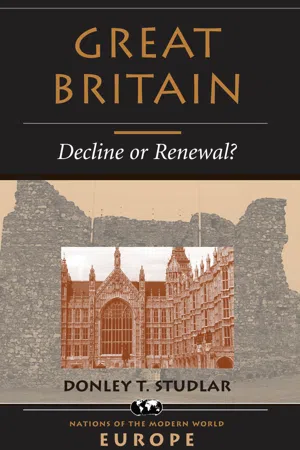
- 272 pages
- English
- ePUB (mobile friendly)
- Available on iOS & Android
eBook - ePub
About this book
This thoughtful introduction to British politics explores a country undergoing a painful transition as the twenty-first century approaches. Informed throughout by a comparative public policy perspective, it surveys British policy, institutions, and behavior since World War II.
Information
1 Introduction: Continuity and Change
The Importance of Britain
Forty years ago, former United States Secretary of State Dean Acheson said that Britain had lost an empire and had not yet found a new role to play in the world. In many ways that statement remains true today. The former confidence of Britons of all political persuasions has been eroded, now replaced by confusion about what roles, foreign and domestic, the country should play. Has there been too much change or too little in British life in the past half century? Did Thatcherism produce a social revolution or did it leave things much the same as they were before? Published analyses conflict—and not on political or ideological grounds alone. It is the purpose of this book to explore the sources of the confusion about how to characterize contemporary British social and political life.
Despite its overall decline in importance in the world, Great Britain is probably still the foreign country about which citizens and students of the United States know the most. Some of the most common bonds between the two countries include the British settlement of America, the ease of communication through common language, close diplomatic relations, use of the British parliamentary model, and the frequent citation of Britain as an economic and foreign policy example for the United States.
Although the closest physical neighbors of the United States, Canada and Mexico, are largely ignored unless what they are doing impinges directly on the interests of the United States, both elite and mass opinion in America reflects British influence. At 9:00 P.M. eastern standard time on Sunday night, for instance, most cable television subscribers across the United States can view either Masterpiece Theater on the Public Broadcasting System or Question Time in the House of Commons on C-SPAN. The personal problems of the monarchy are more often displayed on newsstands in the United States than are the personal problems of any U.S. leaders except the president. The author of a recent well-received journalistic survey of British culture and politics argues that, to a large degree, the elite public of the United States remains enamored of the country.1
Many people in the United States, then, know something about Britain. For many it is the repository of high culture and tradition, the origin of Western liberal democratic values, Christianity, and capitalism. For others its history embodies a warning about what can happen to a society that is class ridden, that relies too heavily on tradition, that does not adjust its economy to changing times, and that becomes too comfortable in its foreign leadership position.
Probably most citizens of the United States (and elsewhere) know less about Britain than they think they do. Of course, much remains the same in any country. But in the past half century, the United Kingdom has changed considerably, at least on the surface. For instance, Britain was recognized as the leading economic power in the world in the nineteenth century largely because of its espousal of industrialization and capitalism. Yet in the twentieth century many articles and books have been written arguing that what hampers Britain today is its continued embrace of its older, aristocratic traditions, which industrialization, urbanization, and capitalism did not overwhelm.2 Further, in Britain church and state are united, both through the monarchy and through various kinds of state support of church activities, ranging from religious instruction in schools to Church of England bishops sitting in the House of Lords. Yet Britons are among the least devout people of “Christian” countries; indeed, one could consider Britain a thoroughly secular country.
Change has been particularly evident in the political and economic realms in recent decades. Since 1970, Britain has no longer had a conventional two-party system, except in Parliament. The world’s first industrialized power has become the preeminent example of deindustrialization. What was once thought of (mistakenly) as a relatively homogenous society has been infused with multiracialism and multiculturalism, especially in urban areas. Parliamentary sovereignty has been compromised by membership in the European Community (EC), or European Union (EU), as it has also been called since 1991.
What has changed, then, and what has remained the same in Britain? What does the current balance of change portend for Britain’s global role in the twenty-first century? In this volume, I examine the social, economic, and political dimensions of Britain’s internal structure and external relations with focus on underlying explanations for continuity and change, especially concerning the trends of the last one-third of the twentieth century. History is examined selectively for its relevance to the contemporary situation of the country. The overriding question to be answered is this: Can Britain’s institutions adapt successfully to the changes facing them in the remaining years of the twentieth century and beyond?
Britain in the Modern World
In 1962, Anatomy of Britain, by British journalist Anthony Sampson, became a touchstone for analysts of British society, economics, and politics.3 With his access to political power brokers, Sampson was able to delineate a broad-based elite portrait of Britain in its Indian summer of postwar prosperity, through the country was troubled about the direction of its society and place in the world. His analysis of various social factors and attitudes and his questioning of the British capacity to adjust to new forces made Sampson’s viewpoint symptomatic of what has come to be called the “decline of Britain” school, a body of thought that continues to flourish today.4 By the 1990s, Sampson was still pessimistic about the direction of the United Kingdom, seeing the country as reluctant to become a full partner in the European Union and as having an overly centralized regime.5
This volume can be considered an attempt to continue this line of examination, though with a more focused political and academic content. No presumption of decline is made herein, as I examine British institutions and assess how well they are coping with the challenges put to them. The focus is on the post–World War II period, now a half-century old, a time period long enough to allow fair assessment. Britain has shared many political problems with West European countries and other advanced industrial countries elsewhere. These include problems of political identity, in the British case including the loyalties that some British citizens hold to such other political units as Wales, Scotland, Northern Ireland, the Irish Republic, and even the European Union. Although the United Kingdom is more frequently referred to as “deindustrialized” rather than “postindustrial,” some of the characteristics associated with postindustrial society, such as shifting values and forms of political participation among the mass public, have also affected the country. Issues such as equal rights for women, race relations, and treatment of the environment have at times risen to the forefront of political debate alongside the more perennial ones of the economy, social welfare policy, national security, and foreign relations. In an increasingly aging society, the question of the trade-off between social welfare administered by the state and allowing sufficient market flexibility to free the economy to be competitive with world market forces has become increasingly acute. Voter volatility has made political parties less certain that their preferred solutions will appeal to their constituents.
If a country does not stand still, neither does its external environment. Britain continues to be a major actor, not only in Europe but on the world stage as well, through its leading role in such organizations as the Group of Seven (G-7) leading industrialized economies, the European Union (formerly the European Community), and the North Atlantic Treaty Organization (NATO). As Europe has changed over the years through greater economic integration and the collapse of the Soviet empire in the East, Britain has played a major role. The choices it makes in these areas, as well as in such other areas as development of information technology, will determine whether Britain can remain an influential actor in the twenty-first century. Britain has to adapt to a changing regional and international environment, but its choices will also influence, however modestly, the direction of those environments.
One overriding question in regard to the potential influence of the United Kingdom internationally is whether its position will be enhanced or diminished by the greater fluidity of international affairs observable since 1989, which presumably will continue. Arguably, the country’s penchant for military strength and general solidarity with the United States helped maintain its international position during the Cold War despite its relative economic decline. How will the United Kingdom fare in a period in which alliances are in flux, military spending is in decline, the EU is enlarged and is perhaps more integrated politically as well as economically, and economic competitiveness is more important for international influence?
Britain has faced similar social, economic, and political challenges before. The innovative technology that led to the industrial revolution was one that Britain had to adapt to, as was the growth of liberalism (individual rights) and democracy (majority rule) as political movements. Internationally, the United Kingdom was able to move from the multipolar world of several major powers of the nineteenth and early twentieth centuries into the bipolar world of United States–Soviet competition after World War II. In fact, Britain is notable among countries for its capacity to adapt to changing circumstances while retaining many of its former characteristics.
Conflict and Change in Britain
Britain has often been viewed as an essentially stable society with conservative political institutions, albeit one that has been flexible enough to adapt when the social and political fabric seemed threatened. The British have avoided political revolution since the seventeenth century, for better or worse. Radicals have often become incorporated into the flexible framework of political institutions in the United Kingdom, becoming reformers. Thus Liberals, suffragettes, and Socialists became, in their fashion, defenders of a system that allowed them to reach at least some of their goals. This “aristocratic embrace” has been viewed with disdain by those immune to its seduction. Many go so far as to argue that what Britain needs is a genuine social revolution, for without that the necessary rearrangement of attitudes and institutions will never occur.
A key element in most accounts of how British society functions to disarm threats to its continuity is the flexibility of the unwritten English Constitution, first celebrated by Walter Bagehot in The English Constitution in the middle of the nineteenth century.6 When threats become too severe from insurgent groups, the Constitution can be readily altered, either by majority vote of the House of Commons or by changing customs and conventions rather than formal laws. The monarchy can be changed from absolutist to constitutional. The House of Lords can be stripped of its capacity as a coequal branch of the legislature yet continue to be chosen by the most undemocratic means of any legislative chamber in a liberal democracy. The right to vote can be expanded to new groups, but in stages rather than all at once.
In short, the flexibility of British institutions means that in order to change policy, it is necessary first to convince enough of the governing elite that policy should be changed. If that can be done, any institutional barriers to change can normally be readily overcome. Policy change is frustrated when the elite is insufficiently convinced to make the necessary institutional adjustments. That was the case with the Labour government’s attempt to introduce devolution (decentralization) for Scotland and Wales in the 1970s. Elite divisions within both parties have also been the major obstacle to full-scale British government acceptance of the demands of the European Union, making Britain an awkward partner for the other European countries over such issues as the Common Agricultural Policy, negotiation of the Maastricht Treaty for a more politically integrated European Community, and voting rights in the enlarged (fifteen-member) EU.
Even when demands for radical change threaten to overwhelm the system, the essential adaptable conservatism of the British elite comes to the fore. The most recent instance of this occurred in the 1970s and 1980s. As labor unrest and inflation surged, seemingly out of control, in the 1970s, expert opinion talked in alarmed tones of Britain’s “ungovernability,”7 the dangers of “elective dictatorships” through constitutionally unfettered major party control of the House of Commons through the executive,8 and the problems of “adversary government” (reversing previous policies, as on trade union legisla...
Table of contents
- Cover
- Half Title
- Title Page
- Copyright Page
- Contents
- List of Figures and Tables
- Acknowledgments
- List of Acronyms
- 1 Introduction: Continuity and Change
- 2 Britain in Historical and Geographical Context
- 3 The Development of Political Institutions
- 4 Political Forces: Organizations And Individuals
- 5 British Foreign Policy: From Great Power to European Periphery
- 6 Economic Policy: From Industrial Giant to Britaly
- 7 Social Welfare Policy: from Leader to Laggard
- 8 Social Regulatory Policies: From Public Morality to Social Permissiveness
- 9 Change And Institutional Adaptation In The United Kingdom
- Further Reading
- Bibliography
- About the Book and Author
- Index
Trusted by 375,005 students
Access to over 1.5 million titles for a fair monthly price.
Study more efficiently using our study tools.
Frequently asked questions
Yes, you can cancel anytime from the Subscription tab in your account settings on the Perlego website. Your subscription will stay active until the end of your current billing period. Learn how to cancel your subscription
No, books cannot be downloaded as external files, such as PDFs, for use outside of Perlego. However, you can download books within the Perlego app for offline reading on mobile or tablet. Learn how to download books offline
Perlego offers two plans: Essential and Complete
- Essential is ideal for learners and professionals who enjoy exploring a wide range of subjects. Access the Essential Library with 800,000+ trusted titles and best-sellers across business, personal growth, and the humanities. Includes unlimited reading time and Standard Read Aloud voice.
- Complete: Perfect for advanced learners and researchers needing full, unrestricted access. Unlock 1.5M+ books across hundreds of subjects, including academic and specialized titles. The Complete Plan also includes advanced features like Premium Read Aloud and Research Assistant.
We are an online textbook subscription service, where you can get access to an entire online library for less than the price of a single book per month. With over 1.5 million books across 990+ topics, we’ve got you covered! Learn about our mission
Look out for the read-aloud symbol on your next book to see if you can listen to it. The read-aloud tool reads text aloud for you, highlighting the text as it is being read. You can pause it, speed it up and slow it down. Learn more about Read Aloud
Yes! You can use the Perlego app on both iOS and Android devices to read anytime, anywhere — even offline. Perfect for commutes or when you’re on the go.
Please note we cannot support devices running on iOS 13 and Android 7 or earlier. Learn more about using the app
Please note we cannot support devices running on iOS 13 and Android 7 or earlier. Learn more about using the app
Yes, you can access Great Britain by Donley T Studlar in PDF and/or ePUB format, as well as other popular books in Politics & International Relations & Economic Policy. We have over 1.5 million books available in our catalogue for you to explore.