- 156 pages
- English
- ePUB (mobile friendly)
- Available on iOS & Android
eBook - ePub
About this book
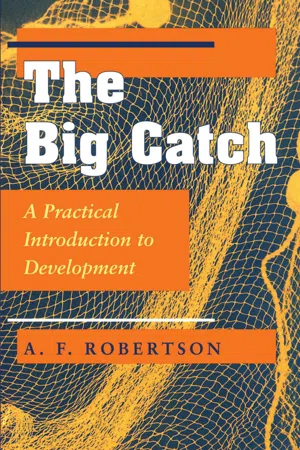
This interactive, role-playing case book is an enormously rich and stimulating way of challenging students to think about the problems of development and how development experts go about trying to alleviate them. One of the most innovative and eloquent anthropologists of development, A. F. Robertson has drawn from his extensive field experience to construct a hypothetical scenario of the sort typically encountered by those who are making development decisions.
Information

PART ONE: SPECIFICATIONS
From the Office of the President
1 Avenue of the Republic
Metropole 10001
ARCADIA
Tel: 201-3000 Fax:201-3131

2 June 1995
Dear
It is my pleasure to invite you, on the recommendation of the Cabinet Office, to join the Special Projects Advisory Committee (SPAC) of the National Planning Commission. The Committee consists of Arcadians from all walks of life (the business community, welfare services, the academy, etc.) who are distinguished by their commitment to the cause of social development in our country.
The President's Office and the Planning Commission hope that you will be able to commit yourself to several days' work with SPAC each month. Arrangements will be made with the organization for which you work to secure your services on secondment, with due compensation provided through Special Project funds.
Attached to this letter you will find a summary of the Special Projects initiative, and of the responsibilities of the Committee. To apprise you of items currently under discussion, I attach papers presented at the most recent meeting, held on May 21.
We ask you to join the Committee at its next meeting, scheduled for July 14. An agenda and documents for that meeting will be sent to you under separate cover.
I look forward to hearing your response to this invitation at your earliest convenience.
Yours sincerely,

Oscar M. Nipotente
Secretary to the Government of Arcadia
Secretary to the Government of Arcadia
NATIONAL PLANNING COMMISSION GOVERNMENT OF THE REPUBLIC OF ARCADIA
12 Avenue of the Republic Metropole 10001 Arcadia
“Helping People to Help Themselves”
Tel: 201-3333
Fax: 201-3344
REGIONAL PROJECTS DIVISION SPECIAL PROJECTS ADVISORY COMMITTEE
Introductory Notes
The Special Projects Advisory Committee (SPAC) was established under the provision of the Special Projects Act of 1990, by which the Government sought to revitalize regional development planning in Arcadia. Recognizing that many previous development initiatives had proved over-ambitious and wasteful, and had taken too little account of the interests of ordinary citizens, the Act sought to sponsor projects which were both more modest in scale and cost, and more precisely adapted to the needs, capacities and circumstances of people in particular localities. SPAC is involved very actively in this task: a group of informed citizens, applying their experience and common sense to the evaluation of Special Project proposals, and delivering concrete advice about how they should be put into effect.
Special Projects: “Helping People to Help Themselves”
The Special Projects Act of 1990 was a radical initiative in Arcadia. It was prompted by growing dissatisfaction with previous development planning efforts in Arcadia. Serious doubt had been cast on the economic, social, and political effectiveness of macro-planning, to which so much faith had been attached in the 1960s and 1970s. World recession and economic difficulties at home made it clear that development schemes should be much less grandiose, more realistically attuned to the needs and capacities of ordinary people, and more respectful of the natural resources at our disposal.
Special Projects strive to meet specific local needs in efficient and equitable ways. Imaginative and innovative, they must nevertheless operate realistically within the limited economic resources at our disposal. They seek new ways and means of improving the lives of all Arcadians, essentially by making better use of existing capacities, rather than setting up new agencies and increasing the costs of development. Above all, Special Projects seek to incorporate the interests and energies of local people, inspiring them to work both for their own prosperity and that of the nation.
The Special Projects Initiative is a response to recent shifts in Government policies on development. First and foremost is the desire to eliminate poverty throughout Arcadia and extend welfare services to neglected regions. The Government is committed to fostering both private and cooperative enterprises, and to developing businesslike attitudes and competence on which the survival of a small state in the modern world must depend. Special Projects are also expected to help stem the flow of people to depressed urban areas, by revitalizing the countryside. They must also take explicit account of underprivileged groups, and in particular they must seek to involve women as full, free and equal partners in development efforts.
A basic premise of Special Projects is to integrate the activities, resources and initiatives of diverse government departments in concrete development efforts: in other words, to focus the energies of existing agencies in cooperative development efforts. The Special Projects Act empowers the Planning Commission to forge immediate and effective links between government agencies in the field, bridging the gaps between one hierarchy and another, and slashing the red tape which prevents a local health officer from collaborating directly with a local teacher or businessman.
The purpose is not simply to eliminate waste and the duplication of effort, but to create synergy among Government departments, voluntary organizations, and private individuals at the local level. Special Projects typically assemble a package of basic infrastructure improvements (roads, water and electricity supply, clinics, etc.), most of which are installed and operated by existing agencies (the Ministries of Health or Education, the Public Works Department, the Cooperative Movement, etc.). Project management is usually assigned to one of these agencies, which then has the responsibility of coordinating inter-departmental efforts and mobilizing public activities around a basic plan (building a dam to raise crop yields, establishing a new factory, developing tourist resources, etc.).
One objective of the Special Projects Initiative is to adopt a more experimental approach to project design and implementation. We seek new development methods appropriate to the history, culture and physical capacities of Arcadia. Successful projects should be replicable, reducing the costs of design and implementation. However, they will not simply pursue fixed goals; they should be regarded as part of a continuous adaptive process based on the cooperative interaction of people and Government.
We need development which works, and which rewards both the needy and the industrious. Special Projects should endure as efficient and equitable enterprises, and serve the interests of all Arcadians, not simply small privileged groups.
Public Participation: The “Dialogue for Development”
Development planning in Arcadia hitherto has been criticized for a certain professional elitism which has failed to involve ordinary people in planning processes. Projects were devised by specialists in National and International bureaus, with too little reference to public interests. The failure of many ambitious development efforts can be attributed at least in part to official ignorance of local circumstances. As a result, the people who were supposed to be the beneficiaries of a project became its victims.
To remedy this, the Special Projects Act proposed three initiatives:
(a) Detailed consultation with local people from the earliest stages of every project;
(b) The collection by qualified social scientists of information about local needs, social values, attitudes, etc., which may elucidate the practicability and likely success of projects;
(c) The creation of a panel of lay people drawn from all walks of life, to scrutinize each Special Project proposal, and make concrete suggestions about how it should be implemented.
It is in the spirit of this third stipulation that the Special Projects Advisory Committee (SPAC) has been established. Chaired by the Director of the Regional Projects Division, it will consist of approximately twenty-four members, each appointed for a two-year term by the President of the Republic. The intention is to involve a group of intelligent and experienced lay people in the development planning process. They are invited to screen the basic plans for each Special Project, and to deliver advice to the Regional Projects Division on how it should be implemented. The projects considered will be very diverse, and the intention is to augment specialist inputs at the research and design stage with common-sense advice from a panel of ordinary citizens.
The approach is experimental. The performance of the Committee will be evaluated in three years by a Parliamentary Standing Committee established in 1991 to review the progress of the Special Projects Act.
NATIONAL PLANNING COMMISSION GOVERNMENT OF THE REPUBLIC OF ARCADIA
12 Avenue of the Republic Metropole 10001 Arcadia
“Helping People to Help Themselves”
Tel: 201-3333
Fax: 201-3344
REGIONAL PROJECTS DIVISION SPECIAL PROJECTS ADVISORY COMMITTEE
Agenda and documents for meeting - May 21
FISHERIES DEVELOPMENT PROJECT FOR ALPHA AND BETA
- At its meeting on May 21 next the Special Projects Advisory Committee will study documents relating to the proposed Fisheries Development Project for the villages of Alpha and Beta, and make general proposals for its implementation and management.
- Under the rubric of the current National Five Year Plan for Peace and Prosperity, the Ministry of Agriculture and Fisheries was invited to collaborate with the Regional Projects Division of the National Planning Commission on the specification of a project or projects for the development of this coastal region of Arcadia.
- People in this region are almost wholly dependent on inshore fishing with small craft, the catch being sun-dried and disposed of locally. Per capita income is low, an estimated one-third of the national average, and local amenities and standard of living are among the poorest in Arcadia. An opportunity for development is suggested by various coastal surveys, which have indicated that much more extensive use could be made of off-shore fish stocks.
- It was agreed that a small, viable project should be designed for the villages of Alpha and Beta. The project should raise significantly the incomes and standard of living of the project participants. Prompt action and basic social and planning costs are justified under the Special Projects (Provisions) Act of 1990, in terms of the backwardness of this region and the possibility of replicating a “package” of improvements in other coastal areas.
- A joint Ministry of Agriculture and Fisheries / Regional Projects Division Working Group laid down guidelines for a project to develop mechanized production of fresh fish for sale on the national market and possibly for export. Under a technical assistance agreement with the Arcadian Ministry of Agriculture and Fisheries, the International Fisheries Institute of the UN Food and Agriculture Organization carried out feasibility studies for the project, and made basic technical proposals. The IFI Mission's summary report is attached hereto.
- Basic specifications for reorganization of fishing and fish processing activities would involve:
- – The introduction of motor launches to extend the range of fishing and the efficiency of operations;
- – The establishment of a cleaning and processing plant to prepare fresh fish for wider distribution;
- – The improvement of harbor facilities;
- – The upgrading of the existing road link to the main coastal highway.
- Under the terms of the Special Projects Act, each component of this basic infrastructure package has been ratified with the various Government Ministries and Agencies, provision being contingent on the fisheries development project being put into effect. Construction of road and harbor facilities will be coordinated by the Public Works Department, and will be funded on the basis of non-recurrent grants. As part of this infrastructure package, a new community center will be built to house health, welfare and community development facilities sponsored by the appropriate government departments.
- Operation of the project will be placed under the supervision of the National Fishermen's Cooperative Union, subject to managerial guidelines laid down by the Planning Commission. Fishing vessels of a class specified in the technical reports will be provided under the terms of a current trade agreement with the Government of Illyria. Loans for the purchase of these craft, and for construction of the processing plant, will be made under the provisions of the Special Projects Act. Cost of establishing and o...
Table of contents
- Cover Page
- Half Title
- Title Page
- Copyright Page
- Table of Contents
- Acknowledgments
- A Note on Weights and Measures
- Introduction
- The Arcadian Argus: “Coastal VIllages Brace Themselves for Transformation”
- Introduction
- From Development Trends 1991: “Republic of Arcadia”
- Part One: Specifications
- Part Two: Proposals
- Part Three: The Exercise
- Reading Guide
Trusted by 375,005 students
Access to over 1.5 million titles for a fair monthly price.
Study more efficiently using our study tools.
Frequently asked questions
Yes, you can cancel anytime from the Subscription tab in your account settings on the Perlego website. Your subscription will stay active until the end of your current billing period. Learn how to cancel your subscription
No, books cannot be downloaded as external files, such as PDFs, for use outside of Perlego. However, you can download books within the Perlego app for offline reading on mobile or tablet. Learn how to download books offline
Perlego offers two plans: Essential and Complete
- Essential is ideal for learners and professionals who enjoy exploring a wide range of subjects. Access the Essential Library with 800,000+ trusted titles and best-sellers across business, personal growth, and the humanities. Includes unlimited reading time and Standard Read Aloud voice.
- Complete: Perfect for advanced learners and researchers needing full, unrestricted access. Unlock 1.5M+ books across hundreds of subjects, including academic and specialized titles. The Complete Plan also includes advanced features like Premium Read Aloud and Research Assistant.
We are an online textbook subscription service, where you can get access to an entire online library for less than the price of a single book per month. With over 1.5 million books across 990+ topics, we’ve got you covered! Learn about our mission
Look out for the read-aloud symbol on your next book to see if you can listen to it. The read-aloud tool reads text aloud for you, highlighting the text as it is being read. You can pause it, speed it up and slow it down. Learn more about Read Aloud
Yes! You can use the Perlego app on both iOS and Android devices to read anytime, anywhere — even offline. Perfect for commutes or when you’re on the go.
Please note we cannot support devices running on iOS 13 and Android 7 or earlier. Learn more about using the app
Please note we cannot support devices running on iOS 13 and Android 7 or earlier. Learn more about using the app
Yes, you can access The Big Catch by A. F. Robertson in PDF and/or ePUB format, as well as other popular books in Sciences sociales & Économie du développement. We have over 1.5 million books available in our catalogue for you to explore.