Treatment Marshes for Runoff and Polishing
eBook - ePub

Treatment Marshes for Runoff and Polishing

  1. 1,030 pages
  2. English
  3. ePUB (mobile friendly)
  4. Available on iOS & Android
eBook - ePub

Treatment Marshes for Runoff and Polishing

About this book

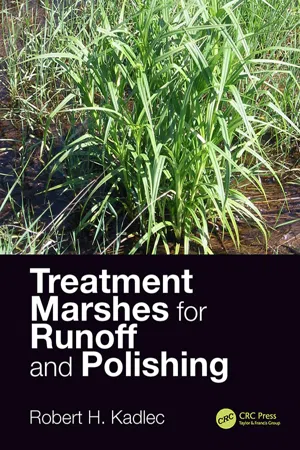
Treatment Marshes for Runoff and Polishing represents the most comprehensive and up-date-date resource for the design, construction, and operation of marsh treatment systems.

This new edition represents a complete rewrite of the surface flow sections of previous editions of Treatment Wetlands. It is based on the performance hundreds of treatment marshes over the past 40 years. Treatment Marshes focuses on urban and agricultural runoff, river and lake water improvement, and highly treated municipal effluents.

New information from the past dozen years is used to improve data interpretation and design concepts. Topics included in this book are


  • Diversity of marsh vegetation


  • Analyses of the human use of treatment marshes


  • New concepts of underground processes and functions


  • Spectrum of marsh values spanning mitigation, restoration, enhancement, and water quality improvement


  • Improved methods for calculation of evapotranspiration and wetland water temperatures


  • Hydraulics of surface and subsurface flows in marshes


  • Analysis of long track records for deterministic and probabilistic behavior


  • Consideration of integrated microbial and vegetative contaminant removals via mass balances


  • Uptake and emission of gases


  • Performance of urban and agricultural wetlands


  • Design procedures for urban and agricultural wetlands


  • Reduction of trace metals, pesticides, pharmaceuticals, endocrine disruptors, and trace organics


  • Updated capital and O&M economics, and valuation of ancillary benefits


  • An updated list of over 1900 references

Frequently asked questions

Yes, you can cancel anytime from the Subscription tab in your account settings on the Perlego website. Your subscription will stay active until the end of your current billing period. Learn how to cancel your subscription.
No, books cannot be downloaded as external files, such as PDFs, for use outside of Perlego. However, you can download books within the Perlego app for offline reading on mobile or tablet. Learn more here.
Perlego offers two plans: Essential and Complete
  • Essential is ideal for learners and professionals who enjoy exploring a wide range of subjects. Access the Essential Library with 800,000+ trusted titles and best-sellers across business, personal growth, and the humanities. Includes unlimited reading time and Standard Read Aloud voice.
  • Complete: Perfect for advanced learners and researchers needing full, unrestricted access. Unlock 1.4M+ books across hundreds of subjects, including academic and specialized titles. The Complete Plan also includes advanced features like Premium Read Aloud and Research Assistant.
Both plans are available with monthly, semester, or annual billing cycles.
We are an online textbook subscription service, where you can get access to an entire online library for less than the price of a single book per month. With over 1 million books across 1000+ topics, we’ve got you covered! Learn more here.
Look out for the read-aloud symbol on your next book to see if you can listen to it. The read-aloud tool reads text aloud for you, highlighting the text as it is being read. You can pause it, speed it up and slow it down. Learn more here.
Yes! You can use the Perlego app on both iOS or Android devices to read anytime, anywhere — even offline. Perfect for commutes or when you’re on the go.
Please note we cannot support devices running on iOS 13 and Android 7 or earlier. Learn more about using the app.
Yes, you can access Treatment Marshes for Runoff and Polishing by Robert H. Kadlec in PDF and/or ePUB format, as well as other popular books in Biological Sciences & Environmental Management. We have over one million books available in our catalogue for you to explore.

Information

1Introduction

Treatment wetlands in general are plant-soil-water systems utilized to promote water quality improvement. This book expands and modernizes information concerning a specific type of treatment wetland, the free water surface system, often called a marsh. It is further restricted to waters at relatively low contaminant concentrations. As a consequence, it is positioned in the gap between ecological desires for wetland restoration and preservation, and engineering concerns for reliable and economical methods for water quality improvement.
The focus of this book is upon constructed marshes rather than the use of natural marshes. Some treatment marshes will be built on former wetland sites, putting them in a category of restoration projects. Others will be built on an existing upland sites and are then in the category of newly constructed wetlands. In other cases, contaminated waters may be introduced into existing wetlands. The fundamental mechanisms of water quality improvement and ecological response are similar in all cases, and the principles of operation and performance forecasting are not different.

1.1 WHY THE WORD MARSH

Within the community of treatment wetland practitioners, systems with exposed water came to be known as free water surface wetlands, beginning somewhere in the late 1970s.They are part of the larger set of treatment wetlands in general (Fonder and Headley, 2013). Within the larger community of wetland scientists, that new terminology is not in common use, and the much older name of marsh has remained in primary usage. Because this book focuses upon systems that both ecological value and water quality improvement benefits, the term treatment marsh is employed. This name is an attempt to bridge the gap between wetland science and wastewater treatment technology, and it corresponds to the wetland systems that will be discussed.
This choice is also driven by the wish for simplicity of terminology. Marshes have single word designations in a variety of languages, whereas free water surface wetlands require three to seven word names (Table 1.1).
TABLE 1.1
Marshes and wetlands in several languages.
Language Wetland Marsh FWS Wetland
English wetland marsh free water surface wetland
Spanish humedale pantano humedal libre de la superficie del agua
German Feuchtgebiete Sumpf freie WasseroberflÀche Feuchtgebiet
French zones humides marais surface humide de l’eau libre
Czech mokƙadĆŻ baĆŸina volnĂ© vodnĂ­ plochy mokƙadĆŻ
Swedish vÄtmark kÀrr fri vattenyta vÄtmark
Danish vÄdomrÄde marsk fri vandoverflade vÄdomrÄde

1.2 SCOPE AND CONTEXT

RELATION TO RESTORATION

Restoration is the manipulation of the physical, chemical, or biological characteristics of a site with the goal of returning the natural/historic functions of the wetland. Restoration is commonly divided into re-establishment, rehabilitation, and creation. Re-establishment refers to the goal of returning natural/historic functions to a former wetland Rehabilitation refers to the goal of repairing natural/historic functions of a degraded wetland. Creation is the construction of a wetland in an area that was not a wetland in the recent past. Implicit in this terminology is the expectation that all wetland functions are to be present, including water quality improvement, floodwater storage, fish and wildlife habitat, aesthetics, and biological productivity (U.S. EPA, 2002).
Mitigation is a term that frequently occurs in connection with restoration, and refers to “the restoration, creation, or enhancement of wetlands to compensate for permitted wetland losses” (Lewis, 1989). Under Section 404 of the Clean Water Act of the USA, wetlands may be legally destroyed, but their loss must be compensated for by the restoration, creation, or enhancement of other wetlands.
When the word treatment is added to the wetland category, it means that the water quality improvement function has primacy, but certainly not to the exclusion of other functions.
This book does not detail the various guidance publications concerning restoration and mitigation (e.g., Ruiz et al., 2013; Biebighauser, 2015; Craft, 2016). This subject is left to other publication venues.

PREDECESSOR BOOKS

Third Edition?

This work builds upon concepts set forth in two predecessor books:
Kadlec and Knight (1996). Treatment Wetlands, CRC Press; and
Kadlec and Wallace (2009). Treatment Wetlands, second edition, CRC Press.
Much of the material in these two predecessor volumes will not be repeated here, either because it is not relevant to the marsh context, or because it has receded to the level of historical interest only. Because of their functional utility, many of the mathematical diagnostics are retained.
These covered a wide range of wetland types and applications. It is no longer feasible to place the numerous modern science and technology developments in a single volume, hence this book is restricted to treatment marshes, as further defined later in this chapter. Nevertheless, the systems covered are the large majority of all treatment wetlands, based upon acreages and water volumes treated. The excluded treatment wetlands are more numerous, but of hugely smaller size.

Relevant Wetland Science Books

There exists a wealth of published information about general wetland science. The reader may consult any of several texts, prominently including:
  • Biogeochemistry of Wetlands: Science and Applications, KR Reddy and R DeLaune, (2008). CRC Lewis Publishers; Boca Raton, Florida.
  • Wetland Ecology Principles and Conservation, PA Keddy (2010). Cambridge University Press; Cambridge, United Kingdom.
  • The Biology of Freshwater Wetlands, A van der Valk (2012). Oxford University Press, Oxford, England.
  • Wetlands, 5th edition, WJ Mitsch and JG Gosselink, (2015). John Wiley and Sons, Hoboken, New Jersey, 456 pp.
  • The Ecology of Freshwater and Estuarine Wetlands, DP Batzer and RA Sharitz (eds.) (2014). University of California Press, Berkeley, California.
  • Wetland Plants: Biology and Ecology, JK Cronk and MS Fennessey (eds.) (2001). Lewis Publishers; Boca Raton, Florida, 462 pp.
  • Wetland Soils, JL Richardson and MJ Vespraskas (eds.), (2001). Lewis Publishers, Boca Raton, Florida, 417 pp.
  • The Wetlands Handbook, E Maltby and T Barker (eds.) (2009). John Wiley and Sons, Hoboken, New Jersey, 800 pp.
Additionally, there are many compilations of research results for specific regional situations. These are for diverse locations, including, for example:
Czech Republic:
Freshwater Wetlands and Their Sustainable Future: A Case Study of the Trebon Basin Biosphere Reserve, Czech Republic, J Kvet, J Jenik and L Soukupova (eds.) 2002. Parthenon Publishing, 495 pp.
Canada:
Prairie Wetland Ecology, HR Murkin, AG van der Valk and WR Clark (eds.) 2000. Iowa State University Press; Ames, Iowa, 413 pp.
Florida:
Phosphorus Biogeochemistry in Sub-Tropical Ecosystems, KR Reddy, GA O’Connor and CL Schelske (eds.) 1999. Lewis Publishers; Boca Raton, Florida, 707 pp.
The Everglades Experiments: Lessons for Ecosystem Restoration, CJ Richardson (ed.), 2008. Springer, New York, 698 pp.
When combined with periodicals focused on wetlands, such as the journal Wetlands, these form a formidable collection of scientific works that explore many facets of wetland behavior and character.
EXCLUSIONS

The information from marshes has been restricted in several ways in this work, so that the database is relevant and useful for data interpretation and design sizing. First, size matters, because of issues of scale-up. Microcosms and mesocosms are useful for investigating component processes, and in general are easily replicated to bolster statistical confidence. Because of edge effects, small systems do not have representative vegetation densities, nor are they typically exposed to a realistic set of meteorological conditions. They usually contain only a few of the components of a large system, such as soil without plants, litter, or animals. The components of the ecosystem, including plants, algae and microbes, are exposed to a time changing water chemistry, which is different from the spatially distributed patterns of these alo...

Table of contents

  1. Cover
  2. Half Title
  3. Title Page
  4. Copyright Page
  5. Preface
  6. Acknowledgements
  7. Author Biography
  8. Chapter 1.  Introduction
  9. Chapter 2.  Hydrology
  10. Chapter 3.  Surface Water Movement
  11. Chapter 4.  The Marsh Underground
  12. Chapter 5.  Microbial and Plant Communities
  13. Chapter 6.  Energy Flows and Temperature
  14. Chapter 7.  Representing Treatment Performance
  15. Chapter 8.  Suspended Solids
  16. Chapter 9.  Nitrogen
  17. Chapter 10.  Phosphorus
  18. Chapter 11.  Event-Driven Systems
  19. Chapter 12.  Ancillary Substances
  20. Chapter 13.  Trace Metals
  21. Chapter 14.  Trace Organics
  22. Chapter 15.  Ecological Perspective
  23. Chapter 16.  Footprints and Performance
  24. Chapter 17.  Interior Design and Construction
  25. Chapter 18.  Management, Operations, and Maintenance
  26. Chapter 19.  Economics
  27. References
  28. Index