eBook - ePub
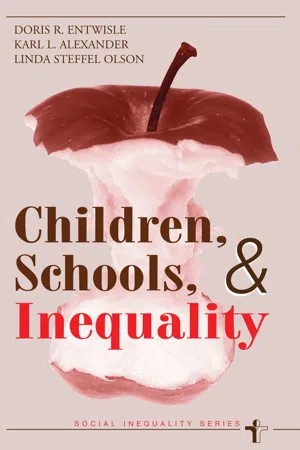
Children, Schools, And Inequality
- 256 pages
- English
- ePUB (mobile friendly)
- Available on iOS & Android
eBook - ePub
Children, Schools, And Inequality
About this book
Educational sociologists have paid relatively little attention to children in middle childhood (ages 6 to 12), whereas developmental psychologists have emphasized factors internal to the child much more than the social contexts in explaining children's development. Children, Schools, and Inequality redresses that imbalance. It examines elementary school outcomes (e.g., test scores, grades, retention rates) in light of the socioeconomic variation in schools and neighborhoods, the organizational patterns across elementary schools, and the ways in which family structure intersects with children's school performance. Adding data from the Baltimore Beginning School Study to information culled from the fields of sociology, child development, and education, this book suggests why the gap between the school achievement of poor children and those who are better off has been so difficult to close. Doris Enwistle, Karl Alexander, and Linda Olson show why the first-grade transition?how children negotiate entry into full-time schooling?is a crucial period. They also show that events over that time have repercussions that echo throughout children's entire school careers. Currently the only study of this life transition to cover a comprehensive sample and to suggest straightforward remedies for urban schools, Children, Schools, and Inequality can inform educators, practitioners, and policymakers, as well as researchers in the sociology of education and child development.
Information
1
Children and Inequality
Letitia is "8 years old, female, and the color of cinnamon... A few weeks ago she completed the second grade in a public school in one of Baltimore's most impoverished neighborhoods. For her good work she received a trophy inscribed with her name. But for a battery of tests, results were dismal...In four years Letitia won't need overt discrimination to stay glued to the margins of the American dream."
—M. P. Fernandez-Kelly, Baltimore Evening Sun, July 12, 1991
This book is about social inequality and children's early schooling. Its purpose is to shed light on the many ways that social structure penetrates and shapes the early schooling of U.S. youngsters, especially in ways that are hidden or overlooked. The major question it seeks to answer is how early schooling may create advantages for some children and disadvantages for others, or put another way, why some children seem to derive more benefit from schooling than others do.
The intellectual legacies undergirding this book draw from three main traditions. The first, which could be described as "mainstream child development," picks up where projects like the Collaborative Perinatal Study leave off when they conclude that social factors far outweigh biological or medical factors in explaining children's success in school. The second is a subfield of status attainment in sociology that focuses on how social resources of families, schools, and communities support schooling and children's cognitive growth. The third tradition is research on human development that takes a life course perspective and emphasizes such things as how parents' sudden loss of income affects their children's psychological well-being, or how becoming a teenage mother affects a woman's work career. A few words will make clear how each of these legacies contributes to our understanding of social inequality and children's early schooling.
Somewhat belatedly, child developmentalists came to realize that, without doing long-term and large-scale research in natural settings, children's development cannot be fully understood. For example, in the mid-fifties, the National Collaborative Perinatal Study began to monitor children born into 50,000 families in fourteen sites scattered across the country. Its purpose was to see how specific medical events in the perinatal period affected developmental disorders in children over the long term. The implicit hypothesis was that there would be fairly clear connections between medical events and the disorders, one, for instance, being why some children of normal intelligence do poorly in school. It turned out, however, that by age four, the intellectual status of children in the study was far better explained by eight variables related to their family's characteristics such as lower socioeconomic status or less maternal education, than by any of the 161 biomedical variables that assessed the condition of mother and child through the first year after the birth (Broman, Nichols, and Kennedy 1975). At the age of seven, about one thousand of these children who had normal intelligence but poor school performance were compared with six thousand others in the same study whose school performance was "normal." Sameroff (1985, p. ix) summarized the findings as follows: The "primary causal factors [of poor performance] reside not in the child's biomedical history but in ... the social context of development;... lower socioeconomic status, less maternal education, higher birth order and larger family size related to higher rates of academic failure." Similarly, Werner's (1980) research on Hawaiian children, which is also prospective and longitudinal, implicates social status and the family caretaking environment rather than severe perinatal stress as the most powerful predictor of childhood learning and behavior disorders.
At about the same time that studies like those just cited convinced mainstream child developmentalists of how strongly children's social environments could affect their development, sociologists began serious study of how one generation confers social status upon the next (Blau and Duncan 1967). Their research centered on how and why individuals sort themselves into occupations of varying prestige, and more particularly on how individuals obtain the educational credentials that govern this occupational sorting. With few exceptions, students in high school or college rather than students in preor elementary school monopolized sociologists' attention (see e.g., Sewell and Hauser 1976). Continuing efforts to model the process of secondary schooling with better and better data and with more elaborate models were not matched by efforts to understand schooling at the elementary level, however. In fact, until recently, sociologists left studies of young children and their schooling mainly to others, even though in the U.S. successive levels of schooling are tightly articulated. Curiously, the earliest grades, including the first-grade transition, have been the most neglected even though they set the stage for all that follows. In our opinion, this neglect of schooling in the earliest grades seriously undercuts understanding of how social inequality is created and maintained, for reasons that this book will make clear.
A third intellectual legacy, and in some ways the most fundamental, is the growing body of research on human development that takes a life course approach, beginning with Elder's (1974) Children of the Great Depression. These studies testify to the crucible nature of social context for children's early development. They also assume that development is to a considerable extent malleable, and in this regard they contrast sharply with earlier child development studies derived from a Freudian perspective which saw the quality of adult life as more or less fixed by early childhood events. The life course approach emphasizes the importance of social context for human development at every life stage and emphasizes change as well as continuity in development. For example, in early work that traced the connections between family income loss in the Great Depression and youngsters' life chances, Elder found that in families who suffered equally severe economic deprivation, daughters in working class families were given less chance for higher education than daughters of middle class families. More recent studies taking similar approaches examine why parents' marital disruption depresses children's school performance (Morrison 1992), or how a mother's being on welfare affects an adolescent's well-being (Furstenberg et al. 1987), or how gender differences in children's first-grade marks affect high school drop-out (Ensminger and Slusarcick 1992), or how quality of neighborhoods may affect children's cognitive development (Entwisle, Alexander, and Olson 1994). A life course approach thus focuses attention on the social processes that could explain why family economic status is associated with cognitive development, as found in the Perinatal Study, or on why gender matters for educational attainment, as in the status attainment research. All three traditions are dedicated to explaining human development, but the life course approach places more emphasis on explaining effects of social context on children's development than do the other two.
This book deals with children's schooling in their middle childhood years (ages 6 to 12). It examines how the inequity embedded in the various dimensions of social structure-school and family organization, family socioeconomic status, gender, and age—affect schooling. We picked these topics because we can add something new to the discussion of each drawing upon data from the Beginning School Study (BSS), a longitudinal prospective investigation of children's schooling, still in progress. Other important social inequities that affect children's schooling which are not on this list, like those created by women's labor force participation or children's physical impairments are omitted, not because we doubt their importance but because the Beginning School Study data can add little to what is presently known about them
Social Stratification
Rigid social stratification begins when children start their formal schooling, or even before, yet much of the social sorting at this point in life is overlooked. For one reason, there are still few national data on children's schooling prior to kindergarten. Sociologists have also been preoccupied with how socioeconomic stratification affects secondary schools rather than elementary schools. Research with secondary students, however, can say little about schooling for younger students because of differences in the capabilities and developmental needs of children in middle childhood as compared with those in adolescence. Also, although it tends to be overlooked, the organizational patterns of elementary schools are quite different from those of secondary schools (Chapter 4). Having said that, we must add that the larger demographic trends that undercut children's performance in secondary school certainly have negative consequences for younger children's schooling as well. In what follows, a thumbnail sketch of recent population shifts and economic trends in Baltimore suggests why.
Baltimore and other cities like it have elementary schools that operate increasingly at the margins of society. Instead of bringing various groups together—African Americans with whites and rich with poor—urban elementary schools are growing more and more isolated from each other and from the larger society. They are not providing paths for children to take toward upward mobility and improved life chances; rather they are evolving more and more into institutions that embody the most intractable of America's social problems: racial segregation and economic polarization. Increasing concentrations of poverty in inner city neighborhoods, as described by Wilson (1987) and others, lead to social isolation and neighborhood decay in U.S. cities. This isolation profoundly affects elementary schools because they are neighborhood schools, even in the largest cities. When other institutions like churches, banks, libraries, stores, and recreational facilities are no longer in neighborhoods, the task of the elementary school is made that much harder.
A key way that the concentrated poverty in inner city neighborhoods touches not just those mired in poverty, but also children struggling to survive at its edges, is that the poorest of them attend elementary schools with others who, like themselves, are severely deprived (see Neckerman and Wilson 1988). At the elementary level, school demographics closely follow residential patterns. For example, in 1970 Baltimore was still a majority white city (53%), but between 1970 and 1990, the white population decreased to 39% while the African American population increased to 59% (U.S. Bureau of the Census 1973; 1991a). This racial re-alignment was accompanied by a rise in poverty; between 1970 and 1990 the percentage of the population in poverty rose from 14% to 22%. But the 1990 Census for Baltimore shows that for school children, poverty was even worse: 31.5% of children were in poverty, including about 49% of the female headed households with children under age 18 (U.S. Bureau of the Census 1991b). Not surprisingly, these demographic changes profoundly affected the public schools, because the city's growing concentration of poor led to a declining revenue base with which to finance City services, including education. By 1983, the net taxable income of Baltimore was 32% below the regional average and the 1984 local assessable property base fell to 41% below the average for the region.
As the financial underpinnings of Baltimore City weakened, faith in the public school system eroded. Between 1970 and 1987 the City lost 17% of its population, but public school enrollment declined even more, by nearly 43%. Part of this decline can be attributed to the nationwide baby-bust of the 1970s, but the decline also reflects a determined effort on the part of some segments of the population to avoid the public schools, either through migration from the City or enrollment in private schools.
In 1980, whites made up 44% of Baltimore's population but their representation in the public schools had fallen to around 22%, Only three-fifths of white families with school-age children enrolled them in public elementary schools. Ten years later, in 1989-90, white enrollment in the Baltimore Public Schools stood at only 18% (Maryland State Department of Education 1990). As the white public school population fell, racial segregation intensified. By 1990, in 65% of the City's elementary schools, over 90% of the students were African American, and a majority (58%) of the white students attended the few elementary schools (14%) with white enrollments of 75% or more (Baltimore City Public Schools 1992). Or, put another way, by 1990,12 of the 118 elementary schools in Baltimore (about 10%) had student bodies that were less than 10% African American; about 25% were integrated, that is from 11% to 89% African American, and over 65% were almost entirely African American (90% to 100%).
Besides becoming more segregated, Baltimore's public school population has become progressively more disadvantaged. In 1990-91, 62% of public elementary school students were receiving meal subsidy, a figure that somewhat underrepresents the true need since not all of those who would qualify apply for the program. In elementary schools, the proportion of students on meal subsidy ranged from a low of 5% in some schools to a high of 100% in others, but in only 7 schools was the proportion below 25% (Baltimore City Public Schools 1991).
Increasing racial segregation has occupied center stage in school board directives and court decisions, but it is a serious mistake to downplay segregation by socioeconomic status (see Wilson 1987). Within elementary schools, segregation by socioeconomic status is much more pronounced than it is in secondary schools. For example, in the early 70s, almost half (47 percent) of the eight to eleven-year-olds in a random sample of Baltimore children attended schools where the variation in social class within the school was less than half of what it was for children fifteen years old or more in the same sample (Rosenberg 1979). Or, put more loosely, elementary schools were twice as segregated by socioeconomic status as high schools. The school-to-school variation in mothers' median education reveals this same cloistering by socioeconomic status. The average education of mothers across elementary schools ranged from 8.1 to 12.7 years, and exceeded the range for mothers (8.8 to 11.4 years) across secondary schools even though secondary schools are on average about 3 times as large as elementary schools (Maryland State Department of Education 1976). Similarly, the percentage of Baltimore students participating in the meal subsidy program also spanned a greater range (5% to 100%) across elementary schools than across high schools (8% to 65%) (Baltimore City Public Schools 1991).
These figures underline the extreme variation in socioeconomic status of children across elementary schools. The social climate in a small elementary school where the average student's mother has some college and where only a sprinkling of students are poor is quite different from the climate in a school where the average student's mother is a high school drop-out and where virtually all students are on meal subsidy. Johnson (1995), in interviews with about 100 white mothers of Baltimore public school students, found that mothers with less than a high school education typically worked at unskilled jobs such as custodian or grocery bagger, lived in sparsely furnished, rented houses, and even when they pooled income with a partner (who typically also held an unskilled job), their joint income barely exceeded the poverty line for a family of four (around $24,000 in 1992). By contrast, she found that mothers of public school students with some college typically worked as teachers or office managers, owned homes in middle class neighborhoods, and had a joint income more than twice that of the mothers with less than high school diploma (over $50,000). Because of the marked variability in family circumstances across elementary schools, almost all youngsters in some schools thus live at or below the poverty line with parents who are drop-outs, while in other schools, almost all youngsters live in settings that are financially comfortable with parents who have a high school education or better.
This book uses data for Baltimore children to show how differences in family circumstances translate into beliefs and activities that help or hinder children's development. (See Chapters 3,5, and 6.) For example, if mothers have less than a high school education, children are less than half as likely to go to the public library in the summer after the second year of school as are children of mothers with 2 or more years of college (35% versus 78%). Or, to take another example, if mothers are drop-outs, they expect their children to get a C in reading on their first report card, while mothers with 2 or more years of college expect their children to get solid B's. Not surprisingly, activities like going (or not going) to the library, lead children to perform at the levels parents expect.
Schooling and Inequality
The literature on schooling and inequality builds on two recurrent themes. One involves identifying family characteristics like those just mentioned and others that could explain the link between socioeconomic status and children's success in school: parent's educational level, economic status, family type, and the like. The other theme involves identifying features of schools that help some students do better than others, such things as school size, school climate, grouping practices, and curriculum structure. This book will draw upon both streams of research, but with certain key modifications and changes in emphasis. A number of large scale studies show that family socioeconomic status is the key predictor of secondary school youths' educational attainment-for example, the correlation between fathers' occupational status and the number of years of schooling their sons achieved is .42 (Duncan, Featherman, and Duncan 1972). But models to explain the schooling of poor elementary children are not necessarily the same as those that explain the schooling of relatively advantaged secondary students. For one thing, many young children these days lack continuous (or any) contact with their fathers, and therefore cannot draw upon the economic resources of fathers that play such a prominent role in the secondary school models. For another, family characteristics may relate differently to the schooling of younger as compared to older children. A mother's never having been married is associated very weakly with children's behavior problems at the preschool stage, but is more strongly linked to children's problems in adolescence, whereas a mother's being on welfare has negative effects at both stages (Furstenberg et al. 1987).
As far as features of schools are concerned, the extensive studies of high school tracking and school climate (Entwisle 1990) have little relevance because the organizational features of elementary schools are different from those of secondary schools. For example, students' social status vis-a-vis their peers in high school is determined in considerable part by their attractiveness to members of the opposite sex, whereas in elementary school children are mostly below the age of puberty. Nevertheless, because high schools are tracked, high school tracking prompted us to search out the hidden tracks in elementary school ("Special Education" and retention). Studies of high school climate call to mind other issues, such as teachers' differential grading of students ...
Table of contents
- Cover
- Half Title
- Title
- Copyright
- Contents
- List of Tables, Figures, and Charts
- Preface
- Chapter One: Children and Inequality
- Chapter Two: The Nature of Schooling
- Chapter Three: Low Socioeconomic Status
- Chapter 4: Elementary School Organization
- Chapter 5: Family Configuration
- Chapter Six: The Pluses and Minuses of Being Male
- Chapter Seven: The Overall Picture
- Appendixes: The Beginning School Study
- References
- Index
- About the Book and Authors
Trusted by 375,005 students
Access to over 1.5 million titles for a fair monthly price.
Study more efficiently using our study tools.
Frequently asked questions
Yes, you can cancel anytime from the Subscription tab in your account settings on the Perlego website. Your subscription will stay active until the end of your current billing period. Learn how to cancel your subscription
No, books cannot be downloaded as external files, such as PDFs, for use outside of Perlego. However, you can download books within the Perlego app for offline reading on mobile or tablet. Learn how to download books offline
Perlego offers two plans: Essential and Complete
- Essential is ideal for learners and professionals who enjoy exploring a wide range of subjects. Access the Essential Library with 800,000+ trusted titles and best-sellers across business, personal growth, and the humanities. Includes unlimited reading time and Standard Read Aloud voice.
- Complete: Perfect for advanced learners and researchers needing full, unrestricted access. Unlock 1.5M+ books across hundreds of subjects, including academic and specialized titles. The Complete Plan also includes advanced features like Premium Read Aloud and Research Assistant.
We are an online textbook subscription service, where you can get access to an entire online library for less than the price of a single book per month. With over 1.5 million books across 990+ topics, we’ve got you covered! Learn about our mission
Look out for the read-aloud symbol on your next book to see if you can listen to it. The read-aloud tool reads text aloud for you, highlighting the text as it is being read. You can pause it, speed it up and slow it down. Learn more about Read Aloud
Yes! You can use the Perlego app on both iOS and Android devices to read anytime, anywhere — even offline. Perfect for commutes or when you’re on the go.
Please note we cannot support devices running on iOS 13 and Android 7 or earlier. Learn more about using the app
Please note we cannot support devices running on iOS 13 and Android 7 or earlier. Learn more about using the app
Yes, you can access Children, Schools, And Inequality by Doris R Entwisle,Karl Len Alexander,Linda Steffel Olson in PDF and/or ePUB format, as well as other popular books in Education & Education General. We have over 1.5 million books available in our catalogue for you to explore.