1.1Climate–Soil Interaction
1.2Soil Life and the Atmosphere
1.3Impacts of Climate on Soil
1.4Impacts of Soil on Climate
1.5The Soil–Climate–Water–Energy Nexus
1.6The Soil–Climate Ecosystem Services
1.7Managing Soils to Mitigate Climate Changes
1.8Soil Health and Climate Change
1.9Translating Science into Action
1.10Conclusions
References
1.1Climate–Soil Interaction
The climate–soil interaction goes back to the origin of Earth and the solar system. The initial atmosphere, 4.5–5 billion years (Ga) ago, consisted of H2 and He, and these light gases escaped into space. The primary atmosphere was formed during the first 500 million years. These gases were replaced by a secondary atmosphere consisting of a mixture of gases attributed to outgassing and accretion (Kasting 1993). Outgassing implies a release of gases by volcanism, which releases water, carbon monoxide (CO), carbon dioxide (CO2), methane (CH4), ammonia (NH3), nitrogen (N2), and other gases (e.g., SO2, S2, Cl2). Differences in atmosphere chemistry of Earth from those of Mars and Venus (Prinn and Fegley 1987; NASA 2017) are due to the presence of life, especially that of plants on Earth.
There was no O2 in the primary atmosphere. Cooling of the Earth condensed H2O vapor into liquid forms and led to the formation of oceans and the hydrosphere about 4 Ga ago. O2 was created by the origin of green plants and a combination of CO2 with water by absorption of ultraviolet rays leading to photosynthesis:
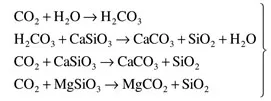
It was the interaction of CO2 with silicate rocks and their weathering which absorbed CO2 and formed carbonates according to the Urey reactions:
The Urey reactions, over geologic timescale, remove CO2 from the atmosphere and its burial in the marine sediments. Thus, over time CO2 has been removed and O2 concentration has been increased. The slow silicate rock weathering has balanced atmospheric CO2 over a millennial timescale. Chemical weathering is faster in the humid tropics than in temperate climates. Weathering of parent rock material and new soil formation is strongly impacted by the atmosphere, especially by its chemistry (e.g., gaseous composition).
The rate of chemical weathering of silicates, eventually leading to the formation of new soil through action with plants and other biota (Jenny 1943), is strongly dependent on climate, especially temperature and precipitation. The rate of silicate weathering is doubled with every 10°C increase in temperature (Vont Hoff Rule). Similarly, an increase in precipitation increases the rate of weathering through an increase in the hydrolysis. There exists a close link between the temperature and precipitation. Thus, climate (atmosphere, temperature, and precipitation) has a direct impact on soil (Jenny 1943).
1.2Soil Life and the Atmosphere
As the Earth cooled and formed a crust, water began to condense, leading to the formation of the hydrosphere. Atmosphere, comprising of gases from volcanic activities (outgoing) and escape of H2 and He (degassing), concentration of CO2, CH4, and H2O vapors increased in the atmosphere. Concentration of CO2 peaked during the Archean era (Figure 1.1) at ~15% due to volcanic activity. Dissolution of CO2 and NH3 in the water led to the formation of H2CO3 and NH4+ ions, which reacted with the rocks according to the Urey reactions:
Figure 1.1The co-evolution of the atmosphere, oceans, rocks, plants, and soil.
These reactions absorbed CO2 from the atmosphere and led to the formation of carbonates and increased concentration of C into the rocks and geological strata.
The solar energy received from the Earth’s surface is partly absorbed and partly reflected back as albedo. The amount of solar energy retained in the Earth’s atmosphere depends on the concentration and type of radiatively-active gases (CO2, CH4, N2O, O3, H2O). With the weathering of rocks, the formation of soil, and the gradual increase in soil organic carbon (SOC) concentration, soil became a sink of atmospheric CO2 and oxidation of CH4....