- 256 pages
- English
- ePUB (mobile friendly)
- Available on iOS & Android
eBook - ePub
About this book
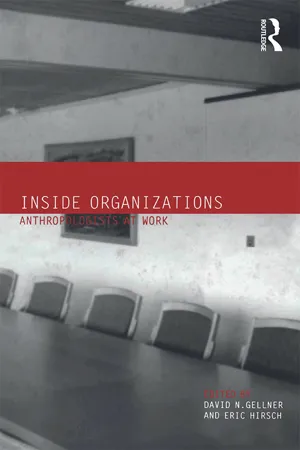
Most of us work in or for one, but there are surprisingly few sustained analyses of the problems and peculiarities of organizations. Anthropologists are increasingly turning their attention to the study of western organizations, and this timely collection addresses the pleasures and pitfalls of ethnographic research undertaken across a range of organizational contexts. From museums to laboratories, health clinics, and multinational businesses, leading anthropologists discuss their fieldwork experiences, the problems they encountered, and the solutions they came up with. This book highlights the practical, political and ethical dimensions of research in organizations. Among issues vividly described are the relations between gender and politics in organizational hierarchies. How are sexual politics played out and experienced in health clinics? How does a business manager's personal biography affect the relationships within the organization as a whole? How are language and metaphor used to refigure the way people think about and act in organizations? Institutions often have well-defined procedures for bringing in visitors and guests. When is the anthropologist an insider to the organization, and when an outsider? What ethical issues arise when researchers are caught between observing organizations and participating in their work? In answering these and other questions the authors consider both the current status and future prospects for organizational ethnography. Comprehensive and varied, the book represents an invaluable aid to anyone interested in the politics and complexities of working life.
Information
Part I
Business
—1—
Social Anthropology and Business Studies: Some Considerations of Method
Malcolm Chapman
A conference was held at Manchester Metropolitan University in April 1998. It was called 'Managing Global Change'. The conference broadly concerned business and management studies, with particular reference to the economies of East and South-east Asia. The conference was an interesting one, with invited contributions from some well-known figures of local and/or international repute: Patrick Minford (economist; see 1998), Peter Dicken (geographer; see 1998), John Dunning (doyen of scholars of international business), Gerald Kaufman (politician), and Bruno Leblanc. The last of these is a scholar, researcher, consultant, and teacher in the world of management education; he is of long experience, and able to work in English, French, German, and Polish. He gave the final address, in which he looked at issues for the future of management education and research. This involved him in looking at the various disciplines which have contributed to business studies notably economics and psychology. Here he noted an absence. 'Looking back,' he remarked, 'it amazes me that we have never had anthropologists in our faculties of business and management; we need them and their ideas.'1
1. This is a cheat, I pretend to quote verbatim, but am really reconstructing from memory; the reconstruction is not far off, however, and the meaning is faithfully rendered.
I was sitting next to Professor Leblanc at the time, having earlier made my contribution to summing up the proceedings. We had not previously conversed during the conference, so I had the heartening experience of being told that I was needed by an entirely disinterested source. Anthropologists will recognize that this is not a particularly common occurrence; not, perhaps, since the days of the Colonial Office have anthropologists had any clear instrumental role in mainstream political and economic activity. Economists, sociologists, and psychologists have, in their different ways, achieved this; anthropology has not. An invitation into the heart of business studies, therefore, where so much busy and expensive pedagogy and research is taking place, is not one to be treated lightly.
I was and am an anthropologist, Oxford-trained from the early 1970s, and particularly influenced by the work and teaching of Edwin Ardener.2 I studied ethnicity and the Celtic fringe, and have published variously on the subject (1978, 1982, 1992, 1993). I began a move into business studies in 1989 by reading for an MBA at one of the U.K.'s oldest business schools, Bradford University Management Centre. This was not, to judge from the surprised responses of my colleagues, a self-evident career move, and its motivations bear upon the content of this chapter. In the Celtic fringe, I had studied ethnicity and language, and I had studied a fishing village and fishing as a means to this. These were interesting subjects, but there nevertheless seemed to be a great deal of life that I was under no compulsion to study, or that was only at the edges of my vision - very generally, nearly all the things that went on in offices, factories, bureaucracies. Virtually everybody in Brittany had some sort of investment in being (or not being) Breton, but for most this was not something they thought about or cared about very much. What where they doing the rest of the time? I came to the view that my concentration upon a 'traditional' occupation, and upon ethnicity, had in some important ways impeded a study of still more important things. I believe that this was not merely a personal idiosyncrasy, but was built into the subject of social anthropology at the time. The limitation was difficult or impossible to surmount, although with hindsight it is not obvious why that should have been so.
2. For what it is worth as an anthropological credential, I was, I think, the very last to be obliged to endure (or to achieve) the once-classical sequence of degrees (MA, Diploma, B.Litt., D.Phil.), ruinously expensive in both time and money, which Oxford anthropology used to require. Innocent pride to salvage from the wreckage: Evans-Pritchard was similarly qualified.
It was, therefore, with a view to overcoming this lingering primitivism in the subject, that I turned to business studies. Social anthropology has a post-war history of concentrating upon primitive societies, of working through the shift from 'function to meaning', of holistic study, of participant observation, and of retreat from numerical analysis. Business and management studies, by contrast, have been late-born aspirants to the positivist social sciences. They have many precedents, and some of the 'founding fathers' (there are no founding mothers) are from the first half of the twentieth century; in general, however, the great explosion in research and teaching was to be in the second half of the century, beginning in the USA in the 1950s and spreading to Europe in the 1960s and 1970s. Business and management academia have been working through their own (as it were indigenous) positivist agenda. For academic resources, in the post-war period, they have looked to social sciences which also aspired to this model: most particularly, to social psychology and to economics (see Buckley and Chapman 1996; Chapman 1996-97). Social anthropology was not an obvious partner, as business and management studies pursued their positivist agenda.
Researchers within business and management studies eventually started to notice, however, as anthropologists had noticed several decades before in relation to their own preoccupations, that the results were not forthcoming - that the predictive science was being continually postponed, amid ever-repeated calls for further research fu nding. Faith in the ultima te appearance of a predictive science is still strong, but doubt is growing nevertheless.
In this situation, many authorities are calling for an integration of other social sciences into the weaponry available to management studies - social anthropology is increasingly cited. This is partly driven by the hope that the specialist knowledge provided by social anthropology will allow the positivist agenda to be furthered, as if the obstacle were merely technical. Within cross-cultural management studies, for example, scholars have commonly tried to tease out the variables which might explain differences from one context to another - variables like law, religion, industry structure, organization structure. There has long been an intuition that something like 'culture' might be important as well, and scholars have turned to social anthropology for a definition of 'culture' (vain hope), so that this too can be measured and fed into the multivariate statistical models - one independent variable among others which will help to explain 'behaviour' (see Sekaran 1983; Negandhi 1983; Roberts and Boyacigiller 1984).
We can perhaps predict that nothing much will come from this, for the potential that social anthropology offers is based upon more fundamental features. Social anthropology has already had the experience of being knocked completely off its poise by anti-positivist and anti-behaviourist arguments; it has already had several decades of experience of finding some sort of (fragile) equilibrium in the aftermath of this; it has also, through its own long debate with itself, gained considerable sophistication in constructing arguments aimed at positivist and behaviourist positions. All these features make it a particularly interesting ally for business studies at the present stage: business studies is still predominantly behaviourist and positivist; it is also still predominantly monocultural (and effectively USA-centred). It is, therefore, vulnerable to, and perhaps capable of enrichment from, social anthropological criticism; business studies is currently undergoing something oddly like 'a shift from function to meaning', and social anthropology can offer its own experience and hindsight. So social anthropology and business studies, by their very differences, offer interesting possibilities for cooperation.
I have experienced the meeting of social anthropology and business studies in many ways and many places, in teaching and research. One particularly fruitful context, however, was provided by a research project, funded by the ESRC under a more general programme called 'Contracts and Competition'. This general programme was inspired by a desire to understand how markets work, particularly in the context of attempts to introduce elements of competition and competitive tendering into the National Health Service. The ESRC wanted to know how markets work, so to speak, so that they could be made to work in the British public sector.
The project, 'The Management of Cooperative Strategies', was conceived by Professor Peter Buckley; his background is in economics, and he is one of the world's leading theorists of the activities of multinational companies. The project was therefore phrased in terms of academic economics, but from the first it was looking explicitly at the frontiers of economics, and at innovative approaches. The aim was to understand how companies organize and understand the range of activities which confront them at their own boundaries. Within text-book economics, the boundary between a company and the outside world is often conceived of as one between 'firm' and 'market'. For the great majority of economic analysis, the firm is a black box, around which inputs and outputs, cost-curves and break-even diagrams, are elaborated. What happens inside a firm to lead to these results is not open to debate within this form of argument. Rationality and competition assume away all problems, all idiosyncrasy, all diversity.
Ronald Coase, in his pioneering attempt to theorize the very existence of the firm (1937), brought the issue of transaction costs into view, opening up as problematic the boundary between the firm and its environment. The firm was still conceived, however, as a unitary entity, unproblematically distinguished from other firms, and unproblematically distinguished from the market. From this viewpoint, there were two kinds of organization - those of market, and those of hierarchy (or organization as commonly understood); within themselves, firms were organized through hierarchy; between firms, market principles ruled. The fluctuating boundaries of firms were to be explained by the varying transaction costs which required, or forbade, recourse to one or another organizing principle. This was a very fruitful approach, and it has been pushed forward in many ways (see Buckley and Casson 1976; Williamson 1975).
The Coasian dichotomy between firm and market, however, is an oversimplification. Many years ago Richardson (1972) argued that the simple dichotomy, firm vs market, actually represented two rather unlikely polar opposites, which were in fact rather rare in reality: the reality, by contrast, occupied the whole range of grey area between these two polar opposites, with things like alliances, friendships, networks, relationships of trust, and so on, actually occupying the real empirical ground. The reality, therefore, could not justifiably be analysed on the basis of a polarization which so signally misrepresented it.
The project 'The Management of Cooperative Strategies' was an attempt to find a method, and a mode of argument, which would allow this problem to be researched. This involved a continuous negotiation of the mutual possibilities and powers of social anthropology and economics. It is possible to live a life as a professional economist, working out complicated models based entirely on assumptions about what the world is like, and without the input of any real factual information at all. When economists look for empirical information, they have a tendency to analyse this using models which are rigorous at the expense of reality: they operate, that is, with assumptions which allow determinate analysis to be carried out, but which are so unrealistic as to preclude any serious tangling with the complexities of real life.
Social anthropology is a kind of polar opposite of this. Anthropologists try to tackle reality head on; they don't necessarily expect it to make unilinear or determinate sense; if there is a clash between theory and reality, then their sympathies - and their responsibilities - are usually with reality. Although anthropology is (at least in my view) a conceptually very sophisticated subject, there is not much within it that could be regarded as 'theory', in the sense in which positivist social science understands the word.
My colleague Peter Buckley's previous research projects had been carried out using either questionnaires or structured interviews. That is to say, his work has always been empirically rather than theoretically based; but the empirical work has been explicitly designed to answer questions arising from theory: it has been, as the research manuals have it, 'hypothetico-deductive'.
My own previous research projects had been carried out using participant observation fieldwork. They were in part related to problems that I wanted to solve, but they were certainly not containable within the framework of positivist research. My main period of fieldwork was spent in Brittany, where I lived in one village for nearly three years; I was interested in fishing and farming, in ethnicity, in bilingualism, and all sorts of other things. I wrote that work up as a doctoral thesis, a 'monograph', which is typically what social anthropologists do. A single case, years of work. No possibilities of comparison, no sampling, no controls, no statistical analysis: a single case.
The result of this is that our attitudes to what counted as evidence, what counted as research, and so on, were very different. To find some sort of compromise of method between the two styles of research to which we were accustomed, we decided to interview managers using what the textbooks call 'unstructured interviews'. (I think my colleague at the time viewed this as a subset of'interviews'; I regarded it as a subset of 'talking to people'.) To get some idea of the differences that we brought to the exercise, a few illustrations may serve.
When we went to do our first interview, my colleague said that going in without a questionnaire he 'felt naked'. At the time, a questionnaire would have felt to me to be an unwieldy and intrusive burden. In retrospect, and now that I have been for several more years in the field of business research, I can better appreciate his feelings, while still not necessarily sharing them. From his research background, going in without a questionnaire raised unwelcome questions such as 'how are we going to find anything out?' and 'what will we talk about?'; for me, going in without a questionnaire promised this: that we would be able to talk about what was important to the manager whom we were interviewing, in terms of understandings that were his, not ours. Thus, we revealed an aspect of the theoretical fissure which runs right through the social sciences, generating many oppositions: quantitative/qualitative, positivist/ interpretive, and so on (see Buckley and Chapman 1997c).
Our first interview lasted about four hours, including talk, lunch, and a walk around the factory. After this, my colleague remarked that this was a particularly long period of time to spend in a company; administering a questionnaire usually only took about half an hour, and you were in any case reluctant to trespass further on management time. (In this case, as in all others, we left to the manager in question the decision as to how long the interview should go on.) I was genuinely surprised by this perception, since by my own standards we had done nothing more than poke a head round the door; the 'four hours' contrasted, for me, not with the half-hour that it would have taken to administer a questionnaire, but with the year-long total immersion fieldwork in the company which would have satisfied purist anthropological criteria.
In an early interview, a manager (who was in production) began to talk of the difficulties of his personal relationship with the new people in the marketing department. My ears pricked up. My colleague's attention wandered. In another interview, we were exploring the relationship of a company to its competitors and suppliers. The conversation wandered to the relationship of the company to the regulators, and to the downstream customers (wholesalers, retailers). Again, I continued scribbling, steeped in holism, and not able to suppose that there was such a thing as 'irrelevant information'. Again, my colleague's attention wandered.
These trivial illustrations have...
Table of contents
- Cover
- Half Title
- Title
- Copyright
- Contents
- Notes on Contributors
- Acknowledgements
- Introduction: Ethnography of Organizations and Organizations of Ethnography
- Part I: Business
- Part II: Science
- Part III: Family, Health, and Welfare
- Part IV: Development and Politics
- Part V: An Ethical Case Study
- Afterword: Natives 'R' Us: Some Notes on the Ethnography of Organizations
- Name Index
- Subject Index
Trusted by 375,005 students
Access to over 1.5 million titles for a fair monthly price.
Study more efficiently using our study tools.
Frequently asked questions
Yes, you can cancel anytime from the Subscription tab in your account settings on the Perlego website. Your subscription will stay active until the end of your current billing period. Learn how to cancel your subscription
No, books cannot be downloaded as external files, such as PDFs, for use outside of Perlego. However, you can download books within the Perlego app for offline reading on mobile or tablet. Learn how to download books offline
Perlego offers two plans: Essential and Complete
- Essential is ideal for learners and professionals who enjoy exploring a wide range of subjects. Access the Essential Library with 800,000+ trusted titles and best-sellers across business, personal growth, and the humanities. Includes unlimited reading time and Standard Read Aloud voice.
- Complete: Perfect for advanced learners and researchers needing full, unrestricted access. Unlock 1.5M+ books across hundreds of subjects, including academic and specialized titles. The Complete Plan also includes advanced features like Premium Read Aloud and Research Assistant.
We are an online textbook subscription service, where you can get access to an entire online library for less than the price of a single book per month. With over 1.5 million books across 990+ topics, we’ve got you covered! Learn about our mission
Look out for the read-aloud symbol on your next book to see if you can listen to it. The read-aloud tool reads text aloud for you, highlighting the text as it is being read. You can pause it, speed it up and slow it down. Learn more about Read Aloud
Yes! You can use the Perlego app on both iOS and Android devices to read anytime, anywhere — even offline. Perfect for commutes or when you’re on the go.
Please note we cannot support devices running on iOS 13 and Android 7 or earlier. Learn more about using the app
Please note we cannot support devices running on iOS 13 and Android 7 or earlier. Learn more about using the app
Yes, you can access Inside Organizations by David Gellner,Eric Hirsch in PDF and/or ePUB format, as well as other popular books in Social Sciences & Anthropology. We have over 1.5 million books available in our catalogue for you to explore.