- 272 pages
- English
- ePUB (mobile friendly)
- Available on iOS & Android
eBook - ePub
About this book
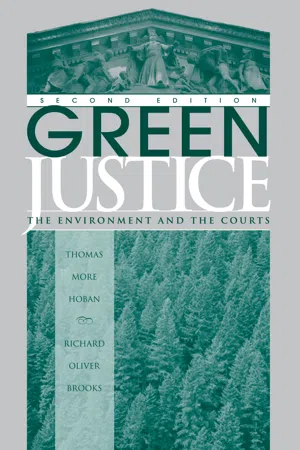
In the nine years since Green Justice first appeared, the field we have come to identi as "environmental law" has taken a number of twists and turns, few of which were foreseen by the authors or, so far as they know, by anyone else. Although this edition attempts to account for many of these changes, it continues to emphasize what we believed then and continue to believe to be paramount, not only for the study of environmental law but for common-law based jurisprudence in general: Despite the immediacy and crush of daily events, closely reasoned analyses of the difficulties and conflicts arising from environmental conflicts, as embodied in major cases or key decisions such as we present here, provide a stabilizing core around which the swirl of daily events takes place, and against which those events must be evaluated. We believed then, and believe even more strongly now, that this is true not only for legal specialists and scholars but for an educated populace as well. Thus this casebook.
Part 1
Environmental, Personal, and Property Rights
For the first Edition of Green Justice, eight years ago, we identified a number of “severe, identifiable ecological or environmental problems: Acid rain falls on the Northeast; the prodigal fishery of Puget Sound is threatened by pollution; the Monument Valley sky is smeared by smoke from the coal-burning power plant at Four Corners, the once ferocious Colorado River evaporated in a fertilizer-encrusted salt pan miles inland from its original delta” (p. 17). Not one of these environmental concerns has been remedied, or even significantly abated: Acid rain continues to fall; the salmon, symbol of the Northwest fisheries, has become sufficiently threatened to warrant the partial suspension of fishing, an entire industry incapacitated; Monument Valley and the Colorado River continue as before. In the brief period between this and the first edition, our attention as a society has become riveted upon new environmental issues, threats, and causes: the spotted owl and the effect its preservation may or may not have upon the timber industry of the Northwest; the “hole in the ozone” over the Antarctic and the consequent worldwide ban imposed on chlorofluorocarbons (CFCs), an entire family of industrial chemicals; the continued cutting of the tropical rainforests. Of these, only rainforest harvesting had been identified as a significant issue when the first edition of this text was published.
Not only have our original ecological problems remained, they may be getting worse. As the list above demonstrates, most of our identifiable environmental problems fall into two broad general categories: pollution problems or a reduction in natural resources. By far the most dramatic are the pollution problems; the environmental issues besieging us daily in the newspapers or over the radio or television are almost always related to pollution. Ecological disasters make good copy and most of us have come uncritically to accept the too-simple equation of environmental law with antipollution law. But there is a great deal more to environmental law than that. As we hope you will come to recognize, these rights issues are directly related to pollution: If a party has the right to use his or her property as he or she wants, with no restrictions, from where does another’s right not to have his or her life disrupted by pollution from that property arise?
Like the environment itself, environmental problems are interrelated: Pollution problems arise in conjunction with other, natural resource, problems. Two of the three cases we have chosen to begin our casebook (Boomer is the exception) have little or nothing to do with pollution as conventionally defined. They deal instead with our rights as citizens: the rights we have to use the property we own in the manner we choose; the right we have to enjoy our own property without unreasonable trouble from our neighbors; and, finally, the right we have (or think we may have) to a decent environment in which to live. The discussions preceding the cases seek to determine just what these rights may be and, perhaps a more intriguing question, just from whence they may come.
As to the Just case, we must consider whether our rights to use our property as we wish (a right for which we have expended good money) can be limited for generalized social or environmental good or whether, in attempting to limit or restrict that use, our society is actually taking away a definable good we have purchased. If a society (in this case, the county) passes a regulation for the greater good, must an individual landowner bear the burden and expense of that regulation? The more significant questions raised by the Just case go far beyond narrowly defined environmental issues: What property, specifically, is being regulated? And, assuming that our use of our property is subject to some social limits or control, just which citizens or groups of citizens get to decide whose property is subject to whose constraints?
A somewhat different issue, but still dealing with our rights to the use and enjoyment of our own property, is the Boomer case. Here we confront the relationship between property rights and pollution directly. At issue is whether our neighbor can use his own property in such a way as to destroy or negatively affect our use of our own property. The further question raised by Boomer is, of course, if so, should the neighbor (or the government, which allows him to use his property that way) pay us for the use or enjoyment he or it has taken?
Finally, in Tanner, we deal with the claim that, as citizens of the United States, we all have a right to a “decent environment.” Brave words. They certainly sound fine enough, but if such a right exists, just where would it come from? Since there is no statute providing it, and since no common law precedent exists on which to base such a claim, it can only come from the United States Constitution. This is what Mr. Tanner thought; as we will see, the court was not as sure. To relate it back to our discussion of mutual rights and responsibilities, if the court had found that Mr. Tanner did have such a right, would he then be able to sue his neighbors for violating that right when they used their backyard barbecue?
1
Property Rights
“Natural” and “Unnatural” Uses of Property
Case Study: Just v. Marinette County
We’ve all been told not to use clichés. But there has always been someone willing to argue that clichés become clichés precisely because they contain more than just a smattering of truth. And although aphorisms may lose their sparkle when their social setting changes, Pierre-Joseph Proudohn’s “Property is theft” can still turn heads a century and a half after it was written. It is certainly true that property ownership prevents others from possessing the same thing at the same time, but is this theft? If so, from whom, specifically, has the thief taken the property in the first place? How can my property belong to my neighbor? How can it not? The first case in this text addresses what we mean by “property” and what we can and can’t do with it; in this case the type of property we call real (real estate, house lots) to distinguish it from personalty.
What does it mean to say that we own something? We all own (or think we own-which may be the same thing) our clothes, books, CDs, computers, pencils, and toothbrushes. These are all physical objects: We can put them aside; lock them up; shut them inside other things we own to protect them; and decide just who, if anyone, we will allow to use them and under which circumstances. Some of us are fortunate enough to own other, intangible, things that can be bought and sold as if they were concrete: stocks representing portions of corporations or other organizations; rights to the interest on loans not yet made, much less paid; objects not manufactured, under contracts not to be performed for years. Others of us, inventors and writers, can own ideas, words, or concepts: so-called intellectual property, owned through patent and copyright mechanisms. To those of us living in the late twentieth century, ownership is like breathing: so perfectly natural that we hardly ever think about it. We assume that if we want, we can just throw away our clothes, burn our books, sell our CDs and computers, and license our patents.
But we don’t live alone, we live in a society and all of our so-called rights have some relationship to (may even originate in the rules of) that society. So it is with property rights. Their boundaries or limits are defined by the society within which we live: the getting (Proudohn’s point-what we own can’t be owned by anyone else); the keeping (a large portion of our societies’ tax expenditures go toward paying the police to protect that property); the spending (the Food and Drug Administration and other governmental agencies decide that there are certain classes of goods you simply cannot purchase); and the parting with property (many capitalists believe, with many socialists, that inheritance should be done away with because it institutionalizes inequities, thereby blocking individual initiative) all have social consequences far beyond mere ownership. There is no aspect of property ownership that could not be argued endlessly.
Before looking at the Just case, let’s examine a few of those social dimensions of property ownership. The social restrictions are most obvious with certain personalty. Although you can burn your books and throw away your clothes, there are some things that society just doesn’t let you do with the things you own: You can own and play your CD, but not so loudly that it bothers your neighbors; you can drive your car, but only so fast in certain areas; you can own a handgun, but its use is strictly regulated, to the point of requiring a permit.
Personalty is not the only form of property subject to governmental constraints. There are currently restrictions on the types of renovations and extent of remodeling that the owners of buildings on the National Register of Historic Buildings can do to their real property. The theory is that the scarcity of these objects has resulted in their becoming museum pieces, “belonging” not just to those who happen to have paid for and live in them but in some sense to those of us who can see them as well. The argument is that once historical buildings are torn down, disappear, or get remodeled beyond recognition, we all lose something. Assuming that this is a reasonable restriction, would the same restriction make equal sense in the case of antique automobiles or airplanes? Should the owners of Bugattis or Sopwith Camels be prevented from driving, racing, or flying their own property lest these historical cultural objects also be destroyed? A good exercise might be to go through a list of your personal property items and examine the ways in which their uses are limited by social conventions and laws. You might also ask how you would react to a new statute preventing you from the commercial use of a building you own in a historic district. In what ways would the Justs’ lakefront property be different from the commercial building? (See case excerpt later in this chapter.)
Social Restrictions on the Use of Real Property
In the 1990s when we speak of environmental law most people probably assume that we are referring to the complex federal and state network of statutes regulating air and water pollution and hazardous waste disposal, including the Clean Air Act, the Water Pollution Control Act or Clean Water Act, the Resource Conservation and Recovery Act, and the Comprehensive Environmental Response, Compensation, and Liability Act (CERCLA or Superfund). But environmental law as conceived of by a practicing attorney or planner has many more facets and a far more familiar face than the mere rumblings of some far off legislative machine in Washington, D.C., or our state capital that we become aware of every month or so on the nightly news.
More immediate and with a much more direct impact on us all are the land-use regulations imposed by our state and local governments. Most Americans, certainly most landowners, are aware that the majority of localities in the United States are zoned. The notable exceptions are Houston, Texas, which did not have conventional zoning until very recently, and Hawaii, which has what amounts to statewide zoning. By and large the United States is zoned village by village, city by city, or county by county.
Understanding the Just decision requires a theoretical background extending beyond traditional zoning. The two basic concepts behind zoning are that some land is more appropriately used for some purposes than is other land and that compatible uses are best kept together and incompatible uses best kept separate. To accomplish these goals, the state gives local governments the authority to enact legislation (local statutes called ordinances) setting up zones. Under a typical zoning scheme the local government would divide the land under its jurisdiction into areas, some of which would be labeled “residential”; others, “commercial”; still others, “industrial.” Obviously, these schemes would vary in scope and complexity depending upon the locality. Within each zone there might be smaller zones. In residential areas, for example, there might be zones where the minimum lot size might be one acre, two acres, or some other predetermined size. At least one locality in the United States has a zone requiring a 50-acre minimum lot size. Other residential areas might permit multiple residences such as two- or three-family apartments but not allow four-family residences. Still others might allow professional offices or only residences of two stories or less.
Similar restrictions would also be applied within commercial or industrial zones in an attempt to establish and maintain a degree of homogeneity and to reduce conflicting uses within and between zones. Certain commercial zones might allow a heavy concentration of stores, restaurants, and service stations, whereas others might limit these commercial establishments to only a handful. A small commercial area might be allowed in residential zones for convenience stores, which could provide milk, bread, and newspapers to people living in those zones. Industrial zones might be limited as to the amount of heavy industry allowed in them, and provisions might be made requiring the industry to be near similar uses, thus keeping down the dust, noise, and dirt levels.
In the abstract, and in a general discussion such as this one, all of this is intuitively consistent; it just makes sense. Because most of us have lived with zoning of this sort for most of our lives, the system seems natural, almost inevitable. But, like all concepts, zoning has a history, and in the United States that history is usually dated from the U.S. Supreme Court decision in Village of Euclid v. Ambler Realty Co, 272 U.S. 365 (1926). Because of the Euclid case, zoning in the United States is even today referred to as Euclidean.
When the Ambler Realty Company attacked the zoning ordinance of the Village of Euclid, Ohio, a suburb of Cleveland, zoning had been used in the United States for about twenty-five years, but its constitutionality had not been directly addressed by the Supreme Court. Although the facts in the Euclid case were fairly complex, it all came down to a bottom-line question for Ambler, which owned a piece of property located on the fringe of an industrial area. Without zoning in force, the parcels would have been worth about $10,000 per acre or $150.00 per running foot of frontage as industrial property. Unfortunately for Ambler, however, the property was zoned residential. As residential property, the value was much lower: $2,500 per acre or $50.00 per running foot of frontage. Zoning was costing Ambler a lot of money, and they didn’t like it one bit. The company went to court claiming that zoning was effecting an unconstitutional deprivation of property (the difference in value that they could not now recover) without due process of law in violation of the Fifth and Fourteenth Amendments to the United States Constitution. The Supreme Court rejected Ambler’s challenge to the ordinance, holding that such laws were constitutional exercises of governmental police power: “Under these circumstances, therefore, it is enough for us to determine, as we do, that the ordinance in its general scope and dominant features, so far as its provisions are here involved, is a valid exercise of authority, leaving other provisions to be dealt with as cases arise directly involving them” (Village of Euclid v. Ambler Realty Co., 272 U.S. 365, 397 [1926]).
To understand the court’s decision-and zoning-more fully we must begin by understanding that local governments in the United States have no independent legal power. The states, which were originally independent and possessed all the political and legal power, gave up some of their power to the central government to permit smoother functioning. Within the states themselves, however, the county, town, or municipal governments are creatures of the state: Legally, they are merely administrative units having only the powers specifically granted them by the state. What the state gives, the state can take away. In land-use and zoning matters the state grants this legal authority to local governments through what is called enabling legislation, and one of the traditional tasks of local governments is to plan the ways that land use will be regulated within the boundaries of the localities. A locality’s powers are limited; it can do no more than the state has allowed it to do. If a local ordinance is challenged as being unconstitutional or too restrictive, a court will look very closely to determine whether the locality has overstepped its bounds by asserting a control over the use of private property that is more stringent than that which the state has allowed it to do in the enabling legislation. If so, the court will declare the local action void for the simple reason that the locality has attempted to do what it cannot. Zoning is one area about which you can fight city hall and win; the arena is the courts.
What the localities are enabled to do generally falls within the bounds of the state’s police power. (The police power is the power to enact legislation to further the general health and public welfare.) Part of the independent power of each state, subject to certain constitutional limits, is the power to regulate individuals’ lives so as to promote the general welfare. The state delegates part of this power to the municipalities.
Land-use regulation is perhaps the most highly developed example of police power delegation. In most states, each town, municipality, county, or other local governmental unit has a planning commission (the name of this group will vary from state to state) whose function it is to plan for growth and land use in the locality. This planning commission will typically develop some sort of comprehensive plan, frequently embodied in a map with specific land-use areas delineated. A person wishing to build must consult this map and the specific requirements for the zone in which the proposed development will go. If the proposed use conforms to the requirements, the developer will receive a permit; if the proposed use does not conform, a permit will probably be refused. The developer will usually have the opportunity to appeal the refusal of the permit to a zoning board of appeals. If that board refuses the permit as well, the developer may proceed to court to ask that this refusal be reversed, usually (as in Euclid) on the grounds that the refusal has unconstitutionally deprived him or her of an allowable use of the property.
The municipality will typically argue that its denial of the permit was a legitimate exercise of police power. In Euclid the village argued that the zoning scheme was necessary for the well-being of most citizens even if Ambler Realty did lose money; the Supreme Court agreed: “If it be a proper exercise of the police power to relegate industrial establishments to localities separated from residential sections, it is not easy to find a sufficient reason for denying the power because the effect of its exercise is to divert an industrial flow...
Table of contents
- Cover Page
- Half title
- Title Page
- Copyright Page
- Contents
- Preface to the Second Edition
- Introduction
- Part One Environmental, Personal, and Property Rights
- Part Two Environmental Statutes
- Part Three: Fundamental Causes of the Environmental Crisis
- Part Four: Law as a Means of Attaining Environmental Ideals
- Conclusion
- Chronology of Cases
- Glossary
- Bibliography for Public Policy, the Environment, and the Law
- About the Book and Authors
Trusted by 375,005 students
Access to over 1.5 million titles for a fair monthly price.
Study more efficiently using our study tools.
Frequently asked questions
Yes, you can cancel anytime from the Subscription tab in your account settings on the Perlego website. Your subscription will stay active until the end of your current billing period. Learn how to cancel your subscription
No, books cannot be downloaded as external files, such as PDFs, for use outside of Perlego. However, you can download books within the Perlego app for offline reading on mobile or tablet. Learn how to download books offline
Perlego offers two plans: Essential and Complete
- Essential is ideal for learners and professionals who enjoy exploring a wide range of subjects. Access the Essential Library with 800,000+ trusted titles and best-sellers across business, personal growth, and the humanities. Includes unlimited reading time and Standard Read Aloud voice.
- Complete: Perfect for advanced learners and researchers needing full, unrestricted access. Unlock 1.5M+ books across hundreds of subjects, including academic and specialized titles. The Complete Plan also includes advanced features like Premium Read Aloud and Research Assistant.
We are an online textbook subscription service, where you can get access to an entire online library for less than the price of a single book per month. With over 1.5 million books across 990+ topics, we’ve got you covered! Learn about our mission
Look out for the read-aloud symbol on your next book to see if you can listen to it. The read-aloud tool reads text aloud for you, highlighting the text as it is being read. You can pause it, speed it up and slow it down. Learn more about Read Aloud
Yes! You can use the Perlego app on both iOS and Android devices to read anytime, anywhere — even offline. Perfect for commutes or when you’re on the go.
Please note we cannot support devices running on iOS 13 and Android 7 or earlier. Learn more about using the app
Please note we cannot support devices running on iOS 13 and Android 7 or earlier. Learn more about using the app
Yes, you can access Green Justice by Thomas M Hoban,Richard O Brooks in PDF and/or ePUB format, as well as other popular books in Law & Environmental Law. We have over 1.5 million books available in our catalogue for you to explore.